




Abstract
In 2006, an unusual nosocomial outbreak of anaplasmosis occurred in Anhui Province, China. To follow these emerging tickborne-rickettsioses, a larger survey of Ehrlichia chaffeensis and Anaplasma phagocytophilum seroprevalence among farm worker populations, and the divergence of the partial 16S rRNA gene sequences of A. phagocytophilum among domestic animals, were conducted in Yanqing, Miyun, and Tongzhou Counties in Beijing from March to April, 2009. Blood samples from 562 farmers, 90 goats, 73 cattle, and 2 dogs were collected. IgG antibodies against E. chaffeensis and A. phagocytophilum were assayed by micro-indirect immunofluorescence assay (IFA). Partial fragments of 16S rRNA genes of A. phagocytophilum were amplified from blood DNA from domestic animals and their sequences analyzed. The total E. chaffeensis and A. phagocytophilum seroprevalence among the farm worker population was 16.4% and 14.1%, respectively. For domestic animals, the seropositive rates of A. phagocytophilum for goats, cattle, and dogs, were 2.3%, 0%, and 0%, respectively. The PCR-positive rates for A. phagocytophilum in goats and cattle were 48.9% and 23.9%, respectively. Three dominant genetic groups of Chinese A. phagocytophilum isolates were determined for goats and cattle, and these isolate varieties were broadly identified in China, Japan, and Korea. The prevalence of E. chaffeensis and A. phagocytophilum among farmers and domestic animals in Beijing rural areas was also demonstrated. The diagnoses and differential diagnoses of these emerging infectious diseases should be emphasized in clinics, and further ecological investigation of E. chaffeensis and A. phagocytophilum vectors and hosts is needed.
Introduction
Materials and Methods
Study sites and sampling
Based on geographical location, the following Beijing Counties and their locations relative to the city were selected: Yanqing, situated in the northwest; Miyun, located in the northeast; and Tongzhou in the southeast (Fig. 1). To balance age distributions, every farm family was investigated as a unit based on registered residences. A questionnaire was used to obtain the participants' data, and included questions concerning gender, age, occupation, medical history, and history of contact with pigs, cattle, goats, or poultry, as well as bites by ticks, mites, fleas, or other vectors. Approval for the study was obtained from the Institutional Review Board of the China Centers for Disease Control and Prevention (CDC), and each participant was asked to sign an agreement of sampling. Upon obtaining consent, 5 mL of non-coagulated blood was collected. With the assistance of local veterinarians, 5 mL of non-coagulated blood was collected from goats via the jugular vein, with dog blood samples collected from the anterior tibial vein. Sera were separated for detection of A. phagocytophilum and E. chaffeensis IgG antibodies, and DNA was extracted from the remaining animal blood samples for amplification of the A. phagocytophilum 16S rRNA gene by nested PCR. Serum and blood clot samples were temporarily stored at −20° or −80°C at the local CDC until transfer to the Department of Rickettsiology, China ICDC, for testing.
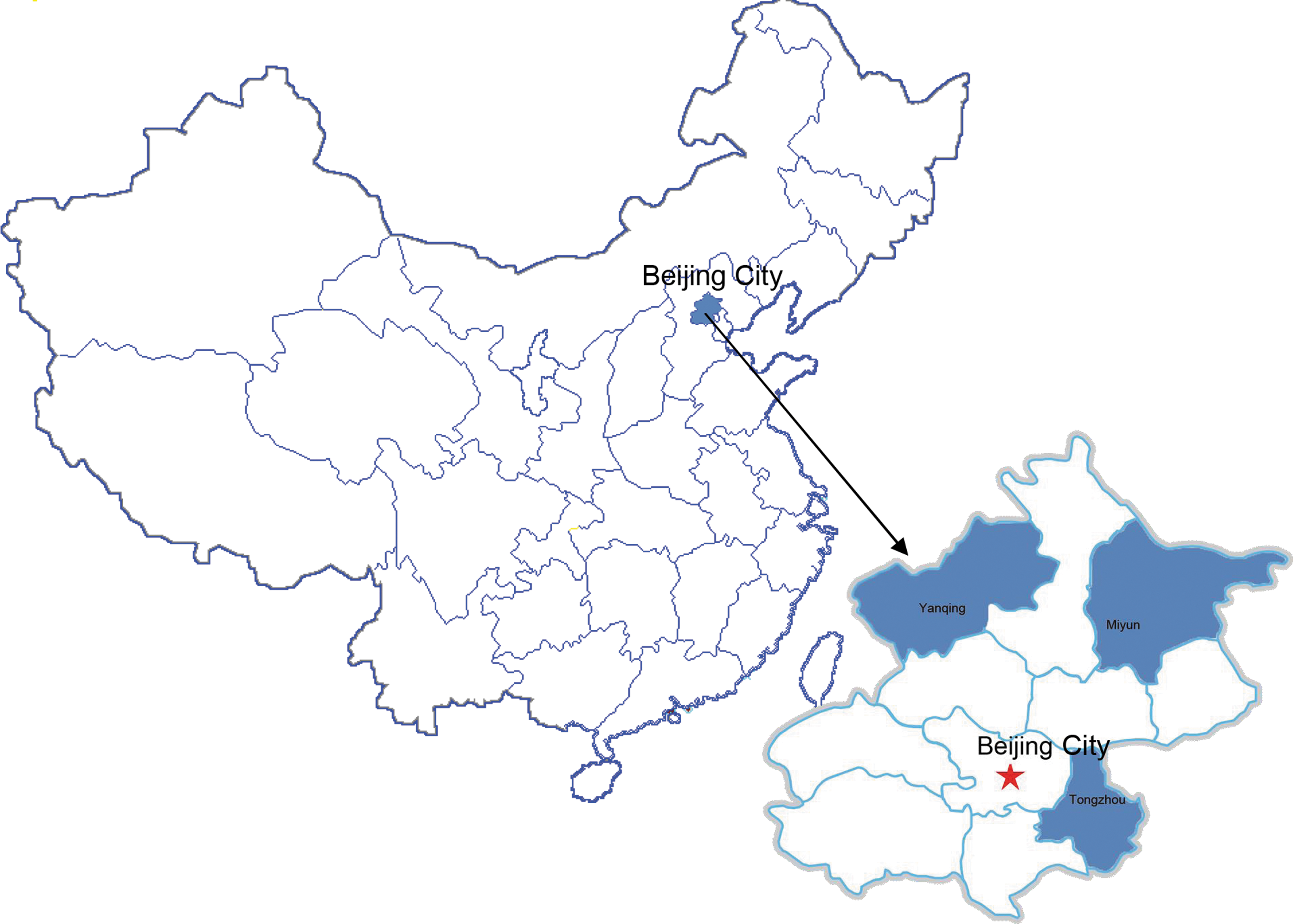
Map of China and Beijing and the three investigation sites. Color images available online at
Antibody detection
Immunofluorescence assays (IFA) were performed per World Health Organization (WHO) guidelines (Eremeeva et al. 1994). A. phagocytophilum (RA2682, lot 03-0403N) and E. chaffeensis (strain Arkansas) antigens were kindly provided by Dr. Robert Massung at the U.S. CDC. Positive control sera were prepared from rabbits infected with these bacteria in our lab. For IFA assays, the serum samples were diluted 1:80 in PBS with 3% nonfat powdered milk, and 25 μL diluted serum was placed in the appropriate wells of antigen slides and incubated at 37°C for 60 min in a moist chamber. After removal of unbound antibody by washing, the slides were reacted with FITC-conjugated rabbit anti-human, anti-goat, anti-cattle, or anti-dog immunoglobulin IgG as a secondary antibody. The stained slides were again rinsed and counterstained with Evans blue before examination under a fluorescence microscope. Samples were interpreted as reactive when clear fluorescent bacterial morphology was evident. Samples reactive at a 1:80 screening dilution were deemed positive.
PCR detection
Animal blood DNA was extracted using a QIAamp blood and tissue kit (Qiagen, Hilden, Germany), according to the manufacturer's instructions. Sterile deionized water was used in place of samples as a negative control, and A. phagocytophilum cultures were used as a positive control. Nested PCR was used to amplify the 16S rRNA genes of A. phagocytophilum (Wen et al. 2002). Briefly, Anaplasma genus-specific primers of outer-1 (5′-TTG AGA GTT TGA TCC TGG CTC AGA ACG-3′)/outer-2 (5′-CAC CTC TAC ACT AGG AAT TCC GCT ATC-3′) were used for the first round of amplification, and species-specific primers of HGA1 (5′-GTC GAA CGG ATT ATT CTT TAT AGC TTG-3′)/HGA2 (5′-TAT AGG TAC CGT CAT TAT CTT CCC TAC-3′) were used for nested PCR. A final 389-bp DNA fragment was produced. In the first round, 10 μL DNA was used for the template, and 0.5 μL first-round PCR products were used as templates for the nested PCR. Positive PCR results were confirmed by commercial sequencing (Shanghai Shengong Biotechnology Co., Shanghai, China), and comparison with GenBank sequences.
Statistical analysis
Data were recorded in a spreadsheet, and the seroprevalence of E. chaffeensis and A. phagocytophilum for humans, animals, sampling regions, and each gender group were calculated using SAS software (version 9.1; SAS Institute, Cary, NC). Comparison of the prevalence among different animals, sampling regions, and gender groups was performed using chi-square and Fisher's exact tests. Significance for these analyses was set at p<0.05. Phylogenic analysis was conducted using MEGA 4.0 software.
Results
Study sites and sampling
All three Counties that were investigated are important areas in Beijing (Fig. 1), and among them, Yanqing and Miyun Counties are typical mountain areas, with abundant water and forest coverage of more than 50%. These geographic features enhance propagation of rickettsial transmission vectors. Eighty-five percent of farmers in the study raised domestic animals and grew fruit trees. In the spring and summer seasons, their animals grazed on mountains or wild fields during the daytime and returned to the farm in the evening. Despite farmers' daily use of insecticides to prevent ticks, the animals nonetheless had many ticks. In addition, farm dogs were not restricted and represented another important tick source.
A total of 562 farmers were recruited for this study and each provided blood samples. The median age of the participants was 45 years (range 30–60 years), with 273 (48.6%, average age 50 years) and 288 (51.4%, average age 49 years) males and females, respectively. Most (95%) participants recalled that they had been exposed to ticks, and 10% of subjects remembered previous tick bites. A total of 163 animal blood samples (90 goats, 71 cattle, and 2 dogs) were obtained in the study.
Serological investigation
The seroprevalence of A. phagocytophilum and E. chaffeensis among farm worker populations is shown in Table 1. The total seroprevalence of A. phagocytophilum for humans in the three sites investigated was 14.1%, and the average seroprevalence of the Yanqing, Tongzhou, and Miyun regions, were 22.8%, 17.5%, and 1.6%, respectively. For seroprevalence, the rate in Miyun was lower than that in Yanqing (p<0.001) and Tongzhou (p<0.001). There was no statistically significant difference with respect to gender distribution in any of the areas investigated. For the animal investigations, two (2.2%) of 90 goats tested had antibodies that were reactive (1: ≥80) for A. phagocytophilum. However, all of the cattle and dogs in the study were negative for the antibodies tested.
E.c, Ehrlichia chaffeensis; A.p, Anaplasma phagocytophilum; −, no sample available.
The overall percentage of the antibody response to E. chaffeensis among farmers was 16.4%. Of the surveyed regions, the seropositive rate in Miyun was significantly higher than that of Yanqing (32.5% versus 4.6%, p<0.001), and Tongzhou (32.5% versus 12.4%, p<0.001). As with A. phagocytophilum, there were no significant gender-related differences in E. chaffeensis seroprevalence.
Geographic distribution
An important finding was that there was a substantial negative relationship between the seroprevalences of E. chaffeensis and A. phagocytophilum in Yanqing (p<0.001) and Miyun (p<0.001) counties, with the prevalence of A. phagocytophilum opposite that of E. chaffeensis in the same regions (Fig. 2). Yanqing County had the highest seroprevalence for A. phagocytophilum, but the lowest seroprevalence of E. chaffeensis. In contrast, Miyun had the highest seroprevalence of E. chaffeensis, but the lowest seroprevalence for A. phagocytophilum. However, for Tongzhou County, no significant differences were found between the seroprevalences of E. chaffeensis and A. phagocytophilum.
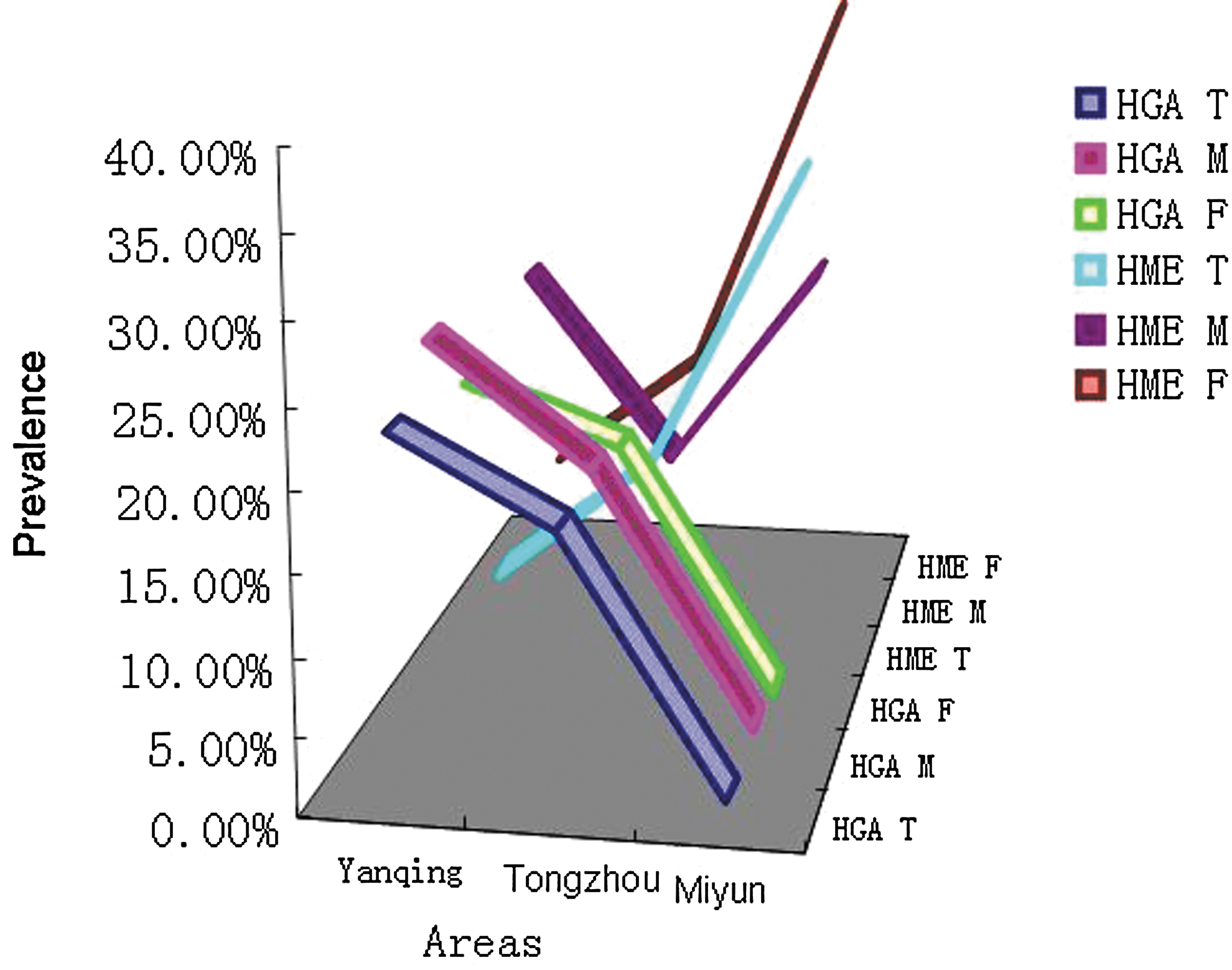
Comparison of E. chaffeensis and A. phagocytophilum seroprevalence among farm workers in the three areas investigated (HGA, human granulocytic anaplasmosis; HME, human monocytic ehrlichiosis; T, total; M, male; F, female). Color images available online at
Molecular characterization of A. phagocytophilum
Based on previous data indicating that domestic animals might be hosts for A. phagocytophilum, we conducted PCR amplification of the A. phagocytophilum 16S rRNA gene in DNA from animal blood. The PCR results indicated that the total PCR-positive rates for the A. phagocytophilum 16S rRNA gene among goats, cattle, and dogs, were 48.9% (44/90), 23.9% (17/71), and 0% (0/2), respectively. The sequences were deposited in GenBank, with four sequences from Yanqing (GQ 500034-37) for goats, and 9 sequences (GQ500025-33) for cattle; 33 sequences from Miyun (GQ499956; GQ499977-500012) for goats; and 3 sequences from Tongzhou (GQ 500022-24) for goats and 8 sequences (GQ 500013-20) for cattle.
Phylogenetic analysis showed that there were three dominant A. phagocytophilum nucleotide sequence groups, although substantial sequence variety was found in the isolates (Fig. 3). Group A, represented by BJ-MY-HGA-S12, and identified in a goat in Miyun, was present in 21.5% of the sequences obtained in this study. This group was not only prevalent in goats in Miyun County, Beijing, but also in Haemaphysalis longicornis samples collected in the Jiaozhou peninsula in Shandong Province. The A. phagocytophilum sequences (EF211110) of patients identified in the 2006 Anhui nosocomial anaplasmosis outbreak clustered with the group B sequence type found in this study (Fig. 3). Similarly, the sequences (EU982709) of patients from Yiyuan County, where the endemic prevalence of HGA was confirmed in a previous study (Zhang et al. 2009), could also be categorized in group B. Group C, which was present in 32.3% of the sequences in this study, was broadly distributed in all three areas investigated here. In addition to the above-mentioned three major sequence groups, another 22 individual sequence types were identified in this study.

Phylogenetic tree of the A. phagocytophilum 16S rRNA gene of domestic animals. Blue indicates sequences obtained from animals in this study, red indicates sequences obtained from patients from Anhui Province in 2006 and Shandong Province in 2007, and purple indicates sequences obtained from ticks in Shandong Province in 2007. Black shows the reference sequence. Color images available online at
Discussion
We investigated the prevalence, host range, and distribution of E. chaffeensis and A. phagocytophilum in three rural Counties in Beijing, and demonstrated the presence of anaplasmosis and ehrlichiosis by serological and molecular epidemiological surveys. This study is the first to be conducted on these emerging tick-borne infectious diseases in Beijing. Our study provides valuable data on the serologic status of these two rickettsioses among the farm worker population and domestic animals (e.g., goats, cattle, and dogs). Like spotted fever, which also is present in Beijing (Yu et al. 1993), here we demonstrated the emergence of E. chaffeensis and A. phagocytophilum as infectious diseases in rural areas in Beijing, with the total seroprevalence of E. chaffeensis and A. phagocytophilum among the farm worker population being 16.4% and 14.1%, respectively. The prevalence of A. phagocytophilum was higher than the 8.8% observed among the farm worker population in Tianjin, as was reported by Zhang and associates (Zhang et al. 2008b), but lower than the 15–36% recorded in endemic areas of North America (Bakken et al. 1998; IJdo et al. 2000). Our study thus indicated a substantial geographical distribution of seropositive rates of E. chaffeensis and A. phagocytophilum. The highest A. phagocytophilum seroprevalence was in Yanqing, while the highest E. chaffeensis seroprevalence was in Miyun. For Tongzhou County, no statistically significant differences in the rates of E. chaffeensis and A. phagocytophilum seroprevalence were observed. In domestic animals, we found the highest A. phagocytophilum seroprevalence (2.2%) in goats, but no antibodies to A. phagocytophilum were found in cattle and dogs. The reason for this finding might be related to the limited sample size. The finding of note in this study is that the positive PCR rate for goat blood samples was as high as 48.9%, despite the significantly lower seroprevalence. The reasons for this finding may be: (1) the broad range of rrs genes used to detect A. phagocytophilum might generate PCR products that include related anaplasmataceae sequences, such as A. marginale and A. bovis, which may not be differentiated due to limitations of product size; (2) the A. phagocytophilum phenotype provided by the U.S. CDC that was used for IFA may differ from that of domestic Chinese isolates; (3) the susceptibility of local Beijing A. phagocytophilum isolates in humans and animals may vary; or (4) the IFA and nested PCR assays may have different sensitivities.
Our molecular epidemiological results suggest that there are three genetic groups, groups A, B, and C, of A. phagocytophilum in the Beijing areas tested. These dominant isolates have also been widely identified in other areas in China. Among these three groups, group C, represented by BJ-MY-HGA-S1, was 100% homologous sequence with that found in goats from Zhejiang Province (HM43932), and southeast areas of China (FJ389576 and EU709493), as well as in wild deer in Japan (AB454075 and AB211164; Zhou et al. 2010). No sequences of 100% similarity for group A were found by BLAST analysis, although this clade was present in 21.5% of the sequences observed in this study. The sequence of BJ-MY-HGA-S12, representative of group A, is 99% identical with that of goats from Zhejiang (HM595732), cattle from southeastern areas of China (FJ169957), and H. longicornis in Jeju Island in Korea (GU 064900). Another sequence (represented by BJ-MY-HGA-S34) had 100% similarity with that of wild deer from Japan (AB454076), dogs from South Africa (AY570530), and H. longicornis from Korea (AF470699).
Since some data indicate that A. phagocytophilum is a typical zoonosis, we performed serological and molecular assays of A. phagocytophilum in domestic animal blood samples. However, since the vector and hosts for E. chaffeensis in Beijing are not known, further investigation of potential local vectors and reservoir animals, as well as their role in the transmission of both A. phagocytophilum and E. chaffeensis, would be valuable for designing strategies to control and prevent these emerging rickettsioses. Such information would help better define the human infection risk, and establish an evidence base for the etiological differential diagnosis of febrile illnesses among people residing and working in these areas.
In recent years, tick-borne rickettsioses have become an increasing concern in China. These infectious diseases are a significant threat to the health of the farm worker population not only in rural areas, but also in urban areas, due to increasing contact between urban and rural populations. In big cities in China, more and more elderly people go to the suburbs to do morning exercise daily. Similarly, the number of young people spending time outdoors has increased significantly. These outdoor sports increase exposure to vectors, meaning an increased risk of vector-borne diseases. The clinical manifestations of these rickettsioses are febrile illnesses that resemble more common viral infections, and thus underdiagnosis or misdiagnosis is common. These misdiagnoses could result in delayed or inappropriate treatment, leading to multi-organ failure and potentially fatal complications. Here we conclude that clinical practices should emphasize improved diagnosis and differential diagnosis of these emerging tick-borne diseases.
Footnotes
Acknowledgments
We thank the epidemiologists, technicians, and administrative personnel for their collaboration on the field investigation and acquisition of blood samples from Tongzhou, Yanqing, and Miyun Counties in Beijing.
Prof. Xiu-chun Zhang is a research worker at the Institute for Infectious Disease and Endemic Disease Control, Beijing CDC. Her research interests include surveillance of diseases of natural focus.
This study was supported by the National Basic Research Program of China (973 Program) 2010CB530200/2010CB530206, and the China Mega-Project for Infectious Disease (2011ZX10004-001).
Author Disclosure Statement
No competing financial interests exist.