




Abstract
Recent molecular analyses of the Anaplasma sp. closely related to Anaplasma phagocytophilum (previously believed to be A. phagocytophilum) in Japan have clarified its distinct phylogenetic position. PCR methods relying on 16S rRNA- and P44/MSP2-based primers designed to detect this species have low sensitivity and specificity. In this study, a highly sensitive and specific nested PCR method using newly designed primers based on heat-shock operon gene (groEL) was developed to detect this species. The method was later used in an epidemiological study testing DNA samples from 85 Ixodid ticks (collected by flagging) and 50 cattle from the same pastureland in Nakaosobetsu, Hokkaido, Japan. Results revealed prevalence rates of 2.4% (2 of 85) in ticks and 2% (1 of 50) in cattle. The present study also reported the first molecular detection of the Anaplasma sp. closely related to A. phagocytophilum in Japan in H. douglasii, and established a new reliable PCR method that detects this Anaplasma sp. closely related to A. phagocytophilum in Japan.
Introduction
16S rRNA based-primers used in previous studies have low specificity that can detect any of the 2 organisms (Jilintai et al. 2009; Yoshimoto et al. 2010). Designing specific primers based on the 16S rRNA gene can be difficult due to a very close homology with A. phagocytophilum (Ybañez et al. 2012). On the other hand, P44/MSP2-based primers may also have low sensitivity because those 16S rRNA-based PCR-positive samples have negative results in the PCR assay using the former gene (Masuzawa et al. 2011). P44/MSP2-based PCR may also yield varied nucleotide product lengths due to a hypervariable region found within the gene (Wuritu et al. 2009); hence, relying on visual confirmation after gel electrophoresis of product amplicons maybe questionable without further sequencing. Blood smear examination may also be unreliable. So far, animals found to be PCR positive with this Anaplasma sp. were negative in the blood smears (Jilintai et al. 2009; Murase et al. 2011). Thus, molecular detection can be considered the most reliable detection method for this species.
In this study, a heminested PCR method using newly designed primers based on groEL was developed to detect Anaplasma sp. closely related to A. phagocytophilum in Japan. The method was tested in previously tested 16S rRNA-positive samples and in several other Anaplasma and Ehrlichia species to evaluate its sensitivity and specificity. The method was later used in DNA samples from ticks and cattle.
Materials and Methods
DNA Samples
Initially, DNA from 20 Anaplasma sp. closely related to A. phagocytophilum-positive samples that were determined by using 16S rRNA-based analysis was used to evaluate the sensitivity of the new PCR method. This included 10 Sika deer blood samples (Cervus nippon yesoensis) from Shizunai, Hokkaido, Japan (Jilintai et al. 2009) and 10 Ixodes persulcatus field samples from Sikaoi, Hokkaido, Japan. DNA from the following species were also used to evaluate the specificity of the new PCR method: Ehrlichia canis (supplied by Dr. Simonne Harrus, Israel), Ehrlichia muris (Tamamoto et al. 2007), Ehrlichia sp. from I. ovatus (supplied by Dr. H. Fujita, Japan), A. bovis (Jilintai et al. 2009), A. marginale (Ooshiro et al. 2009), A. centrale (Inokuma et al. 2001), A. platys (Inokuma et al. 2002), A. phagocytophilum from human (formerly human granulocytic ehrlichia, supplied by Dr. P. Brouqui, France), horse (formerly Ehrlichia equi, supplied by Dr. P. Brouqui, France), and cattle (supplied by Dr. G. Jouncour, France).
Additionally, ticks and cattle blood were collected from pastureland in Nakaosobetsu, Shibecha, Hokkaido, Japan, in May, 2011. A total of 85 Ixodid ticks, including 35 Haemaphysalis douglasii, 37 I. persulcatus, and 13 I. ovatus collected by flagging and 50 EDTA blood samples from cattle, were used. DNA was extracted using QIAamp DNA Mini Kit (QIAGEN, Valencia, CA), eluted with 200 μL of TE buffer, and stored at −30° until further use.
Primer design, DNA amplification, and purification methods
Primers were designed based on the groEL nucleotide sequences of Anaplasma sp. closely related to A. phagocytophilum in Japan (JN055359, JN055358). The sequences of the designed primers used in this study are indicated in Table 1. In the first phase of the heminested PCR, a final volume of 10 μL was used. It is composed of 4.5 μL of distilled water, 1 μL of 2 mM dNTP,1 μL of 10× PCR buffer, 0.4 μL MgCl2 (50 mM), 0.5 μL of 10 μM of each primer, 0.1 μL Taq DNA polymerase (5 U/μL), and 1 μL of DNA template. The step-down cycling conditions were the following: Initial denaturation at 95°C for 5 min, followed by 35 cycles of 95°C for 30 sec, 72°C (with a 2° incremental decrease until reaching final annealing temperature at 65°C) for 30 sec and 72°C for 1.5 min, and final extension at 72°C for 5 min. In the second phase of the heminested PCR, a final volume of 25 μL was set. It was composed of 15.35 μL of distilled water, 2.5 μL of 2 mM deoxyribonucleotide triphosphates (dNTP), 2.5 μL 10×PCR buffer, 1 μL of MgCl2, 1.25 μL of 10 μM of each primer, 0.1 μL of 5 units Taq polymerase, and 1 μL of the first PCR amplicon. The same cycling conditions as the first PCR were used. The negative and positive controls used were distilled water and Anaplasma sp. closely related to A. phagocytophilum from Sika deer in Japan (Ybañez et al. 2012), respectively. Amplification products were visualized using 1.5% agarose gel after migration, and were purified using either QIAquick PCR purification kit (QIAGEN, USA) or QIAquick Gel Extraction Kit (QIAGEN, USA).
Sensitivity and specificity of the PCR method
To evaluate its sensitivity, the groEL-based PCR method was tested in 20 Anaplasma sp. closely related to A. phagocytophilum-positive samples (using 16S rRNA) from Sika deer (Cervus nippon yesoensis) (Jilintai et al. 2009) and Ixodid tick samples. Random sequencing of 2 amplicons was performed to confirm positivity. DNA from an infected deer (Ybañez et al. 2012) was serially diluted using double-distilled water until 1×10⁻⁸, and was used as template in the 16S rRNA-based standard PCR using the internal primers and in the groEL-based standard PCR using internal primer and first outer reverse primer. 16S rRNA-based nested PCR and groEL-based heminested PCR were also performed using the same template. To evaluate specificity, these methods were tested using DNA from 3 A. phagocytophilum strains. The groEL-based method was further tested in 7 other Ehrlichia and Anaplasma species.
Sequencing and analyses
A direct sequencing method was performed using the same PCR internal primers. In cases where the sequence result was short, the amplicons were cloned into a vector using TOPO TA cloning (Invitrogen, USA) and sequenced using the primers provided with the product. Nucleotide sequence results were initially checked using BLAST for comparison to other known sequences. Percent identities were computed using EMBOSS pairwise alignment (using the local method) hosted by the European Bioinformatics Institute (
Nucleotide accession numbers
The nucleotide accession numbers of sequences used for comparison are indicated beside the organism`s name (Fig. 1). groEL sequences of Anaplasma spp. obtained in this study were registered at GenBank with accession numbers JQ317186 (from H. douglasii) and JQ317185 (from Sika deer).
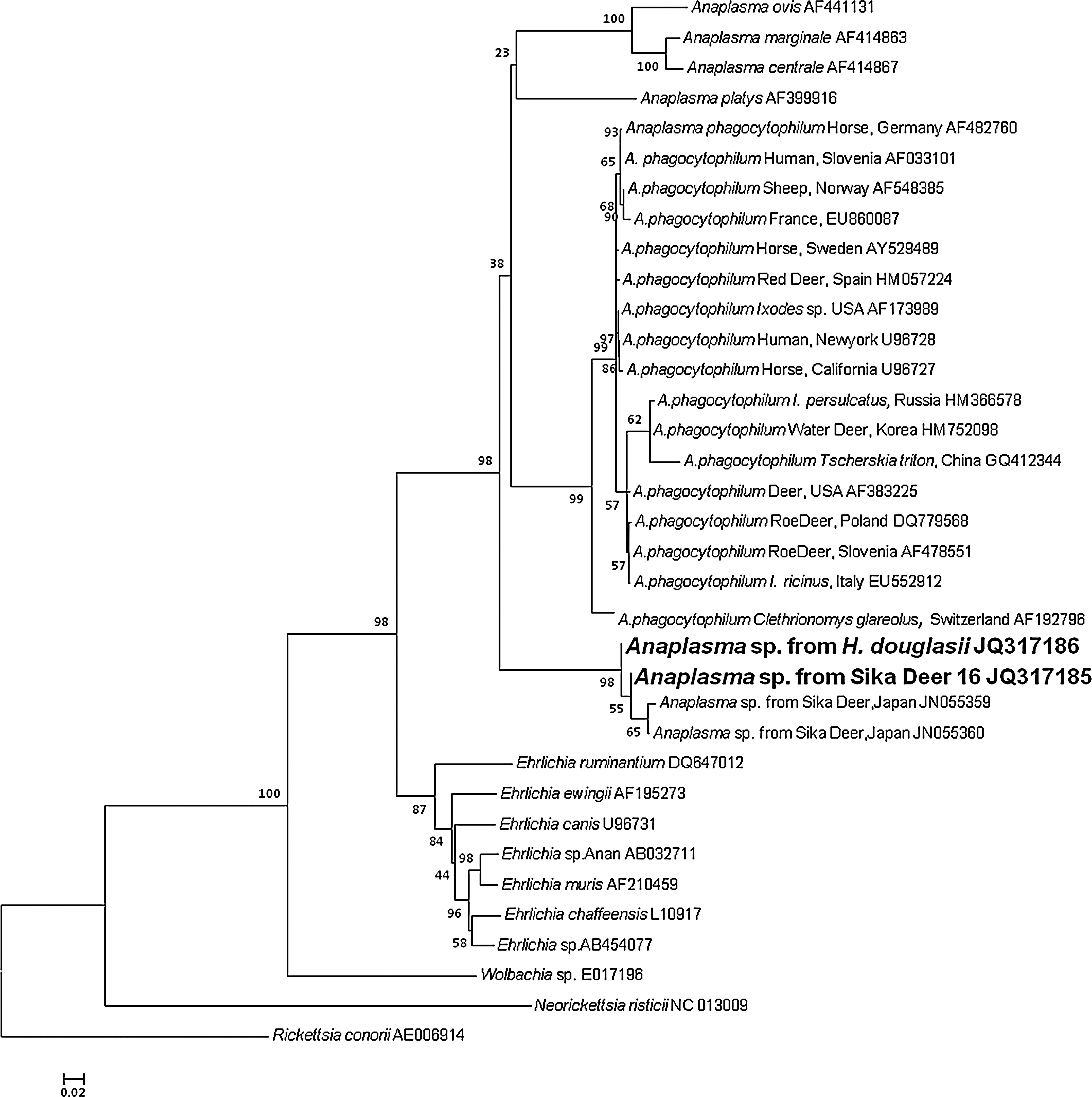
Phylogenetic relationship of Anaplasma sp. from Haemaphysalis douglasii from Nakaosobetsu, Hokkaido, Japan, and Sika deer from Shizunai, Japan, with other Anaplasmataceae organisms based on groEL. The tree was analyzed using nucleotide sequences by neighbor-joining method(pairwise deletion) and supported by 1000 bootstrap replications. Rickettsia conorii was used as an outgroup.
Results
All samples that were found to be positive using the 16S rRNA-based PCR (Kawahara et al. 2006) were also found to be positive with the newly developed heminested PCR method (based on groEL). Direct sequencing from 2 randomly selected amplicons from the positive samples resulted in the targeted 228-bp nucleotide. All sequences revealed 99.6% (1-bp difference) homology with JN055360 (Anaplasma sp. closely related to A. phagocytophilum from Sika deer in Japan). For the groEL-based PCR, serial dilution assays showed a sensitivity limit of 1×10⁻³ for the standard PCR, and at least up to 1×10⁻⁸ for the heminested protocol (all of which demonstrated strong bands). On the other hand, 16S rRNA-based PCR only had sensitivity limits of 1×10⁻² and 1×10⁻⁴ for the standard and nested PCR assay, respectively (Fig. 2).

Sensitivities of the groEL- and 16S rRNA-based PCR assay by 10-fold serial dilution of DNA in standard PCR using internal primers (
The groEL-based PCR method was only positive in the Anaplasma sp. closely related to A. phagocytophilum, whereas the 16S rRNA-based PCR was positive in all these strains (Fig. 3). Moreover, the groEL-based PCR method was also negative in all other species of Ehrlichia and Anaplasma species used in this study (data not shown).
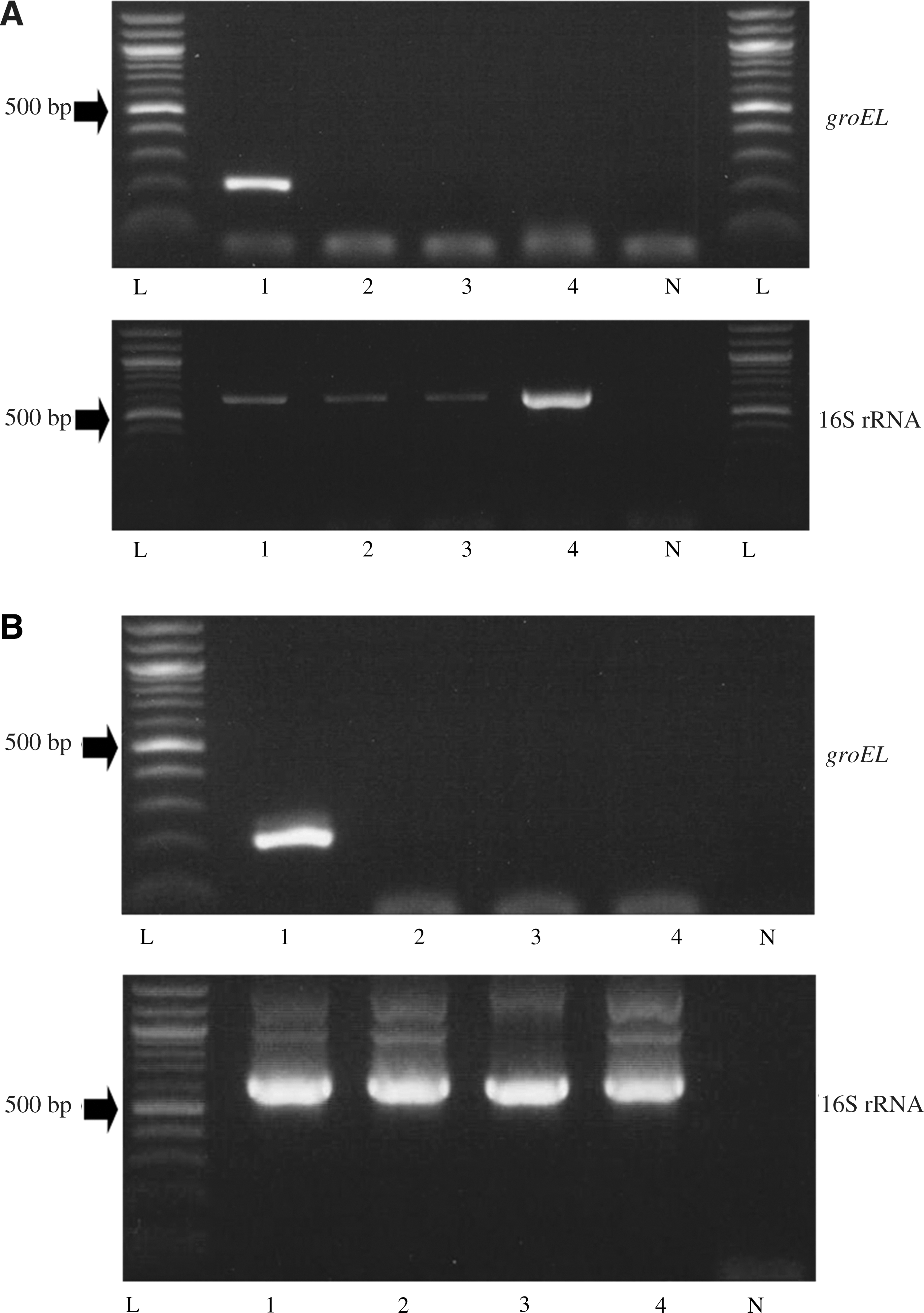
Specificities of the groEL- and 16S rRNA-based PCR assay in standard PCR using internal primers (
Testing the DNA samples obtained from Nakaosobetsu, Hokkaido, Japan, revealed prevalence rates of 2.4% (2 of 85) and 2% (1 of 50) in Ixodid ticks and cattle, respectively. The positive tick samples were 1 adult male and 1 nymph identified as H. douglasii. Sequencing of the strongest positive amplicon (from H. douglasii adult male) after cloning showed 228-bp nucleotide results that were 99.1% (2-bp difference) similar with JN055360. Phylogenetic analyses also demonstrated that this sequence clustered with the Anaplasma sp. closely related to A. phagocytophilum in Japan (JN055359 and JN055360) and not with other Anaplasma species. The clade was also supported by a high bootstrap value (Fig. 1). Similar results were also obtained when deduced amino acid sequences and/or maximum likelihood method was employed (data not shown).
Discussion
The newly developed PCR method based on groEL appears to be highly sensitive and specific in detecting Anaplasma species closely related to A. phagocytophilum in Japan as compared to the 16S rRNA-based PCR. The new method detected 100% of all 16S rRNA-positive samples and had a higher detection limit in both the standard and heminested PCR protocol than the 16S rRNA-based PCR. Results indicate that compared with the 16S rRNA-based PCR, the groEL-based PCR in the present study is 10 times more sensitive using the standard PCR protocol and at least 1000 times more sensitive using the heminested PCR protocol. The increased sensitivity of the groEL-based PCR over the 16S rRNA method needs further investigation and may also be useful in designing groEL-based molecular detection methods in other species. Moreover, It was also found to be more specific than the 16S rRNA-based PCR because it excluded other Ehrlichia and Anaplasma species. The use of groEL in designing a PCR method appears to be more advantageous because it is highly conserved at the intraspecies level than the P44/MSP2 (Wuritu et al. 2009), and more divergent at the interspecies level than the 16S rRNA gene (Sumner et al. 1997). Several studies on Anaplasma have been conducted using this gene (Sumner et al. 1997; Chae et al. 2000; Inokuma et al. 2002a; Inokuma et al. 2002b). Ybañez et al. (2012) also used this gene for the amplification of the Anaplasma species closely related to A. phagocytophilum in Japan, but its specificity and sensitivity were not evaluated. Moreover, the previous method amplifies the complete groEL fragment, whereas the groEL-based PCR in the present study amplifies only a partial fragment.
The prevalence rate in cattle (2.0% or 1 of 50) from Nakaosobetsu, Hokkaido, Japan, was within previously reported range of 1.0–3.4% (Jilintai et al. 2009; Murase et al. 2011), while that in Ixodid ticks (2.2% or 2 of 89) was lower than the previous report (7.1% by Murase et al. 2011). Molecular detection of Anaplasma sp. closely related to A. phagocytophilum in H. douglasii is the first report in such species so far. This pathogen has been detected before in I. persulcatus, I. ovatus (Ohashi et al. 2005) and H. megaspinosa (Yoshimoto et al. 2010). This result provides additional evidence of distinction of this Anaplasma sp. in Japan from A. phagocytophilum due to a varied range of possible tick vectors.
The Anaplasma sp.–positive cattle in this study was asymptomatic, similar to the findings of Jilintai et al. (2009). This is also similar to A. phagocytophilum infection in horses, wherein the persistent infection of the pathogen is not associated with any detectable clinical or pathological abnormalities (Franzen et al. 2009). However, the absence of symptoms and negative blood smears in relation to the pathogenesis of the Anaplasma sp. closely related to A. phagocytophilum needs further study. In conclusion, this study established a new reliable PCR method to detect the Anaplasma sp. closely related to A. phagocytophilum in Japan.
Footnotes
Acknowledgments
This research was supported in part by grants H21-Shinkou-Ippan-014 for Research on Emerging and Re-Emerging Infectious Diseases from the Japanese Ministry of Health, Labor, and Welfare. The authors would also like to thank Mr. Jose Ma. M. Angeles, Dr. Hassan Hakimi, and Ms. Rochelle Haidee D. Ybañez from the National Research Center for Protozoan Diseases, Japan for their technical support, Dr. Kazutoshi Maeno and Dr. Shin-Ichi Matsui for the cattle blood samples, and the students and staff from the Laboratory of Internal Medicine of Obihiro University, Japan, for the tick and blood collection.
Author Disclosure Statement
No competing financial interests exist.