




Abstract
At the end of 2009, 21,313 cases of dengue-3 virus (DENV-3) were reported in the islands of Cape Verde, an archipelago located in the Atlantic Ocean 570 km from the coast of western Africa. It was the first dengue outbreak ever reported in Cape Verde. Mosquitoes collected in July 2010 in the city of Praia, on the island of Santiago, were identified morphologically as Aedes aegypti formosus. Using experimental oral infections, we found that this vector showed a moderate ability to transmit the epidemic dengue-3 virus, but was highly susceptible to chikungunya and yellow fever viruses.
Introduction
The mosquito Aedes aegypti formosus, native to the rain forests of West Africa, has evolved a more domestic behavior, exhibiting an increasing trophic preference for humans (Brown et al. 2010). However, Aedes a. formosus is characterized by a low vector competence for DENV (Failloux et al. 2002; Sylla et al. 2009) and YFV (Tabachnick et al. 1985; Lourenço-de-Oliveira et al, 2002) compared to Aedes a. aegypti.
At the end of 2009, 21,313 cases of DENV-3, including 174 hemorrhagic cases and 4 deaths, were reported in the islands of the southern group (Sotavento) of Cape Verde, an archipelago of 10 islands located in the Atlantic Ocean 570 km from the coast of western Africa (Fig. 1; World Health Organization, 2010). The samples were laboratory confirmed as dengue virus serotype 3 by the Institut Pasteur of Dakar, a World Health Organization (WHO) Collaborating Centre for Arboviruses and Viral Hemorrhagic Fevers. It was the first dengue outbreak ever recorded in Cape Verde, with 70% of the cases occurring on the island of Praia (World Health Organization, 2009). It should also be noted that CHIKV transmission is not known to have occurred in Cape Verde, and no recent YF outbreak has been recorded.
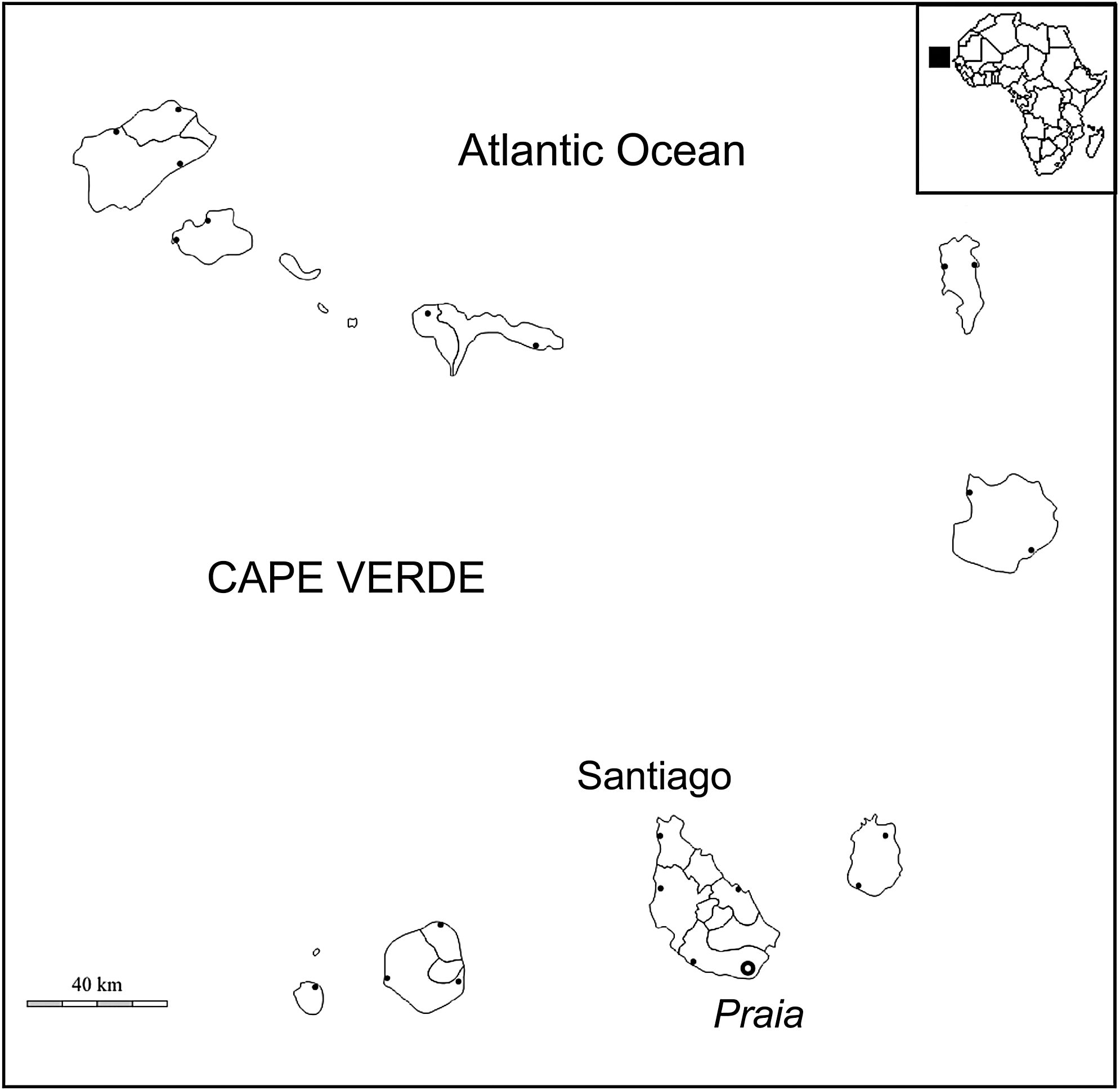
The archipelago of Cape Verde in the Atlantic Ocean, which is 570 km from the coast of west Africa. The highest number of DENV-3 cases was reported on the island of Santiago, where Aedes a. formosus was collected for experimental infections with dengue, chikungunya, and yellow fever viruses.
A. aegypti has been reported in Cape Verde since the 1930s, and is the only potential DENV vector present (Alves et al. 2010). Based on the absence of silver scales on the first abdominal tergite, which is the best way to distinguish between the two forms of A. aegypti (Sylla et al. 2009), mosquitoes collected in 2010 in Praia, Cape Verde, were identified as A. a. formosus (Mattingly 1957).
Using experimental infections in a biosafety level-3 (BSL-3) insectarium, we assessed vector competence of A. a. formosus from Cape Verde for DENV-3 isolated from a human case in Cape Verde, and for our reference strain DENV-2 isolated from a human case in Thailand (Vazeille-Falcoz et al. 1999). In addition, we also estimated the potential risk for A. a. formosus from Cape Verde to transmit two other arboviruses, CHIKV and YFV.
Materials and Methods
Mosquito larvae were collected in July 2010 in the city of Praia, on the island of Santiago, where the highest number of DENV-3 cases was reported, and reared in the insectaries of the Institut Pasteur in Paris under standard conditions. Larvae were collected from a single breeding site. Identification was done on the adult stage 24 h after emergence for all individuals. A. a. formosus was the only form recorded in Praia in different sites by the entomological team. F1/F2 adult females were exposed to infectious blood meals containing 107 FFU (foci fluorescent units)/mL of virus as previously described (Vazeille-Falcoz et al. 1999), and maintained at 28°C for 14 days. The mosquitoes were tested at days 7, 10, and 14 post-infection (PI).
Two DENV isolates were tested: DENV-3 isolated in 2009 from a human case in Cape Verde, and our reference strain DENV-2 isolated in 1974 from a human case in Thailand (Vazeille-Falcoz et al. 1999). In addition, we also estimated the potential risk for A. aegypti from Cape Verde to transmit: (1) CHIKV isolated in 2005 from a human case in La Reunion and exhibiting an amino acid change (A226V) in the envelope glycoprotein E1 (Schuffenecker et al. 2006), and (2) YFV isolated in 1979 from a human case in Senegal (Rodhain et al. 1979). Viral stocks were produced on C6/36 Aedes albopictus cells.
Two parameters were determined at different days PI: (1) the disseminated infection rate (DIR), corresponding to the percentage of orally-exposed mosquitoes with viral dissemination in the head as detected by immunofluorescence assay, and (2) the transmission rate (TR), representing the percentage of mosquitoes with viral particles in saliva detected on C6/36 Aedes albopictus cells by focus fluorescence assay. The method used for the collection of saliva by forced salivation has been described by Dubrulle and colleagues (2009), and titration was performed using a protocol described in Vazeille and associates (2010), and slightly modified. Briefly, dilutions of each sample were added to monolayers of C6/36 cells in 96-well plaques to detect infectious particles by the foci forming assay (FFA) using a fluorescence assay. The cells were incubated at 28°C under an overlay consisting of 50% of Leibovitz L-15 medium supplemented with 10% FBS and 50% carboxyl methyl cellulose for 3 days for CHIKV and 5 days for DENV and YFV. The staining was performed using mouse ascitic fluid at a dilution of 1:1000 for CHIKV and 1:100 for DENV and YFV (all ascitic fluids were provided by the French National Reference Center for Arbovirus at the Institut Pasteur), and a FITC anti-IgG-mouse (Biorad, Marnes la Coquette, France). The titer of infectious particles in the saliva was expressed as FFU/mL.
Results
As shown in Table 1, A. a. formosus from Cape Verde ensured more efficient dissemination of DENV-3 isolated from a patient from Cape Verde than of DENV-2 from Thailand: at day 7 PI, 27.3% for DENV-3 versus 8.3% for DENV-2, and at day 14 PI, 80% for DENV-3 versus 46.1% for DENV-2. However, TRs were quite low for both DENV types, suggesting an efficient salivary gland barrier (20% at day 10 for DENV-3 and 8.3% at day 14 for DENV-2, with only 1–2 viral particles detected in saliva).
Disseminated infection rate is the percentage of mosquitoes with virus detected in head samples. Transmission rate is the percentage of females with virus in saliva samples.
–, not determined; n, number of mosquitoes tested; PI, post-infection; CHIKV, chikungunya virus; YFV, yellow fever virus; DENV, dengue virus.
For CHIKV, DIRs were as high at day 7 PI as at day 14 PI (91.5% and 100%), but the TR was higher at day 7 PI (70%) than at day 14 PI (40%). TRs were proportional to the number of viral particles detected in saliva, 49 (range 3–120) viral particles at day 7 PI versus 14 (range 3–50) at day 14 PI.
With YFV the DIR was low, 14.6%, and was only detected at day 14 PI. Surprisingly, the TR was 50%, and high viral loads were detected in saliva, 273 (range 120–400) viral particles.
Discussion
Our results show that A. a. formosus from Cape Verde is susceptible to oral infection and is able to transmit DENV, CHIKV, and YFV at different magnitudes.
A. a. formosus from Cape Verde is susceptible to oral infection by autochthonous DENV-3, but is less efficient at replicating a reference DENV-2 strain. This could suggest a specific vector genotype–virus genotype interaction (Lambrechts et al. 2009). The TRs are extremely low, suggesting an efficient salivary gland barrier for the tested DENV type. The method used to collect and titrate saliva was the same for the three viruses, so these low TRs are not due to technical problems. A. a. formosus is known to be less competent at acquiring and transmitting dengue and yellow fever viruses than A. a. aegypti (Tabachnick et al. 1985; Failloux et al. 2002). Lourenço-de-Oliveira and associates (2002) tested a sample of A. a. formosus for YFV and found a low DIR of 3.3%. For the same DENV-2 that we used in our study the DIR was 36.9% (unpublished data).
However, even with a low competence for viral replication and transmission, a vector can sustain an epidemic outbreak (Miller et al. 1989). Furthermore the abundance of the vector and the frequency of contacts between the vector and humans during the rainy season are as important as the number of infected particles delivered in the saliva as measured under laboratory conditions. Finally, transmission was probably enhanced by the naïve immunological status of the human population of Cape Verde for DENV-3.
During the last decade, the number of CHIKV outbreaks has been increasing in central Africa, in Cameroon (Peyrefitte et al. 2007) and in Gabon (Peyrefitte et al. 2008). The CHIKV is highly transmitted by A. aegypti from central Africa (Paupy et al. 2010). We also demonstrated the high potential of A. a. formosus from Cape Verde to transmit CHIKV.
YFV continues to cause severe morbidity and mortality in Africa despite the availability of the 17D vaccine. Our results suggest that A. a. formosus from Cape Verde would be efficient at YFV transmission.
The future introduction of DENV, CHIKV, or YFV via travelers from continental Africa may cause other outbreaks in Cape Verde, whose population is not immune to most arboviruses. Therefore mosquito and virus surveillance as well as control must be urgently undertaken and reinforced.
Footnotes
Acknowledgments
We thank L. Mousson, C. Arias-Goeta, and F. Amraoui for technical assistance. This work was funded by the Institut Pasteur.
Author Disclosure Statement
No competing financial interests exist.