




Abstract
We report experimental evidence for bioconcentration of a low-pathogenicity avian influenza virus (H6N8) in the tissue of freshwater clams. Our results support the concept that freshwater clams may provide an effective tool for use in the early detection of influenza A viruses in aquatic environments.
Introduction
Here we used a controlled laboratory experiment to examine the hypothesis that Asiatic clams are effective bioconcentrators of AIV by testing the predictions that (1) clams bioconcentrate AIV, and (2) higher initial virus concentrations in water result in greater bioconcentration by clams.
Materials and Methods
Sets of three commercially-purchased clams were placed in nine identical tanks of 500 mL of well-water treated with the low-pathogenicity AIV A/Mallard/Minnesota/182737/98 (H6N8) to reach concentrations of 103, 102, and 101 EID50/mL. As controls, sets of two clams were placed in nine identical tanks with untreated water. The clams from three tanks of each concentration and three untreated control tanks were sampled at 6, 12, and 24 h after initial exposure (n=99 clams in 36 tanks). After depuration (i.e., allowing the clams to filter clean water to remove impurities or unbound virus from the digestive tract) in distilled water for 30 min, the length, width, depth (mm), and the mass (g) of each clam were measured. We collected 50 mL of the water from each tank when the clams were sampled for use in estimating bioconcentration, for which bioconcentration equals the difference between AIV concentration in clams at time t and AIV concentration in the surrounding water at time t.
Tissues were removed from the shell of each clam and homogenized. Virus RNA was then extracted from a 0.03-g aliquot of each homogenate using RNeasy Mini Kits (Qiagen, Valencia, CA), following the manufacturer's instructions. Virus concentrations in the clam tissue homogenates and in the water samples were determined using real-time reverse transcription-PCR (RRT-PCR; Spackman et al. 2003).
Using bioconcentration as a response variable, data were analyzed using mixed model regression (SAS 9.1 Proc MIXED software; SAS Institute, Cary, NC), with tank as a random effect. In addition to treatment effects, we considered models with bioconcentration as a linear or quadratic function of time, as well as models incorporating measures of clam size and shape as additive factors influencing bioconcentration. We used an information-theoretic approach to multimodel inference, with Akaike's Information Criterion corrected (AICc) for small sample sizes for model selection (Burnham and Anderson 2002).
Results
We found evidence to suggest that Asiatic clams appeared to bioconcentrate the AIV H6N8 in their tissues. The concentration of virus declined in inoculated water and increased in clam tissues exposed to inoculated water over time, except for a temporary decline at 12 h (Fig. 1a–c). Our top model (Akaike weight=0.28) incorporated a time×treatment interaction with bioconcentration as a quadratic function of time, and an interaction of total clam mass with treatment. This model explained 69.9% of the variation in our data, and suggested that (1) clams exposed to higher initial concentrations in water bioconcentrated relatively more virus in their tissues, and (2) bioconcentration decreased with clam mass at the lowest starting AIV concentration in water, but increased with clam mass at the higher initial concentrations (Fig. 1a–c). Measures of clam allometry (e.g., mass and length) were included in all models with Akaike weights >0.05 (n=5 models). These models all included the quadratic time×treatment interaction, and accounted for 80% of the total Akaike weight.
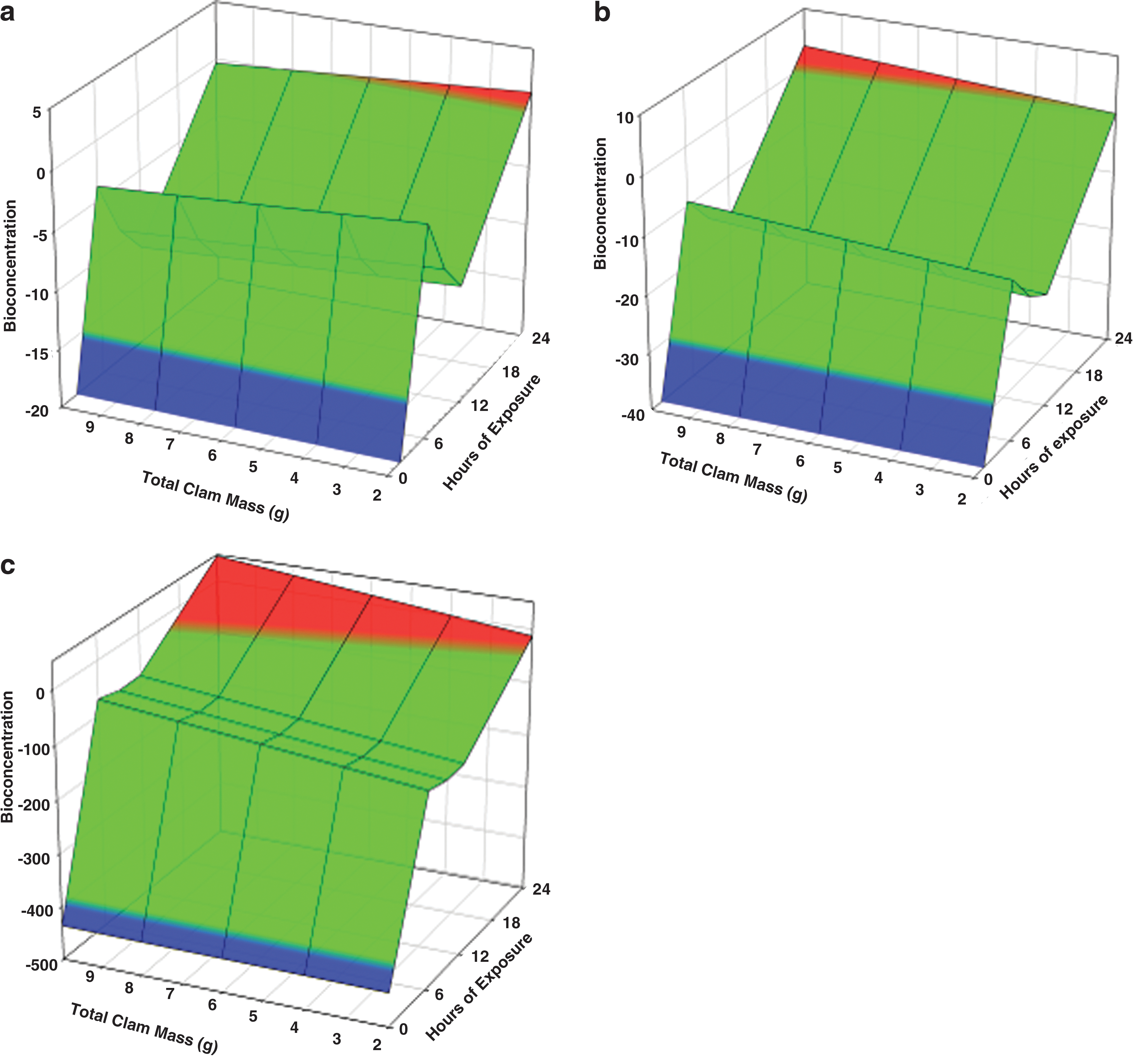
Bioconcentration of avian influenza virus by Asiatic clams (Corbicula fluminea) over time, and total clam mass for (
Discussion
Given the importance of aquatic habitats in the spread and maintenance of AIVs (Franklin et al. 2011), effective tools to detect these viruses in water are needed. We found that live Asiatic clams can bioconcentrate AIVs in their tissues and reduce viral concentrations of water within 24 h of exposure; this highlights the utility of bivalves for early detection of virus in water. The presence of virus in clam tissue after our depuration procedure supports the general finding that clams remove virus from the water. If virions were not concentrated in clam tissue during filtering, bioconcentration should not have increased over time, because filtration during depuration would have flushed virus out of the alimentary canal. Our findings corroborate those of other recent studies (Faust et al. 2009; Stumpf et al. 2010), demonstrating cleansing of AIV-inoculated water by bivalve filtration within 24 h post-infection. However, we used relatively lower initial concentrations of virus in larger tanks, factors which may more closely mimic natural conditions (VanDalen et al. 2010).
We found that the highest levels of bioconcentration were in clams that had been exposed for 24 h, and that a quadratic time effect was important in our study: levels of bioconcentration initially rose at 6 h, dipped at the 12-h sampling, and increased to the highest levels at 24 h. The apparent decline at 12 h may correspond to a period of inactivity that follows an initial period of rapid filtration typically lasting ∼6 h in other freshwater clams (Badman 1975), or active rejection of particles by clams if particles of optimal size were not available (Lehman 1976). To function effectively as sentinels in aquatic habitats where AIV is suspected to be present, clams should be collected from or maintained in these aquatic environments for at least 24 h. An example protocol evaluating the presence of AIV in a field setting could include: (1) placing sets of live clams in plastic mesh bags, (2) suspending these bags in the water column just above the substrate, (3) collecting the bags 24 h later, and (4) evaluating the levels of AIV in the clams by RRT-PCR, all of which are incorporated into an appropriate sampling design (McClintock et al. 2010). In addition to highlighting the potential for Asiatic clams as tools for virus detection, our results may help inform future studies about the role of invertebrates such as clams in the transmission and maintenance of influenza viruses in aquatic systems.
Footnotes
Acknowledgments
We thank several colleagues for their help and insights given throughout the project, especially Robert G. McLean, Kaci K. VanDalen, Heather K. Sullivan, Paul T. Oesterle, and William H. Clements. We appreciate the logistical support from Thomas J. DeLiberto, Christopher A. Myrick, and the USDA/ARS/Southeast Poultry Research Lab. This study was supported by funding from the USDA/APHIS/WS National Wildlife Disease Program.
Author Disclosure Statement
No competing financial interests exist.