




Abstract
A study on tick fauna and tick-borne pathogens was undertaken in Pianosa, an island in the Tuscany Archipelago that constitutes an important stopping and nesting point for migratory birds. Ticks were removed from feral cats and a few terrestrial birds, and host-seeking ticks were collected by dragging. A total of 89 ticks were found on animals: 57 Ixodes ventalloi Gil Collado, 1936 and 32 Ixodes acuminatus Neumann, 1901. Host-seeking ticks were 354 Hyalomma spp. larvae and 18 Hyalomma spp. adults, identified as Hyalomma marginatum C.L. Koch, 1844 (n=11) and 7 Hyalomma detritum Schulze, 1919 (n=7). A sample of adult ticks was subjected to molecular analyses to look for Rickettsia spp. and Borrelia burgdorferi sensu lato (s.l.). Sequence analysis of the 5S–23S intergenic spacer region and OspA gene of B. burgdorferi s.l.–positive samples showed the presence of Borrelia spielmanii (n=3; 3.7%, 95% confidence interval [CI] 0.08–10.4) and Borrelia valaisiana (n=13; 13.6%, 95% CI 7.0–23.0) in Ixodes ticks from cats and terrestrial birds. Ixodes spp. were also infected by Rickettsia helvetica (n=19; 23.4%, 95% CI 14.7–34.2). Finally, we detected Rickettsia aeschlimannii in 3 out of 12 host-seeking Hyalomma spp. adults tested (25%, 95% CI 5.5–57.2). Our study shows the presence of several tick-borne pathogens in Pianosa. Hyalomma spp. and Ixodes ticks other than I. ricinus seem to be involved in their epidemiological cycle, and birds could contribute to the pathogen dispersal along their migration routes. This is the first finding of B. spielmanii in Italy. We hypothesize the involvement of peridomestic rodents or hedgehogs in its maintenance in Pianosa.
Introduction
Migratory birds could be partly responsible of the heterogeneous distribution of tick-borne pathogens in Europe, because they are considered responsible for the dissemination of ticks in their migration routes and are recognized reservoir hosts of some agents (Kjelland et al. 2010).
The island of Pianosa is an important stopping and nesting site for avian species because of its history, which has made it unspoiled and scarcely inhabited for many years. Within a project aiming at capturing feral cats, which constituted a threat for migrating birds, ticks were collected from the felines and from terrestrial birds. Moreover, host-seeking ticks were collected by dragging. Tick identification and molecular analyses were then undertaken to describe the tick fauna of Pianosa and the presence of tick-borne pathogens.
Materials and Methods
Study area
The island of Pianosa (N 42° 34′ 53″, E 10° 4′ 34″) is part of Tuscany Archipelago in the Tyrrhenian Sea, Tuscany region, Italy. Pianosa has an area of 10.2 km2, is plain, and its highest point reaches about 30 meters above sea level. From 1858, it was the seat of an agricultural penal colony. For this reason, and thanks to the establishment of a National Park (Parco Nazionale dell'Arcipelago Toscano) in 1996–1997, Pianosa remained unspoiled by human presence and activities for many years. Since the closure of the prison in 1997, the island is almost uninhabited, and only daily guided tours are possible for tourists during the summer season.
The vegetation is characterized by typical Mediterranean species, such as junipers (Juniperus communis, J. oxycedrus and J. phoenicea), mastik trees (Pistacia lentiscus), rosemaries (Rosmarinus officinalis), cists (Cistus incanus, C. monspeliensis), myrtle (Myrtus communis), helichrysum (Helichrysum litoreum), and lavender (Lavandula stoechas) (Colom et al. 2004). The fauna are represented by small mammals, such as rodents, hedgehogs (Erinaceus europaeus), Kuhl's pipistrelles (Pipistrellus kuhlii), and wild hares (Lepus europaeus). The black rat (Rattus rattus), Norway rat (Rattus norvegicus), and house mouse (Mus musculus domesticus) were accidentally introduced to the island, and wild hares were introduced for hunting (Agnelli 1998, Angelici et al. 2009). Cats (Felis catus) live as wild predators; they were abandoned by humans after the closure of the penal colony and represent a threat for land and marine birds (seagulls and shearwaters in particular). The avifauna, both local and migratory, are abundant in Pianosa. Among others, colonies of Audouin's gull (Ichthyaetus audouinii), Cory's shearwater (Calonectris diomedea), Mediterranean shearwater (Puffinus yelkouan), and European shag (Phalacrocorax aristotelis desmarestii) are present. Moreover, a large population of pheasants (Phasianus colchicus) and red partridges (Alectoris rufa) inhabits the island, and several marine and terrestrial species spend their winter there.
Tick collection
Ticks were collected on vertebrate hosts and by dragging the vegetation, within the framework of the LIFE Natura Project LIFE04NAT/IT/000172, co-financed by European Union and region of Tuscany (2004–2007). One of the project aims was eliminating wild cats from the island by sterilizing and releasing them on the Elba Island.
Ticks were collected from trapped cats and from 3 terrestrial birds found dead/dying on the island footpaths—1 common pheasant (Phasianus colchicus), 1 red partridge (Alectoris rufa), and 1 water rail (Rallus aquaticus). Dragging was performed on the same transects used to trap wild cats, which were randomly chosen after dividing the island in 6 areas and considering existing footpaths. Four 1-km length transects per area were selected, and dragging was carried out by 2 operators, using a 1-square meter cotton cloth. The operators stopped at each 10 meters approximately to check the cloth for tick presence. Tick collection was performed in October, 2006 (on-the-host and host-seeking ticks collection), and August, 2007 (dragging only); sampling periods were chosen based on convenience (logistic support on the island by the personnel of LIFE Natura project). A total of 7 dragging transects were covered in October, 2006, and 24 in August, 2007. Arthropods were stored in 70% ethanol and subsequently identified using keys by Manilla (1998), Estrada-Peña et al. (2004), and Cringoli et al. (2005).
Molecular analyses
Tick DNA was extracted by using the QIAGEN DNeasy tissue kit (Qiagen GmbH, Hilden, Germany). The infection by B. burgdorferi s.l. was investigated by a PCR protocol targeting a 337-bp fragment of the intergenic spacer (IGS) region included between genes coding for the 5S and 23S subunits of ribosomal RNA (Rijpkema et al. 1995). For better characterization, positive samples were submitted to the amplification of a 800-bp fragment of the outer surface protein A (OspA) gene. In detail, 5 μL of DNA extract were put in 25-μL reactions containing 10X CoralLoad PCRBuffer PCR (Qiagen), 0.03 mM concentrations of the forward primer OspAf (Grego et al. 2007; 5′-ATGAAAAAATATTTATTGGGAATA-3′) and of the reverse primer OspAr_gen (5′-ATTCTCCYTATTTYAAAGCG-3′), 200 μM of deoxyribonucleotide triphosphates (dNTPs), and 1 U/reaction of Taq DNA polymerase (Qiagen). Cycling conditions included denaturation at 94°C for 3 min; 40 cycles of 94°C for 1 min, 50°C for 1 min, and 72°C for 1 min; and a final extension at 72°C for 10 min. DNA from Borrelia afzelii (Nancy strain) and B. garinii (BL3 strain) was used as positive controls in each PCR run. The OspA reverse primer was designed based on the alignment of B. burgdorferi s.l. reference sequences available on GenBank and the sequences database obtained from previous studies.
The presence of rickettsial DNA in ticks was investigated as described in Tomassone et al. (2010): a first PCR assay targeted the citrate synthase gene (gltA); positive samples were further tested to detect the ompA gene, specific for the SFG rickettsiae. In each PCR run, DNA from Rickettsia conorii was used as a positive control.
RNase- and DNase-free water and nucleic acid extracts from sure negative samples were used as negative controls to determine any possible cross-reactivity or contamination; 1 negative control every 5 field samples was included in each PCR run.
Amplified products were analyzed by electrophoresis in 2.5% agarose and visualized by staining with 0.1% ethidium bromide. Amplicons were purified using ExoSAP-IT PCR Clean-up Kit (GE Healthcare Limited, Chalfont, UK) and sent to an external service (Macrogen Inc., Amsterdam, The Netherlands) for automatic sequencing. Sequences were analyzed by Chromas 2.0 software (Technelysium, Helensvale, Australia) and submitted to BLAST (
Prevalence of tick species and PCR-positive results were calculated, with 95% exact binomial confidence intervals (95% CI), by using R software (R Development Core Team, 2008).
Phylogenetic analysis
Sequences obtained from positive samples were aligned with reference sequences available in GenBank using ClustalW (Thompson et al. 1997) and were imported into PAUP* (ver. 4.0b10; Swofford, 2003). The model of molecular evolution was estimated using a hierarchical likelihood ratio test approach and the Akaike information criterion (Akaike 1973) implemented in the computer program ModelTest ver. 3.7 (Posada and Crandall 2001). The phylogenetic trees and the statistical support for clades were created using the Bayesian methods implemented in MrBayes (ver. 3.1.1; Ronquist and Huelsenbeck 2003). A Markov chain Monte Carlo search for 1,000,000 generations using 2 runs with 4 chains (temperature=0.05) was performed, and results were represented as a 50% majority rule consensus tree. The pairwise genetic distance comparisons were calculated by the Nei–Gojobori method (Nei and Gojobori 1986).
Results
A total of 426 ticks were collected during fieldwork. On-the-host ticks were all adults (n=89): 57 Ixodes ventalloi Gil Collado, 1936, and 32 Ixodes acuminatus Neumann, 1901. Host-seeking ticks were 354 Hyalomma spp. larvae, which were identified at the genus level, and 18 Hyalomma spp. adults, namely Hyalomma marginatum C.L. Koch, 1844 (n=11) and Hyalomma detritum Schulze, 1919 (n=7) (Table 1). Eleven Hyalomma larvae were collected in October, 2006 (0.16 specimens per 100-meter dragging), while in August, 2007, we gathered 343 larvae (1.43 specimens/100 meters) and the 18 adults (0.075/100 meters).
CI, Confidence interval; SFG, spotted fever group; na, not applied.
The PCR for B. burgdorferi s.l. and Rickettsia spp. detection was performed on 81 Ixodes spp. ticks. The Rickettsia spp. PCR assay was also carried out on 12 host-seeking Hyalomma spp. adults. The remaining Ixodes and Hyalomma specimens were kept in the laboratory as reference specimens.
Overall, 16 Ixodes spp. were positive to B. burgdorferi s.l. 5S-23S IGS PCR (19.7%; 95% CI 11.7–30.1): 12 I. ventalloi, and 4 I. acuminatus. The sequences clustered into two clades defined by reference strains of B. spielmanii and Borrelia valaisiana (Fig. 1). The pairwise genetic distances varied from 0 to 0.034 among the B. spielmanii sequences and from 0 to 0.027 among the B. valaisiana sequences. Positive ticks were taken from 3 different cats and from the red partridge (B. spielmanii), water rail, and pheasant (B. valaisiana). Results are detailed in Table 1. The borrelia OspA gene could be amplified only from 9 Ixodes spp. positive to 5s–23s IGS. The dendrogram based on the ospA gene (Fig. 2) showed that the B. valaisiana sequences belong to the subgroup I strain (Wang et al. 2000; Ryffel et al. 2003); the pairwise genetic distances varied from 0 to 0.023. Only one ospA B. spielmanii sequence was obtained.

Phylogenetic tree based on the 5S–23S intergenic spacer (IGS) of Pianosa B. burgdorferi s.l. sequences and National Center for Biotechnology Information (NCBI) reference sequences. Pianosa sequences are highlighted by a square (positive ticks from pheasants), a circle (from cats), a rhombus (from water rail), or a triangle (from red partridge). Iv, I. ventalloi; Ia, I.acuminatus; cat, tick collected on a cat; ph, on pheasant; wa, on water rail; pa, on partridge. Posterior probability values are reported below branches. Bar, 0.01 substitutions per site.
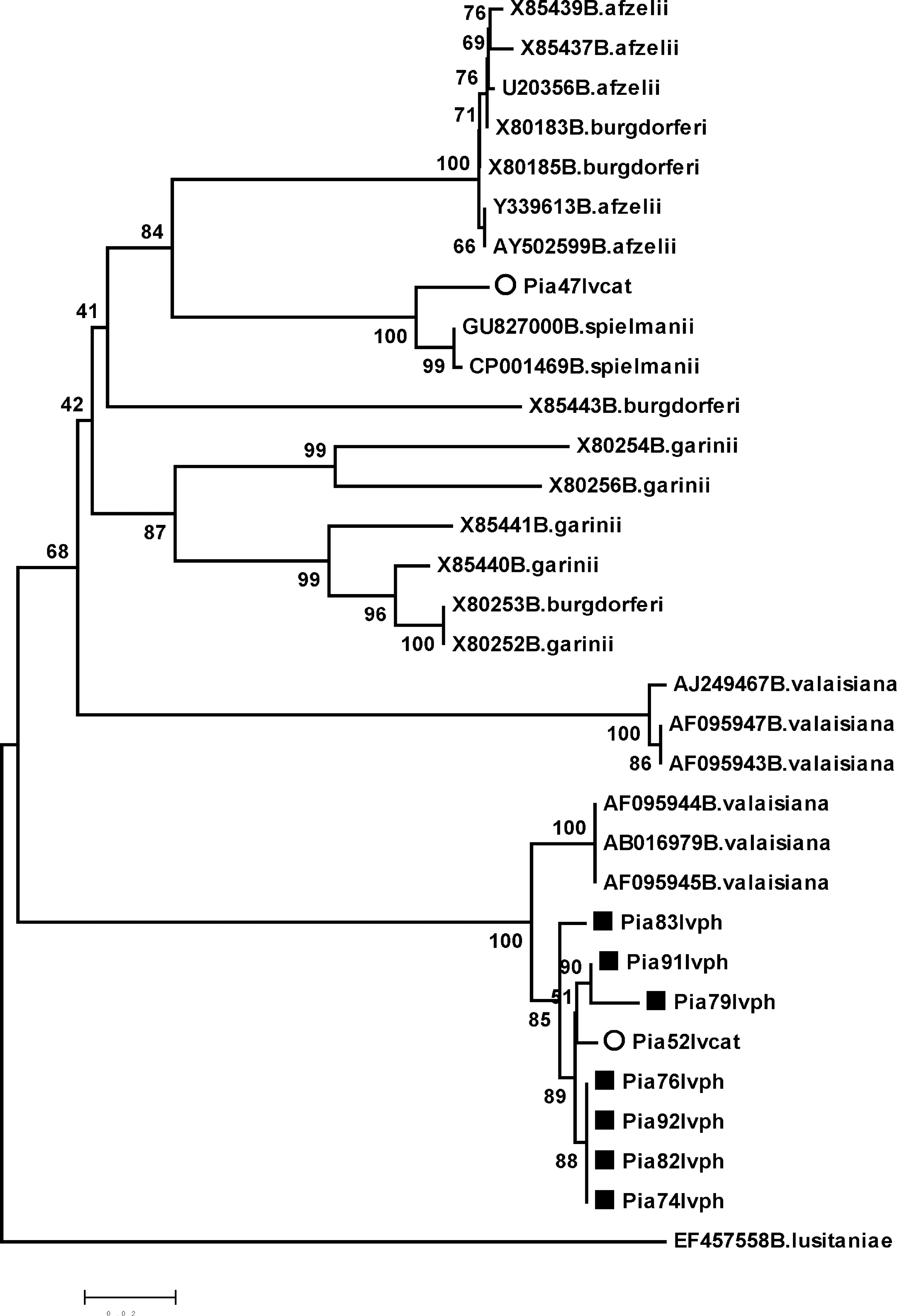
Phylogenetic tree based on the OspA gene of Pianosa B. burgdorferi s.l. sequences and NCBI reference sequences. Pianosa sequences are highlighted by a square (positive ticks from pheasants) or a circle (positive ticks from cats). Iv, I. ventalloi; cat, tick collected on cat; ph, tick collected on pheasant. Posterior probability values are reported below branches. Bar, 0.02 substitutions per site.
The Rickettsia gltA gene was detected in 20 Ixodes spp. (35.8%; 95% CI 25.5–47.2) collected from cats and terrestrial birds. Nine I. ventalloi and 10 I. acuminatus were found infected by Rickettsia helvetica, whereas Rickettsia sp. IRS3 was detected in 1 I. ventalloi from a cat. Positive ticks were collected from 8 different cats. Co-infection by B. valaisiana and R. helvetica was detected in 1 I. acuminatus from a cat and 1 I. ventalloi from the pheasant, whereas B. spielmanii was detected together with R. helvetica in 1 I. acuminatus collected on the red partridge. Finally, 3 out of the 12 adult host-seeking Hyalomma examined were positive to both gltA and OmpA rickettsial genes (25%, 95% CI 5.5–57.2), and Rickettsia aeschlimannii was identified.
Discussion
A variety of tick-borne zoonotic agents were detected in our study in Pianosa. B. spielmanii is reported for the first time in Italy. This spirochete is characterized by a focal distribution in Europe (Fingerle et al. 2008) and is considered to be more host specific than other B. burgdorferi s.l. genospecies, being strictly associated with the garden dormouse (Eliomys quercinus; Richter et al. 2004). Dormice are not reported in Pianosa (Angelici et al. 2009); thus, we can hypothesize the maintenance of B. spielmanii by resident alternative hosts such as peridomestic rodents or hedgehogs. Indeed, mice (Apodemus sylvaticus, Apodemus flavicollis, M. musculus) and Norway rats were shown to be competent hosts for B. spielmanii, although being less efficient reservoirs than dormice (Richter et al. 2011). Moreover, Skuballa et al. (2007, 2012) detected B. spielmanii in tissues from E. europaeus and in Ixodes ricinus ticks subjected to xenodiagnostic experiments on hedgehogs, showing the possible role of these animals as a reservoir.
B. valaisiana also infected our tick sample. This borrelia, occasionally detected in Lyme disease patients (Strle and Stanek 2009), is considered to be associated with avian species (Kurtenbach et al. 2002). Indeed, we detected it in over 80% I. ventalloi collected from the pheasant (Table 1, Figs. 1 and 2). Because pheasants have been shown to be reservoir hosts of B. valaisiana (Kurtenbach et al. 1998), it is possible that ticks were infected either during the blood meal on the examined host or on other pheasants in the previous tick stages. B. valaisiana was also detected in a I. ventalloi feeding on the water rail. This bird species was found infected by B. burgdorferi sensu stricto in a study in migrating birds in Slovakia (Schwarzová et al. 2006).
Apart from terrestrial birds, Ixodes ticks infected by borrelia were collected on felines. Cats, feral ones in particular, are exposed to B. burgdorferi s.l., but clinically apparent disease is not common. Their role as reservoir for this pathogen is unknown (Berrada and Telford 2009). Our results show a few positive ticks from cats (8%), infected by B. spielmanii or B. valaisiana (Figs. 1 and 2), and we can thus hypothesize that these animals are not involved in the pathogen transmission in our study area.
The phylogenetic analysis of 5S–23S IGS showed the clusterization of Pianosa samples in the B. spielmanii or B. valaisiana groups; no associations between genetic variability and unique ticks species or hosts were observed. Focusing on the B. valaisiana ospA gene, this gene was conserved among our sequences. This may be due either to it being found in a single tick species, or to a geographic conservation in the island (Qiu et al. 2002). Indeed, only B. valaisiana subgroup I was identified in Pianosa. In other geographic areas, B. valaisiana subgroups I and II co-exist, such as in the regions at the France–Germany borders (Margos et al. 2009). A possible explanation of the presence of a unique subgroup in our study area may be the single migratory route, from Africa to northern Europe, passing on the Tuscany Archipelago through Tunisia.
Lyme spirochetes were detected in I. ventalloi and I. acuminatus. Recently, B. afzelii infection in I. acuminatus was reported in Hungary (Rigó et al. 2011), but this is the first finding of B. burgdorferi s.l. in I. ventalloi. Although B. burgdorferi s.l. has been detected or isolated from several ticks, Ixodes hexagonus and Ixodes uriae are the unique recognized alternative vectors besides I. ricinus (Gern et al. 2008). However, no other Ixodes spp. species were collected in Pianosa, so our results suggest the involvement of I. ventalloi and I. acuminatus in the B. burgdorferi s.l. biological cycle. The same tick species may be involved in SFG rickettsiae maintenance, because they were found to be infected by R. helvetica and Rickettsia sp. IRS3. Positive ticks were collected from terrestrial birds and cats; however, the role of vertebrate hosts in the transmission cycle of R. helvetica and other rickettsiae is not known, and ticks are considered reservoir and vectors of the pathogens (Boretti et al. 2009). Rickettsia spp. were already reported in I. ventalloi collected from migrating birds in Cyprus (Ioannou et al. 2009), Spain (Márquez 2008; Márquez and Millán 2009), and Portugal (Santos-Silva et al. 2006).
To the best of our knowledge, we report for the first time R. helvetica in I. acuminatus. Also R. helvetica is commonly associated with I. ricinus ticks, but according to Santos-Silva et al. (2006), the presence of this pathogen in alternative ticks could indicate the existence of secondary maintenance cycles. I. acuminatus is a parasite of small rodents, insectivores, and hedgehogs (Boyard et al. 2008; Rigó et al. 2011). The I. ventalloi life cycle depends on wild rabbits (Millán et al. 2007; Márquez 2008), but it was reported on carnivores, including cats, rodents, hedgehogs, and birds such as the partridge (Beichel et al. 1996; Santos-Silva et al. 2006, 2011; Ioannou et al. 2009). Because both Ixodes species are known to infest humans (Gilot and Marjolet, 1982), their possible role as zoonoses vectors can be speculated.
Likewise, Hyalomma ticks are well-known human parasites and can transmit a variety of diseases, including Crimean-Congo hemorrhagic fever (CCHF; Estrada-Peña and Jongejan 1999). Adults show an aggressive host-seeking behavior, and in our study area they were frequently found on the dragging operators' clothes. The small numbers of specimens obtained by dragging may be due to the limits of the method for collecting Hyalomma adults (Barandika et al. 2011). We detected R. aeschlimannii in host-seeking H. marginatum and H. detritum. This pathogen is characterized by a broad geographical distribution and is generally found in Hyalomma ticks from southern Europe (Croatia, Corsica, Cephalonia, Spain, Portugal, and Sicily; Beninati et al. 2005; Parola et al. 2005), North and sub-Saharan Africa (Beati et al. 1997; Mediannikov et al. 2010), and southwestern Russia (Shpynov et al. 2009). However, because of the long attachment on the hosts, Hyalomma immatures can be passively transported from the birds' wintering areas along migration routes (Jameson et al. 2012) and can spread rickettsiae to northern countries. For example, R. aeschlimannii was recently detected in one H. marginatum from a bird migrating to Germany from Africa (Rumer et al. 2011).
In the light of the importance of the Tuscany Archipelago islands in the avian migratory routes, it would be interesting to clarify the role of avian species in the epidemiological cycles of both Lyme spirochetes and SFG rickettsiae in Pianosa. In fact, the involvement of wild birds in dispersing ticks and tick-borne pathogens in Europe, and their role as reservoir hosts, are well established. Migrating birds may indeed contribute to the dispersal of ticks and tick pathogens from areas where their biological cycles are maintained, either acting as a reservoir or being responsible for pathogen transmission to species of the local fauna (Olsén et al. 1995, Santos-Silva et al. 2006, Elfving et al. 2010, Hildebrandt et al. 2010, Kjelland et al. 2010, Dietrich et al. 2011, Hasle et al. 2011, Vollmer et al. 2011, Jameson et al. 2012). Contacts between different bird species in seabird colonies and the presence of relatively generalist tick vectors may indeed provide opportunities for pathogen transmission between different enzootic systems (Dietrich et al. 2011). For example, the admixture between marine and terrestrial strains of B. garinii was recently demonstrated (Gómez-Díaz et al. 2011). The changes in climate and environment may facilitate the establishment in new areas of infected tick species transported by birds (Rumer et al. 2011), so the study of avian migration patterns, and of the agents infecting the ticks from migratory birds, may be very useful for the surveillance and control of emerging tick-borne zoonoses.
In conclusion, our survey showed the presence of emerging zoonotic agents in the B. burgdorferi s.l. complex and SFG rickettsiae in Pianosa and indicated the potential vectorial role of Hyalomma and Ixodes spp. ticks. These results highlight the risk of human exposure to Lyme disease and rickettsiosis in Pianosa, and tourists and workers visiting the island should pay attention to tick bites.
Footnotes
Acknowledgments
The authors thank the Direction of the Tuscan Archipelago National Park and personnel involved in the LIFE Nature Project LIFE04NAT/IT/000172, co-financed by EU Commission and Tuscany Regional Government (2004–2007).
Author Disclosure Statement
No competing financial interests exist.