




Abstract
Echinococcus granulosus is the causative agent of cystic echinococcosis with medical and veterinary importance worldwide. The aim of this study was to determine the genotype distribution of E. granulosus in animals in Yushu, Qinghai Province, northeastern China. The mitochondrial nicotinamide adenine dinucleotide+hydrogen (NADH) dehydrogenase subunit 1 (nad1) and cytochrome c oxidase subunit 1 (cox1) genes from 30 echinococcosis isolates were analyzed by sequence alignment, generating two unique sequence profiles at both nad1 and cox1 loci. Phylogenetic analysis demonstrated that 28 isolates (93.3%) belonged to the well-known G1–G3 complex (E. granulosus sensu stricto), and 2 (6.7%) were placed in G6–G10 complex (E. canadensis). The present study provides the genetic composition of E. granulosus from animals in Yushu, Qinghai Province, and confirms that, for the first time, the E. granulosus G6–G10 complex (E. canadensis) is not only limited to Xinjiang and might be of greater public health significance than previously believed in China.
Introduction
E. granulosus shows high genetic variability, with 10 genotypes (G1–G10) described thus far, presenting different host ranges, geographical distribution, and pathogenicity (Eckert and Deplazes 2004, Jenkins et al. 2005). Recently, E. granulosus has been reclassified into E. granulosus sensu stricto (G1–G3), E. equinus (G4), E. ortleppi (G5), and E. canadensis (G6–G10) (Sharbatkhori et al. 2009, Jabbar et al. 2011).
Previous studies from different regions have revealed the presence of two E. granulosus genotypes in China: Genotype G1 (sheep strain) is a major cause of infection in both humans and animals, whereas genotype G6 (camel strain) is limited to Xingjiang (Yang et al. 2005, Bart et al. 2006a, Nakao et al. 2010). However, the transmission of E. granulosus in some endemic regions of China is poorly understood. The aim of our study was to determine the genotypic distribution of E. granulosus in animals in Yushu, Qinghai Province, northeastern China.
Materials and Methods
The Yushu Tibetan Autonomous Prefecture includes Yushu, Zaduo, Chenduo, Nangqian, Zhiduo, and Qumalai counties (Fig. S1) (Supplementary Data are available at
Thirty E. granulosus cysts (1 per animal) were obtained from slaughterhouses in Zaduo (2 from sheep and 5 from yaks), Nangqian (6 from yaks), Qumalai (2 each from sheep and goats), Yushu (11 from yaks), and Zhiduo (2 from sheep). DNA was extracted from the cysts using a genomic DNA extraction kit (TaKaRa MiniBEST Universal Genomic DNA Extraction Kit Ver.4.0), as previously described (Bart et al. 2006b). PCR was conducted to amplify the mitochondrial nicotinamide adenine dinucleotide+hydrogen (NADH) dehydrogenase subunit 1 (nad1) and cytochrome c oxidase subunit 1 (cox1) genes. The primers used were egND1-for and egND1-rev, which amplified a 332-bp fragment of the nad1 gene, and JB3 and JB4.5, which amplified a 450-bp fragment of the cox1 gene (Bowles et al. 1992, Busi et al. 2007).
PCR products were cloned into the pMD18-T vector (TaKaRa) and sequenced on an ABI 3130 Genetic Analyzer. Nucleotide sequences were aligned using the program ClustalX with reference sequences of known E. granulosus genotypes (Bowles et al. 1992). Phylogenetic analysis was carried out using MEGA v5.05.
Results and Discussion
The mitochondrial nad1 and cox1 genes were amplified from the collected E. granulosus cysts and sequenced. The sequence alignments generated 2 unique sequence profiles at both cox1 and nad1 loci. Twenty-eight of the 30 E. granulosus cysts produced cox1 and nad1 sequences with the highest homology to the corresponding sequences of genotypes G1–G3. The remaining 2 cysts from goats of Qumalai produced 100% sequence identity to G6 genotype in cox1, and 99.7% to G6 and G7 genotypes in nad1 (Fig. S2).
A phylogenetic analysis of the cox1 and nad1 sequences E. granulosus detected herein, together with the representative sequences from all recognized species of Echinococcus in China, and reference sequence from different genotypes of E. granulosus was conducted (Table 1). As shown in the Figure 1A (cox1 analysis), a large clade consisted of isolates N3, Y4, and Y6 from Yushu, Qinghai, and other isolates from China. Reference genotypes G1–G3 were present, forming the well-known G1–G3 complex (E. granulosus sensu stricto). In contrast, the isolate Q1 was placed in the clade containing the G6–G10 complex (E. canadensis), together with G6 from Xinjinag (GenBank accession no. DQ356884). Figure 1B (nad1 analysis) also shows similar results. In both figures, the G1–G3 isolates from this study formed a subcluster distinct from the reference genotypes G1–G3, although still belonging to G1–G3 complex (E. granulosus sensu stricto). This was especially the case at the nad1 locus, where G1–G3 identified in this study had sequence similarity to G6–G10 at the 5′ and 3′ ends of the fragment under analysis (Fig. S2).
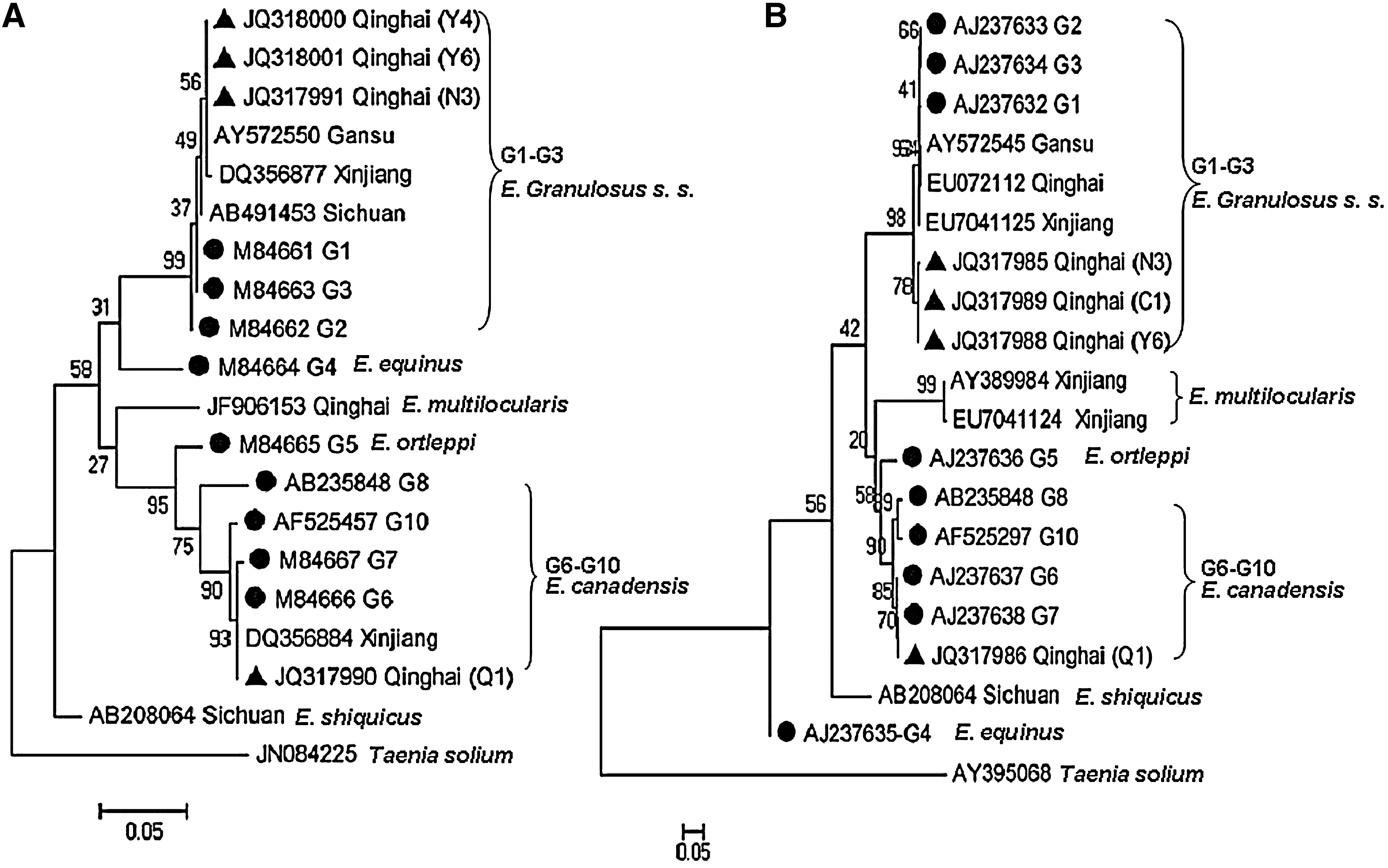
Phylogenetic tree showing the relationship between E. granulosus isolates from Yushu, Qinghai, China (C1, Y6, N3, and Q1) and previously described isolates based on the 366-bp fragment of the cox1 gene (
NA, Not available.
Consistent with previous studies (Li et al. 2008) the E. granulosus G1–G3 complex (E. granulosus sensu stricto) was most commonly detected in slaughtered animals in Yushu, Qinghai Province (93.3% of the 30 cyst isolates). Although only 2 isolates from goats were identified as the G6–G10 complex (E. canadensis), our preliminary data, for the first time, suggest that the E. granulosus G6–G10 complex (E. canadensis) is not only limited to Xinjiang. Therefore, the E. granulosus G6–G10 complex (E. canadensis) might be of greater public health significance than previously believed. Further studies are necessary to determine host specificity, geographical distribution, transmission dynamics, and infectivity to humans of this genotype in China. As the G1–G3 isolates detected in this study had distinct nucleotide differences from reference sequences of G1–G3 from other countries at both cox1 and nad1 loci, more studies are also needed to determine the true identity of these isolates from China and whether they represent yak-adapted E. granulosus sensu stricto.
Footnotes
Acknowledgments
We thank the staff of the Veterinary Stations in Yushu, Qinghai Province, China for collection of echinococcosis cysts. This study was supported by the National Basic Research Program of China (“973” Program) (2012CB722501).
Author Disclosure Statement
No competing financial interests exist.
References
Supplementary Material
Please find the following supplemental material available below.
For Open Access articles published under a Creative Commons License, all supplemental material carries the same license as the article it is associated with.
For non-Open Access articles published, all supplemental material carries a non-exclusive license, and permission requests for re-use of supplemental material or any part of supplemental material shall be sent directly to the copyright owner as specified in the copyright notice associated with the article.
