




Abstract
To gain insight into the strain(s) causing human cases of West Nile virus (WNV) infection in Greece in 2012, mosquitoes were collected and tested for probable WNV infection. WNV lineage 2 sequences were obtained from two of 14 Culex spp. pools collected in Xanthi Prefecture, and especially in the municipality with the highest incidence in Greece. As in the 2 previous years, the strain contains the H249P substitution in the NS3 protein. It seems that this specific strain is fully established in Greece and causes large-scale outbreaks. Thus, prevention and control measures have to be taken, while enhanced surveillance is needed.
Introduction
During August 6–22, 2012, CO2 traps were set in 12 sites of the Xanthi Prefecture, and especially in the two municipalities where the highest incidence of WNND cases was observed—Topeiros and Avdira (78.4 and 53.11 per 100,000 population, respectively) (Fig. 1). A total number of 595 Culex spp. mosquitoes were collected, 292 from the Topeiros municipality, and 303 from the Avdira municipality, grouped in eight and six pools, respectively. Using an RT-nested PCR with generic primers (Sanchez-Seco et al. 2005), a PCR product of the expected size was obtained from two pools of Culex spp. mosquitoes, both collected in Melissa Village, in the Topeiros municipality (Fig. 1). Sequencing of the PCR products gave the first evidence that the strain belonged to WNV lineage 2, whereas further application of a second PCR (Papa et al. 2012) showed that the sequences were identical with the respective ones of Nea Santa, Greece in 2010, thus containing the H249P substitution in the NS3 protein. The minimum infection rate (MIR) for the Topeiros municipality was estimated to be 6.84.
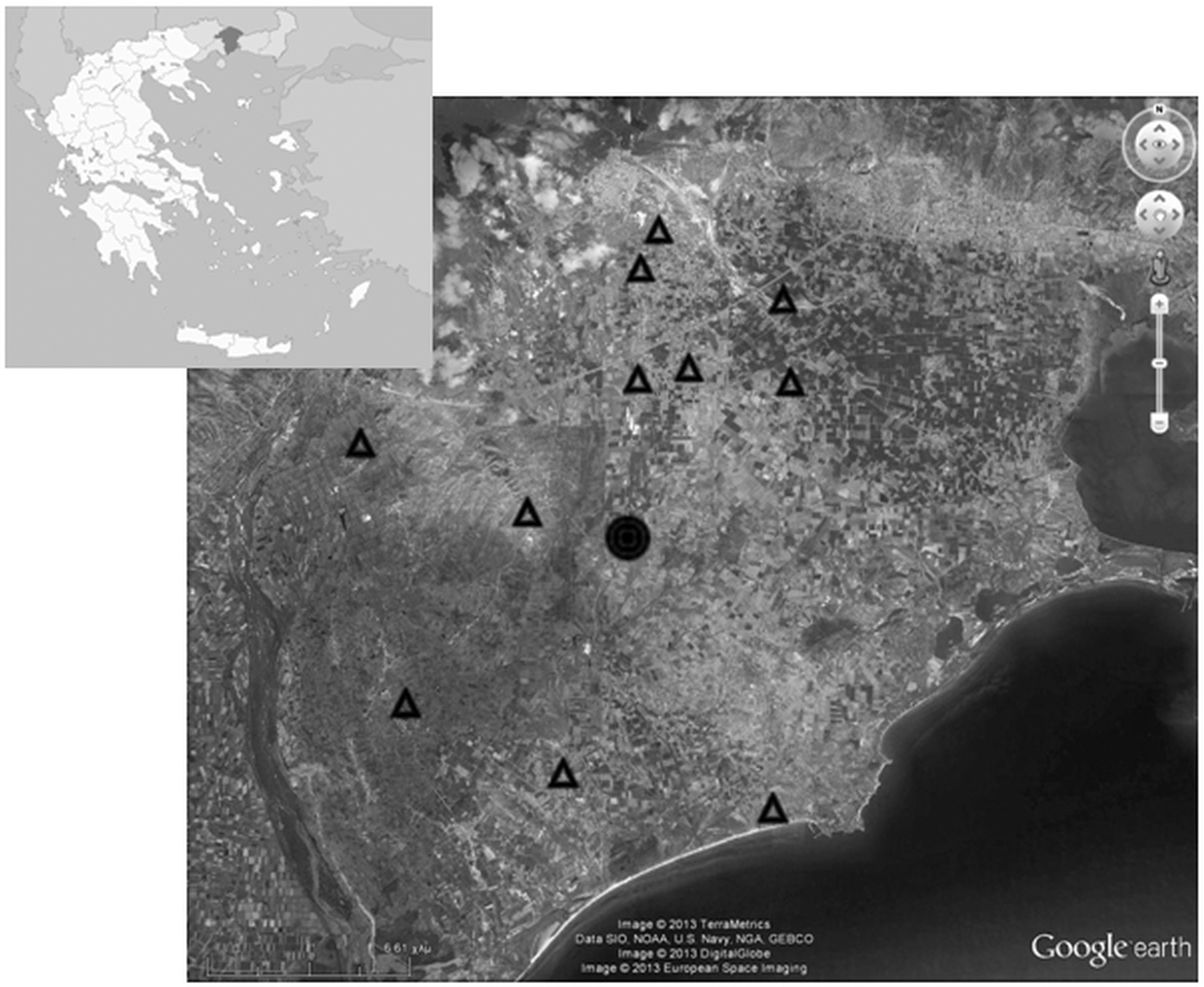
Locations (triangle) in Xanthi prefecture where the collection of the Culex spp. mosquitoes was performed. The location where the two WNV-positive mosquito pools were collected is indicated with a circle. The map of Greece is shown in the inset: the Eastern Macedonia and Thrace region is seen in light grey, with the Xanthi prefecture in dark gray.
As in the previous 2 years, the WNV strain detected in Culex mosquitoes in 2012 in Greece belongs to the lineage 2, and carries the H249P substitution, suggesting that this strain is established in Greece and has caused outbreaks every year since 2010. Because it seems that WNV is likely to remain of public health concern in the next years, prevention and control measures have to be taken and enhanced surveillance is needed.
Footnotes
Author Disclosure Statement
No competing financial interests exist.