




Abstract
During an outbreak of sheep anthrax in Basilicata, southern Italy, the owner of a flock located about 3 km away from the affected farm developed skin lesions attributable to cutaneous anthrax. The DNA extracted from the human scabs confirmed the diagnosis, and a 15-loci multiple locus variable number tandem repeat (VNTR) analysis (MLVA) following single-nucleotide repeat (SNR) analysis yielded the same genotype as that found in the dead sheep. The breeder, who had not had contact with infected or dead animals, reported having been stung by gadflies.
Case Report
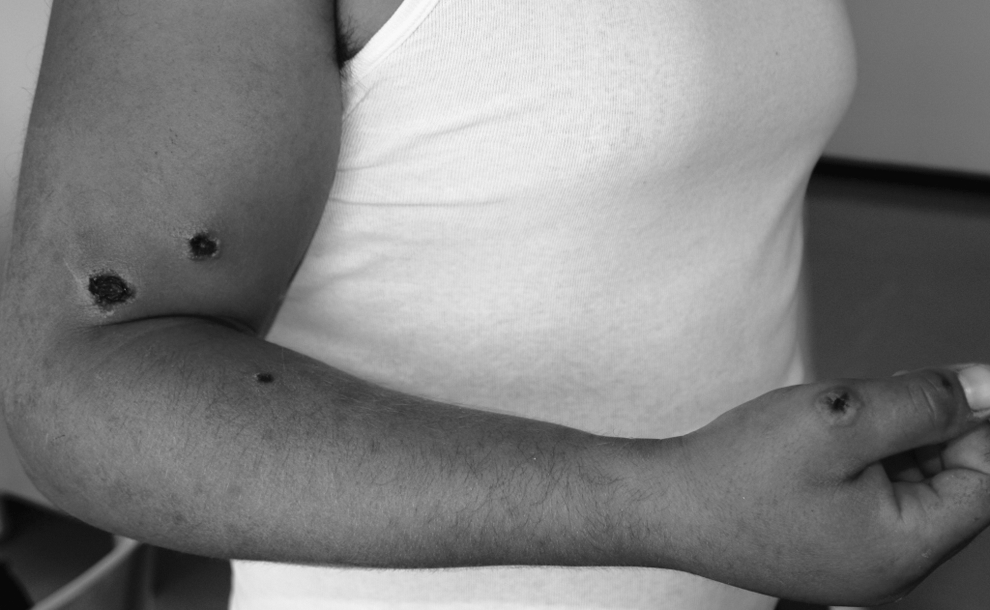
Young man with five necrotic eschar lesions on his right arm. The patient admitted that only after scratching the first lesion, which was very itchy, did he notice the other four.
The patient added that only after scratching the first lesion, which was very itchy, did he notice the other four. On August 29th, the day following hospitalization, two scabs 1 cm in length and 0.5 cm in width were removed from the patient's arm. Each scab was divided into two aliquots and homogenized with the aid of a scalpel. These were used for bacteriological and biomolecular testing, respectively. In addition, blood samples were collected from the two dead sheep during the autopsy. A semiselective medium, Trimethoprim, Sulfamethoxazole, Polymyxine, 5% Sheep Blood (TSMP) agar, was used for isolation. The bacterial cultures performed on the human scabs remained negative, whereas those on sheep blood produced white, nonhemolytic colonies. DNAeasy Blood and Tissue kits (Qiagen) were used to extract both microbial DNA and DNA from the human scabs, following, respectively, the protocol for Gram-positive bacteria and the protocol for tissue. DNAs were subjected to PCR using anthrax-specific pXO1 and pXO2 plasmids and chromosome (Fasanella et al. 2001). A 15-loci multiple locus variable number tandem repeat (VNTR) analysis (MLVA) was performed to define genetic relationships (Van Ert et al. 2007), followed single-nucleotide repeat (SNR) analysis to increase the likelihood of differentiating closely related isolates, as described by Kenefic et al. (2008).
PCRs on DNAs extracted from both suspect colonies and human scabs were positive for Bacillus anthracis, with matching MLVA and SNR patterns. This, coupled with the fact that the patient was bitten during the period that elapsed between the first and the second case of anthrax-related death in sheep, suggests that the human case was strictly correlated with the animal outbreak. In addition, no other outbreaks in livestock were reported in the area. The negative bacteriological result obtained from the human scabs could be attributed to the well-established difficulty to isolate B. anthracis from skin lesions once the patient has started antibiotic therapy (Stefos et al. 2012). It is, however, possible to make a diagnosis by PCR on DNA extracted from scabs up to the second day of antibiotic treatment.
Discussion
Human cutaneous anthrax is often associated with the slaughter of infected animals (Chakraborty et al. 2012a, b). We report here a case of suspect vector transmission of human cutaneous anthrax during an anthrax outbreak in animals. Basilicata is the Italian region at highest risk of anthrax (Fasanella et al. 2010, Palazzo et al. 2012). Between August 28th and September 27th, 2011, 28 outbreaks of anthrax were recorded in an area covering 50 km2 in the regions of Basilicata and Campania. Over 60 animals belonging to different species developed a subacute form of anthrax and died.
Laboratory studies have shown, using mouse and guinea pig models, that stable flies Stomoxys calcitrans and Aedes aegypti and Aedes taeniorhyncus mosquitoes are able to transmit the infection. The percentage of transmission is very low (about 17% in the flies and 12% in the mosquitoes), but it is suspected that when the insect population density is high, they could be an important vehicle in the spread of the disease (Turell and Knudson 1987). The role of tabanid Haematobia irritans in the spread of the disease had been confirmed in two old scientific papers (Mitzmain 1914, Morris 1920). Recently, Blackburn et al. (2010) isolated B. anthracis from flesh-eating flies and demonstrated the importance of this kind of insects with a wildlife anthrax outbreak in North America and the potential role in anthrax epizootics. Moreover the hypothesis that blood-sucking insects such as tabanids (gadflies or horse-flies) can play an important role in spreading diseases of livestock and other animals is widely accepted (Krinsky 1976).
This case study supports the hypothesis that human cutaneous anthrax may be transmitted by tabanid vectors. Although we are unable to prove beyond doubt that the tabanid transmitted the disease to the farmer after sucking blood from one of the dead sheep, this seems very likely because the sheep's blood and the patient's scabs yielded the same subgenotype, in a geographical context in which many subgenotypes of B. anthracis are known to be present (Garofolo et al. 2010). Another interesting aspect emerging from the present case study is the possibility that, through scratching, anthrax bacteria may have been transported from an initial lesion to other sites where new lesions developed. A similar case was reported by Kumandas et al. (2007), which showed a human genital infection associated with touching of genitals after interacting with the saliva of a cow and not washing hands afterward.
Close cooperation between medical and veterinary professionals, such as that which produced the present case study, could improve the diagnosis and control of anthrax. Medical alerts during animal anthrax outbreaks, for example, can facilitate the diagnosis of skin lesions due to anthrax in the human population and also, as sick and dead animals are not always observed and reported, a medical alert can warn the veterinary services of an active anthrax outbreak in livestock. In addition, molecular biology techniques have proven useful for the diagnosis of anthrax in scabs, and their application in clinical contexts should be considered.
Footnotes
Acknowledgments
The authors thank Frencesco Tolve and Michela Iatarola for technical support.
Author Disclosure Statement
No competing financial interests exist.