




Abstract
West Nile virus (WNV) is a mosquito-borne virus belonging to the family Flaviviridae included in the Japanese encephalitis antigenic complex (JEAC). A seroepidemiological study was carried out in 2011 using 160 horse sera collected from different areas of Bolivia to investigate the presence of WNV antibody. A high proportion (59.4%) of the tested sera were positive to a commercially available WNV competitive enzyme-linked immunosorbent assay (C-ELISA). Sixty-six randomly selected C-ELISA-positive sera were further tested by WNV plaque reduction neutralization test (PRNT), virus neutralization (VN), and immunoglobulin M (IgM)-WNV ELISA to exclude false-positive results due to possible cross-reactions to other members of the JEAC and to investigate if the horses were recently infected. No WNV IgM was detected in these samples, whereas neutralizing antibodies were found in 21 and 18 samples by PRNT and VN, respectively. In conclusion, a high proportion of the Bolivian horses included in this study reacted serologically against viruses of the JEAC. WNV was partially responsible (31.8%) for these reactions, supporting the conclusion that WNV circulated in Bolivia.
Introduction
W
Materials and Methods
During July, 2011, a convenience sampling of 160 horse sera was conducted; the sera were randomly selected among those sent to LIDIVET (St. Cruz, Bolivia) to be subjected to a Coggins test for equine infectious anemia control program. Sera were tested for the presence of WNV antibodies by a commercially available competitive enzyme-linked immunosorbent assay (C-ELISA) (ID screen West Nile competition, IDvet Innovative Diagnostics, Montpellier, France). Horses were located in the Departments of St. Cruz, Beni, and Tarija. No information was available on vector-borne infection risk factors. The C-ELISA kit was designed to detect multispecies antibodies directed against an epitope of envelope E protein common to WNV and other members of the JEAC. Sixty-six out of 95 C-ELISA–positive sera, randomly chosen, were subsequently sent to the Istituto zooprofilattico sperimentale (IZS) of Teramo (Italy) to be tested for the presence of IgM and WNV neutralizing antibody. These sera belonged to horses located in the following provinces: Andrés Ibanez, 44; Velasco, 6; Florida, 2; Chiquitos, 5; Nuflo de Chavez, 4; Wames, 1; Marban, 3; Gran Chaco, 1. The presence of IgM was detected by the IgM-WNV ELISA (IDEXX, Montpellier, France). C-ELISA and IgM-WNV ELISA were performed and interpreted according to the manufacturer's instruction.
For the detection of WNV-specific neutralizing antibody, the sera were tested by the plaque reduction neutralization test (PRNT) and virus neutralization test (VN) in microtiter plates, using WNV strain Eg-101 kindly supplied by the Unité des Arbovirus et des Fièvres Hémorragiques, Institut Pasteur, Paris (France).
Two-fold serial dilutions of heat-inactivated sera were mixed with an equal volume of 100 median tissue culture infective dose (TCID50) of virus to perform the VN assay. After an incubation at 37°C for 1 h, Vero cells were added to the wells. Plates were read after 6 days of incubation at 37°C. The antibody titer was defined as the reciprocal of the highest serum dilution, which showed at least 90% neutralization.
The PRNT procedure to detect WNV antibodies was performed as described by the OIE Manual of Standards (World Organisation for Animal Health 2012). The titer was determined as the reciprocal of the highest serum dilution with a 90% reduction of the number of plaques (PRNT90). For both the aforementioned tests, sera with a titer ≥10 were considered positive. To ascertain the concordance between PRNT and VN assays, the K measure of agreement (Cohen 1960) was calculated.
Results
Ninety-five out of 160 tested sera (59.4%, 95% confidence interval [CI] 51.8–67.0%) were positive via C-ELISA. None of the 66 randomly selected C-ELISA–positive sera were positive to the IgM-WNV ELISA, whereas 21 and 18 of the same panel of sera tested positive, respectively, to WNV PRNT and VN with titers ranging from 10 to 80. The K measure of agreement between PRNT and VN was 0.926. All of the sera negative to PRNT were negative also to VN, and only three sera were positive to PRNT at titers of 10, giving a result just below the cutoff at VN. The frequency distribution of titers to WNV PRNT and VN is shown in Table 1. Figure 1 shows the geographical location of horses positive to WNV PRNT on a map on which the average of Bolivian annual rainfall is also reported.
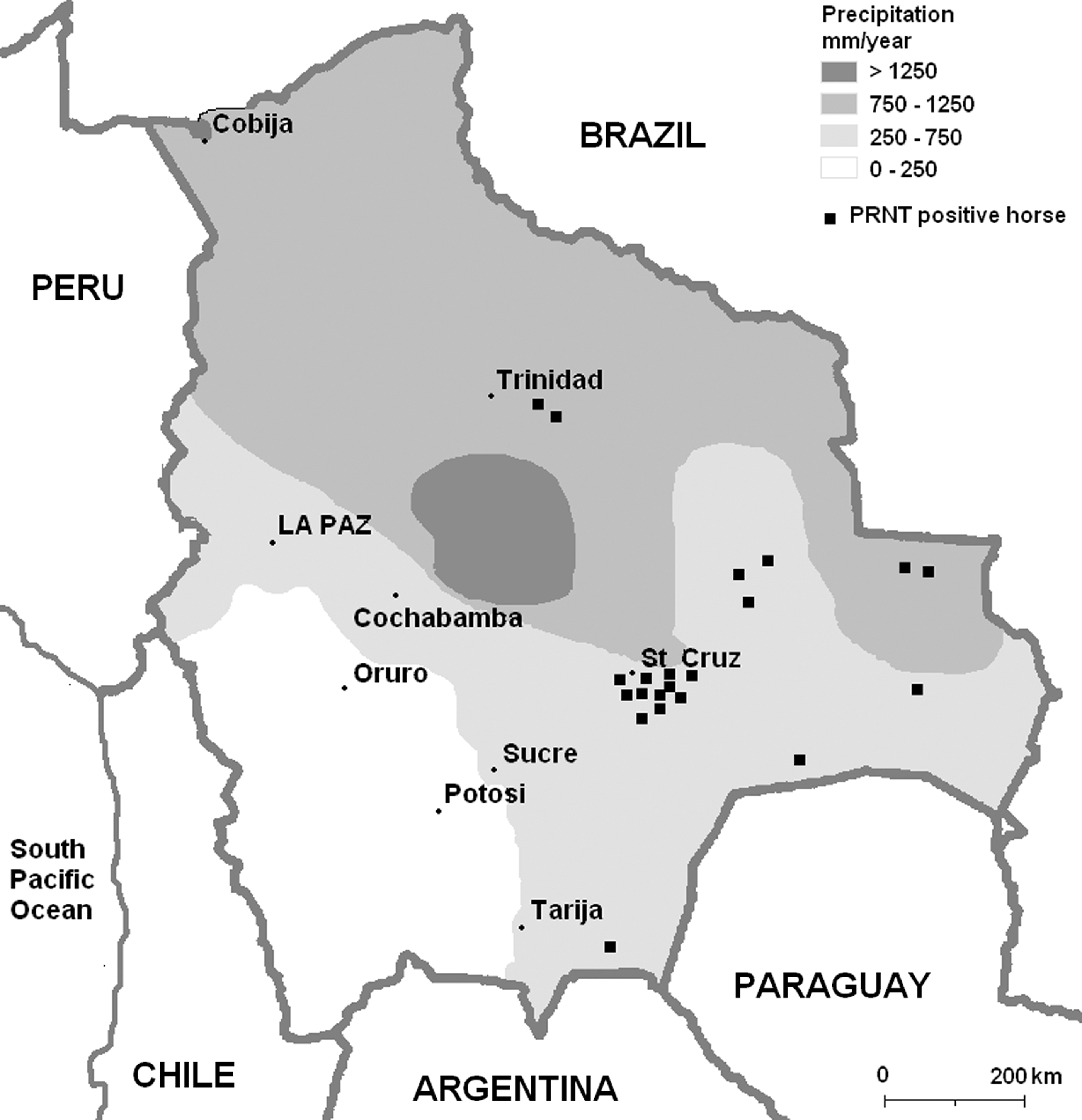
Geographical location of horses positive to West Hile virus (WNV) plaque reduction neutralization test (PRNT) on Bolivian annual rainfall a map.
Titers were determined as the reciprocal of the highest serum dilution with a 90% reduction of the number of plaques (PRNT90) or neutralization (VN90).
WNV, West Nile virus; PRNT, plaque reduction neutralization test; VN, virus neutralization.
Discussion
A high proportion of the tested horses were found positive to C-ELISA. The C-ELISA kit, although designed to detect antibody against WNV, suffers from low specificity due to cross-reactions with other members of the JEAC. Therefore, according to these findings, a high number of sera reacted against JEAC viruses. Nevertheless, more than one-third of the selected horses showed specific WNV neutralizing antibodies. The high specificity of PRNT and VN, also confirmed by their high concordance, provides evidence that these horses experienced WNV infection. The infections were not recent because no IgM-specific antibodies were detected. Horses with WNV neutralizing antibodies were located mainly in some provinces of the St. Cruz Department. These data clearly reflect the bias of sampling and therefore cannot be used for prevalence estimates. Nevertheless Figure 1 shows that these horses were located in areas with climatic conditions suitable for transmission of viral diseases by mosquito vectors. Positive results to C-ELISA not confirmed by PRNT and VN might be due to SLEV a virus already detected in Argentina (Tauro et al. 2012), or other viruses belonging to JEAC, detected also in Equador and Brazil (Johnson et al. 2007, Medeiros et al. 2007).
Conclusions
Considering that WNV and most viruses of the JEAC have zoonotic potential and may have an impact on public health, we think that these preliminary results should be taken into consideration by Bolivian health authorities. It will be important to start a long-term surveillance system for vector-borne infections to define and understand the epidemiology of WNV and of others JEAC members in Bolivia and to better evaluate their impact in public health. This should be achieved by different coordinated actions: (1) Serological surveys based on probability sampling designed to have information on the prevalence estimates in different areas and species; (2) specific virological analysis followed by viral identification on vectors and vertebrates; and (3) active data collection on suspected cases of disease followed by laboratory investigation.
Footnotes
Acknowledgments
We thank the staff of LIDIVET for providing assistance in obtaining the samples. The work was partially granted by the University of Pisa and by the Italian Ministry of Foreign Affairs (Project “Fortalecimiento de la red de salud en el Chaco Boliviano”, 2009).
Author Disclosure Statement
No competing financial interests exist.