




Abstract
Sindbis virus (SINV) is an arbovirus that causes clinical symptoms, including arthritis, rash, and fever during acute human infections. In Europe, SINV outbreaks are largely restricted to northern Europe. Intrigued by the isolation of SINV from mosquitoes in southwestern Germany in 2009, we initiated a passive arbovirus-monitoring program in birds and analyzed a total of 685 samples. By this approach, we were able to detect a SINV in a Hooded Crow in Germany for the first time. It was possible to isolate SINV virus in cell cultures and even to visualize virus particles by electron microscopy. After the determination of the complete SINV genome sequence, the phylogenetic analysis revealed its close relationship to SINV genotype I sequences previously obtained from mosquitoes in Germany and Scandinavia. This first report on the isolation of viable SINV indicates the potential involvement of crows in an enzootic circulation of SINV in Germany and Central Europe.
Introduction
S
In the past, autochthonous human SINV infections were not reported in Germany (Jost et al. 2011). However, SINV-specific antibodies were detected in blood donors from southwestern Germany and SINV was isolated from mosquitoes from the same region (Jost et al. 2010, Jost et al. 2011). In the present paper, we report the first isolation of SINV from a Hooded Crow found injured in the city center of Berlin in 2010. The isolate was passaged in cell culture and characterized by electron microscopy as well as by phylogenetic analyses following complete genome sequencing.
Material and Methods
A total of 685 samples from migratory and resident birds were collected in the period 2007–2010 in the context of a national surveillance study for West Nile virus (WNV) in Germany (Seidowski et al. 2010). The samples were stored at −70°C and processed individually. Detailed data for real-time RT-PCR, virus isolation, virus neutralization test, and electron microscopy are found in the Supplementary Methods section (Supplementary Data are available at
Results and Discussion
RNA was isolated from wild and migratory bird cruor samples and subsequently analyzed with a SINV specific quantitative real-time RT-PCR (Jost et al. 2010). Only one of 685 samples gave a positive signal for SINV that belonged to a Hooded Crow (Corvus corone cornix), which was found injured at the bottom of a tower building in Berlin on August 28, 2010. It suffered from a debris fracture of the humerus and therefore was euthanized. The animal was well nourished (420 grams) and did not show any clinical signs otherwise. Blood was drawn from it before euthanasia.
For virus isolation, clarified supernatants of the cruor sample homogenate were used to inoculate cell monolayers. Subsequently, cells displayed a cytopathic effect (CPE) after 4 days postinfection (dpi). In the cell culture sediments, numerous typical alphavirus particles with distinct surface projections were found. The examination of ultrathin sections revealed the presence of characteristic cytoplasmic alphavirus nucleocapsid particles, budding at the cell membrane, and mature virus particles at the cell surface (Fig. 1A, B). The complete genome of the initial SINV isolate was generated (accession no. JX570540) by sequencing 20 overlapping fragments (primer sequences are available from the authors). The Bayesian phylogenetic tree was constructed with 18 SINV full genome sequences representing SINV genotypes I, II, IV, and V. Aura virus was used as an outgroup.
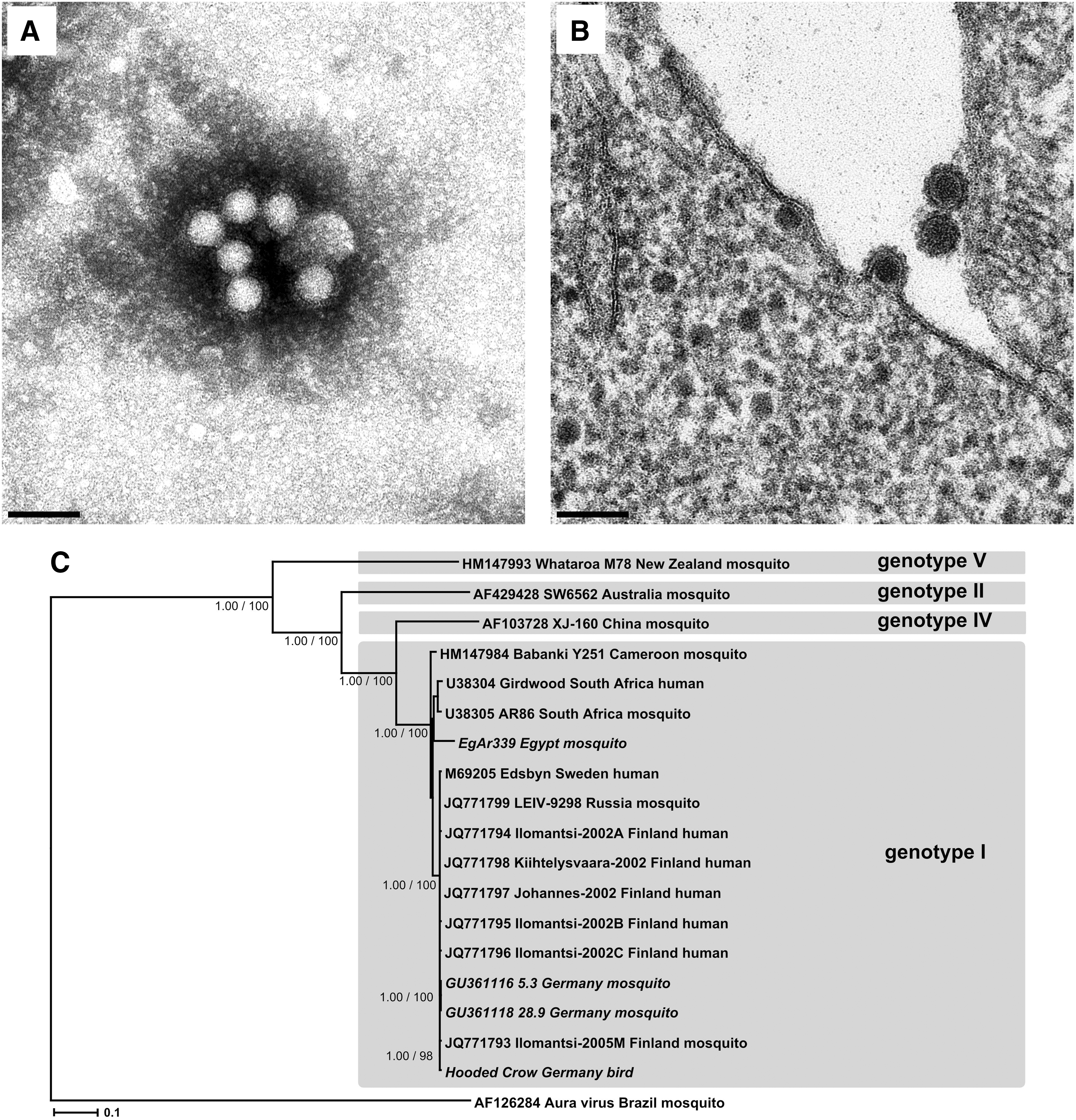
Alphavirus particles in the cell culture supernatant after negative staining with phosphotungstic acid
The data demonstrate that the SINV strain isolated from a Hooded Crow in Germany clusters within SINV genotype I and there is a close relationship to sequences from Finland, Sweden, and Russia (Fig. 1C). Interestingly, the phylogenetic network based on SINV genotype I sequences indicates a close relationship of the Hooded Crow strain with the Finnish strain Ilomantsi-2005M detected in a mosquito in 2005 (Fig. S1). In contrast, the two German SINV mosquito strains 5.3 and 28.9 detected in Germany in 2009 cluster with two human Finnish strains from 2002 (Fig. S1). A similar clustering of the Hooded Crow strain to the Finnish strain Ilomantsi-2005M is found when a phylogenetic analysis from the nucleotide sequence of the structural polyprotein region was carried out (Fig. S2). The alignment of the deduced amino acid sequence of the nonstructural protein nsp3 showed differences of 16 amino acids compared to German mosquito isolates, but only four to a human isolate from Finland. (Fig. S3).
In summary, the separate clustering of the German crow and mosquito strains suggests the circulation of different SINV strains in Germany and their possible introduction by additional avian species. The isolation of SINV from a crow in the eastern part of Germany highlights the role of short-range migratory birds in the spread of SINV in Germany because the infected animal was found more than 600 km away from the Upper Rhine valley where SINV was isolated once from mosquitoes in 2009 (Jost et al. 2010). To evaluate the circulation of the virus within the crow population, 39 crows from this study as well as 12 additional crows from 2011 were tested for SINV-neutralizing antibodies. Only two out of the 51 crow sera exhibited SINV-neutralizing antibodies, which derived from specimens from 2010 and 2011, and displayed virus neutralization test (VNT) titers of 30 and 10, respectively. The viremic crow was antibody negative.
A broader distribution in central Europe is supported by SINV antibody prevalence rates in humans and animals from Austria, Belarus, Czech Republic, Slovakia, Poland, Germany, and also in the United Kingdom (Hubalek 2008). The SINV isolate belongs to genotype I, which is exclusively distributed in Europe and Sub-Saharan Africa and includes SINV strains from Finland and Sweden that cause Pogosta and Ockelbo diseases, which might be more pathogenic to humans than other genotypes (Lundstrom and Pfeffer 2010).
Experimental data on SINV infections for avian species are sparse, if not absent. Experimental transmission studies may be helpful to determine the SINV virulence and pathogenesis in crows and other potential amplifying hosts. In general, the role of crows in distributing zoonotic viruses should be elucidated in more detail, since another emerging virus, WNV, was isolated in Sardinia in 2012 from Carrion Crows (Corvus corone corone) (Savini et al. 2013). Moreover, studies in South Africa showed that both SINV and WNV display similar transmission cycles involving avian hosts and Culex mosquito vectors (Uejio et al. 2012).
Therefore, the potential for crows, especially of the species Corvus corone, to transmit SINV and probably induce local SINV virus activity should be further evaluated. Future work should be undertaken to monitor potential resident reservoir species as well as the maintenance of virus transmission and to assess the dynamics and interactions among the pathogen, vectors, and environment.
Footnotes
Acknowledgments
This study was partially funded by European Union grants FP7-261504 EDENext (catalogued by the EDENext Steering Committee as EDENext158 (
Author Disclosure Statement
No competing financial interests exist.
References
Supplementary Material
Please find the following supplemental material available below.
For Open Access articles published under a Creative Commons License, all supplemental material carries the same license as the article it is associated with.
For non-Open Access articles published, all supplemental material carries a non-exclusive license, and permission requests for re-use of supplemental material or any part of supplemental material shall be sent directly to the copyright owner as specified in the copyright notice associated with the article.
