




Abstract
Since 2007, a canine leishmaniasis (CanL) surveillance program has been carried out in public kennels of the Emilia-Romagna region with the aim of providing health guarantees for dog adoptions. According to this program, monitoring activities were performed to verify the presence of sandflies and infected dogs, and a specific CanL risk class was assigned to each kennel, resulting in different control approaches (entomological and/or serological monitoring, clinical surveillance, therapeutic treatment of infected dogs, protections against vector bites). From 2007 to 2012, 20,931 dogs, 89.8% of which were identified by microchip and housed in 73 kennels, were examined using an indirect fluorescent antibody test. In all, 528 (2.8%) dogs tested positive, and 43.0% of these were asymptomatic. The authors used monitoring results, in particular serological tests performed on dogs at admittance to the kennel and annual controls of sentinel dogs, to estimate CanL risk in the whole region and to evaluate the efficacy of the preventive measures adopted. CanL seroprevalence in dogs tested at the admittance in kennels increased significantly from 2010 (1.0%; 29/2858) to 2012 (2.4%; 69/2841). In contrast, the number of seroconversions in sentinel dogs was stable in 2010 (1.2%; 11/896) and 2011 (1.6%; 13/825) and decreased in 2012 (0.9%; 8/850), suggesting the efficacy of the preventive measures applied.
Introduction
L
Phlebotomine sandflies are the biological vectors and transmit the pathogen to vertebrate hosts: in Italy, the main competent vectors of CanL are Phlebotomus perniciosus and P. perfiliewi; in northern Italy, P. neglectus is also regarded as being a competent vector of L. infantum (Capelli et al. 2004, Maroli et al. 2008). CanL is now endemic in most parts of Italy. The last decades have been characterized by a northward spread of the infection toward areas previously regarded as nonendemic (Maroli et al. 2008, Biglino et al. 2010), because infection spreads rapidly and extensively among the exposed dog population when environmental conditions allow vector activity (Baneth et al. 2008).
In Emilia-Romagna (ER), a region of northern Italy, leishmaniasis has been reported repeatedly in both dogs and humans, representing a concern for veterinary medicine and public health (Pampiglione et al. 1974, Baldelli et al. 2001, Mollicone et al. 2003). Thus, a regional surveillance program on leishmaniasis was started in 2007 within a wider plan focused on vector-borne diseases (Venturi et al. 2009). According to this program, serological and entomological monitoring were performed to verify the presence of phlebotomine sandflies and infected dogs in all regional public kennels. On the basis of the results of this monitoring, a specific CanL risk class was assigned to each shelter, resulting in different control approaches. Besides active surveillance in kennels, the regional program includes a passive surveillance protocol on owned dogs and, when a human autochthonous CL/VL case occurs, the application of specific control measures in the area encompassing the patient residence. In fact this surveillance program requires the collaboration of Official Veterinary Services, private sector veterinarians, Universities of Veterinary Medicine, and Public Health Services (Tamba et al. 2008).
In this paper, we used the results of the monitoring activities carried out in the kennels to estimate CanL occurrence in the whole region and to evaluate the efficacy of the preventive measures adopted in these structures.
Materials and Methods
Population
In the period 2007–2012, all of the 73 public kennels, which were distributed throughout the whole region, were gradually put under surveillance. Each shelter housed stray dogs captured nearby or in the territory of other municipalities that had formalized a specific contract with the kennel, as required by the Italian legislation (Law n. 281/1991). The number of dogs housed in the public shelters was not stable. The population varied due to the admission of abandoned or roaming dogs and to the transfer of adopted animals. At the end of 2012, about 8076 dogs were housed in the kennels. Depending on the presence of infected dogs and/or vectors, kennels were classified in four risk classes (Fig. 1). For each class, different control approaches and monitoring activities were defined: Clinical surveillance, entomological monitoring, serological monitoring, periodic control of sentinel dogs, therapy on infected animals, and the use of individual antivector measures, such as pyrethroid-impregnated bands or spot-on formulations.
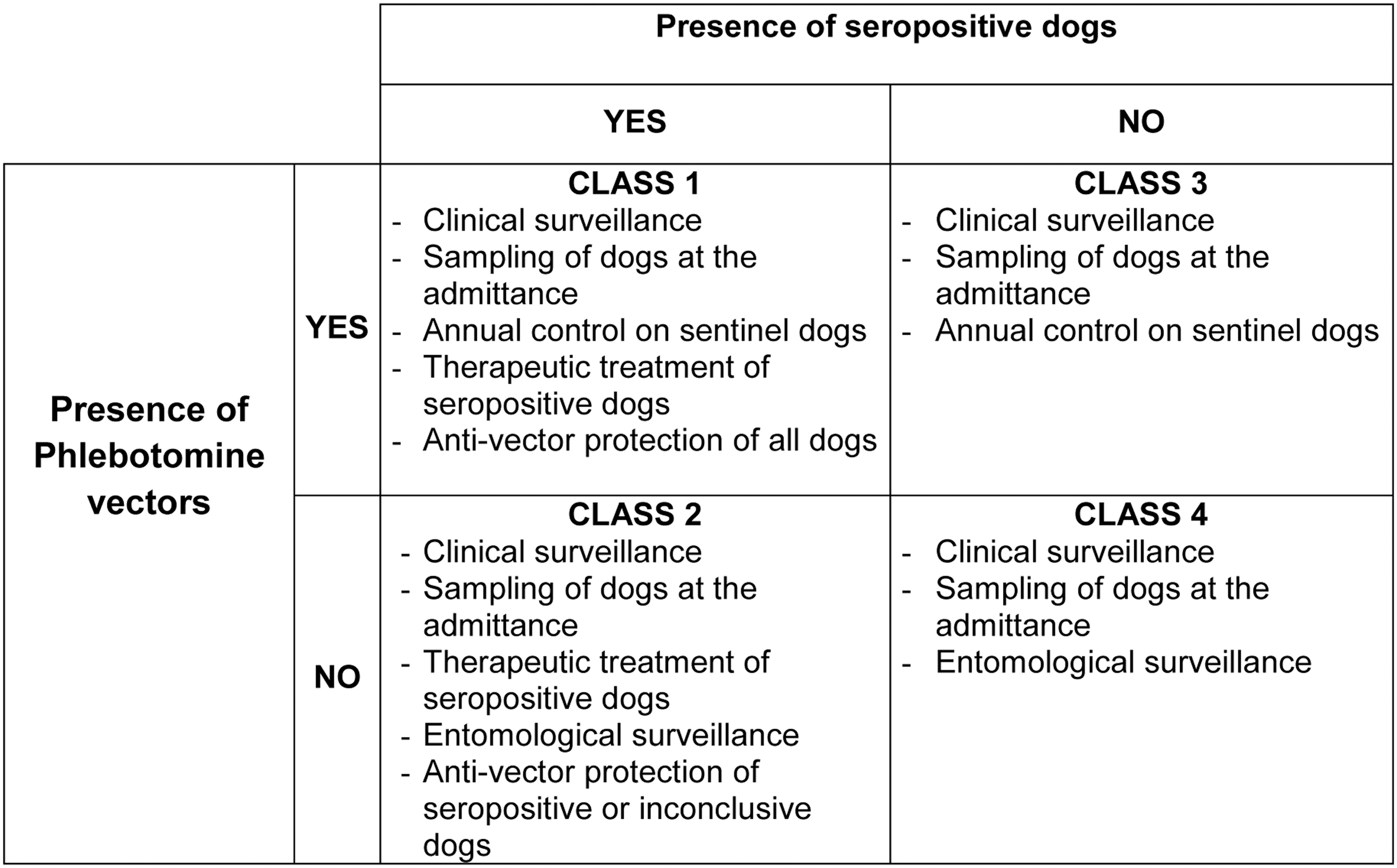
Risk-based classification of kennels and related surveillance activities.
Entomological monitoring
From 2007 to 2009, phlebotomine sandflies were collected fortnightly using sticky traps; captures were performed from the beginning of June to the beginning of October. Sampling stations, individually geo-referenced and identified by a reference code, were positioned in three specific sites for each kennel; at least eight sticky traps were set in each site of sampling. Since 2010, monitoring efficacy was improved by also using a CDC miniature light trap set in a single site in each shelter (Calzolari et al. 2012).
Samples were refrigerated and delivered within the shortest possible time to the entomological laboratory, accompanied by a specific sampling form. The entomological surveillance was no longer performed in kennels once the presence of the vector was finally confirmed.
For species identification, phlebotomine sandflies were cleared in lacto-phenol and chlorine (3–4 days at room temperature) and placed on microscope slides. Identification was carried out through observation under a microscope and examination of morphological details, such as pharynges, female spermatecae, and male genitalia (hypopygium), as suggested by Romi et al. (1994).
Serological monitoring
The monitoring activity started in 2007; all of the dogs housed were univocally identified by a microchip and tested for the presence of CanL antibodies. Testing was performed only in dogs older than 6 months. After the initial monitoring, all succeeding incoming dogs were identified and sampled for CanL at the moment of admittance to the shelter.
Since 2009, all of the public kennels were involved in the regional surveillance program. From 2010, it has been possible to estimate CanL prevalence in the whole region from serological test results of incoming dogs. Moreover, with the aim to detect possible seroconversions and to assess the efficacy of the preventive measures, every year a sample of sentinel dogs, which are correctly identified dogs that tested negative at least once, has been enrolled in each kennel where the presence of vectors and/or infected dogs was previously proved.
All blood samples were analyzed by an indirect fluorescent antibody test (IFAT), according to the laboratory procedures described in the OIE Manual of Diagnostic Tests and Vaccines for Terrestrial Animals; the test has a sensitivity of 96% and specificity of 98% (OIE 2008). Promastigotes of L. infantum were used as antigen and the cutoff was set at 1/40. As defined by national guidelines (Gradoni et al. 2004), dogs with an IFAT titer of 1/40 or 1/80 were considered inconclusive and had to be retested at least 6 months later. Animals that showed titers ≥1/160 were considered infected. All tests were performed in the same laboratory.
Prevalence estimation
To estimate the prevalence of CanL in Emilia-Romagna (ER), only dogs univocally identified with a microchip and subjected to the first blood sampling at the time of the admittance to the shelter were considered. The prevalence was calculated as the proportion between the number of seropositive dogs (IFAT titer ≥1/160) per year and the number of sampled dogs per year, during the period 2010–2012. Dogs with inconclusive IFAT results or with certain extraregional origins were not considered in the estimation procedure.
Anamnestic information
At the moment of sampling, a questionnaire was filled in for each incoming dog to collect information about the probable district of origin, age, microchip number, and possible clinical signs of CanL. The data were recorded in a database (MS-Access).
Results
Entomological surveillance
Entomological surveillance detected the presence of P. perfiliewi and/or P. perniciosus in 46 of the 73 (63.0%) monitored kennels. P. perfiliewi was detected in 32 shelters, P. perniciosus in five, and both species in nine sites. This activity, complemented by a literature review (Portolani et al. 2002; Francisci et al. 2003) and data collected in other surveys (Calzolari et al. 2012), allowed a preliminary evaluation of the phlebotomine sandflies distribution in ER (Fig. 2).
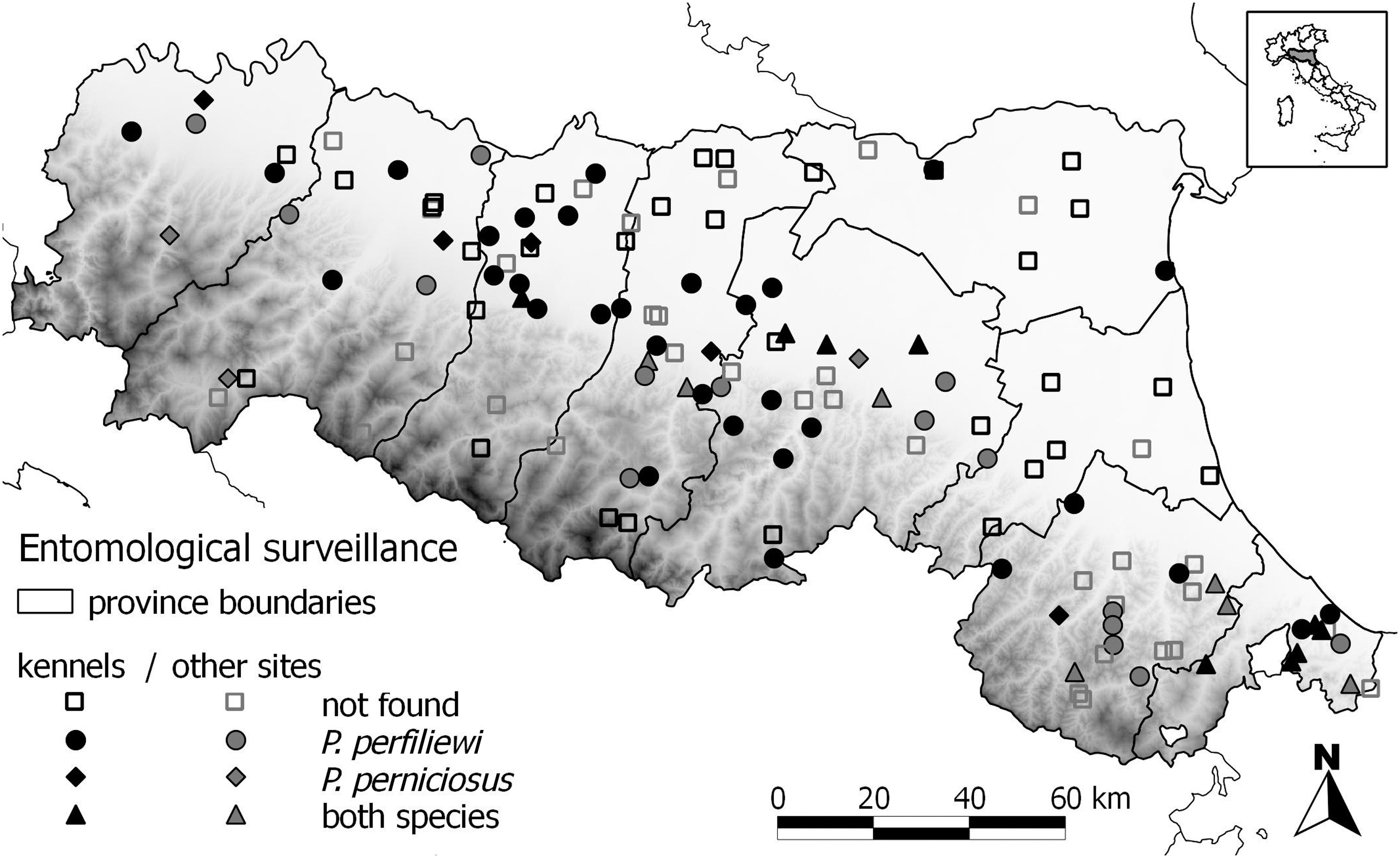
Entomological surveillance: Distribution of canine leishmaniasis (CanL) sandfliy vectors in Emilia-Romagna.
Serological monitoring
The gradual recruitment of kennels for this survey was carried out during the period 2007–2009 and was completed in 2009, when all the kennels of the region were part of the program. At the end of 2012, the regional database gathered IFAT data on 20,931 dogs, of which 18,806 (89.8%) were identified by microchip. The number of serological controls performed year by year is shown in Table 1. From 2007 to 2012, a total of 528 (2.8%) out of the 18,806 identified dogs housed in the regional kennels tested seropositive for CanL.
IFAT, indirect fluorescent antibody test.
Prevalence estimation
From 2010 to 2012, the annual prevalence was estimated using the results of IFAT carried out on 8267 dogs sampled at the admission to the kennel. Prevalence values recorded in 2010, 2011, and 2012 were 1.0% (29/2858, 95% confidence interval (CI) 0.7–1.5%), 1.6% (41/2568; 95% CI 1.2–2.2%), and 2.4% (69/2841; 95% CI 1.9–3.1%), respectively. The trend in seroprevalence increased significantly (chi-squared for trend=17.23, p<0.001; Fig. 3).
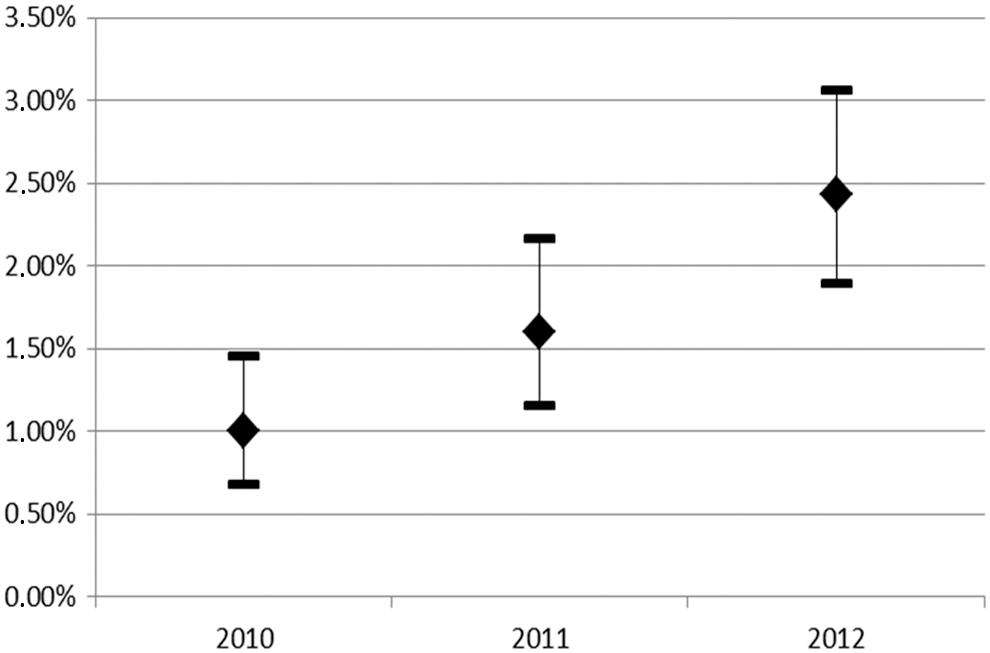
Canine leishmaniasis (CanL) prevalence in dogs tested at the admittance in kennel, years 2010–2012.
Seroconversions
A total of 32 seroconversions in 22 kennels were detected in the 3-year period (Table 2). Thirty-one seroconversions occurred in Class 1 (30) or Class 3 (1) kennels, where sandfly vectors presence was known, and only one seroconversion was recorded in a Class 2 kennel, where the vector presence was not proved yet. The majority of seroconversions (81.8%) occurred in kennels positioned below 200 meters of altitude, 13.6% in those located on hillside (200–600 meters of altitude), and just one (4.6%) above 600 meters, where P. perfiliewi was collected in 2009 (Fig. 4).
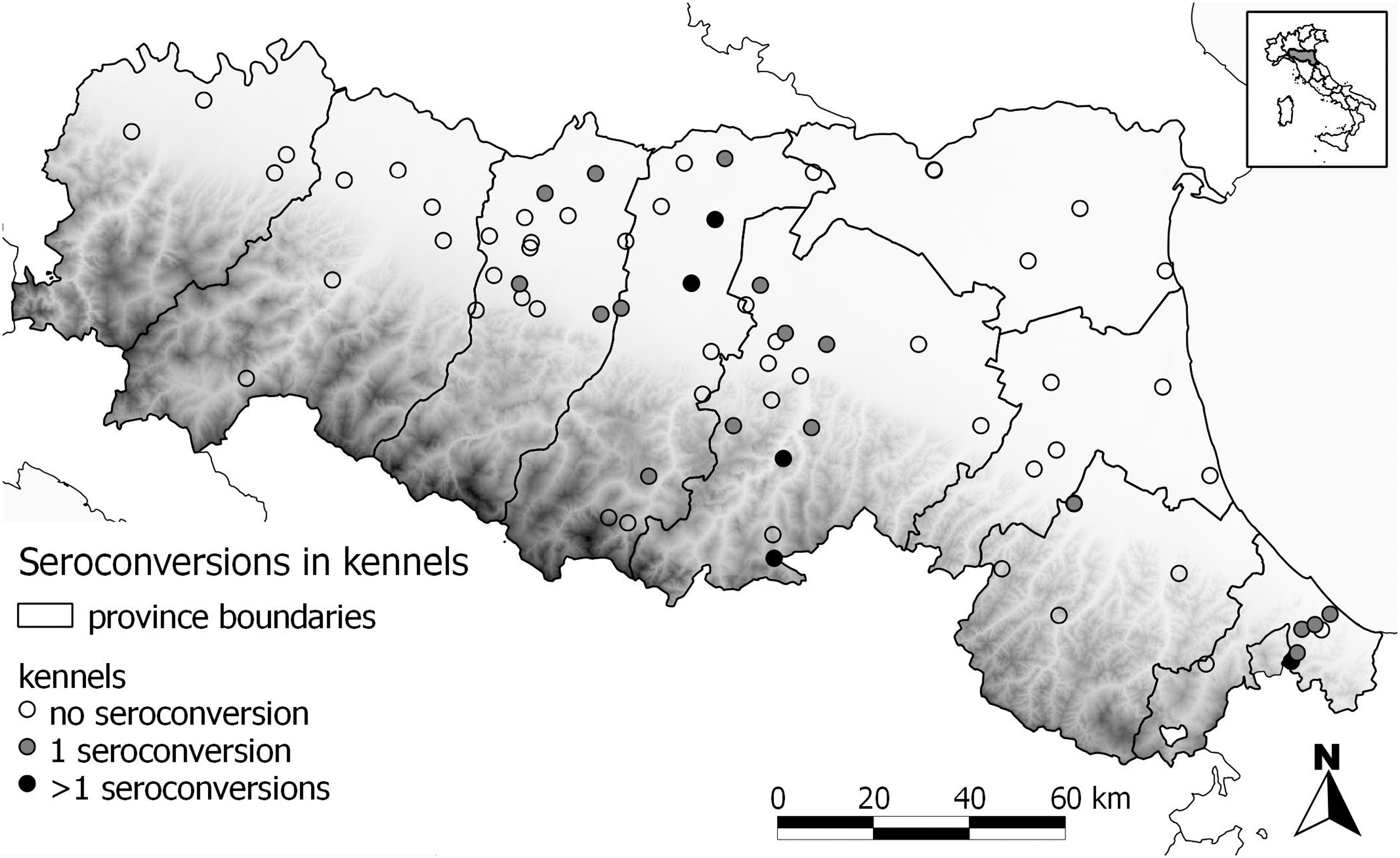
Distribution of kennels with seroconversions in sentinel dogs, years 2010–2012.
Anamnestic information
An anamnestic form was filled in for 381 out of 528 total seropositive dogs (72.2%). They indicated that 43.0% (164/381; 95% CI 38.0–48.2%) of these dogs were asymptomatic. The most frequent signs in dogs with clinical disease were cutaneous lesions (65.6%), lymphadenopathy (46.6%), onychogryphosis (17.8%), and ocular lesions (17.8%; Table 3).
Discussion
Serological monitoring has been carried out since 2007 and, to the best of our knowledge, this is the first multiyear surveillance program involving a whole region in Italy. Results from other surveys were in fact limited in space or time (Maresca et al. 2009, Podaliri-Vulpiani et al. 2009, Biglino et al. 2010, Galvez et al. 2010, Baldelli et al. 2011). During the last 3 years, CanL prevalence in dogs tested at the admittance in kennels has increased from 1.0% in 2010 to 2.4% in 2012. The identification of dogs using microchips has allowed an accurate estimation avoiding possible bias due to repeated testing of the same dog.
Prevalence values seem to be lower than those resulting from surveys conducted in other regions of northern Italy (Piedmont and Veneto) and in some endemic regions of central and southern Italy (Capelli et al. 2004, Maroli et al. 2008, Biglino et al. 2010). The increasing trend of prevalence suggests a gradual spread of CanL probably caused by a higher sandfly activity promoted by more favorable climate conditions, as suggested by other researchers (Podaliri Vulpiani et al. 2011). In fact, due to the universal distribution of the domestic reservoir and the mobility and frequent importation of infected dogs, the main limitation to CanL and zoonotic leishmaniasis transmission is the availability of competent vectors, whose distribution and density is thought to be highly dependent on temperature and relative humidity (Morosetti et al. 2009, Podaliri Vulpiani et al. 2009).
Results of the entomological surveillance carried out in ER suggest an increased vectors distribution over the whole regional territory, from hill to plain, updating the knowledge about distribution of the two species of phlebotomine vectors (Fig. 2). The most frequent species detected is P. perfiliewii, which is considered a less efficient vector than P. perniciosus but it is able to support the transmission of infection (Baldelli et al. 2001). In the whole region, P. neglectus has not been found yet, although its presence is confirmed in other regions of northern Italy, such as Piedmont, Lombardy, and Veneto (Maroli et al. 2002, Maroli et al. 2008). In our country, it is well known that a hilly environment is the most adequate habitat for the vector, but we have registered CanL occurrence also in plain areas, confirming the results reported by Baldelli et al. (2011).
The number of seroconversions registered in kennels was stable in 2010 and 2011 and decreased in 2012. Because of high turnover related to dog adoptions, only a few sentinel dogs have more than two IFA tests, so the use of seroconversion rate as a CanL incidence estimate might be unsuitable. Seventeen out of 32 (53.1%) seroconversions occurred in sentinel dogs that tested negative only once. It is possible that these animals, due to the long time between infection and seroconversion (Oliva et al. 2006), entered the kennel already infected. Nevertheless, against an increase in CanL prevalence in incoming dogs, a decreasing seroconversion rate suggests the efficacy of the preventive measures applied in high-risk kennels and confirms the results obtained in a single dog pound by Podaliri Vulpiani et al. (2009).
Clinical signs observed in dogs with clinical CanL are comparable to those reported by other authors (Baneth et al. 2008, Cortes et al. 2012). However, asymptomatic and symptomatic dogs play a role in the spread of infection, because they are both capable of infecting sandflies (Maroli et al. 2010, Gramiccia, 2011). Classifying the kennels depending on CanL risk factors (presence of infected dogs and/or vectors) should be a simple method for applying specific control measures in these structures. It seems appropriate to apply some preventive measures even if just one of the two risk factors considered is present; in fact, we detected a seroconversion in a kennel where vector presence had not been confirmed. However, the control measures proposed seem effective because while CanL prevalence is increasing in dogs newly admitted in the kennel, the yearly number of seroconversions is decreasing.
Conclusions
The surveillance program in kennels of the Emilia-Romagna Region consists of monitoring and prevention measures based on the risk of CanL transmission, with the aim of providing health guarantees for dog adoptions. Facing an increased seroprevalence, seroconversions in kennels are reduced by individual preventive measures against sandfly bites and systematic treatment of infected dogs. Therefore, it should be appropriate to suggest these control measures on a wider scale, extending them to owned dogs as well.
Footnotes
Acknowledgments
We wish to thank all the colleagues of official veterinary services who contributed for sampling and other surveillance activities. Funding for this work was provided by Emilia-Romagna Region.
Author Disclosure Statement
No competing financial interests exist.