




Abstract
Since 1998, Lyme disease cases have increased in south-central Pennsylvania, which includes Gettysburg National Military Park (NMP). Limited information is available about tick populations or pathogens in this area, and no data regarding frequency of tick bites or prevention measures among Gettysburg NMP employees are available. To address these gaps, ticks were collected, classified, and replaced (to minimize disruptions to tick populations) at two sites within Gettysburg NMP during April–September, 2009, among eight nonremoval samplings. On two additional occasions during May and June, 2009, ticks were collected and removed from the two original sites plus 10 additional sites and tested for tick-borne pathogens by using PCR. A self-administered anonymous survey of Gettysburg NMP employees was conducted to determine knowledge, attitudes, and practices regarding tick-borne diseases. Peak Ixodes scapularis nymph populations were observed during May–July. Of 115 I. scapularis ticks tested, 21% were infected with Borrelia burgdorferi, including 18% of 74 nymphs and 27% of 41 adults; no other pathogen was identified. The entomologic risk index was calculated at 1.3 infected nymphs/hour. An adult and nymph Amblyomma americanum were also found, representing the first confirmed field collection of this tick in Pennsylvania, but no pathogens were detected. The survey revealed that most park employees believed Lyme disease was a problem at Gettysburg NMP and that they frequently found ticks on their skin and clothing. However, use of personal preventive measures was inconsistent, and 6% of respondents reported contracting Lyme disease while employed at Gettysburg NMP. These findings indicate a need to improve surveillance for tick bites among employees and enhance prevention programs for park staff and visitors.
Introduction
T
During 2008, the year before this study commenced, a total of 3818 Lyme disease cases were reported to the Pennsylvania Department of Health, with the vast majority having illness onset during May–August (Pennsylvania Department of Health, unpublished data, 2009); in 2012, the year with the most recent available data, 4146 cases were reported (Pennsylvania Department of Health, unpublished data, 2013). In contrast, other tick-borne diseases are rarely reported in Pennsylvania, including two (2008 and 2012) cases of anaplasmosis (caused by Anaplasma phagocytophilum), zero (2008) and one (2012) case of Rocky Mountain spotted fever (caused by Rickettsia rickettsii), and zero (2008) and three (2012) cases of ehrlichiosis (caused by Ehrlichia chaffeensis and Ehrlichia ewingii). Although all of these infections are reportable by state regulation, underdiagnosis and underreporting are likely. The number of cases of babesiosis (caused by Babesia microti) and southern tick-associated rash illness (possibly associated with Borrelia lonestari) are unknown; these conditions are not reportable in Pennsylvania.
During 1998–2008, Lyme disease cases in Pennsylvania were increasingly reported beyond the endemic southeastern region, extending to the central and western regions of the state (Pennsylvania Department of Health, unpublished data, 2009). The westward spread of Lyme disease includes Adams County, located in south-central Pennsylvania and containing Gettysburg National Military Park (NMP); however, no studies regarding tick populations or Lyme disease in Adams County or Gettysburg NMP have been published. (Gettysburg National Military Park and the adjoining Eisenhower National Historic Site are administered jointly by the National Park Service [NPS]; we use Gettysburg NMP to refer to both locations.)
Gettysburg NMP encompass approximately 2720 hectares and receive >1.6 million visitors annually. Composed of mixed hardwood forest, fields, trails, and brushy areas, Gettysburg NMP surrounds the town of Gettysburg and also serves as a local park for area residents. Substantial exposure to tick habitat can occur within the park, especially during peak visitation months in the late spring and summer. Gettysburg NMP's limited size and emphasis on historical events might cause visitors to perceive the park as an outdoor museum rather than a natural environment and to therefore not use precautions against tick-borne diseases. In addition, park employees who work outdoors are potentially at increased risk for Lyme disease (Smith et al. 1988). In general, however, the risk for exposure to tick-borne pathogens in national parks is not well described (Eisen et al. 2013). Our objectives were to determine the burden and seasonality of I. scapularis and other ticks at Gettysburg NMP, estimate the prevalence of B. burgdorferi and other tick-borne pathogens, and characterize the extent of tick exposures and prevention practices of park employees.
Materials and Methods
Tick sampling
We adapted a tick-sampling method described by Nicholson and Mather (1996). White flannel flags measuring 0.5 by 1.0 meters were dragged on the ground for 30-s intervals. After each 30-s drag, flags were examined for ticks, which were counted and identified in the field by species, sex, and life stage. This was done 50 times/site, without repeating areas previously sampled that day, yielding a total of 25 sampling min/site.
We developed one tick-sampling protocol to estimate tick population size and a second protocol to estimate pathogen prevalence. For the first protocol, we chose two sites within Gettysburg NMP (Fig. 1, sites 1 and 8) that were recognized by park employees as prime tick habitats (hardwood forest). From these two sites, ticks were sampled and identified approximately every 2–3 weeks for a total of eight times during April–September, 2009, months that reflect the anticipated seasonality of the nymph population (Falco et al. 1999). In this protocol, ticks were returned to their habitat after species identification to minimize disruptions to the local tick population.
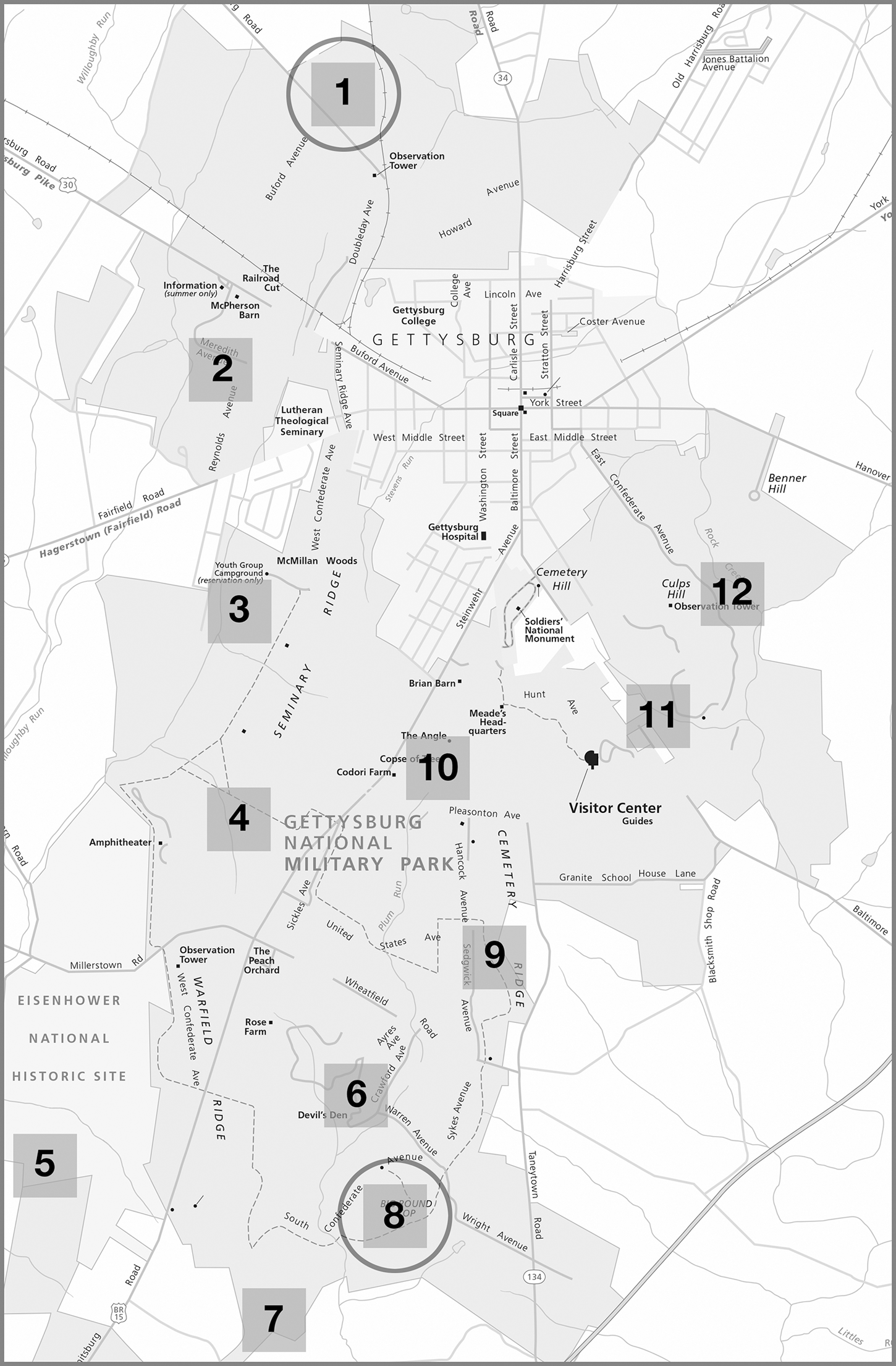
National Park Service visitor's map of Gettysburg National Military Park indicating the town of Gettysburg in the center surrounded by national park, overlaid with the locations of the 12 tick-sampling sites. Sites 1 and 8 were the locations where nonremoval sampling occurred eight times from April to September, 2009. All 12 sites, including sites 1 and 8, were sampled for ticks on May 13 and June 15, 2009, for tick removal and pathogen testing. (Source: National Park Service.)
For the second protocol, ticks were not only counted and identified, but also removed and placed in vials for pathogen testing at the U.S. Army Public Health Command's Tick-Borne Disease Laboratory. Tick-removal sampling was performed at 12 sites (Fig. 1, sites 1–12) on May 13 and June 15, during the anticipated peak period for nymph populations. These sites included the two original sites and 10 additional sites chosen on the basis of park employee knowledge of tick habitat, visitor points of interest, and employee work locations. Because Gettysburg NMP is relatively limited in size, the objective was not to identify particular locations that were of higher or lower risk but rather to understand the tick population across the whole park environment.
We calculated the entomologic risk index (ERI) for I. scapularis nymphs at Gettysburg NMP. ERIs measure the number of infected ticks to which a person might be exposed in tick habitat. Because the nymphal life stage is responsible for most transmission of B. burgdorferi to humans, ERIs are calculated for nymphs only. We estimated the risk for encountering an infected nymph per hour of exposure time spent in tick habitat by using the method described by Mather et al. (1996).
Polymerase chain reaction
Genomic tick DNA was extracted by using the Zymo Genomic DNA II Kit™ (Zyme Research Corporation, Orange, CA) according to the manufacturer's instructions (Stromdahl et al. 2011). I. scapularis ticks were tested for the presence of B. burgdorferi (Straubinger 2000), A. phagocytophilum (Bell and Patel 2005), and B. microti (Tonnetti et al. 2009). Samples positive for B. burgdorferi in the initial PCR were reconfirmed by using a second target (Leutenegger et al. 1999). Dermacentor variabilis ticks were tested for spotted fever group Rickettsia species (Jiang et al. 2005). Ambylomma americanum ticks were tested for B. lonestari (Bacon et al. 2004) and for E. chaffeensis and E. ewingii (Bell and Patel 2005).
Park employee survey
To determine self-reported exposure to ticks and tick habitat and to measure knowledge, attitudes, and practices regarding Lyme disease, we implemented an anonymous survey that was adapted from two prior survey instruments (one was adapted from two prior survey instruments: one that was used in U.S. Forest Service employees in California, and the other was used among Connecticut homeowners). (The entire 33-question survey is available by e-mail from the corresponding author.) Because the survey did not collect personally identifiable information, it was determined to be exempt from Institutional Review Board assessment by both the Pennsylvania Department of Health and the Centers for Disease Control and Prevention (CDC). Paper copies were distributed to park employees during September and December, 2009, at two staff meetings. Additionally, Gettysburg NMP administration e-mailed employees an Internet link for an online version of the survey created using SurveyMonkey® (SurveyMonkey, LLC, Palo Alto, California) three times during September–November, 2009.
Results
Tick sampling and identification
During April–September, 2009, a total of 141 ticks (110 I. scapularis nymphs, 15 I. scapularis adults, and 16 D. variabilis adults) were counted at sites 1 and 8, among eight nonremoval and two removal samplings (Fig. 2). The I. scapularis nymph population peaked during May–July; the adult population was low throughout the sampling period. A limited number of D. variabilis adults and no D. variabilis nymphs were found. One A. americanum adult and one nymph were found on different dates (May 13 and June 15, respectively) at the same site (Fig. 1, site 2).
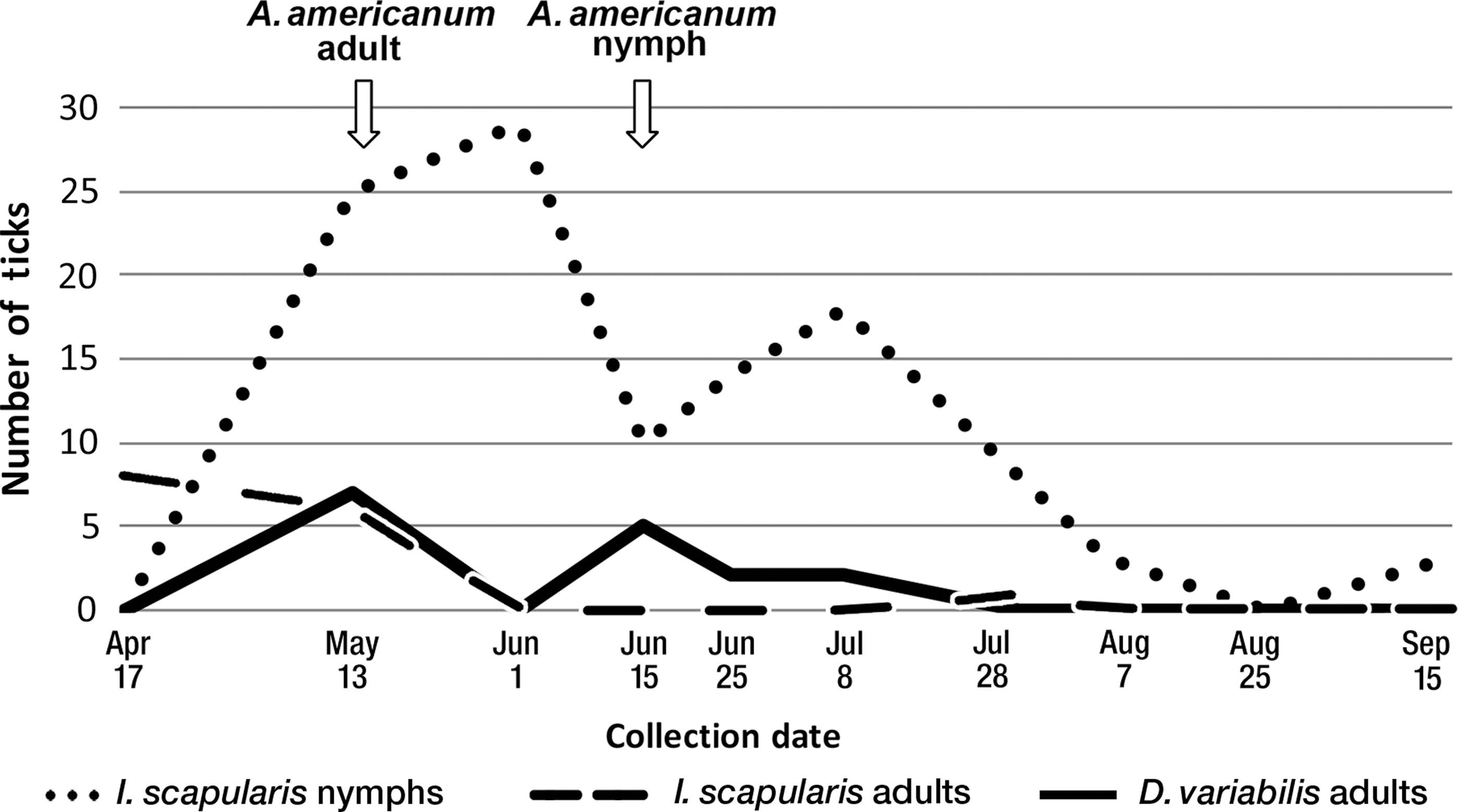
Number of ticks by species collected at sites 1 and 8 from April 17 to September 15, 2009. An Amblyomma americanum adult was collected on May 13 and an A. americanum nymph was collected on June 15; both were found at site 2 (see Fig. 1).
Tick pathogens
On May 13 and June 15, a total of 115 I. scapularis, 44 D. variabilis, and two A. americanum were collected from the 12 sites where we performed removal sampling for pathogen testing; the only tick-borne pathogen identified was B. burgdorferi. Of 115 I. scapularis ticks, 13 (18%) of 74 nymphs and 11 (27%) of 41 adults were infected. Neither A. phagocytophilum nor B. microti were identified among any I. scapularis ticks. R. rickettsii was not identified among any D. variabilis ticks, and no E. chaffeensis, E. ewingii, or B. lonestari were identified among the two A. americanum ticks.
To calculate the ERI for Gettysburg NMP, we first calculated the total time spent in tick habitat on the basis of the 25 sample-minutes of flagging conducted at each of the 12 sites, multiplied by two collection visits, which equals 600 sample-minutes (10 sample-hours). Of the 115 I. scapularis ticks collected, 74 were nymphs, yielding an average of 7.4 nymphs collected/h. This nymph encounter rate multiplied by 0.18 (proportion of nymphs infected) results in an ERI of 1.3 infected nymphs/h for Gettysburg NMP during the 2009 peak nymph season.
Park employee survey responses
Of 110 employees, 79 (72%) completed the survey. Table 1 displays employee response rates by occupational division. The highest response rate was from the maintenance division, where typical activities include fence repair, monument preservation, and trail maintenance; the next highest response rate came from park rangers, which include interpretive guides and law enforcement officers, followed by resource managers, who manage and conduct research on natural vegetation and wildlife; the lowest response rate was from the administration division. Characteristics of survey respondents are reported in Table 2. The number of employees who reported working outdoors ranged from 11 during winter months to 60 during April–September, when park visitation peaks. Approximately half (49%) of all employees reported working outdoors >20 hours during an average workweek. Frequency of employee exposures and prevention practices are summarized in Figure 3. Eighty percent of employees reported going off trail one or more times/week; wearing long pants and checking for ticks on their clothes and body were the most common prevention measures used.

Survey responses regarding Gettysburg National Military Park employee exposures and prevention practices (n=79). (
Includes Interpretation and Visitor & Resource Protection divisions.
Not all respondents answered all questions.
Lyme disease was thought to be a somewhat or very serious problem at Gettysburg NMP by 82% of employees; 62% thought they were somewhat or very likely to acquire Lyme disease while working at Gettysburg NMP. At least one unattached tick was found by 84% of employees during the past year, and 51% found one or more attached ticks during the past year. Nine (11%) employees reported ever having received a diagnosis of Lyme disease by a physician, and five (6%) had received their diagnosis while employed at Gettysburg NMP.
Discussion
This study of the distribution of tick species in Gettysburg NMP revealed I. scapularis to be the predominant species; D. variabilis and A. americanum were present, but less common. The I. scapularis peak nymph population (May–July) coincides with the highest levels of visitor and employee activity in the park. Our results are consistent with tick abundance and distribution data derived from ticks submitted to the Pennsylvania State University Insect Identification Laboratory for 1900–2000, which revealed a statewide distribution of D. variabilis and I. scapularis, and limited numbers of A. americanum (
Our study is the first to detect A. americanum from environmental sampling in Pennsylvania. Transportation by birds might account for an occasional finding of A. americanum, but the finding of an adult and a nymph during 2 different months indicates an emerging A. americanum population at Gettysburg NMP. Presence of an established population of A. americanum ticks in Pennsylvania is of concern, not only because they bite aggressively and can be infected with human pathogens (Childs and Paddock 2003), but also because A. americanum is a hardier species that is less restricted by habitat than I. scapularis and can rapidly spawn large populations (Ginsberg et al. 1991). Prior to 2011, the CDC map of A. americanum distribution did not show the range of the tick extending beyond the southern border of Pennsylvania. In 2011, an updated map increased the range across the state to reflect new information on distribution of the tick (
B. burgdorferi was the only tick-borne pathogen identified at Gettysburg NMP. Although this might be a result of the limited sample size of collected I. scapularis (n=161), this finding is consistent with the substantial number of reported Lyme disease cases but infrequent cases of other tick-borne diseases in Pennsylvania. The B. burgdorferi infection rates of 18% among nymphs and 27% among adults are also consistent with the nymphal (22%) and adult (28%) infection rates among I. scapularis (n=209) submitted to HTTK during 2008–2010 from two military installations near Gettysburg, Fort Indiantown Gap and Carlisle Barracks (E.Y. Stromdahl, unpublished data, 2011), as well as with other tick surveys from the northeastern United States (Ullmann et al. 2005, Schulze et al. 2006, Diuk-Wasser et al. 2012).
The ERI for Gettysburg NMP of 1.3 infected nymphs/h is similar to ERIs for the mid-Atlantic region and is the only one that has been calculated in south-central Pennsylvania. ERIs of 0–22.7 (mean, 4.4) were calculated across 31 sites at Aberdeen Proving Ground, Maryland (E.Y. Stromdahl, unpublished data, 2009), and ERIs of 0–13.2 were calculated from six Rhode Island towns (Mather et al. 1996). ERIs only estimate the encounter rate of infected nymphs, not necessarily the attachment rate of nymphs in tick habitat, and they only apply to persons who enter tick habitats.
Visitors to Gettysburg NMP can enter tick habitats, and the number of visitors increases during the summer months. Casual visitors who restrict themselves to paved paths are likely at low risk for tick-borne diseases, but visitors with extensive interest in Gettysburg NMP might be more prone to venture beyond paved paths and into tick habitats, thereby increasing their exposure to ticks. Data on off-trail use or the incidence of Lyme disease among visitors to Gettysburg NMP are not routinely collected.
The employee survey demonstrated that Gettysburg NMP employees are concerned about ticks and Lyme disease, and that they frequently work outdoors during months with high nymph populations. Our finding that 6% of employees reported contracting Lyme disease while employed at Gettysburg NMP is consistent with a serosurvey of outdoor workers in New York that reported that 6.5% of 414 employees had serologic evidence of past B. burgdorferi infection (Smith et al. 1988). Using tick protective measures was irregular among park employees. Apart from clothing-related measures, employees frequently performed tick checks on themselves but often did not apply insect repellent.
Gettysburg NMP, the entire NPS, and all U.S. Department of the Interior bureaus use the Safety Management Information System (SMIS) for employees to report work-related injuries and illnesses. Tick bites can also be recorded; however, only 15 tick bites were reported among Gettysburg NMP employees during 2006–2009 (NPS, unpublished data, 2010). Because a primary function of SMIS is to manage and process workers' compensation claims, park employees indicated that SMIS likely underestimates the true number of tick bites, particularly in cases where employees remain asymptomatic. Data from our anonymous survey validate underreporting of tick bites in SMIS. Pilot efforts are underway to encourage reporting of all tick bites among NPS employees on separate tick logs via SMIS.
One limitation of this study is that we chose our tick sampling sites on the basis of likely tick habitats and the locations of visitor and employee activities, rather than randomly selecting locations around the park. Therefore, our study was not designed to determine whether certain areas of the park are riskier than others. Additionally, not all park employees responded to the survey. Employees who did not respond might have less awareness or concern about ticks and Lyme disease, which can affect their perceptions of risk and their use of personal preventive measures. Finally, because park visitors and local residents were not surveyed, our study cannot address their tick exposures and prevention practices.
Our findings demonstrate that I. scapularis ticks are present at Gettysburg NMP and are infected with B. burgdorferi, posing a potential risk for Lyme disease. Additionally, A. americanum, an aggressive biter, might be an emerging problem at the park. To address these issues, Gettysburg NMP should continue to support an evidence-based employee tick and Lyme disease prevention program that includes education on symptoms and treatment, providing and encouraging use of insect repellents, consistently conducting tick checks after outdoor activity, and showering within 2 h of coming indoors (Mead 2011). Because NPS policy is to leave natural ecosystems unimpaired, interventions to suppress tick populations are not viable options in national parks, except under rare situations. Factory-treated, permethrin-impregnated uniforms for outdoor use are another potential prevention measure. These uniforms are used by the U.S. Army and have been shown to be effective in a study involving outdoor workers in North Carolina (Vaughn and Meshnick 2011). Finally, although not directly addressed by our data, NPS should consider enhancing tick and Lyme disease education for visitors through ranger-led programs (Wong and Higgins 2010), park Internet sites, and visitor center displays. By developing a comprehensive tick prevention program, Gettysburg NMP can help decrease the risk of Lyme disease and other tick-borne diseases for both employees and the visiting public.
Footnotes
Acknowledgments
The authors thank the numerous persons from the Pennsylvania Department of Health, the U.S. Army Public Health Command, and the U.S. Army 1st and 9th Area Medical Laboratories who assisted in tick sampling efforts. We also thank Mary Vince and the Tick-Borne Disease Laboratory for their contribution to the laboratory identification of tick pathogens and the National Park Service Office of Public Health for providing funding for tick pathogen testing. We thank Zach Bolitho and the administrators and employees of Gettysburg National Military Park and Eisenhower National Historic Site for their participation in the survey and assistance with selecting tick-sampling sites, as well as Gettysburg College professor Steven James for local background information. Finally, we acknowledge the contributions of Rebecca Eisen, Heidi Brown, Paul Mead, Kevin Griffith, and Joseph Piesman of the Division of Vector-Borne Diseases, National Center for Emerging and Zoonotic Infectious Diseases, CDC for providing invaluable feedback regarding the study design, tick sampling protocols, and the employee survey.
Author Disclosure Statement
No competing financial interests exist. The findings and conclusions in this report are those of the authors and do not necessarily represent the official position of the Centers for Disease Control and Prevention, U.S. Army, or National Park Service.