




Abstract
The presence of West Nile virus (WNV) in humans has been known in Romania since the 1950s; the 1996 epidemics emphasized the reemergence potential of WNV in Romania. Serological surveys made on susceptible species, known as good sentinels or reservoir hosts, e.g., horses, wild and domestic birds were undertaken from 2006-2011. Our results corroborated incidence data in human patients and other recent seroprevalence studies in animals, and should partially clarify the emergence of WNV in the eastern rural territories of Romania. It also highlighted risk zones for endemic WNV infection in Romania.
Introduction
W
In the natural cycle of WNV transmission, birds are the main amplifying hosts, with horses and humans representing dead ends. Vectors are mosquitoes of the Culex genus (Tsai 1997, Hayes et al. 2005), which are highly represented in Romania (Nicolescu 1995). There are many species of birds that can be infected with WNV, and the acute and long-term viremia observed in wild birds allows the transmission of WNV to mosquitoes. The climate and geographical location of Romania in bird migration corridors and the presence of wetlands with mixed ecosystems meet all of the conditions for WNV emergence. In addition, extensive horse and domestic fowl farming makes it hard to predict the real impact of this infection in domestic animals.
This article presents the results of screenings in animals made annually from 2006 to 2008 and after the 2010 epidemics in 2011. Our results were in agreement with WNV reemergence in humans and, with studies in animals and they partially clarify the distribution of WNV in Romania in the Danube delta area and eastern countries.
Materials and Methods
During the period 2006–2011, we performed serologic surveys to assess the level of WNV activity in horses, known as good indicators of virus dissemination (Chevalier et al. 2011, Phoutrides et al. 2011). The mobility of the tested horses was assessed, and none of the animals had left the home county during the study. We also wanted to determine the susceptibility of birds to WNV infections (domestic fowl and wild bird). The samplings were made annually between 2006 and 2008. In 2009, the official veterinary authorities started an active surveillance of WNV in horses, and we considered that the screening should be stopped (European Centre for Disease Prevention and Control 2011). Generally, sampling sites were situated in the eastern and southeastern parts of the country (17 counties from a total of 41) and were chosen taking into account the location in the lower Danube basin (especially in Danube Delta-TL district for the bird samples), the vicinity of migrating birds zones, and the presence in the sampling sites of ecosystems able to maintain an enzootic cycle of WNV. During 2007–2008, a screening in birds (domestic fowl and wild birds) from eight localities located in Danube Delta-TL district was performed. The horses were chosen randomly, taking into account only the pasture near watercourses and lakes and the presence of stagnant water. In addition, horses from two stud farms in Suceava-SV, a county situated in the north of the country, were sampled to see if the infection had spread in a colder region where the vectors are less probable to live (Fig. 1).
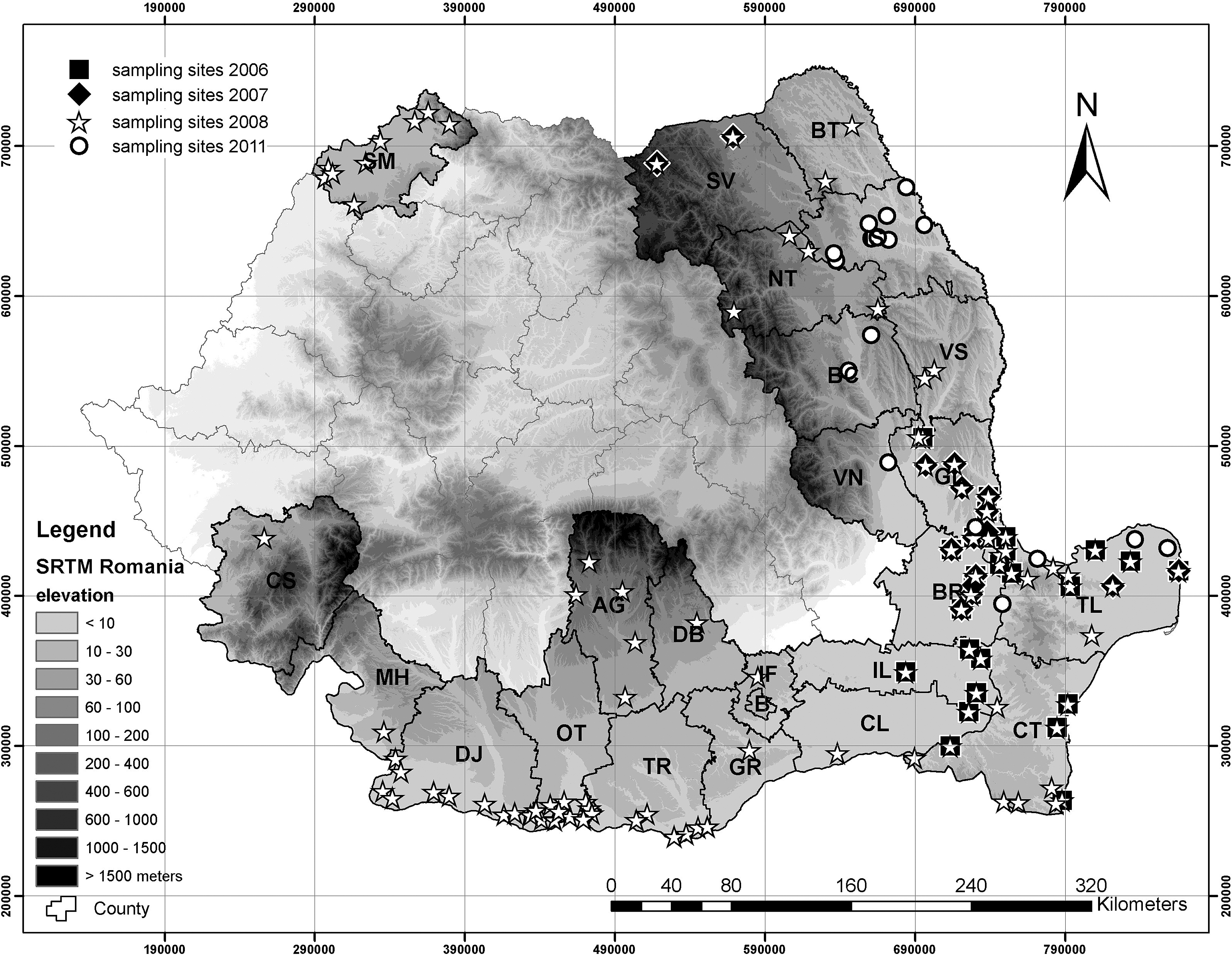
Sampling sites for horses in different years of screening. Letters represent the abbreviation of the county names, as explained in Table 1.
WNV dynamics in Romania renewed-changed during the 2010 epidemics, with a wider distribution and a predominantly rural activity compared with the 1996 episode. Eastern, parts of Romania were considered for serological investigation, especially counties situated near major tributaries of the Danube (Siret and Prut), and not previously studied. Those chosen for screening were sera from rural counties located in Braila (BR), Bacau (BC), Galati (GL), Iasi (IS), Tulcea (TL), and Vrancea (VN) districts were chosen. Samples were collected between May and October, 2011, following the indications of the World Organisation for Animal Health Manual of Diagnostic Tests and Vaccines for Terrestrial Animals (World Organisation for Animal Health 2010).
The horse sera were evaluated, using enzyme-linked immunosorbent assay (ELISA) and adequate procedures for the detection of specific immunoglobulin G (IgG) and IgM antibodies against WNV. These included an indirect ELISA kit (Kit for detection of West Nile anti prM-E antibodies in horse sera, ID.VET Innovative Diagnostics), competition ELISA kit (ID Screen® West Nile Competition ELISA kit), and a monoclonal antibody (mAb) capture ELISA assay. The competition ELISA used has a high specificity (99.4%) and sensitivity (84.9%) for WNV infection (Padilla et al. 2009). Bird samples were tested using a plaque reduction neutralization test (PRNT) in the European Community Reference Laboratory–Maison Alfort France as described (World Organisation for Animal Health 2010) and the competition ELISA kit. Seroprevalence was estimated and for each proportion obtained in this study, and 95% confidence intervals (CI) were calculated using the Bayesian approach through the beta distribution (Sivia 1996).
Results for the 2006–2008 Screening
In 2006, seroprevalence tests were conducted for the detection of WNV-specific IgG on 382 horse samples collected from the southeastern part of Romania (n=167) and from the two stud farms situated in the northern part of the country (SV district, n=215). The results showed a global seroprevalence of 15.2%, but if we consider only the southeastern area, it was 33.5%, with the highest value in the TL (46.6%) and BR (50%) districts. The results correlated with favorable climatic conditions and the presence of the mosquito vectors, as described in previous entomological investigations (Nicolescu 1998, Nicolescu et al. 2002). Detection of IgM was made on 67 samples (TL and BR samples from southeastern part of Romania) and on all 215 samples from the SV district.
The 215 samples tested from the stud farms in the Carpathian Mountains were negative for specific IgM, but there were two IgG-positive samples from the Radăuţi stud farm (Table 1). The presence of IgM was determined in one sample from the Danube Delta, and this confirmed the activity of WNV in 2006 in this area.
Indirect enzyme-linked immunosorbent assay (ELISA) (kit for detection of West Nile anti prM-E antibodies in horse sera” ID.VET, Innovative Diagnostics).
Competition ELISA kit (ID Screen® West Nile Competition ELISA kit).
IgG, immunoglobulin G; CI, confidence interval.
In 2007, horses (n=283) were sampled in the summer and autumn, and the seroprevalence was 65.4%. In the summer, tests were conducted twice for the detection of both anti-WNV-specific Ig G and IgM on samples from TL and BR counties (n=67) where the seroprevalence was higher in 2006 and also from Lucina stud farm in Carpathians (n=34). In the autumn, IgG tests were made on 170 samples from GL county.
The results for the IgG detection in the summer of 2007 were negative for all 34 samples from the stud farm Lucina in Carpathians, but in the lower Danube area we have found again seropositive horses with 32.4% prevalence. The 170 samples from GL in the autumn showed a 92.4% seroprevalence.
An important aspect of the research is that we obtained two positive responses for IgM in horses from the TL region and two positive samples for IgM in Braila (BR), indicating a recent infection in the summer of 2007 (Savuţa et al. 2007). The 2008 survey in horses (n=1032) showed a smaller percentage of seroprevalence at 17.4%, but positive samples were found in 13 of the 18 targeted counties (Fig. 2).
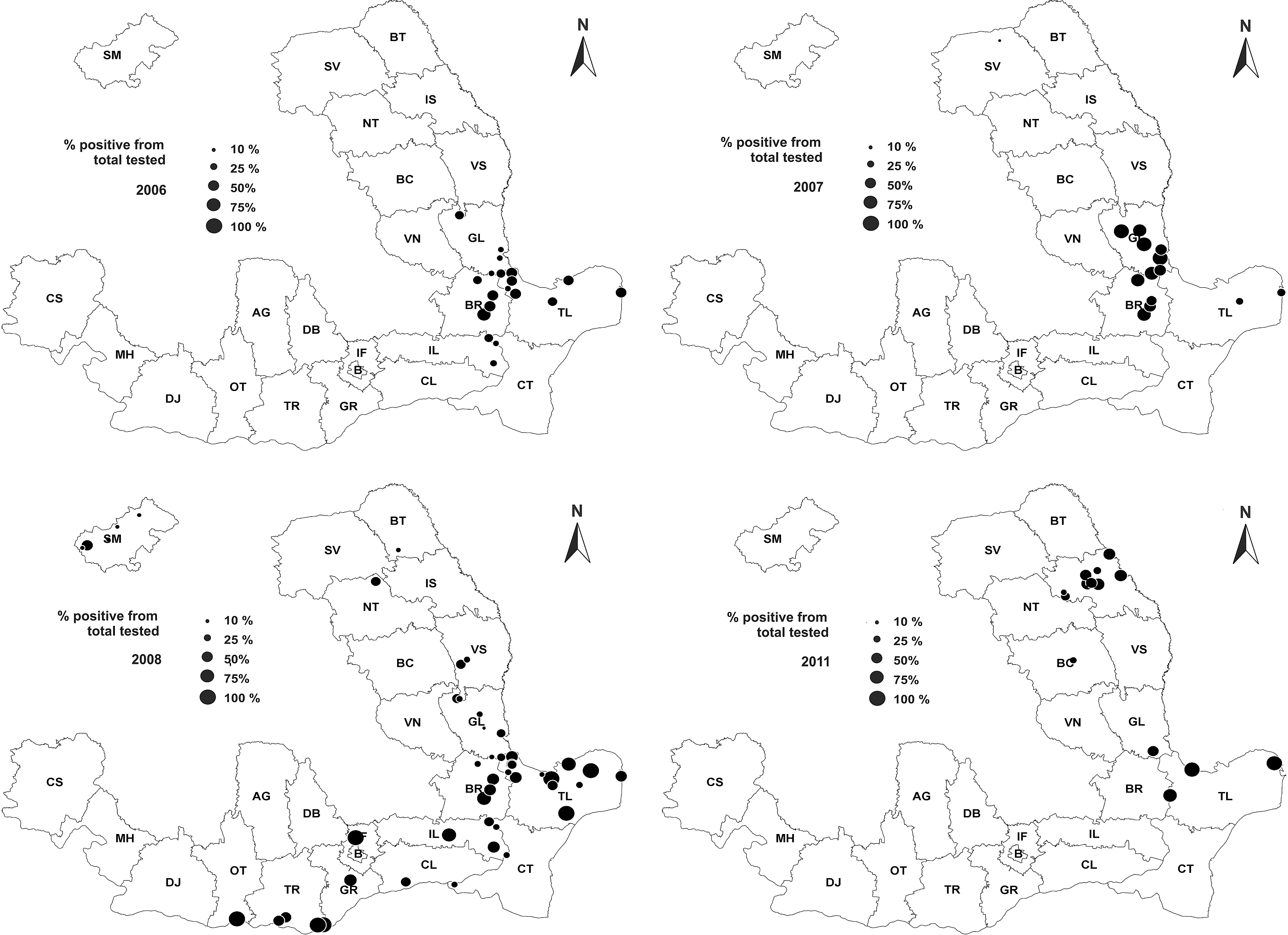
Geographical distribution of immunoglobulin G (IgG)-positive horse samples yearly in the interval 2006–2011.
As for the results of bird screening using the PRNT test, the global seroprevalence was 5.2% (37/713), with an average prevalence of 3.5% (3/43) in wild bids and 7.9% (22/279) in domestic fowl. The largest number of positive samples in wild species was obtained in sera from Corvidae and Passeriformes, thus sustaining the hypothesis that WNV is well established in the Danube Delta, considering that the positive samples were found in resident birds (Table 2).
Results of Serosurvey after the 2010 Epidemics
A number of 808 horse serum samples from the east of Romania and a number of 37 bird samples (chickens and crows) from the Danube Delta were tested after 2010 for the detection of anti-WNV-specific IgG using the competition ELISA test. The overall seroprevalence in horses was 58.5% (Ludu et al. 2012). The increasing number of seropositive animals was in correlation with the human outbreaks and stands for new introductions of West Nile virus (Table 3). Serological analysis revealed a 57.5% rate of seropositivity in horses from GL county; in 2010 in this county, according to the information received from the national veterinary authority, no virus-specific antibodies were detected in horses, but human cases were recorded.
ELISA, enzyme-linked immunosorbent assay; IgG, immunoglobulin G; CI, confidence interval.
In crow samples from the Danube Delta, the percentage of seropositivity was 16.7% (3/18), which supports the hypothesis that this species could represent an important national WNV reservoir (Ludu et al. 2011). The elevated seroprevalence percentage registered in localities from IS county in 2011 reflects the previous emergence of the infection in the area and the future presence of the disease (Neghina et al. 2011). This percentage of seroprevalence indicates an intense activity of WNV in IS county. In support of this statement is the fact that two cases of human infection were reported and diagnosed here in 2011 and 2012.
Discussion
Signals of the presence of WNV in Romania have been documented since the 1950s (Nicolescu et al. 2009). After two WNV human encephalitis outbreaks in the central (Mureş district) and southwestern areas of the country in 1955 and 1964, no official data were registered until 1996. The 1964 outbreak can be related with the Camargue episode in early 1960s that was characterized by encephalitis in both humans and horses (Calistri et al. 2010), even though no data regarding the encephalomyelitis in horses were registered in Romania (Campbell et al. 2001). In 1996, an epidemic confined to 15 districts in the Danube plain of southeastern Romania evolved. This was the first time that well-documented epidemic dates were published (Neghina et al. 2011).
In October of 1996, epidemiological, entomological, ornithological, and environment surveys were conducted in Bucharest and in the adjacent rural areas. These surveys showed that Culex pipiens mosquitoes were the main vector of the epidemic, a fact confirmed by the isolation of WNV serotype RO97-50 from Cx. pipiens samples (Savage et al. 1999).
The presence of WNV infections in animals was characterized by significant numbers of equine WNV encephalitis cases (Cantile et al. 2000) documented in Europe (France and Italy), Africa (Morocco), and the United States (Komar 2000, Zeller et al. 2004). During the Romanian epidemic, those clinical and epidemiological futures were not reported. The emergence of WNV in Romania was characterized by a lack of massive avian mortality, as observed in countries from Europe (Wodak et al. 2011) and on the contrary to North America (Eidson et al. 1999). After that first large epidemic, further investigations in the following years confirmed circulation of the virus in humans (Cernescu et al. 2000, Ceianu et al. 2001), birds, and horses (Ionescu et al. 2006). During 1997–2008, a total of 96 cases, including six fatalities (13%), were diagnosed in humans, but the disease did not recur (Campbell et al. 2001).
In birds, the results of serosurvey studies conducted during 1997–2000 in domestic fowl from the southeastern Romania showed a seroprevalence of 8% (34/447). In wild species, from 152 wild birds of 22 species and six orders sampled in the TR and TL districts, a total of 12 birds (8%) had neutralizing antibody to WNV, including seven seropositives among 12 young-of-the-year. All seropositives were nonmigratory species (Ceianu et al. 2001).
Other studies regarding animal reservoirs and hosts for WNV were made in 2006 in the Danube Delta area and Dobrodjean Table, and the seroprevalence was 16.52% (173/1047) (Nicolescu et al. 2009). The highest seroprevalence was found in Hooded Crow (24.24%), Rook (23.07%), Great Reed Warbler (22.1%), and House Sparrow (20%). In 2007, investigations regarding the presence of WNV in horses were made in the TL and IF districts and in Bucharest. The overall seroprevalence in Bucharest and Ilfov district was 14.4% and 32.1% for the TL district (Nicolescu et al. 2009). Data gained from subsequent serological studies carried out in sheep, horses, and poultry in 2009 and 2010 showed a very high seroprevalence in the horse population. Seroprevalence rates of 33.4% and 24.7% were found in horses in 2009 and 2010 respectively, while 8.6% and 13.5% of poultry in 2009 and 8.2% of poultry in 2010 had WNV antibodies eastern area as well as in western districts (European Centre for Disease Prevention and Control 2011).
In 2010, Romania has registered the most important WNV infection outbreak since 1996. A total of 47 cases of WNV infection were identified between July and October with a case fatality rate of 8.7%. Cases were distributed in 19 districts in the southern, western, central, and eastern parts of the country. This was the first time in many years that the human cases included counties outside the southeastern area (European Centre for Disease Prevention and Control 2011, Sirbu et al. 2011). Regarding the animals, neither encephalomyelitis in horses nor mortality in birds was reported, but data provided by the veterinarian official services showed that WNV-specific antibodies were found in poultry from two districts in the eastern and western parts of the country. WNV-specific IgG antibodies were also detected in horses from 22 districts across the country, including nine districts in which human cases of WNV infection occurred in 2010. Also IgM antibodies in horses indicating recent activity of the virus were detected in six counties in which the disease in humans was signaled (Sirbu et al. 2010, Zeller et al. 2010).
The 2010 episode showed us that epidemiological surveillance and a more detailed view of the field situation are even more important because horses in Romania are not currently vaccinated against this infection. Understanding the current immunological status in birds and horses is necessary given the context WNV enzootic circulation in animals and re-emergence in humans. Of all susceptible species, birds are the best sentinel (Komar 2001, Chevalier et al. 2011) and an active surveillance system can be implemented in parallel within other national veterinarian surveillance programs (e.g., avian flu). The official veterinary services in Romania have not done a continuous serological survey of WNV presence in bird and horse populations, even if aside from bird amplifier hosts, horses are good indicators of WNV circulation, and the specific anti-WNV IgG and IgM can be easily detected without requiring special laboratory conditions.
Conclusion
In the last years, WNV, known to be endemic in the Danube Delta, has emerged in the eastern part of Romania extending to the Moldavian borders. The mechanism of its emergence is not known and characterized. The screening results reported here correlated with other available data and have given us indications about the presence and dissemination of WNV in animals. A more clear methodology and an active system of surveillance in horses, birds, and mosquito vectors can be an early warning system for WNV infections in humans and could save lives. The key to a functional warning system for WNV in Romania should be a better collaboration between veterinary and human health authorities and a better visibility of research results. Veterinarians should report any suspicion of WNV infection in the active surveillance data to the human health authorities. The detection of IgG can no longer be a sustainable screening method, because in the southeastern territories and in the eastern part, at least in IS county, WNV infection seems to be endemic. Given the possibility of cross-reactions with other flaviviruses and the differences in sensitivities and specificities for different ELISA methods used, only IgM detection followed by PRNT should be made in the future. This should provide more accurate data.
Horses remain a good indicator of WNV presence, and with a systematic screening methodology, future emergence of WNV and risks for the humans can be predicted. Even if a more systematic screening in birds is hard to realize without proper financing, the national surveillance programs for other diseases (e.g., highly pathogenic avian influenza) can provide samples from sentinel birds placed in the migratory bird routes and from wild birds. Seroconversion in those species can indicate the origins of continuous presence of WNV in Romania. Given the reporting of human WNV infections in urban areas, screening cosmopolitan species could be an indicator.
On the basis of these results, we encourage researchers to establish collection sites for mosquitoes to determine to which lineage WNV strains circulating in Romania belong. A genetic characterization should explain the lack of neurological manifestations in horses and of mortality in birds and clarify if those are really particularities of WNV infections in Romania or a surveillance artifact (Chevalier et al. 2011). In Romania, the Danube Delta area, the southeastern counties, and at least IS and GL counties from the eastern area represent risk zones for WNV transmission to humans.
Footnotes
Acknowledgments
This work was co-financed from the European Social Fund through Sectoral Operational Programme Human Resources Development 2007–2013, project number POSDRU/I.89/1.5/562371, Postdoctoral Schole in Agriculture and Veterinary Medicine area, and partially by the CEEX project 105/2006, Biotech-Program of the Romanian Ministry of Research. Many thanks are given to the anonymous reviewers for the time spent and for the advice given to the authors.
Author Disclosure Statement
The authors declare that they have no conflicts of interest.