




Abstract
Orf virus, which belongs to the Parapoxvirus genus, induces a zoonotic infectious disease characterized by acute, highly vascularized cutaneous pustular lesions in sheep and goats. A number of Orf outbreaks have been reported in sheep and goats in recent years, but no reports have described an Orf virus strain from humans in China. In this study, we diagnosed Orf virus infection in two people, a mother and son, in the Gansu province of China. The human Orf virus was isolated and its phylogenetic characterization was analyzed based on a complete B2L gene. The results are useful for developing prospective programs to control Orf virus infections in both goats and humans
Introduction
O
No reports have described molecular characterization of the Orf virus strain from humans in China. This study provides phylogenetic information about the Chinese human strain of the Orf virus. The present study was approved by the local institutional review board and adhered to the tenets of the Declaration of Helsinki. Additionally, written informed consent was obtained from the patients. These data are useful for developing a prospective program to control Orf virus infections in China by vaccinating animals, since they are the link in the transmission chain and are potential risk factors for zoonotic infections.
Materials and Methods
In a small town located in the Gansu province, the patients bred 84 housekeeping Boer goats. Clinical symptoms of Orf were observed in the goats on October 8, 2012. On October 15, 2012, the mother and son wounded their hands slightly while transporting hay for the goats. After being wounded, they cared for infected suckling lambs without any protection. Ten days later, their hands were swollen and painful and showed tender injuries. Until November 8, 2012, they were treated by a local surgeon.
Patient 1, the son, a 31-year-old man, was examined on November 8, 2012, by a surgeon in a small local hospital. He had a fever and a lesion on his left thumb (Fig. 1A); no local complications were observed. He subsequently underwent surgery, and approximately 5 mm of pathological tissue was carefully removed from the nodular lesion. Intravenous blood was then collected from his arm. Patient 2, the 53-year-old mother of patient 1, was hospitalized on November 8, 2012, for surgical excision of lesion tissue on the fourth finger of her right hand (Fig. 1B). She also had a fever, and intravenous blood was collected from her arm. Their skin biopsy samples and anticoagulant blood samples were then sent to the virology laboratory at Lanzhou Veterinary Research Institute.
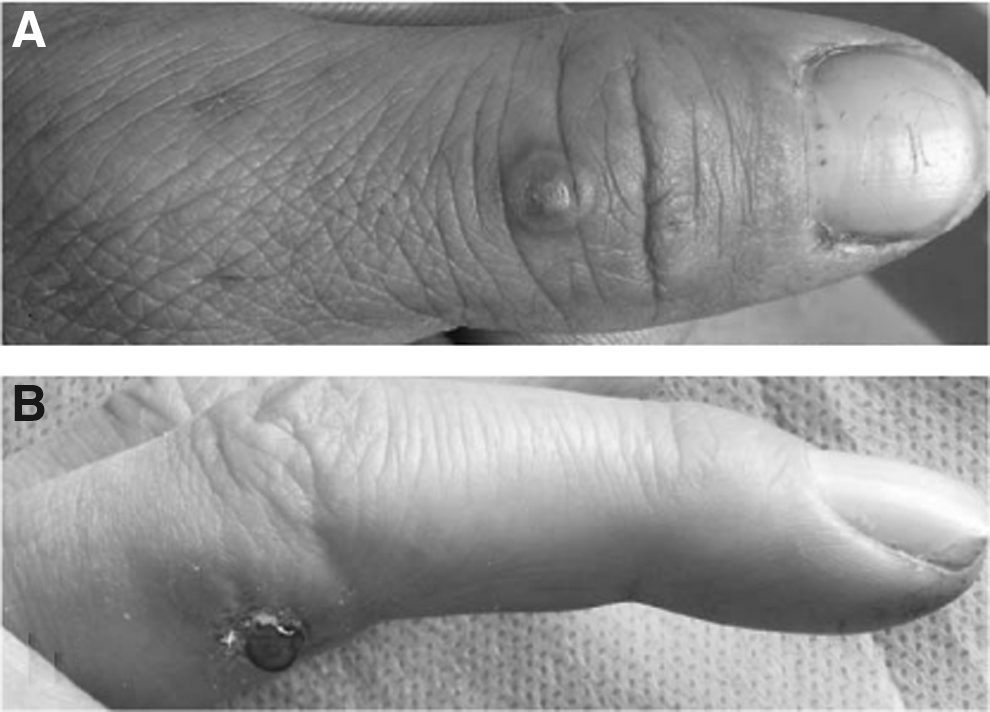
Clinical symptoms of Orf in humans. (
Total DNA was extracted from anticoagulant blood samples using a DNA extraction kit according to the manufacturer's instructions. Primers targeting the B2L gene were designed and synthesized. Complete B2L gene PCR amplification was performed according to the procedures noted in previous studies (Hosamani et al. 2006, Oem et al. 2009, Karakas, et al. 2013).
Serum of the two patients was separated from intravenous blood. A neutralizing test was performed as follows: Serum was inactivated at 56°C for 30 min in a water bath and diluted two-fold in 50 μL of Dulbecco's modified Eagle medium (DMEM) in flat-bottomed 96-well plates. DMEM (100 μL) containing 200 tissue culture infective dose (50%) (TCID50) Orf virus was added to each serum plate and incubated for 1 h at 37°C in a 5% CO2 incubator. Subsequently, 100 μL of an ovine epithelial cells suspension that contained 106 cells was added to each well. Finally the plates were incubated for 3–4 days at 37°C in a 5% CO2 incubator. Neutralizing antibody level was determined as the highest serum dilution that completely prevented cells from ORFV infection.
Results and Discussion
Detection of ORFV by PCR based on the B2L gene has been used (Inoshima et al. 2001, Tikkanen et al. 2004, Hosamani et al. 2006). Molecular characterization and phylogenetic analysis have been performed using the B2L gene (Guo et al. 2003, Guo, et al. 2004, Hosamani et al. 2006), therefore the B2L gene was selected in this study.
The B2L gene was amplified from the finger lesions and blood samples. Orf virus serum-neutralizing antibody titers of patients 1 and 2 were 1:32 and 1:16, respectively. To ensure the validity of the sequence as far as possible, the B2L gene was sequenced two times. Gene sequences from both patients were identical and named Human/Gansu/China/2012 (GenBank accession no. KC485343). The complete B2L gene sequence was compared with the 22 published Orf virus strains from China, using the BLAST program. A phylogenetic tree was generated by the neighbor-joining method using MEGA software (version 5.0) (Tamura et al. 2011). Phylogenetic analysis showed that the Chinese strain of the Orf virus obtained from a human shared a close genetic relationship with 29 other Orf virus strains in China (Fig. 2), and the amino acid homology between them was 94.3–98.2%.
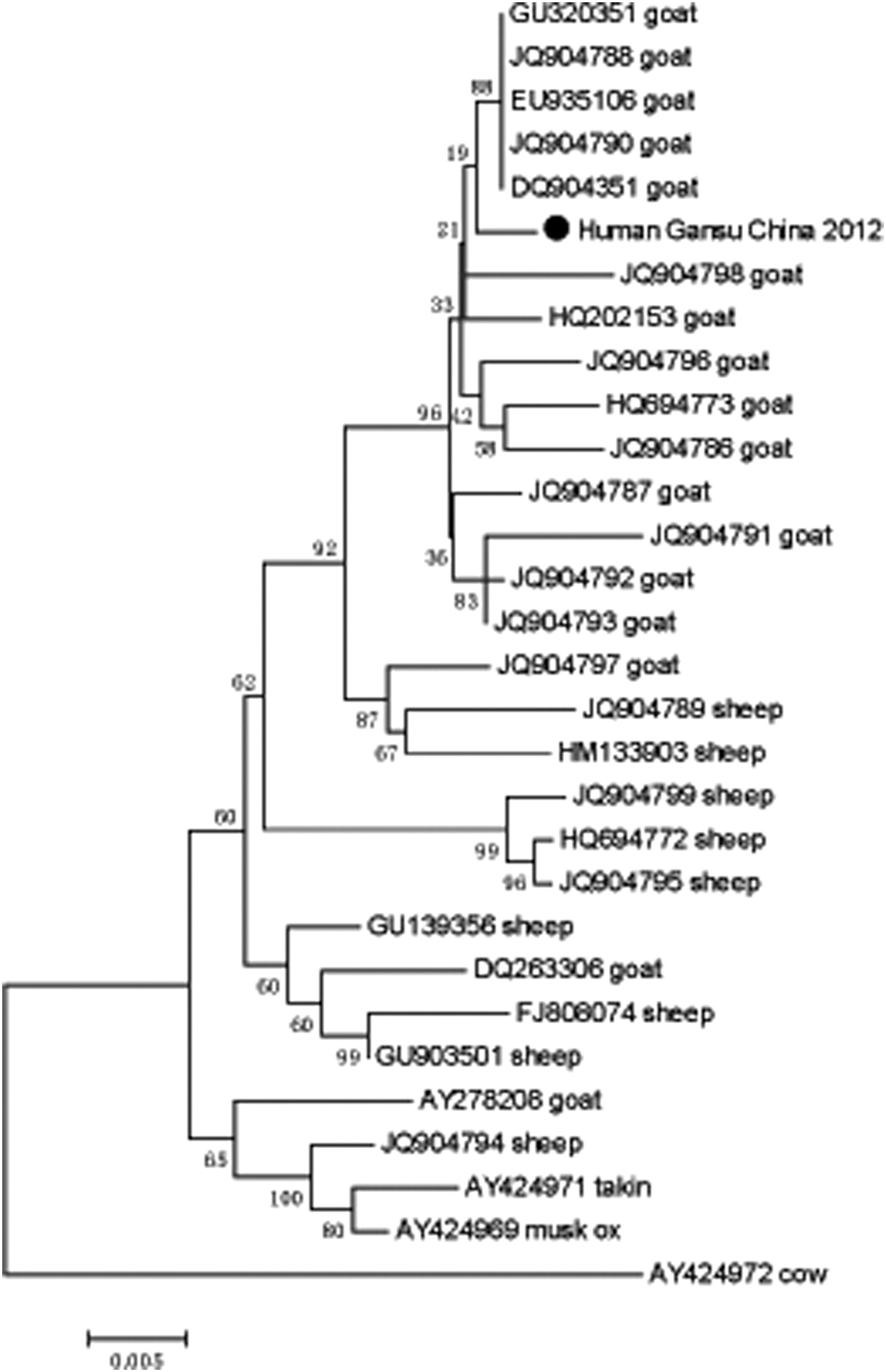
Phylogenetic analysis based on the complete B2L gene sequence. (Black dot) Virus identified in this study. Scale bar, nucleotide substitutions per site.
The results of this investigation indicated that the outbreak of this human Orf case was due to infection with ORFV, which is genetically closely related to ORFVs isolated from goats. Human/Gansu/China/2012 shares the farthest phylogenetic relationship with AY424972, which originated from a cow in Namibia. After the Orf virus was confirmed through biopsy, virus isolation and identification were performed using ovine epithelial cells, PCR, and electronic microscopy observation. ORFV-like particles were observed under an electron microscope with negative staining method (Fig. 3). The patients were treated with amoxicillin, and subsequently the lesions regressed slowly and spontaneously for the next 2 weeks; no scarring was observed.
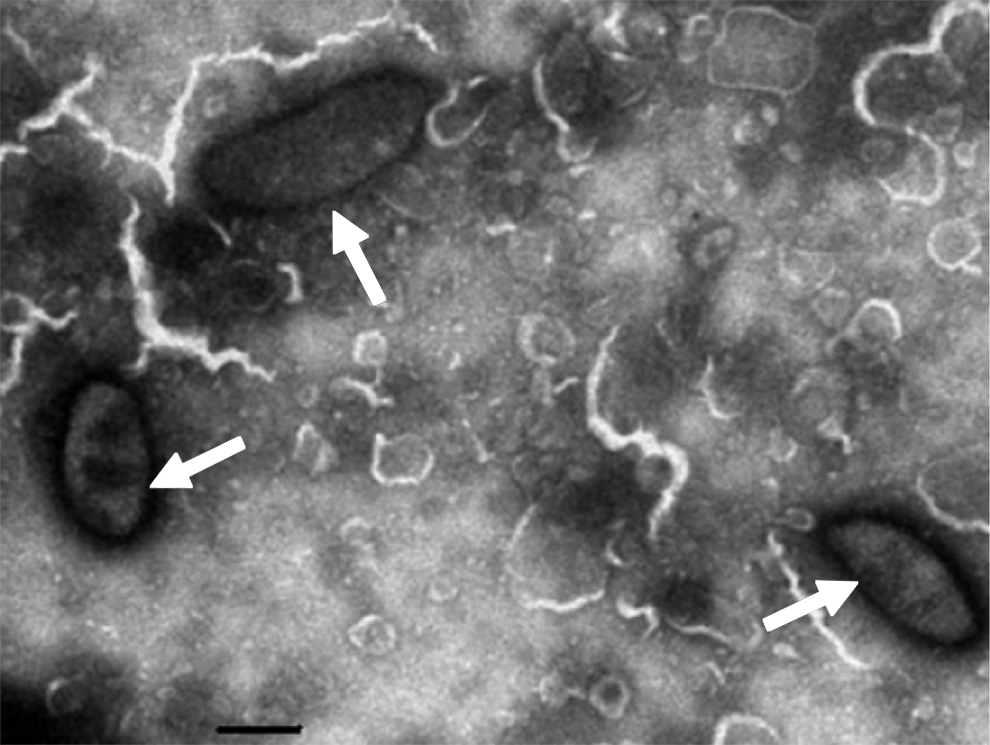
Observation by electron microscopy showing the morphology of an Orf virion from patients skin lesion with negative staining method. The arrow indicates the position of a virus. Bar, 100 nm).
This report showed that goat-to-human transmission of Orf virus may occur from time to time in poor, isolated, rural districts of China. Infection wounds were observed on the hands of the patients because they touched the infected lambs without wearing any protection. In addition, the mother experienced more serious symptoms than her son, and we postulate that this was because she had a weaker immune system. This report should caution people, especially those with a weakened immune system, to take appropriate measures to prevent animal-to-human transmission of pathogens while handling animals. Persons who handle animals should wear plastic gloves, avoid exposure of open wounds, or wash their skin wounds thoroughly with water and soap after handling animals. People at an increased risk for Orf virus infection include butchers, farmers, and veterinarians who often contact animal products, contaminated equipment, or infected animals. Those suspected of having contracted the infection should be tested, diagnosed, and treated immediately. Orf in animals and humans should be treated as an equally important research goal in the future.
Footnotes
Acknowledgments
This work was supported by the National Natural Science Foundation of China (grant no. 31201914), China Postdoctoral Science Foundation–funded project (2013M530683), and China Agriculture Research System (CARS-39).
Author Disclosure Statement
No competing financial interests exist.