




Abstract
Toxoplasma gondii is an important zoonotic protozoan pathogen that causes serious illness in immunocompromised humans and infection in animals worldwide. The current study was conducted for detection of T. gondii infection and determination of the seroprevalence of the pathogen in native Korean goats (Capra hircus coreanae). Analysis of a total of 610 sera samples collected from 60 herds between 2009 and 2011 were performed using a commercial enzyme-linked immunosorbent assay (ELISA) kit for detection of anti–T. gondii IgG antibodies. Among the animals tested, 5.1% (31/610) showed seropositivity for anti–T. gondii antibodies, and 38.3% (23/60) of the herds were seropositive. The prevalence rates between young (<1 year) and adult (≥1 and ≤3 years) goats were 7.0% and 4.1%, respectively, without statistical significance (p>0.05). Likewise, the prevalence rates observed during cold season (October–March) and warm season (April–September) were 2.9% and 5.5%, respectively, without statistical significance. Seroprevalence rates observed in the northern, central, and southern regions were 7.9%, 3.8%, and 4.2%, respectively. In conclusion, we report for the first time on the seroprevalence of anti–T. gondii antibodies in native Korean goats (Capra hircus coreanae). The results of this study also indicate that there is a nationwide distribution of T. gondii infection among goats. Therefore, the implementation of integrated control strategies as well as measures for prevention and control of T. gondii infection within goats is recommended.
Introduction
T
Toxoplasmosis can be transmitted by ingestion of raw or undercooked meat containing T. gondii tissue cysts, consumption of fresh vegetables or water contaminated with oocysts, or vertically by transmission across the placenta (Dubey 1996, Dubey and Lindsay 2006). Congenital toxoplasmosis is a major cause of abortion and stillbirth in farm livestock, especially sheep and goats, resulting in significant economic losses to the livestock industry (Buxton 1998).
Several serological tests are available for detection of Toxoplasma infection in both humans and animals (Dubey and Lindsay 2006). These include the Sabin–Feldman dye test, indirect hemagglutination assay (IHA), indirect fluorescent antibody test (IFAT), latex agglutination test (LAT), enzyme-linked immunosorbent assay (ELISA), and modified agglutination test (MAT). ELISA was found to be less prone to interlaboratory variation because reading was automated and provided reliable results in identification of serum antibodies against T. gondii and was appropriate for use in epidemiological surveys of Toxoplasma infection in goats (Figueiredo et al. 2001, Hill et al. 2006, Opsteegh et al. 2010).
Seroprevalence of T. gondii infection in goats has been shown to vary, ranging from 0% to 77% among different countries and regions within a country (Tenter et al. 2000, Jittapalapong et al. 2005, Ramzan et al. 2009, Zhang et al. 2010). Native Korean goat (Capra hircus coreanae) is the only breed of goat that is indigenous to Korea; the number of registered native Korean goats is approximately 562,000 (KOSIS 2005). These goats are raised mainly for meat and for use as a natural health supplement. Although T. gondii is considered one of the most important zoonotic protozoa, there is a scarcity of reports on caprine toxoplasmosis in Korea (Youn 2009). Therefore, the purpose of the current study was to detect T. gondii infection and to determine the seroprevalence of the pathogen in native Korean goats.
Materials and Methods
Study area and goat population
The sampling area was divided into three geographical regions (northern, central, and southern) of Korea according to the administrative boundary and the latitude (Fig. 1). The entire study area lies between 34°20′ and 37°11′ North latitude and between 126°07′ and 129°19′ East longitudes with a mean annual temperature of 13.6°C and mean annual precipitation of 1500 mm. The study population consisted of approximately 14,800 goats in 60 herds distributed throughout the entire country. The farming system is semi-intensive, where goats are kept under confinement with a limited grazing time and freedom to move in confinement. Goats are raised for up to 3 years before slaughter for meat. Male goats are usually put on the market after being raised for 1–1.5 years, whereas females are put on the market after being raised for 2 years for gestation.
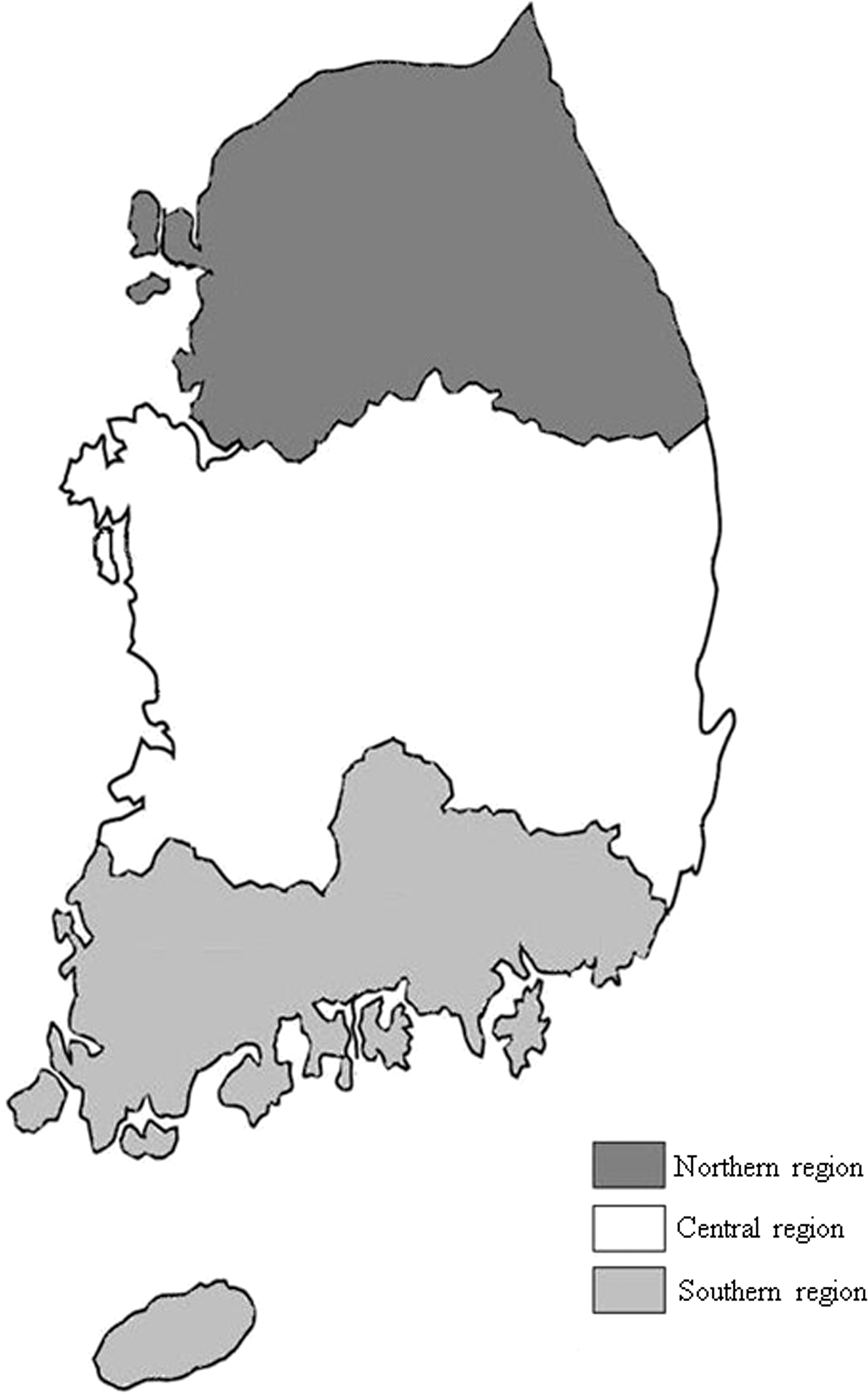
Study areas: Regions of origin of the goat sera samples tested for the presence of anti–T. gondii immunoglobulin G (IgG) antibodies.
Sample size determination and sample collection
An appropriate sample size with an expected prevalence of 50%, accepted error of 5%, and confidence level of 95% was determined using a stratified simple random sampling method as described previously (Thrustfield 2005). Accordingly, a total of 610 goats (C. hircus coreanae) from 60 herds with a minimum of 10 goats per herd were evaluated for study, and every tenth goat was selected for sampling as they came out of their pen. Blood samples were collected from the jugular vein between November, 2009, and August, 2011. Serum was separated according to standard procedures and stored at −20°C until use. The ages of animals used in this study were 1 month to 3 years with an average age of 1.5 years and grouped as young (<1 year) and adult (≥1 and ≤3 years) goats. In addition, results were analyzed according to seasons of sample collection and geographic location of the animals reared.
Serological assay
The presence of anti–T. gondii IgG antibodies in the serum samples was investigated using a commercial ELISA kit (IDEXX Laboratories, Westbrook, ME) according to the manufacturer's instructions. The test results were expressed as the optical density (OD) index and interpreted as positive or negative. The OD index was calculated as the ratio of the test sera OD and the negative control sera OD (OD index=OD test sera/OD negative control sera). Sera presenting OD% greater than 30% were deemed as positive and OD% ≤30% as negative as per the instructions. The sensitivity and specificity of the IDEXX ELISA kit when tested in sheep sera were confirmed and estimated as 90.5% (83.4–95.6) and 97.8% (94.2–99.5), respectively (Mainar-Jaime and Barberan 2007, Iovu et al. 2012).
Statistical analysis
A chi-squared test was used for analysis of differences among the variables. p values<0.05 were regarded as statistically significant. The GraphPad Prism software package (v. 5.04; GraphPad Software Inc., La Jolla, CA) was used in performance of statistical analysis. A 95% confidence interval (CI) for all estimates was calculated based on the exact binomial test.
Results and Discussion
Among the 610 serum samples analyzed, 31 (5.1%) were found to be seropositive for anti–T. gondii IgG antibodies (Table 1). The result observed in the current study is lower than that of caprine toxoplasmosis reported in Brazil (46.0% by IFAT and 43.0% by ELISA; Carneiro et al. 2009) and Bulgaria (59.8% by IHAT; Prelezov et al. 2008). In addition, the seroprevalence rates reported in other Asian countries like China (31.7% by ELISA and 26.7% by MAT), Thailand, and Pakistan (27.9% and 25.5% by LAT, respectively) were found to be higher than those of the current study (Jittapalapong et al. 2005, Ramzan et al. 2009, Zhang et al. 2010). Our result was also below the previously estimated global average prevalence of 31% (Fayer 1981). However, a lower seroprevalence (4.6%) than that of the current study, based on ELISA, was reported in Nigeria (Kamani et al. 2010). Differences among various countries might be attributed to differences in ecological zones, diagnostic methods used, climate or the number, and spread of final hosts (cats and other felids) in the study areas.
CI, confidence interval.
Our findings showing a lower prevalence than the global average suggest the presence of a relatively low number of feral and owned free-roaming cats in the study areas (Dubey and Livingston 1986). In addition, the confined movement and limited grazing farm management system that reduces exposure of goats to an environment contaminated with infectious cat
Similar seroprevalence of T. gondii infection was observed between the two age groups of goats (p>0.05) (Table 1). This result was contrary to findings reported in previous studies, which suggest that a longer period of exposure to different risk factors may account for a greater prevalence of toxoplasmosis in adult goats (Figueiredo et al. 2001, Jittapalapong et al. 2005, Carneiro et al. 2009).
Although T. gondii occurs throughout the year, changes in prevalence according to season were investigated. Similar seroprevalence was observed during both the warm (April to September) and cold (October to March) seasons, with no significant difference (Table 1). This finding differs from results obtained from a study conducted in Nigeria in which T. gondii infection was more common during the warm and humid season than during the cold or hot dry season (Kamani et al. 2010). Warm and moist environments favor survival of oocysts outside the host, thus increasing the seroprevalence of T. gondii. Similarities in regional seroprevalence observed in the current study could be due to a lack of variation in weather conditions among most regions of Korea and similarities in management systems of the farms from which the samples were collected.
In conclusion, the current study is the first to evaluate the seroprevalence of anti–T. gondii antibodies in native Korean goats. The results demonstrated that T. gondii infection has a nationwide distribution among goats in Korea. Therefore, implementation of integrated control strategies that are vigilant enough to limit and stop the risks of contamination and transmission from felids such as feral cats as well as measures for prevention and control of T. gondii infection within the goats to prevent human infection during eating of raw or undercooked goat meat for medicinal purposes is recommended.
Footnotes
Acknowledgments
This work was financially supported by the National Veterinary Research and Quarantine Service (B-AD21-2010-11-03), Ministry of Food, Agriculture, Forestry, and Fisheries, Korea.
Author Disclosure Statement
No completing financial interests exist.