




Abstract
A total of 261 healthy farm and pet animals (75 cattle, 52 goats, 100 dogs, and 34 cats) from different regions of Tunisia were screened for Staphylococcus aureus nasal carriage. Molecular typing of isolates (by spa- and multilocus sequence-typing) was performed, and their antimicrobial resistance and virulence genotypes were determined by PCR and sequencing. S. aureus isolates were detected in 17 of 261 tested samples (6.5%). All S. aureus isolates recovered were methicillin-susceptible (MSSA), and one isolate/sample was further studied. Eight different spa types were detected (t189, t279, t582, t701, t1166, t1268, t1534, and t1773), and eight different sequence types were identified (ST6, ST15, ST45, ST133, ST188, ST700 [clonal complex CC130], ST2057, and a new ST2121). MSSA from pets (six isolates) showed resistance to (number of isolates, resistance gene): penicillin (six, blaZ), tetracycline (one, tet[M]), erythromycin one, erm[A]), streptomycin (one, ant[6]-Ia), and ciprofloxacin (one). All isolates from farm animals showed susceptibility to the tested antimicrobials, except for two penicillin-resistant isolates. Five S. aureus isolates from goats and cats harbored the lukF/lukS-PV genes, encoding the Panton–Valentine leukocidin, and six isolates from goats harbored the tst virulence gene. In addition, diverse combinations of enterotoxin genes were detected, including two variants of the egc cluster. Goats and cats could represent a reservoir of important toxin genes, with potential implications in animal and human health.
Introduction
S
S. aureus is able to produce numerous adhesins and virulence factors that facilitate cell invasion and bacterial growth, and they are associated with the severity of S. aureus infections. One of these virulence factors is the Panton–Valentine leukocidin (PVL), a cytotoxin that causes leukocyte destruction and tissue necrosis related to staphylococcal skin and pulmonary infections. Other important virulence factors are the toxic shock syndrome toxin (TSST-1) and staphylococcal enterotoxins (SEs) responsible for food poisoning (Argudin et al. 2010, Zecconi and Scali 2013). It is also important to consider the capacity of S. aureus to acquire antibiotic resistance; therefore, methicillin-resistant S. aureus (MRSA) represents a major therapeutic problem with an increasing frequency in severe infections.
The epidemiology and ecology of this bacterial species in animals has gained interest in the last years, not only for its importance in veterinary medicine but also for increasing evidence of its zoonotic potential. The presence of S. aureus in animals plays an important role in its epidemiology, and contact with positive animals, especially MRSA carriers, may pose a risk to human health (Weese 2010, Graveland et al. 2011, Fitzgerald 2012). Animal-associated clonal lineages of S. aureus are emerging, as it is the case of MRSA ST398 among farm animals, mainly pigs, or CC97 among bovines (Fitzgerald 2012). People exposed to livestock have a greater risk of colonization and subsequently of infection. Molecular typing techniques have demonstrated that isolates from pets usually show similar characteristics to those of the human isolates of the same geographic region (Haenni et al. 2012). Cases of S. aureus transmission between humans and animals have increasingly been reported (Van Duijkeren et al. 2005, Vitale et al. 2006, Fitzgerald 2012, Walther et al. 2012, Gómez-Sanz et al. 2013).
During last decade, most studies on S. aureus in humans and animals have focused on the molecular epidemiology of MRSA. Recently, there have been an increasing number of studies focused on clonal lineages of methicillin-susceptible S. aureus (MSSA) in different countries. It is thought that MRSA emerged by the acquisition of mecA or mecC genes in MSSA and, for that, it is highly interesting to study the clones and the characteristics of MSSA strains in diverse ecosystems. Thus, we will be able to know more about the evolution of this microorganism.
The objective of this study was to determine the nasal carriage of S. aureus in healthy farm and pet animals in Tunisia, to carry out the molecular typing of recovered isolates, and to determine their content in antimicrobial resistance and virulence genes.
Materials and Methods
Sampling and microbiological isolation
Nasal swabs of 127 healthy farm animals (75 cattle and 52 goats) were obtained during 2010–2011 from two farms of the north and central region of Tunisia and one abattoir of Tunis (Tunisia) that received cattle and goats from the entire country. In addition, nasal samples of 134 healthy pets (100 dogs and 34 cats) were obtained in the National School of Veterinary Medicine of Sidi Thabet and in two veterinary clinics of Tunis. These animals came from Tunis and several regions around Tunis and were brought in by their owners for vaccination. The ARRIVE (Animal Research: Reporting of In Vivo Experiments) guidelines were followed in this study. The origin of the 261 samples is shown in Table 1. All nasal swabs were incubated in tryptone soy broth (TSB) and later subcultured on Baird–Parker (BP) agar and on oxacillin-resistance screening agar base (ORSAB) supplemented with oxacillin (2 mg/L) for S. aureus and MRSA recovery, respectively. Plates were incubated at 37°C for 24–48 h. One S. aureus–suspected colony per positive plate was selected and identified by conventional methods (Gram-staining, catalase test, oxidase test, DNase production, and ability to coagulate rabbit plasma [BioRad]). S. aureus identification and methicillin resistance/susceptibility were then confirmed by amplification of the species-specific nuc gene and the mecA gene by multiplex PCR (Gharsa et al. 2012a). No clinical studies or patient data were included in this study.
National School of Veterinary Medicine.
Antimicrobial susceptibility testing
Susceptibility to 18 antimicrobial agents was performed using the disk-diffusion method in accordance with the Clinical and Laboratory Standards Institute (CLSI) recommendations (Clinical and Laboratory Standards Institute 2012). Antimicrobial agents tested were (charge in μg/disk, except unit/disk for penicillin): Penicillin (10), oxacillin (1), cefoxitin (30), kanamycin (30), gentamicin (10), tobramycin (10), tetracycline (30), chloramphenicol (30), trimethoprim–sulfamethoxazole (1.25/23.75), erythromycin (15), clindamycin (2), amikacin (30), ciprofloxacin (5), mupirocin (5), vancomycin (30), teicoplanin (30), fusidic acid (10), and streptomycin (10).
Detection of antimicrobial resistance genes
The presence of several genes that confer resistance to penicillin (blaZ), tetracycline (tet[K], tet[L], tet[M], and tet[O]), macrolides/lincosamides (erm[A], erm[B], erm[C]), and streptomycin (ant[6]-Ia) was analyzed by PCR (Gharsa et al. 2012a). In addition, isolates that belonged to the lineage CC130 were tested for the presence of the novel mecC gene (formerly named mecALGA251) (Cuny et al. 2011, García-Alvarez et al. 2011).
Pulsed-field-gel-electrophoresis
All S. aureus isolates were characterized by pulsed-field-gel-electrophoresis (PFGE) with SmaI restriction enzyme digestion as previously described (Bouzaiane et al. 2008). Samples were run on a 1% agarose gel in 0.5×Tris-borate-EDTA (TBE) buffer at 14°C on a CHEF DR-II PFGE system using switching times ranging from 5 to 40 s during 20 h at 6 V/cm. The DNA fingerprints generated by PFGE were analyzed visually and digitally according to Tenover criteria (Tenover et al. 1995) and by Gel-Pro v. 3.1 software, respectively. The obtained results were submitted to MVSP software generating a dendrogram according to simple matching coefficient and the unweighted pair group method with arithmetic mean (UPGMA) algorithm.
Other molecular typing methods of S. aureus isolates
S. aureus protein A (spa) typing was performed in all S. aureus isolates as described elsewhere (Harmsen et al. 2003). The polymorphic X region of the spa gene was amplified by PCR, and sequences were analyzed using Ridom Staph-Type software v.1.5.21 (Ridom GmbH), which automatically detects spa repeats and assigns a spa type according to
Multilocus sequence typing (MLST) was performed in all S. aureus isolates detected. The allelic profile of each isolate was obtained by sequencing internal fragments of seven unlinked housekeeping genes (arcC, aroE, glpF, gmk, pta, tpi, and yqiL) to determine the sequence type (ST) and clonal complex (CC) assigned by MLST and BURST (Based Upon Related Sequence Types) analyses (
Detection of staphylococcal toxin genes
All isolates were tested by PCR for the presence of 18 genes coding for staphylococcal enterotoxins (sea, seb, sec, sed, see, seg, seh, sei, sej, sek, sel, sem, sen, seo, sep, seq, ser, and seu). The presence of the enterotoxin gene cluster egc was considered when five SE genes (seg, sei, sem, sen, and seo) were detected; the egc-like cluster included six SE genes (seg, sei, sem, sen, seo, and seu) (Jarraud et al. 2001, Hwang et al. 2007).
Isolates were also screened for the presence of tst gene encoding the TSST-1 (Jarraud et al. 2002), lukF/lukS-PV genes encoding PVL, lukE-lukD genes encoding the bicomponent leukotoxin LukE-LukD, lukM gene encoding leukocidin M, as well as eta and etb genes encoding exfoliative toxins A and B, respectively, and genes encoding hemolysins A, B, D, G, and Gv (Jarraud et al. 2001, Lozano et al. 2011).
Results
Field survey results for S. aureus isolates from healthy animals
To isolate S. aureus from nasal samples, each enrichment culture of nasal swabs was subcultured on BP medium. At 48 h postinoculation, S. aureus-like colonies were identified in 17 of the 261 nasal samples (6.5%), including 10 goats (19.2%), four dogs (4%), two cats (5.9%), and one cow (1.3%). From each putative S. aureus–positive sample, one S. aureus–like colony was selected and further tested for identification of the species using both conventional methods and a species-specific PCR method, as described in Materials and Methods. All 17 isolates were confirmed as S. aureus and all of them were MSSA.
The enrichment cultures of nasal swabs were also tested for MRSA recovery by inoculating to ORSAB plates. No staphylococcal colonies were detected on ORSAB plates for all samples tested.
Characteristics of S. aureus isolates detected in healthy farm animals
S. aureus isolates were recovered from 11 of the 127 tested samples (8.7%) of farm animals. These isolates were recovered from 10 goat samples and one cow sample. The characteristics of the 11 MSSA recovered isolates are shown in Table 2. Four different spa types were detected among these S. aureus isolates (t1534, t1268, t1773, and t1166), and four different STs were identified by MLST (ST2057, ST45, ST700, and ST133). The STs detected among these MSSA isolates of farm animals were classified into four clonal complexes: CC522 (four isolates), CC45 (three isolates), CC130 (three isolates), and CC133 (one isolate). Typing of the agr locus showed that S. aureus isolates were ascribed to agr type I (eight isolates), to agr type II (two isolates), and to a nontypeable agr (one isolate).
Animal type and location indicated.
When only some of the isolates of the group presented the gene, the number is indicated as a superscript.
egc-like include seg, sei, sem, sen, seo and seu; egcv includes seg, sei, sem, sen, and seu.
New ST detected.
MLST, multilocus sequence typing; ST, sequence type; CC, clonal complex; PFGE, pulsed-field gel electrophoresis; PVL, Panton–Valentine leukocidin; F2, farm 2; PEN, penicillin; A, abattoir; NT, nontypeablel; NSVM, National School of Veterinary Medicine; CIP, ciprofloxacin; TET, tetracycline; ERY, erythromycin; STR, streptomycin.
Analysis of SmaI macrorestriction profiles of the 11 MSSA isolates revealed five different PFGE patterns (P1–P5) (Fig. 1 and Table 2).
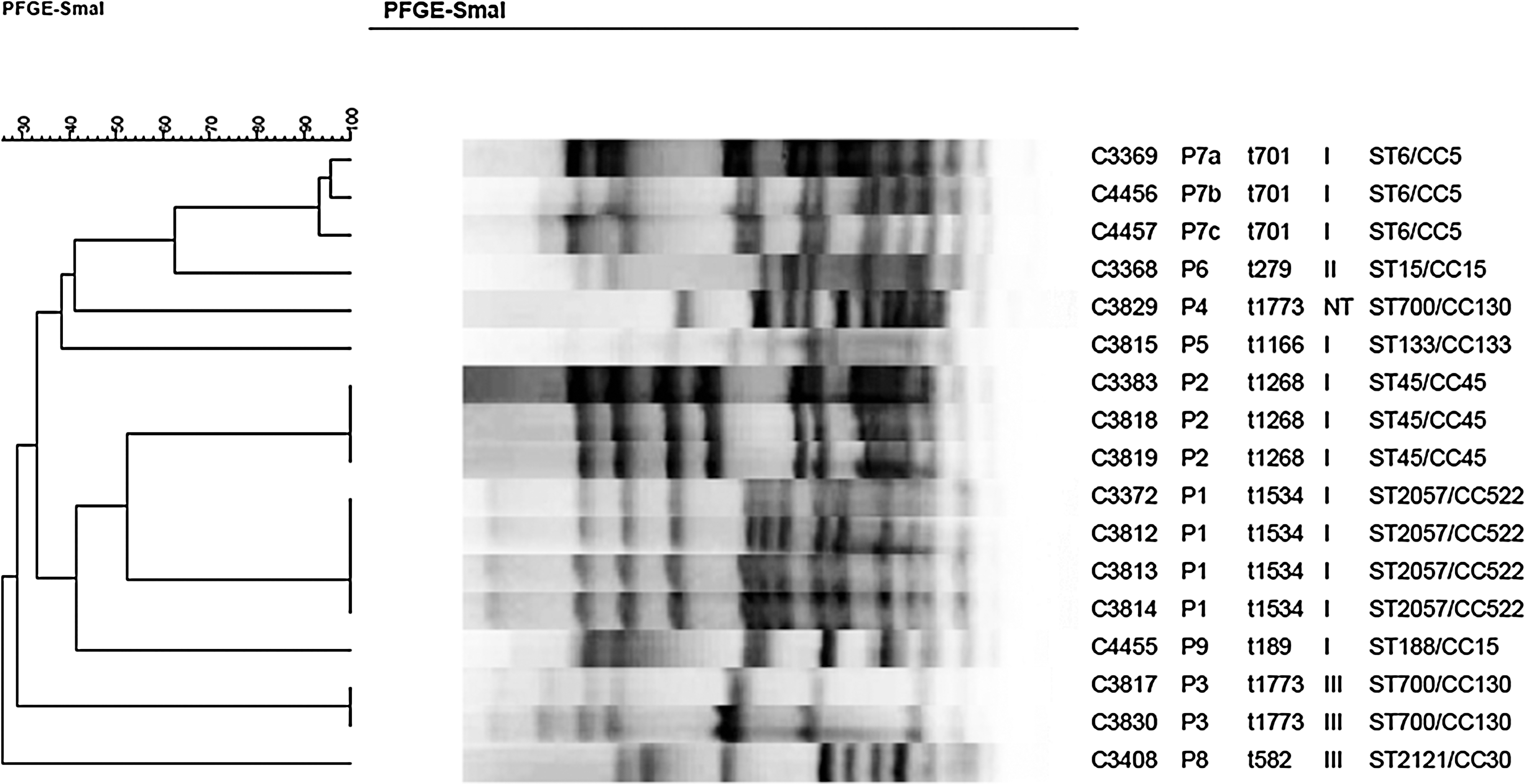
Dendrogram of pulsed-field gel electrophoresis SmaI patterns among 17 Staphylococcus aureus isolates recovered in this study, generated by GelCompar II software using the unweighted pair group method with arithmetic mean (UPGMA) algorithm and the Dice similarity coefficients.
Two isolates from goat samples showed resistance to penicillin (with the bla[Z] gene), and the remaining isolates from farm animal samples were susceptible to all tested antimicrobial agents. The three MSSA isolates that belonged to the clonal complex CC130 were tested by PCR for the mecC gene, obtaining a negative result.
Three S. aureus isolates from goats harbored the lukF/lukS-PV genes and six isolates presented the tst gene. Other virulence genes carried by MSSA isolates were (number of isolates): hla (eleven), hlb (eight), hld (eleven), hlg (three), hlgv (three), lukED (eight), lukM (six), sec (six), sed (two), seg (one), sei (one), sej (three), sel (nine), ser (four), and egc-like cluster: seg-sei-sem-sen-seo-seu (three) (Table 2). The remaining PCR virulence genes tested were negative among these isolates.
Characteristics of S. aureus isolates detected in healthy pets
S. aureus isolates were recovered from six of the 134 tested samples of healthy pets (4.5%), obtained from four dogs and two cats, all of them of the National School of Veterinary Medicine. The characteristics of the six MSSA isolates from pet animals are shown in Table 2. Four different spa types were detected among these isolates (t189, t279, t582, and t701), and four STs were also identified by MLST (ST6, ST15, ST188, and a new ST registered as ST2121). ST2121 showed the allelic profile numbered as follows: arcc(2)-aroe(2)-glpf(2)-gmk(2)-pta(7)-tpi(3)-yqil(2). The sequence types detected among these S. aureus isolates of pet animals were classified into three clonal complexes: CC5 (three isolates), CC15 (two isolates), and CC30 (which enclosed the new ST2121). Typing of the agr locus showed that S. aureus isolates were ascribed to agrI (four isolates), agrII (one isolate), and agrIII (one isolate).
Analysis of SmaI macrorestriction profiles of the six MSSA isolates revealed four different PFGE patterns (P6–P9), and three subtypes in pulsotype P7 (P7a–P7c) (Fig. 1 and Table 2). The three isolates with closely related PFGE patterns corresponded to those typed as ST6, spa type t701, and agrI, and they were recovered from two unrelated dogs and one cat.
All MSSA isolates showed penicillin resistance (harboring the blaZ gene); one isolate also exhibited tetracycline and erythromycin resistance (with the tet[M] and erm[A] genes), and one additional isolate presented streptomycin resistance (containing the ant[6]-Ia gene) (Table 2).
The two S. aureus isolates from cats harbored the lukF/lukS-PV genes encoding the PVL. Other virulence genes carried by MSSA from pets were (number of isolates): hla (six), hlb (four), hld (six), hlg (one), hlg v (one), lukED (five), sea (three), see (two), sei (two), ser (four), and an egc cluster variant that included the seg-sei-sem-sen-seu genes (one) (Table 2). The remaining virulence genes tested were negative among these isolates from pets.
Discussion
A relatively low recovery rate of S. aureus isolates was detected among nasal samples of healthy animals in this study (6.5%), with different rates depending on the animal species. However, MRSA was not detected in the analyzed samples. To our knowledge, this is the first study of this type performed in Tunisia. Higher S. aureus nasal carriage rates in goats (>64%) and cows (7.5%) were identified by others in Norway, Canada, or Denmark (Barbour et al. 1997, Mork et al. 2010, Eriksson et al. 2013). Regarding pets, a study performed in Canada showed a rate of 14% in dogs and 4.3% in cats, MRSA being detected in 1.5% of analyzed dogs (Hanselman et al. 2009). Other studies carried out in healthy pets detected a rate of 8.8% in China (four) and 12% in Spain (Gómez-Sanz et al. 2013). However, lower values have been also detected in other studies (Wan et al. 2011). These different carriage rates might be due to the different animal population studied or to the employed methodologies, among other factors.
The high diversity of genetic lineages of S. aureus detected among farm animals and pets is noteworthy. In these terms, the results of molecular typing by MLST, PFGE, and spa typing (Table 2 and Fig. 1) exhibited elevated variability. Higher diversity in the different molecular typing approaches has been previously shown in MSSA isolates in comparison with MRSA (Grundmann et al. 2010).
Four STs distributed in four CCs were identified among our S. aureus isolates from goat and bovine samples. Lineage ST700 detected in three MSSA isolates (from two goats and one cow) belonging to CC130, which was mainly related to bovine animals. However, this ST has been also identified in goats (Smyth et al. 2009, Porrero et al. 2012, Eriksson et al. 2013). It is important to remark that our CC130 isolates did not harbor the recently described mecC gene. This gene was first described in MRSA (mecA negative) of this lineage in cattle in 2011 (García-Alvarez et al. 2011), and since then several studies have reported its presence in MRSA of a wide range of mammal species in Europe, the majority of them belonging to the same lineage (Cuny et al. 2011, Paterson et al. 2012). Alternatively, the clonal complex CC522, also detected in isolates from goats in our study, had previously been identified in samples of this animal species in Spain (Porrero et al. 2012). CC133, detected in one MSSA from goats, is considered as one of the major small-ruminant lineages (Guinane et al. 2010, Eriksson et al. 2013). The three PVL-positive MSSA from goats belonged to the clonal complex CC45 and to the agr type I, characteristics previously detected among human MRSA strains (Seidl et al. 2011). A possible human origin of this clonal complex has been previously suggested (Sobral et al. 2012).
The four STs identified among MSSA from pets were distributed in three different CCs, as is the case of CC5, CC15, and CC30. The presence of S. aureus that belongs to CC5 among pets is becoming unexceptional (Haenni et al. 2012, Walther et al. 2012), and its presence in other animals as poultry is commonly observed (Hasman et al. 2010). The clonal complex CC15, identified in two MSSA isolates in our study (one dog and one cat), has been recently described in MSSA of pets in France and in a recent study on S. aureus of donkeys in Tunisia (Gharsa et al. 2012a, Sobral et al. 2012). In addition, a new ST belonging to CC30 was identified (ST2121). This CC is one of the predominant hospital- and community-associated MRSA clones, and MSSA isolates of this lineage have also been described (Monecke et al. 2011), its presence in swine isolates being also unexceptional (Hasman et al. 2010). These data and our results illustrate the spread of S. aureus human lineages among different animal species.
The detection of PVL-positive MSSA isolates in farm animals (6% of tested goats) and pets (6% of tested cats) is of relevance due to the important role that this toxin seems to have in serious infections (Melles et al. 2006). A high prevalence of the PVL genes in MRSA isolates recovered from dogs has been detected in other studies (Rankin et al. 2005, Van Duijkeren et al. 2005). On the other hand, none of the canine S. aureus isolates harbored the PVL genes in other reports (Boost et al. 2008, Hanselman et al. 2009, Walther et al. 2012, Gómez-Sanz et al. 2013). Regarding its detection in cats, there are several studies that have identified these toxin genes in MRSA of these animals, but not in MSSA isolates (Rankin et al. 2005, Vitale et al. 2006). The existence of the PVL genes in three S. aureus isolates from goats in our study population is also relevant. A recent study revealed the presence of lukF/lukS-PV genes in ewe isolates (Van Duijkeren et al. 2005), but not in goats.
Our results showed that S. aureus isolated from goats had a high enterotoxigenic potential. Similar results were found in S. aureus isolated from goat and bovine mastitis in Turkey (Unal et al. 2012). S. aureus isolates from our goat and sheep population contained sec and sel genes, whereas those from cows carried mainly sea, sej, and sed genes. Moreover, six S. aureus isolates of goats that harbored the sec gene were simultaneously positive for the tst gene. These combinations of toxin tst/sec genes have been described before in S. aureus isolated from goats (Scherrer et al. 2004). The frequency of other enterotoxins (sed, seg, sei, sej, sel, sem, sen, seo, ser, seu) in our goat isolates is in agreement with previous studies (Valle et al. 1990), which described healthy goats as an important reservoir of enterotoxigenic staphylococci. An egc-like cluster was detected in three of our 10 isolates from goats. Similarly, the detection of this egc cluster was reported in goats, and it has been suggested that its presence may confer a survival advantage of S. aureus in animals by modulating the immune response (Smyth et al. 2005).
With regard to the enterotoxin genes detected in isolates from pets, a previous study performed in Egypt revealed that 10% and 2.1% of dogs and cats, respectively, carried enterotoxigenic S. aureus isolates (Abdel-Moein et al. 2011). Additionally, a recent report from Spain revealed that 75% of pet animals (dogs, cats) investigated presented at least one enterotoxin gene (Gómez-Sanz et al. 2013). These data highlight the potential role of enterotoxigenic S. aureus–positive pets in the epidemiology of household food poisonings. An egc cluster variant carrying seg-sei-sem-sen-seu was detected in one S. aureus isolate of a dog. The egc cluster and its variants are considered as a putative source of superantigens in S. aureus (Jarraud et al. 2001).
All of our MSSA isolates showed susceptibility to the tested antimicrobials, with few exceptions. Penicillin resistance was detected in a high proportion of tested isolates of pets. However, this result contrasts with the low rate detected in farm animals in the current study and in a recent report on sheep isolates in Tunisia (Gharsa et al. 2012b). The low penicillin resistance among these animals is in agreement with other authors (Unal et al. 2012). However, elevated rates of penicillin resistance are very common among the general S. aureus population.
It should be taken in consideration that in this study the data were obtained from two farms and one abattoir. However, more extensive studies with farms and abattoirs in the entire country are necessary to determine the global situation in this country.
Conclusions
The data reported here demonstrate that the nares of healthy pets, goats, and cows could be reservoirs of PVL-positive and TSST-1–positive S. aureus isolates and other virulence genes, such as those encoding enterotoxins. It is noteworthy that not only MRSA but also MSSA isolates from these animals should be studied. More studies should be performed in the future to expand the knowledge on the genetic lineages of S. aureus circulating among healthy farm animals and pets, as well as on the capacity of these isolates to produce virulence factors, due to the risk of animal-to-human bacterial transference and therefore its potential animal and human health implications.
Footnotes
Acknowledgments
This study has been jointly supported by an Integrated Action and a project financed by the Agencia Española de Cooperación Internacional al Desarrollo (AECID) from the Ministerio de Asuntos Exteriores of Spain (A1/038210/11) and from the Tunisian Ministry of Higher Education and Scientific Research and also by project SAF2012-35474 of the Ministerio de Economia y Competitividad of Spain and FEDER (Fondo Europeo de Desarrollo Regional). We thank the company Ellouhoum (production and marketing of meat in Tunisia) for their cooperation in sample collection as well as the team of the Hospital of the National School of Veterinary Medicine, Sidi Thabet, Tunisia, for their help in sample collection.
Part of the results of this manuscript were presented in the 7th European Congress on Tropical Medicine and International Health in Barcelona, Spain, October 3–6, 2011, and in the 22nd European Congress of Clinical Microbiology and Infectious Diseases in London, United Kingdom March 21 to April 3, 2012.
Author Disclosure Statement
No competing finantial interests exist.