




Abstract
Mathematical modeling and notably the basic reproduction number R 0 have become popular tools for the description of vector-borne disease dynamics. We compare two widely used methods to calculate the probability of a vector to survive the extrinsic incubation period. The two methods are based on different assumptions for the duration of the extrinsic incubation period; one method assumes a fixed period and the other method assumes a fixed daily rate of becoming infectious. We conclude that the outcomes differ substantially between the methods when the average life span of the vector is short compared to the extrinsic incubation period.
Introduction
T
In the well-known Ross–Macdonald model, R
0 is described by this formula:
where m is the ratio of mosquitoes to humans, a the mosquito biting rate (on humans), b and c the pathogen transmission efficiencies, p the daily survival rate of mosquitoes, r the recovery rate in humans (i.e., the reciprocal of the infective period of the human host), and n the duration of the extrinsic incubation period (EIP). The EIP is the period required for pathogen development in the vector; it is the duration of the period from ingestion of the infective blood meal until the vector becomes infectious (i.e., the salivary glands become infected). The Ross–MacDonald formula assumes that EIP lasts a fixed number of days and that the mosquito can become infectious only after that period. Under this assumption, the probability to survive the EIP equals pn .
In the field of theoretical epidemiology, traditionally focused on directly transmitted diseases, R 0 formulas are generally derived from systems of ordinary differential equations (ODEs), which divide the population into Susceptible, Exposed, Infected, and Recovered individuals, the so-called SEIR models. For mathematical simplicity, these models assume fixed rates of change between different classes. That is, the mortality rate, the rate of becoming infected, etc., are all fixed probabilities per time step.
For many directly transmitted diseases that have a short incubation period compared to the average life span of infected individuals (such as measles or influenza), this may be a reasonable assumption, because death due to other causes during the incubation period is an unlikely event. However, for vector-borne disease systems, the probability that a vector will survive the EIP is an important factor. Today, examples of R
0 formulas that use the “fixed rate” assumption in vector-borne disease epidemiology are numerous and include models for dengue (e.g., Newton and Reiter 1992, Adams and Boots 2010), West Nile virus (e.g., Wonham et al. 2004, Hartemink et al. 2007), leishmania (e.g., Chaves and Hernandez 2004), and bluetongue (e.g., Gubbins et al. 2008, Hartemink et al. 2009). In this type of R
0 formula, the vectors are assumed to leave the exposed state with a fixed probability per day. That is, if the duration of the EIP is 8 days, the assumption is that every day 1/8 of the vectors in the exposed class become infected. Under this assumption, the probability to survive the EIP is
Both methods are now frequently used, but the impact of the different assumptions has not been assessed. Therefore, we here set out to explore how these two different underlying assumptions about the duration of the EIP influence the outcome of R 0 models.
Materials and Methods
In the Ross–MacDonald formula, the EIP is assumed to have a fixed duration. The probability that a vector survives the EIP equals pn
. Mathematically, this is equivalent to e
−EIP/life span. In the SEIR model–derived R
0, the EIP is assumed to be exponentially distributed; that is, there is a fixed daily rate of becoming infectious, the probability that a vector will survive the EIP is modeled as
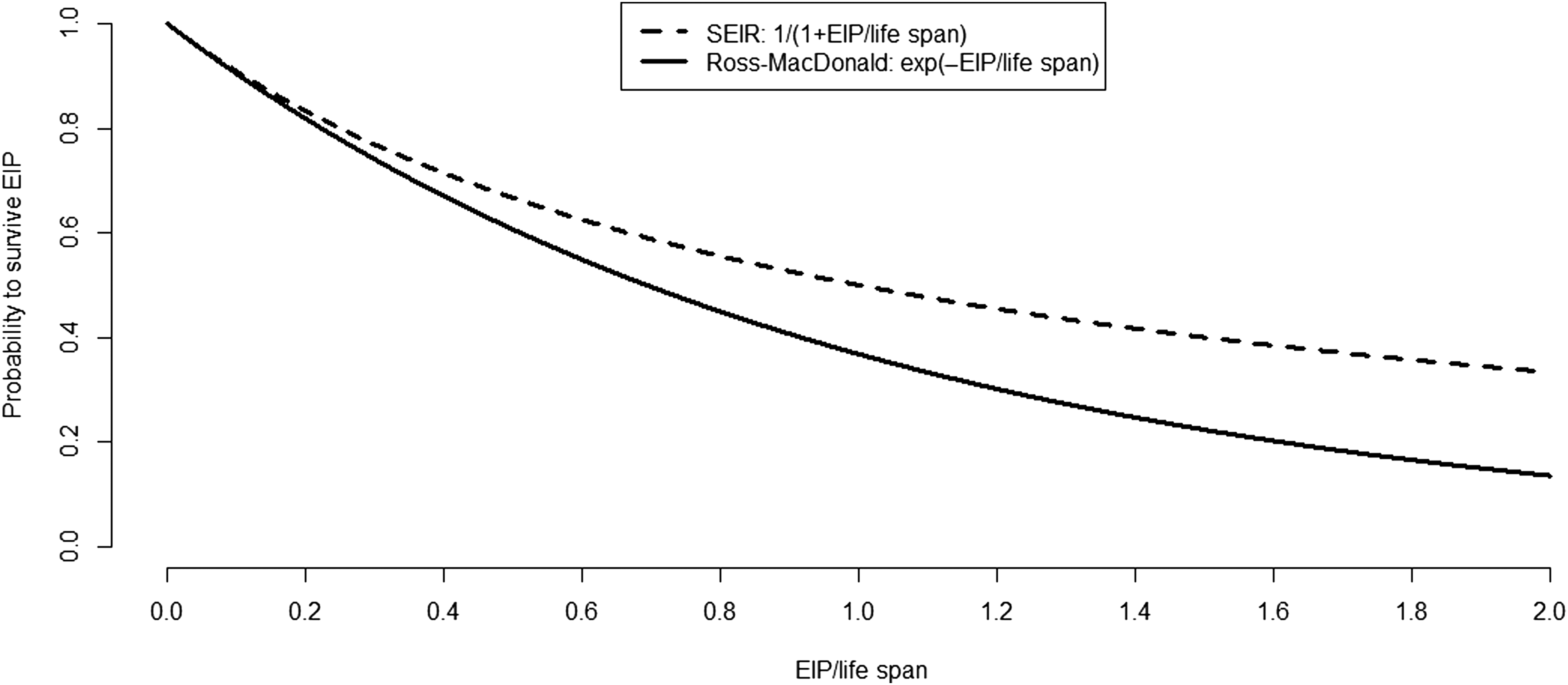
Plot of the probability to survive the extrinsic incubation period (EIP) as used in the Ross–MacDonald formula (solid line) and the SEIR- (Susceptible, Exposed, Infectious, and Recovered) derived formula (dashed line) against the ratio of the EIP and the average vector life span.
For small values of EIP/life span, both probabilities are close to unity and the curves are fairly similar. For higher values of EIP/life span, i.e., situations where the EIP is long compared to the life span, the curves start to deviate. The probability of surviving the EIP is higher when using the SEIR-type assumption (dashed curve) than when using the Ross–MacDonald assumption (solid curve). Hence, the impact of the assumption is considerable if the EIP is long compared to the average life span.
Effect on R 0
The effect on R 0 can be shown by comparing the R 0 values for the two assumptions, using an arbitrary but biologically plausible set of parameters values. Imagine a vector-borne disease system where the average remaining life span for adult vectors is 6 days and the duration of the EIP 10 days. The infectious period of the host is 3 days (r=1/3), the vector-to-host ratio m is 100, the transmission efficiencies b and c both 0.5, and the biting rate a is 0.2 per day. For this parameter set, the Ross–MacDonald formula yields an R 0 value of 3.40, whereas the SEIR-model derived formula yields a value of 6.75. The difference (a factor of 6.75/3.4=1.99) is the result of the difference in probability to survive the EIP.
Discussion
Because the EIP has a particular length (depending on temperature) and the vector is not infective until that period is complete, the assumption used in the Ross–MacDonald formula is more realistic from a biological point of view. The other assumption will only yield a good approximation when the EIP is short compared to the vector's life span. For situations where the EIP is long compared to the life span, the probability to survive the EIP is best modeled as e − EIP/life span (i.e., pn ).
Footnotes
Acknowledgments
The authors would like to thank Sarah Randolph for triggering our interest in this topic and Odo Diekmann, Hans Heesterbeek, and the UCL Geography of Health group for useful discussions. This study was funded by European Union grant FP7-261504 EDENext and is catalogued by the EDENext Steering Committee as EDENext246 (
Author Disclosure Statement
No competing financial interests exist.