




Abstract
Following the identification of Aedes (Ae.) aegypti in the Sochi area in Russia at the beginning of 2000, entomological surveys were conducted during the summers of 2007, 2011, and 2012, leading to the identification of Ae. albopictus and Ae. koreicus. These findings highlight Russia as being the only country in the World Health Organization European Region with a documented presence of both Ae. aegypti and Ae. albopictus mosquitoes. Both mosquito species are found on the coasts of the Black Sea. Control measures are needed to reduce the possible risks of importing exotic vector-borne infections, such as dengue and chikungunya.
Introduction
A
edes spp.
The large-scale outbreaks of dengue fever in Greece in 1927–1928 sustained by Ae. aegypti resulted in successive spread to other Mediterranean countries and to some Turkish Black Sea ports close to the USSR border. Since the 1950s, extensive mosquito control measures to prevent the spread of dengue fever in USSR had eliminated Ae. aegypti.(Marzinovsky et al. 1929, Gornostaeva et al. 2000).
In 2001–2004, during the months of August and September, a small number of Ae. aegypti females were found for the first time in the Central District of Sochi (Riabova et al. 2005). Following this observation, several studies were planned to evaluate whether Ae. aegypti had established itself outside the Sochi area and to quantify the presence of Aedes spp. larvae and adult mosquitoes.
Materials and Methods
Entomological surveys were conducted during the summer season (July to mid-October), in 2007, 2012, and 2013, in the Greater Sochi and adjacent areas of Russia, from Anapa (northward) to Sukhumi, the capital of Abkhazia (southward of the Greater Sochi). Overall, 70 biotopes in 11 settlements were covered. Suitable sites for mosquito breeding were selected to cover the Russian coast around Sochi, for a length of about 120 km.
Adult Ae. aegypti, Ae. albopictus, and other Aedes spp. mosquitoes were collected by the “collection itself” method, using sucking tubes for sampling indoor-resting populations of mosquitoes and by sweep nets for swarming mosquitos near breeding sites within the settlements. Larvae were collected from hollow rocks, used tires, abandoned baskets, and various other forms of containers and placed into small cuvettes to breed adults to determine the species. Identification of Ae. aegypti and Ae. albopictus mosquitoes was performed in accordance with morphological characteristics, and confirmed by PCR; the Basic Local Alignment Search Tool (BLAST) was used to compare sequences obtained from DNA amplification products with those included in the GenBank—AY512668 for Ae. aegypti, and AB231675 for Ae. albopictus. Nucleotide sequences of mitochondrial markers ND5 and COI from the 2008–2011 collections of mosquito DNA were recorded in the GenBank with the accession numbers HE820718, HE820719 (COI of Ae. aegypti, from Sochi and Gudauta), HE820721, HE820722 (ND5 of Ae. aegypti, from Sochi and Gudauta), and HE820720 and HE820723 (COI and ND5 of Ae. albopictus, from Khosta).
Results
The results of the surveys are summarized in Table 1 and Figure 1. Ae. aegypti was found in almost all regions throughout the study period, being predominant in Tuapse and to a lesser extent in Agoy, an area with typically semi-dry Mediterranean climate. Ae. albopictus was predominant within the humid subtropical climate zone of the Greater Sochi, from Adler to the village of Lasarevskoe; this area includes several sites, such as Sochi, Mamayka, and Adler. In virtually all sites, the ratio between Ae. albopictus and Ae. aegypti mosquitoes detected in the surveys tended to increase over the years. Finally, Ae. koreicus was detected for the first time in 2013 in Mamayka.
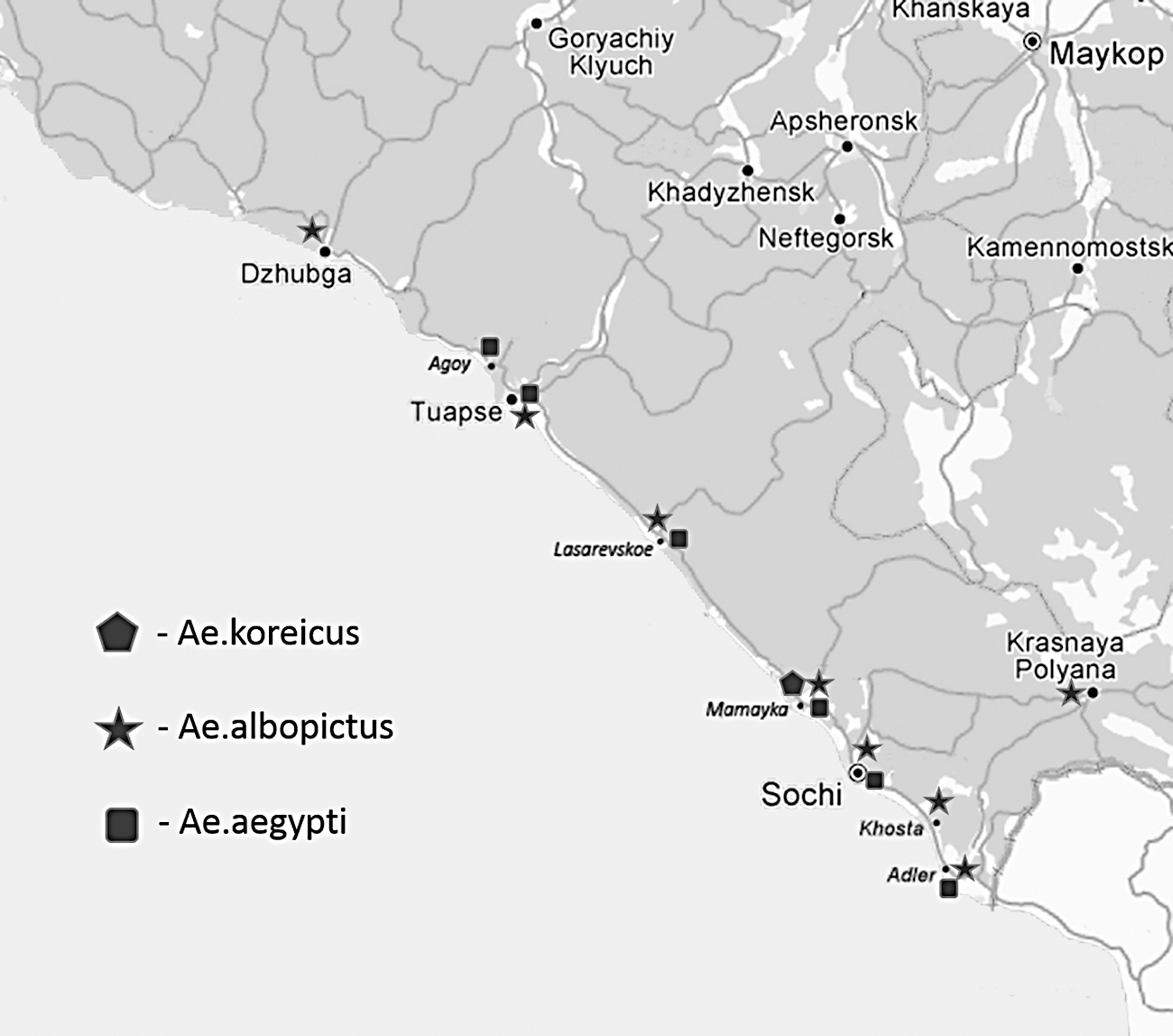
Map of the study area showing the localities where Aedes spp. mosquitoes were identified.
Year of first identification.
Cumulative data for 2001–2004; mosquitoes were identified for the first time in 2001.
Discussion
Aedes mosquitoes were not found in the northwestern towns of Anapa, Novorossiysk, and Gelendzhik (Ganushkina et al. 2013). Surprisingly, although Ae. aegypti was predominant in the northern area of the Greater Sochi, only Ae. albopictus was found in the northernmost area in the village of Dzhubga, along with Culex and Anopheles larvae (data not shown). Additionally, Ae. aegypti imago and larvae were found also further south, outside the borders of Russia, in the Abkhazian towns of Sukhumi and Gudauta (Iunicheva et al. 2008).
Aedes spp. mosquitoes were detected not only on the coast but also inland. As an example, an Ae. albopictus mosquito was first identified in the coastal village of Khosta in 2011 (Ganushkina et al. 2012), but later also in Krasnaya Polyana, which is located 44 km from the coast, at an altitude of 600 meters above sea level (Ganushkina et al. 2013), and in the Tuapse district at about 15 km from the coast. Ae. koreicus was found for the first time in the microdistrict of Mamayka (Bezzhonova et al. 2014); although its natural habitat is in the Far East, this mosquito has recently been found in Western European countries, such as Italy and Belgium (Capelli et al. 2011, Versteirt et al. 2012).
One main limitation of the study was that other mosquito species were not quantified. Although Culex pipiens was the predominant species, being detected 1.2–1.5 times more than Aedes spp. mosquitoes, the exact number of mosquitoes collected was not recorded (data not shown). Thus, the density of specific mosquito species could not be measured. Furthermore, we cannot exclude Aedes spp. presence in areas with negative results, due to insufficient sampling.
In conclusion, Russia is the only country in the World Health Organization European Region that has documented the presence of both Ae. aegypti and Ae. albopictus mosquitoes. Both mosquito species, which are competent vectors for dengue and chikungunya viruses, appear to have established themselves on the coasts of the Black Sea. Preparedness activities for early detection of mosquito and other exotic diseases, necessitates the use control measures to reduce the risk of vector-borne infection, importation, and spread.
Footnotes
Author Disclosure Statement
No competing financial interests exist.