




Abstract
The West Nile virus (WNV) transmission cycle includes a wide range of migratory wetland birds as reservoirs, mosquitoes as biological vectors, and equines and humans as dead-end hosts. Despite the presence of potential vector species, there is no information about the existence of WNV in mosquito vectors in Iran. The Iranian West Azerbaijan Province is located in the northwestern part of Iran and has borders with Turkey, Iraq, Armenia, and the Republic of Azerbaijan. The current study was conducted to identify the wetland mosquitoes of the West Azerbaijan Province and their infection with WNV. In this study, 2143 specimens were collected, comprising 1541 adults and 602 larvae. Six species belonging to four genera were collected and identified: Anopheles maculipennis sensu lato (s.l.), Culex (Cx.) hortensis, Cx. pipiens s.l., Cx. theileri, Culiseta longiareolata, and Aedes (Ae.) (Ochlerotatus) caspius. In total, 45 pools of mosquitoes were examined. Two of the adult pools collected from the same location showed the presence of WNV in Ae. (Och.) caspius, from Sangar, Makoo County, as confirmed by PCR and sequencing. Due to the discovery of WNV in the mosquito population of the region, and the presence of wetlands and significant populations of migratory birds, the health sector should carefully monitor the factors involved in the cycle of this disease.
Introduction
A
Because of the presence of different climatic conditions and theoretically suitable environments for the establishment of WNV foci across Iran, several studies have focused on the presence of WNV in humans (Naficy and Saidi 1970, Saidi et al. 1976, Talebian 2010, Chinikar et al. 2012, Meshkat et al. 2015), equines (Ahmadnejad et al. 2011), and birds (Fereidouni et al. 2011). However, despite the presence of potential vector species (Azari-Hamidian et al. 2009), there is no information about the existence of WNV in mosquito populations in Iran. The Iranian West Azerbaijan Province is located in the northwestern part of Iran and has borders with Turkey, Iraq, Armenia, and the Republic of Azerbaijan. This province is well-known for its abundant water resources and wetlands for migratory birds from around the world (John 2005, Salmanzadeh et al. 2011). Also, the presence of potential vector species of mosquitoes in this region, e.g., Culex (Cx.) pipiens sensu lato (s.l.), Aedes (Ae.)(Ochlerotatus) caspius, Anopheles maculipennis s.l., and Culiseta (Cs.) longiareolata (Azari-Hamidian et al. 2009, Khoshdel-Nezamiha et al. 2014), prompted us to conduct the current study to identify the wetland mosquitoes of the West Azerbaijan Province and their infection with WNV.
Materials and Methods
Study area
The West Azerbaijan Province in Northwestern Iran borders Turkey, Iraq, Armenia, Azerbaijan, and the provinces of East Azerbaijan, Zanjan, and Kurdistan (Fig. 1). This province is dominated by forest steppe with different climatic regions: Hot Summer Mediterranean climate, Mediterranean continental climate, and Hot Summer climate. It also contains different geographical regions, such as mountainous areas near the border with Iraq and Turkey, plains near the Aras and other rivers, and the coastline of the Urmia Lake. There are more than 30 wetlands across this province, of which six have been designated as Ramsar sites (wetlands of international importance), and 278 species of birds have been reported from this region (Lepage 2015).
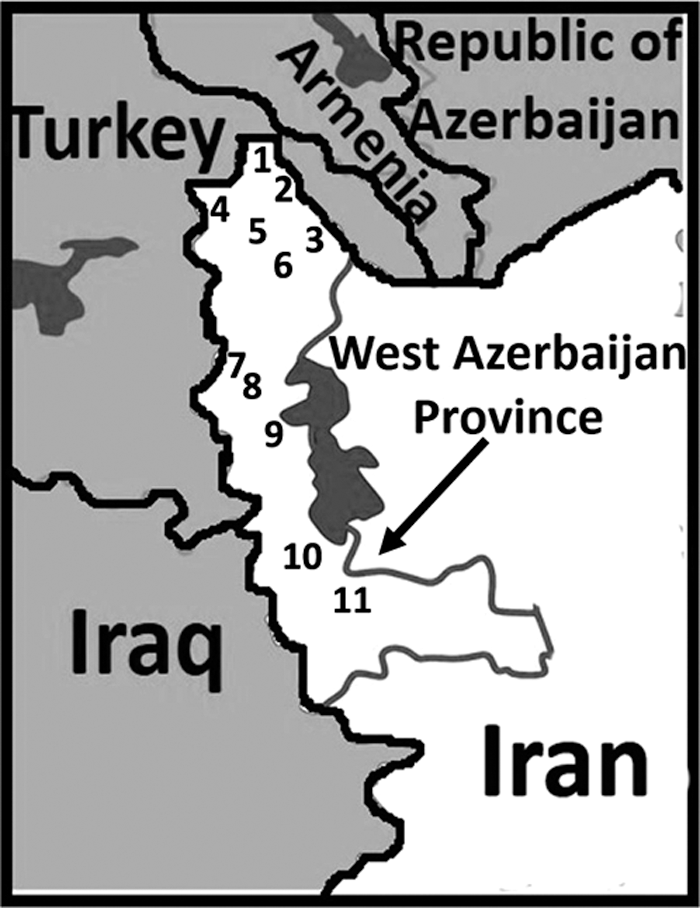
Map of study area and collection sites. 1, Khol-Kholeh; 2, Ghooch-Ali; 3, Deim-Gheshlagh; 4, Yarim-Ghiye; 5, Milan; 6, Sangar; 7, Naz-Loo; 8, Koor-Abad; 9, Ghahraman-Loo; 10, Khoor-Khoreh; 11, Kani-Barazan.
Species collection and identification
Mosquito larval collection was carried out during May through November, 2012, in 11 localities of five counties across the West Azerbaijan Province (Tables 1 and 2). Larvae were collected from different habitats using a 350-mL dipper according to the standard dipping method (Silver 2008). The third- and fourth-instar larvae were identified using a standard morphological key (Azari-Hamidian and Harbach 2009).
According to Köppen–Geiger climate classification (Kottek et al. 2006).
Dfa, Hot Summer climate; Csa, Hot Summer Mediterranean; Dsa, Mediterranean continental climate.
Collection of adult mosquitoes was employed twice with a 2-week interval. Collected samples were quickly identified using a stereomicroscope at the collection sites and a standard morphological key (Azari-Hamidian et al. 2009). The samples were then labeled and transferred to the laboratory in liquid nitrogen. Several methods for adult collection were used: Hand catches (during sunrise from human and animal dwellings), day and night landing catches on cows, pit shelter collection, and total catch (Silver 2008). For total catch, a human or animal dwelling was covered by white cotton fabric, and all entrances and exits of the location were closed before spraying insecticides for less than 1 min. After 10–15 min, all windows and doors were opened, and the white cotton fabric was carefully inspected for dead or knocked-down mosquitoes.
RNA extraction and RT-PCR investigations
From each location, typically 50 specimens of each species were pooled. Larvae and female adults were pooled separately. The samples were kept in −80°C until virus detection surveys were undertaken. RNA extraction from each pool of mosquitoes was carried out using the Total RNA Extraction Mini Kit (Yekta Tajhiz Azma®, Iran) according to the manufacturer's instructions.
An amplicon of the 3′-untranslated region (3′-UTR) was amplified using previously described primers (Lanciotti et al. 2000) with the One-Step RT-PCR Kit (Yekta Tajhiz Azma®, Iran). For all RT-PCR reaction sets, a plasmid containing the 3′-UTR region of WNV was used as positive control and distilled H2O as negative control. Each 25-μL reaction consisted of 2 μL of RNA and 50 pmol of each primer (forward primer, CAGACCACGCTACGGCG; reverse primer, CTAGGGCCGCGTGGG) and was run with the following conditions: 1 cycle of 45°C for 1 h followed by 94°C for 3 min and then 40 cycles of 94°C for 30 s, 55°C for 1 min, and 68°C for 3 min (Lanciotti et al. 2000). The amplicons were checked by 3% agarose gel electrophoresis and verified by sequencing. The sequences were submitted to GenBank under the accession numbers KP168714 and KP168715.
Results
In this study, 2143 specimens were collected in the wetlands of the West Azerbaijan Province comprising 1541 adults and 602 larvae (Table 2). Six species belonging to four genera were collected and identified: A. maculipennis s.l, Cx. hortensis, Cx. pipiens s.l, Cx. theileri, Cs. longiareolata, and Ae. (Och.) caspius. The most prevalent species were Ae. (Och). caspius (n = 672, 31%), Cx. theileri (n = 618, 29%), A. maculipennis (n = 368, 17%), and Cx. pipiens (n = 354, 17%) (Table 2). Among the 11 collection localities, the wetlands of Sangar in the Makoo County located in the north of the West Azerbaijan Province revealed the richest fauna of mosquitoes where all six identified species were collected. In contrast, only one species was collected from the Ghahramanloo and Deim-Gheshlagh locations in Urmia and Bazargan, respectively (Table 2).
For determination of WNV infection of the collected specimens, 45 pools of mosquitoes were examined. Two of the adult pools collected from the same location (a total of 60 specimens) showed the desired band and were sequenced, confirming the presence of WNV in Ae. (Och.) caspius, from Sangar, Makoo County. These adult Ae. (Och.) caspius mosquitoes were collected mainly using daytime cattle-bait collection methods.
The current study used the pool-testing method for estimating the minimum infection rate (MIR) to 33.3 for Ae. (Och.) caspius (MIR is the ratio of the number of positive pools to total number of each species of mosquitoes tested). However, because the number of tested specimens was below 1000, the MIR may not accurately represent the true infection rate in the population (Bernard et al. 2001, Nasci et al. 2002, Gu et al. 2004).
Discussion
Despite the favorable natural and climatic conditions for the establishment and transmission of WNV in the Middle East region, the current study represents one of the first reports demonstrating the infection of mosquitoes with WNV in this region and shows the local transmission of the virus in Iran. It is only recently that WNV-infected mosquitoes have been reported from Turkey (Ergunay et al. 2014). Birds migrating from different parts of the world to the wetlands in the region provide a means for the transmission of this disease (Malkinson et al. 2002). In addition, the presence of potential vectors of the disease in the area (Khoshdel-Nezamiha et al. 2014) can complete the cycle of this disease.
The mosquito species (Ae. [Och.] caspius) that was found to be infected with WNV in this study has been suggested as one of the potential vectors of WNV (Balenghien et al. 2008, Aranda et al. 2009, Muñoz et al. 2012, Ergunay et al. 2014). Of the collected mosquito species, several are medically important. Apart from Ae. (Och.) caspius, being involved in WNV transmission, A. maculipennis, Cx. pipiens, Cx. theileri, and Cs. longiareolata are also potential vectors of WNV (Hubálek and Halouzka 1999, Jupp 2001, Romi et al. 2004). The identified species have been reported as vectors of other mosquito-borne diseases. For instance, Cx. theileri transmits dirofilariasis (Santa-Ana et al. 2006) and Ae. (Och.) caspius transmits insect-specific flaviviruses (Aranda et al. 2009, Vázquez et al. 2012).
Due to the discovery of WNV in the mosquito populations of the region, the presence of wetlands, and significant populations of migratory birds and horses, the health sector should carefully monitor the factors involved in the cycle of this disease and develop predictive models using the Geographical Information System (GIS) and remote sensing (RS). In any case, the possible role of imported exotic birds or inadvertently transported mosquitoes should not be ignored (Rappole et al. 2000).
Conclusions
The current study showed that Iranian mosquitoes are infected with WNV, demonstrating the local transmission of WNV in the region. Because the studied area (West Azerbaijan Province, Iran) is at the junction of five countries, these findings should alert the health sector in all of these countries. We recommend that control programs for mosquito-borne diseases take into account a possible transmission of WNV, especially at times of political or natural crises.
Footnotes
Acknowledgment
This article is part of the results of the first author's dissertation for fulfillment of an MSc degree in Medical Entomology and Vector Control from the Department of Medical Entomology and Vector Control, School of Public Health, Urmia University of Medical Sciences, Urmia, Iran. This study was financially supported by the Urmia University of Medical Sciences (project no. 1492).
Author Disclosure Statement
No competing financial interests exist.