




Abstract
The Asian house gecko Hemidactylus frenatus has been widely introduced in Costa Rica and tends to establish in human settlements. Some studies in other invaded countries have suggested that this gecko plays a significant role in the epidemiology of salmonellosis and it is of value to public health. To our knowledge, no studies have examined Salmonella from this species in Costa Rica. Therefore, we collected 115 geckos from houses in two Costa Rican regions. We examined gut contents for Salmonella through microbiological analysis. Presumptive Salmonella spp. were sent to a reference laboratory for serotyping and antimicrobial susceptibility testing. Molecular typing was also conducted with the main Salmonella isolates of zoonotic relevance in Costa Rica. H. frenatus was found in 95% of the houses surveyed. Salmonella was isolated in 4.3% of the samples, and four zoonotic serovars were detected. None of the isolates were resistant to the antibiotics most frequently used for salmonellosis treatment in Costa Rica. All Salmonella isolates from the lower gut of H. frenatus are associated with human salmonellosis. Pulsotypes from Salmonella enterica serotype Weltevreden were identical to the only clone previously reported from human samples in Costa Rica. Molecular typing of Salmonella Weltevreden suggested that H. frenatus harbors a serovar of public health importance in Costa Rica. Results demonstrated that H. frenatus plays a role in the epidemiology of human salmonellosis in two regions of Costa Rica. However, more detailed epidemiological studies are needed to understand better the role of the Asian house gecko with human salmonellosis, especially caused by Salmonella Weltevreden, and to quantify its risk in Costa Rica accurately.
Introduction
T
The Asian house gecko, Hemidactylus frenatus, is a very successful invasive reptile (Rödder et al. 2008, Hoskin 2011). It is native to Asia and the Indo-Pacific and has colonized many tropical and subtropical areas of the world (Savage 2002). It is remarkably well adapted to and regularly establishes in human settlements and highly human-modified habitats (Lever 2003). Some studies of H. frenatus have reported Salmonella serovars that are associated with human salmonellosis and have suggested that this gecko plays a significant role in the epidemiology of salmonellosis in invaded places (Chan 1982, Callaway et al. 2011, Nwachukwu et al. 2014). Because this gecko can harbor Salmonella associated with human salmonellosis and is commonly found in houses, there is substantial opportunity for disease transmission to humans through contaminated gecko droppings (Singh et al. 2013, Nwachukwu et al. 2014).
In Costa Rica, the Asian house gecko was introduced more than two decades ago; it now appears widespread in most of the country and tends to establish in human settlements (Abarca 2006). Nonetheless, Costa Rican scientists have shown little concern about the introduction of this gecko and its potential risks for human health. According to recommendations of the Office International des Epizooties (OIE), it is important to analyze not only the risk of a nonnative animal becoming invasive but also the risk of pathogens being introduced with the animal (Office International des Epizooties 2012).
To explore the gecko's potential role in the epidemiology of human salmonellosis, the main objectives of this study were to determine the prevalence of Salmonella spp. from the lower gut of H. frenatus from two regions of Costa Rica, identify the serotypes of Salmonella isolates, determine their susceptibility to antimicrobials, and establish the pulsotype of the main Salmonella isolates of zoonotic relevance in Costa Rica.
Materials and Methods
Sampling and sample collection
We aimed to collect ∼120 geckos from five rural towns from the North Pacific and Northwest Caribbean region of Costa Rica (∼60 individuals per region; see below) between June, 2013, and February, 2014. These regions were chosen because a previous study had confirmed the isolation of Salmonella Weltevreden from human infections in both regions (Bolaños et al. 2012) and the geckos were known to be present. We selected three towns in the North Pacific region: Sardinal, Palmira, and San Blas, and two towns in the Northwest Caribbean region, Puerto Viejo de Sarapiquí and La Virgen. In each region, we identified each neighborhood block from the towns, numbered them, and randomly selected 60 blocks. Then, from each selected block we randomly selected one house to collect one gecko and perform a 10-min survey.
We captured geckos by hand using a new pair of disposable gloves for each captured individual and placed them in individual sterile plastic bags with breathing holes. Captured geckos were transported to the Laboratory of Veterinary Bacteriology at the National University of Costa Rica (UNA) within 2 days of capture. Upon arrival, geckos were euthanized by intracardiac administration of 0.05 mL of T-61 Euthanasia Solution (Hellebrekers 1990). The lower gut was removed aseptically, and culturing procedures for Salmonella (see below) were conducted within 1 h of removal.
Sample size
We selected a sample size of 60 individuals per region using the methods described in Lwanga and Lemeshow (1991) with an estimated proportion of 0.07, a confidence level of 95%, and a precision value of ± 0.065. We hypothesized that Salmonella proportion (prevalence) would be around 7% on the basis of a previous study of H. frenatus in Northern Australia by Callaway et al. (2011). We calculated the sample size using Piface software version 1.76 (Lenth 2007).
Salmonella isolation
The lower gut of each gecko was weighed and processed separately. Tissues were first homogenized in buffered peptone water solution (BPW) in a 1:10 ratio. Samples were processed using two protocols in parallel, direct plating and with enrichment. For direct plating, we streaked a swab of the mixture onto agar plates with Salmonella selective media (Brilliant Green Agar [BGA], and Xylose Lysine Tergitol 4 [XLT4]) and then incubated plates for 24–48 h at 37°C. For the enrichment method, 40 μL of the mixture was inoculated into 3 mL of BPW and incubated for 24 h, along with the directly streaked plates. After BPW incubation, 100 μL and 1000 μL were transferred into 10 mL of Rappaport–Vassiliadis (RV) broth and 10 mL of tetrathionate broth, respectively. Both tubes were then incubated for 24 h at 42°C, after which a swab from each selective-enrichment broth was inoculated onto BGA and XLT4 plates and incubated for 24–48 h at 37°C. After incubation, plates from both protocols were examined for typical Salmonella colonies and tested, with the biochemical screening tests Christensen urea, triple sugar iron (TSI), and lysine iron agar (LIA). Strains with a biochemical profile consistent with Salmonella were then tested serologically with Salmonella Omnivalent antiserum (Denka), and biochemical identification was confirmed by Vitek 2 using a GN ID Card.
Serotyping, antimicrobial susceptibility testing, and molecular typing
Salmonella isolates were sent to the National Bacteriology Referral Center (Centro Nacional de Referencia en Bacteriología [CNRB]) of the Costa Rican Institute for Research and Teaching in Nutrition and Health (Instituto Costarricense de Investigación y Enseñanza en Nutrición y Salud [INCIENSA]), in Cartago, Costa Rica, for serotyping and antimicrobial susceptibility testing (Kirby Bauer/Clinical and Laboratory Standards Institute [CLSI]). The isolates were assigned to different serovars according to the White–Kauffmann–Le Minor Scheme (Grimont and Weill 2007). The results of the antimicrobial analysis were interpreted using guidelines of the CLSI (CLSI M100-S23, 2013). The antimicrobial agents used for sensitivity testing were ampicillin, trimethoprim–sulfamethoxazole, ceftazidime, chloramphenicol, ciprofloxacin, cefotaxime, nalidixic acid, tetracycline, streptomycin, sulfonamides, piperacillin, piperacillin–tazobactam, and nitrofurantoin. The main Salmonella isolates of zoonotic relevance in Costa Rica were selected for molecular typing with pulsed-field gel electrophoresis (PFGE) according to the standardized protocol of the PulseNet Latin America and Caribbean Network (Ribot et al. 2006) using the restriction enzyme XbaI. PFGE profiles were analyzed by using Bionumerics software version 5.1 (Applied Maths). The dice coefficient and unweighted pair group with arithmetic mean (UPGMA) with 1.5% band position tolerance were applied to compare the genetic relatedness between isolates.
Salmonella prevalence
The prevalence of Salmonella spp. from the lower gut of geckos and the 95% confidence interval (CI) was calculated using the package “Prevalence” (Devleesschauwer et al. 2014) in R version 3.1.1 (R Development Core Team 2014).
Ethics and permissions
The animal handling and procedures were in accordance with the guidelines established by the Comité de Bienestar Animal y Bioética de la Escuela de Medicina Veterinaria de la Universidad Nacional de Costa Rica and in agreement with the corresponding law Ley de Bienestar de los Animales of Costa Rica (Law 7451 on Animal Welfare). This study was conducted under research permission of the Ministerio de Ambiente y Energía (069-2013-SINAC).
Results
A total of 121 houses were visited across the two study regions and 115 geckos were collected. Sixty-three individuals were collected from Sardinal (n = 36), San Blas (n = 13), and Palmira (n = 14) in the Pacific region. In the Caribbean region, 52 individuals were collected from La Virgen (n = 21) and Puerto Viejo de Sarapiquí (n = 31). Collected individuals included 60 females and 55 males. The average mass of the lower guts of geckos was 0.13 ± 0.01 gram (mean ± standard error [SE], range 0.12–0.28 gram).
The prevalence of Salmonella spp. from the lower gut of the geckos in the Pacific region was 6.5% (4/63; 95% CI 3–12%), in the Caribbean 2% (1/52; 95% CI 0–6%), and for both regions 4.3% (5/115; 95% CI 1–8%). The serotyping of Salmonella revealed four serovars from S. enterica subsp. enterica (Table 1). In anecdotal sampling outside of our study region in Bagaces, Guanacaste, we also isolated Salmonella Adelaide from one of 10 geckos collected from a single house, but these individuals were not included in the prevalence analysis.
Two isolates of Salmonella Weltevreden were obtained from different regions that showed indistinguishable PFGE patterns (Fig. 1). Both isolates showed the pulsotype CRINJQPX01.0002 using the restriction enzyme XbaI.
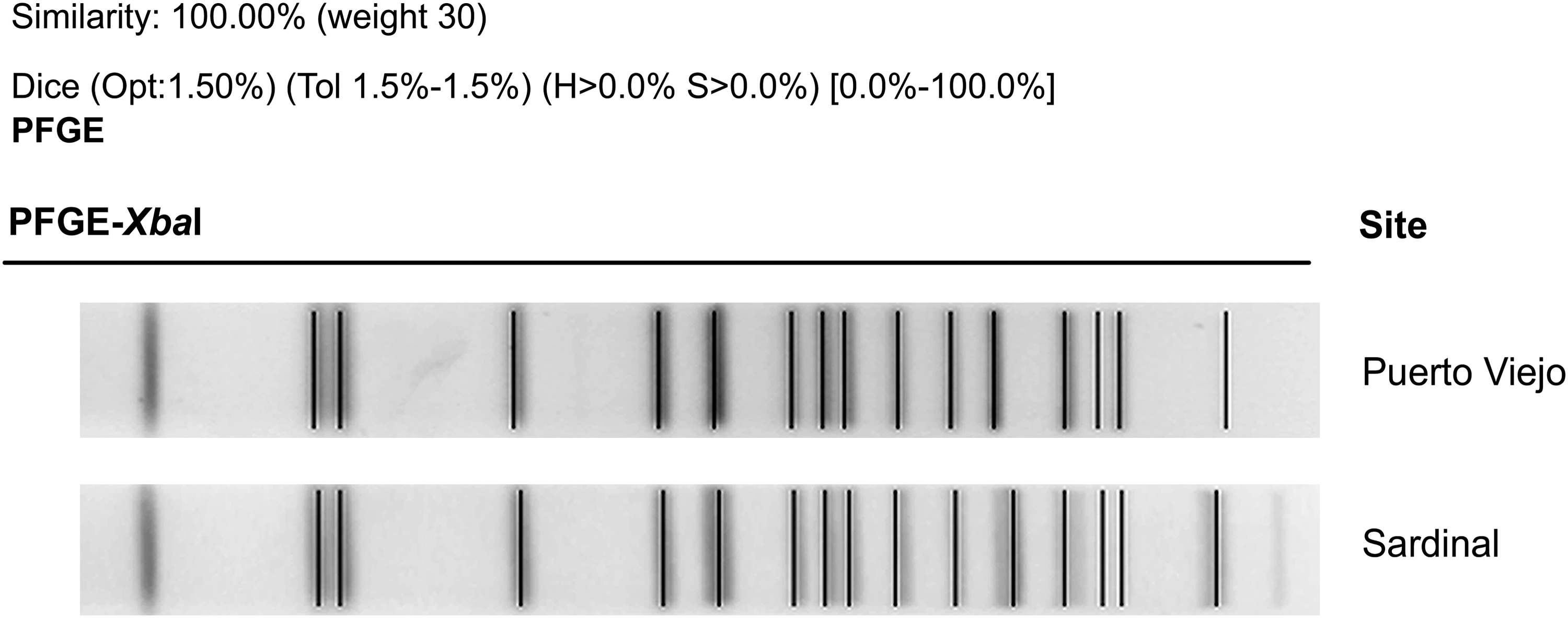
Pulsed-field gel electrophoresis (PFGE) patterns showing the close genetic relationship of Salmonella Weltevreden isolated from the lower gut of Asian house geckos (H. frenatus) from two regions of Costa Rica.
None of the Salmonella isolates were resistant to the antibiotics commonly used to treat human salmonellosis in Costa Rica, such as trimethoprim–sulfamethoxazole, ciprofloxacin, or cefotaxime (Table 2). However, 50% of isolates showed intermediate resistance to streptomycin and resistance to sulfonamides.
Resistance testing followed the Kirby–Bauer method; numbers indicate the inhibition zone diameter in mm.
AMP, ampicillin; SXT, trimethoprim–sulfamethoxazole; CEF, ceftazidime; CHL, chloramphenicol; CIP, ciprofloxacin; FOX, cefotaxime; NAL, nalidixic acid; TET, tetracycline; STR, streptomycin; SUL, sulfonamides; PIP, piperacillin; TAZ, piperacillin–tazobactam; NIT, nitrofurantoin; R, resistant; i, intermediate.
Discussion
In this study, 95% of the houses we surveyed were inhabited by Asian house geckos. Individuals were found in different places in houses, such as bedrooms, living rooms, and kitchens, confirming that this species has invaded practically all of our study areas and has settled efficiently in houses. Thus, human residents of these areas live in close relationship with H. frenatus, as was also seen in Northern Australia (Callaway et al. 2011).
To our knowledge, this is the first study examining Salmonella in an introduced and peridomestic species in Costa Rica. This study is important because along with other studies conducted in other invaded countries, it demonstrates the potential of H. frenatus as a reservoir of a bacteria that is of public health relevance in developing and developed countries (Chan 1982, Callaway et al. 2011, Singh et al. 2013, Nwachukwu et al. 2014). Geckos could be colonized by Salmonella through contact with animal reservoirs or via ingestion of contaminated food (i.e., insects) or water (Smith et al. 2012). We suggest that cockroaches and house flies eaten by H. frenatus might be the main source of zoonotic isolates of Salmonella because these insects have high contact with human and animal excreta (Nwachukwu et al. 2014); however, further research is needed to elucidate the most important transfer mechanism. The low prevalence of Salmonella is similar to that determined for H. frenatus in Northern Australia (7%) (Callaway et al. 2011) and is much lower than the prevalence reported in H. frenatus from houses in Nigeria (25.7%) and in Gekko gecko from houses in Singapore (23%) (Oboegbulem and Iseghohimhen 1985, Murphy and Myers 1993, Nwachukwu et al. 2014).
All serovars detected in this study have been reported previously in reptiles and are of zoonotic concern (Oboegbulem and Iseghohimhen 1985, Murphy and Myers 1993). Despite the low prevalence of Salmonella, which is a positive insight for public health, the fact that all of the serovars detected are zoonotic pathogens is of concern because these geckos cohabit closely with humans. In Costa Rica, all of the serovars found in this study, with the exception of Salmonella Weltevreden, have been isolated sporadically from clinical human samples (Bolaños et al. 2014). Salmonella Glostrup is not commonly isolated in most countries and is considered to be a rare serovar. It was, however, reported from the feces of a child and from material in the tank housing the child's pet lizards (Mabuya quinquetaeniata); because both isolates were genetically related, the pets are thought to be the most likely source of infection (Old et al. 1999). To our knowledge, the current study provides the first report of Salmonella Glostrup isolated from a gecko. Salmonella Adelaide is another rare serovar that has been cultured from reptiles, including turtles and snakes (De Jong et al. 2005, Chen et al. 2010). From 1983 to 1984, the reported human isolates of Salmonella Adelaide increased from 45 to 78 in the United States; Illinois, New York, and Virginia accounted for 51% of this serovar (Hargrett-Bean 1988). Salmonella Abaetetuba has been detected in wild iguanas in Ecuador, and in Canada it was reported causing salmonellosis in humans (Woodward et al. 1997, Franco et al. 2011). Salmonella Weltevreden has been reported as one of the most common serovars and an increasing cause of human infection in Southeast Asia, including in Thailand, Malaysia, and Vietnam (Yasin et al. 1995, Bangtrakulnonth et al. 2004). It is not very common in the Americas, Caribbean, Europe, or Africa (Bangtrakulnonth et al. 2004). This serovar has been isolated previously from geckos in Asia, Australia, and Nigeria (Oboegbulem and Iseghohimhen 1985, Murphy and Myers 1993, Callaway et al. 2011), and also from well water (Thong et al. 2002) and from animal and vegetable products (Heinitz et al. 2000, Vo et al. 2006, Barua et al. 2014). Also, introduced house geckos in Hawaii have been reported to harbor Salmonella Weltevreden and they appear to be the major source of Salmonella infection in that area (Steele 2008). In Costa Rica, this serovar has recently become a problem for human health.
The National Bacteriology Referral Center (NBRC) reported an increased frequency of cases of human salmonellosis by Salmonella Weltevreden from 2010 (n = 8) to 2012 (n = 21), and it is one of the five most frequent serovars identified in human samples from Costa Rica (Bolaños et al. 2014). This pathogen is currently distributed in all Costa Rican provinces and, to date, the vehicle(s) of infection that favored its dispersion is unknown (Bolaños et al. 2012). Furthermore, NBRC reported that 11 isolates of this serovar, from six of the seven provinces of the country, showed indistinguishable PFGE patterns, suggesting that it is a clone with wide distribution in Costa Rica (Bolaños et al. 2012). Interestingly, the pulsotype from our two isolates of Salmonella Weltevreden (CRINJQPX01.0002; Fig. 1) was identical to the one from these 11 isolates previously reported from human samples by Bolaños et al. (2012).
The wide distribution of Salmonella Weltevreden in humans, along with the close genetic relationship between isolates from humans and H. frenatus, suggests that the Asian house geckos harbor a serovar of public health importance in Costa Rica. Therefore, this gecko might be a possible source of this serovar for human infections via feces in houses. Further research is required to better understand the role of H. frenatus in the dynamics of this relevant zoonotic serovar in Costa Rica.
Worldwide, the prevalence of antibiotic resistance in Salmonella has increased, which is becoming a serious problem for treatment of this infection (Chen et al. 2013). Nonetheless, the Salmonella isolates from geckos in this study expressed no resistance to the antibiotics most frequently used in clinical treatment (Table 2), suggesting that people infected with these clones can be treated effectively with a wide range of antibiotics. This result also suggests that the geckos have had little exposure to antibiotics or antimicrobial-resistant bacteria from domestic animals or humans. Streptomycin was the only antibiotic to which one isolate of Salmonella Weltevreden, and both isolates of Salmonella Abaetetuba, presented antibiotic resistance, and streptomycin-resistant Salmonella is also known from other studies of reptiles (Corrente et al. 2004, Chen et al. 2010).
Our study shows that a widespread, introduced, and peridomestic species has a low prevalence of Salmonella and harbors isolates of Salmonella associated with human salmonellosis that are sensitive to the antibiotics most commonly used in clinical treatment. These results are highly relevant for health authorities attempting to prevent and control Salmonella infections in humans. The major finding of this work is a PFGE pattern for Salmonella Weltevreden that is indistinguishable between H. frenatus and humans isolates with wide distribution in the country, suggesting that this gecko may serve as a vector of a serotype of public health importance in Costa Rica.
Furthermore, we highlight that the relationship between humans and geckos in houses identified in this study might have zoonotic implications because we found zoonotic Salmonella serovars, and in particular isolates of Salmonella Weltevreden, in both regions. The droppings from this gecko likely contaminate the human environment with zoonotic enteropathogens, including nontyphoidal salmonellae (Callaway et al. 2011, Singh et al. 2013, Nwachukwu et al. 2014). Future studies must determine to what extent or how often pathogens from infected gecko feces enter human bodies and affect people. For now, we recommend that people should be cautious and clean up areas in their houses where gecko feces are found, because these feces are considered a relevant route of direct and indirect contamination and transmission to humans. This study identifies a potential risk for salmonellosis in two regions of Costa Rica, but we propose that more detailed epidemiological studies are needed to understand better the role of the Asian house gecko with human salmonellosis, especially that caused by Salmonella Weltevreden, and to accurately quantify its risk in Costa Rica.
Footnotes
Acknowledgments
Financial support for this research was provided by the US Fish and Wildlife Service, Division of National University, National Council for Scientific and Technological Research of Costa Rica, and Ministry of Science and Technology of Costa Rica. We thank the Laboratory of Veterinary Bacteriology at National University for assistance with Salmonella isolates. We also thank the National Bacteriology Referral Center of the Costa Rican Institute for Research and Teaching in Nutrition and Health for serotyping, antimicrobial susceptibility testing and molecular typing Salmonella isolates. We thank Karen Warkentin and Jennifer Stynoski for their comments and English revision to the draft manuscript. We also thank Hernán Coello, Tania Chacón, Natalia Díaz, and Diego Gutiérrez for field assistance.
Author Disclosure Statement
No competing financial interests exist.