




Abstract
The persistence of tick-borne encephalitis virus (TBEV) in nature is maintained by numerous species of reservoir hosts, multiple transmissions between vertebrates and invertebrates, and the virus adaptation to its hosts.
Our Aim:
was to compare TBEV isolates from ticks and small wild mammals to estimate their roles in the circulation of the viral subtypes.
Methods:
TBEV isolates from two species of ixodid ticks, four species of rodents, and one species of shrews in the Novosibirsk region, South-Western Siberia, Russia, were analyzed using bioassay, hemagglutination, hemagglutination inhibition, neutralization tests, ELISA, reverse transcription with real-time PCR, and phylogenetic analysis.
Results:
TBEV RNA and/or protein E were found in 70.9% ± 3.0% of mammals and in 3.8% ± 0.4% of ticks. The TBEV infection rate, main subtypes, and neurovirulence were similar between ixodid tick species. However, the proportions of the virus that were pathogenic for laboratory mice and of the Far-Eastern (FE) subtype, as well as the viral loads with the Siberian and the European subtypes for the TBEV in Ixodes pavlovskyi Pomerantsev, 1946 were higher than in Ixodes persulcatus (P. Schulze, 1930). Percentages of infected Myodes rutilus, Sicista betulina, and Sorex araneus exceeded those of Apodemus agrarius and Myodes rufocanus. Larvae and nymphs of ticks were found mainly on rodents, especially on Myodes rufocanus and S. betulina. The proportion of TBEV-mixed infections with different subtypes in the infected ticks (55.9% ± 6.5%) was higher than in small mammals (36.1% ± 4.0%) (p < 0.01).
Conclusions:
Molecular typing revealed mono- or mixed infection with three main subtypes of TBEV in ticks and small mammals. The Siberian subtype was more common in ixodid ticks, and the FE subtype was more common in small mammals (p < 0.001). TBEV isolates of the European subtype were rare. TBEV infection among different species of small mammals did not correlate with their infestation rate with ticks in the Novosibirsk region, Russia.
Introduction
E
Tick-borne encephalitis (TBE) is the most important flavivirus infection of the central nervous system in Eurasia. Its etiological agent, the tick-borne encephalitis virus (TBEV), circulates among vertebrate hosts and arthropod vectors (ticks). Host species abundance, multiple transmission cycles, and adaptation of TBEV to different hosts provide stability to the whole parasitic system (Mansfield et al., 2009; Bakhvalova et al., 2011; Rizzoli et al., 2014). Ticks are ideal carriers of TBEV due to their ability to feed on a variety of vertebrates, intracellular digestion of blood, and their long life cycle. Natural TBEV infection has been revealed in 16 species of ixodid ticks (Korenberg, 1989). Among them, Ixodes persulcatus and Ixodes pavlovskyi (Bogdanov, 2006; Bakhvalova et al., 2011; Romanenko and Kondrat'eva, 2011) are the prevalent tick species in Western Siberia and are, therefore, the main vectors of TBEV in that area. Ixodid ticks parasitize vertebrates, including mammals, birds, reptiles, and amphibians (Levkovich et al., 1967; Filippova, 1985). TBEV is not pathogenic in most hosts. Small mammals with life spans shorter than that of ixodid ticks assisted by high reproduction rates, the immature immune system of young animals, and vertical transmission of TBEV support the intracellular TBEV persistence even in the presence of virus-specific antibodies (Bakhvalova et al., 2006).
TBEV as a member of the family Flaviviridae possesses a single-stranded, positive-sense genomic RNA of approximately 11 kb (Gritsun et al., 2003; Mansfield et al., 2009). Molecular typing of TBEV using ELISA, molecular hybridization with radioactive oligonucleotide probes, sequencing of the gene E, more recently, complete genome sequencing, and phylogenetic analysis permitted to reveal three main intraspecies subtypes (Pogodina et al., 1981; Zlobin et al., 1996; Ecker et al., 1999; Bakhvalova et al., 2000), namely the Far-Eastern (FE) subtype, the Siberian (Sib) subtype, and the European (Eur) subtype with 15.2–16.4% nucleotide changes and 6.2–6.9% differences in amino-acid sequences (Kozlova et al., 2013). The FE subtype includes mainly isolates from Far-Eastern Russia, China, and Japan; the Sib subtype earlier included isolates from Eastern and Western Siberia, Urals, and FE Russia, and at present is the dominant subtype in many endemic regions of Russia and surrounding countries, gradually replacing other TBEV subtypes (Pogodina et al., 2007); and the Eur subtype comprises almost all known isolates from Europe (Gritsun et al., 2003; Mansfield et al., 2009). Besides the three conventional subtypes, 178–79 and “886–84 group” strains have been proposed as fourth and fifth TBEV subtypes, respectively (Kozlova et al., 2013). The TBEV isolates belonging to the phylogenetically defined subtypes can be found in every endemic region in different proportions (Zlobin et al., 1992).
The three main TBEV subtypes are associated with varying degrees of disease severity. Human infections with the TBEV FE subtype are usually severe, frequently with encephalitic symptoms, and have a case fatality rate of 5–35%. The Sib subtype causes a less severe disease (fatality rate of 1–3%), with a tendency for patients to develop chronic infections. Infections caused by the Eur subtype typically take a biphasic course: The first (viraemic) phase presents with fever, often followed by a symptom-free interval; the second phase in 20–30% of infected patients is characterized by meningitis, meningoencephalitis, meningoencephalomyelitis or meningoencephaloradiculitis, the appearance of specific antibodies in the serum and cerebrospinal fluid, and a fatality rate of less than 2% (Gritsun et al., 2003; Mansfield et al., 2009). Accordingly, as a consequence, changes in the proportions of the TBEV subtypes could have significant implications for public health. Therefore, geographic distribution of the TBEV subtypes in natural populations should be studied for appropriate vaccine formulation and risk prognosis.
Our aim was to compare TBEV isolates from ticks and wild small mammals to estimate their roles in circulation of the viral subtypes.
Materials and Methods
Ticks and small mammals
Monitoring of population dynamics of ixodid ticks and small mammals along with their TBEV infection rate was performed in aspen-birch and pine forests near Novosibirsk, Russia (54°49' N, 83°05' E, total area approximately 90 km2) on fixed sites each year during the period 1980–2014 by using zoological and virological methods (Bakhvalova et al., 2006).
Ticks were collected from vegetation in 3–5 days during May and June (when ticks are the most active in the region) by using 60 × 100 cm cotton cloths along several 1.5 and 3 km long routes according to the modified dragging method (Chong et al., 2013). The results of the dragging method are highly correlated with the sweeping method (Chong et al., 2013). After every 10–15 m of the routes, unfed ticks were removed from the “flag” by forceps and placed in tubes. Ticks per 1 flag-km indicate the score of relative abundance of ticks that is calculated as the number of unfed adult ticks averaged per 1 km,
Small mammals were trapped using standard pitfall grooves (50 m long, 20 cm deep, and 20 cm wide with five iron cylinder traps) (White et al., 1982; Kobayashi et al., 1994; Barnett and Dutton, 1995; Lunney et al., 2009) from May to August each year. Pitfall grooves (4–6 in each biotope) were inspected every day in the morning and in the evening. Data are expressed as a number of captured animals per 100 trap nights (Simonetti, 1986; Theuerkauf et al., 2011).The number of animals per 100 trap nights is a measure of the relative abundance of small mammals trapped in pitfalls and is calculated as
Additionally, to determine infestation of small mammals with immature ticks and to study TBEV infection rate, small mammals were captured using live traps (more than 20 traps with 10 m intervals between them) (White et al., 1982; Narita et al., 1995; Theuerkauf et al., 2011), which were also examined from May to August each year.
During the spring–summer seasons of 2009–2014, unfed adult ticks and small wild mammals were also collected for molecular typing of the TBEV isolates. Ticks were kept alive at +4°C for less than 1 week before TBEV detection and isolation. Samples of brain, spleen, and blood clot from the animals were separately washed with 0.15 M NaCl, and 10% suspensions in physiological solution were prepared for individual analysis.
The research complied with the guidelines for work with experimental animals and protection of animals against cruelty (Animal Welfare Act no. 246/1992 Coll.) and was in accordance with the law N755 of the Russian Ministry of Health of 1977-12-08.
TBEV detection
TBEV was detected using ELISA, reverse transcription with real-time PCR (RT2-PCR), bioassay, hemagglutination and hemagglutination inhibition, and neutralization tests as previously described (Bakhvalova et al., 2006). Phylogenetic analysis of nucleotide sequences of RT-PCR products corresponding to the TBEV E and NS1 genes was carried out using the Mega 6.06 software (
Pathogenicity of the TBEV isolates was estimated by intracerebral and subcutaneous infections of 1–3 day-old ICR mice with supernatants of homogenates of ticks or organs of wild mammals with subsequent passages of the infected mouse brain suspensions using 10–12 day-old mice. Pathogenicity was estimated by the development of tick-borne encephalitis symptoms, including at the early stage of infection decreased mobility, languor, lack of appetite or refusal to eat, later thrill, slight tremor of extremities, rapid breathing, photophobia, spasms, paresis and paralysis of hindquarters, and at last death in several hours after appearance of first signs in the infected mice. Specificity of the infection was confirmed using RT2-PCR, ELISA, hemagglutination, hemagglutination inhibition, and neutralization tests. Specimens were considered nonpathogenic if the TBEV RNA and/or protein E were detected in the absence of TBE manifestations among the infected laboratory mice after original infection and subsequent passages.
Neurovirulence of TBEV was determined by means of intracerebral and subcutaneous administrations of 5- and 10-fold dilutions of the TBEV-containing homogenates to ICR mice (8–10 g) and subsequent calculation of the virus titers in lg LD50/ml according to Reed and Muench (1938). Neuroinvasiveness of TBEV was estimated on the basis of the invasiveness index (II) as the ratio of virus titers after intracerebral and subcutaneous infection of mice (Pogodina et al., 1981; 1986).
Viral loads were estimated using quantitative PCR with a calibration curve of dependence between quantities of recombinant plasmid pBR322-TBEV* containing a full-length DNA copy of the TBEV complete genome and threshold cycles (Ct) of fluorescence as previously published (Morozova et al., 2012).
Statistical comparisons were carried out using the Student's t-test. In the text and tables, mean values are represented with the Standard Error of the Mean (SEM) and percentages with the Standard Error of the Percentage (SEP) (Lakin, 1980; Sheskin, 2011). Correlation analysis was performed using Statistica 7.0 (StatSoft, Inc.). In all cases, p-values <0.05 were considered significant.
Results and Discussion
Population dynamics of ixodid ticks and small mammals as vectors and reservoir hosts of TBEV
In the TBEV endemic region located near Novosibirsk (54°49′ N, 83°05′ E) in the eastern part of Western Siberian forest steppe, Russia, the annual temperature range is optimal but low humidity (coefficient of humidity 0.35–0.45) restricts the development of ixodid ticks (Filippova, 1985). During 1980–2005, tick densities varied from 4.4 to 18.6 ticks per flag/km, but after 2006 a rapid increase of their populations up to 66.3 ticks/flag-km was recorded (Fig. 1) with a rapid replacement of the earlier dominant I. persulcatus with I. pavlovskyi in urban and suburban areas (Bakhvalova et al., 2011). In South-Western Siberia, small wild mammals include nine species of the order Soricomorpha (Hutterer, 2005) with dominant Sorex araneus and 12 species of the order Rodentia, excluding synanthropic species associated with human dwellings. Total population structure, species ratios, and population numbers of small rodents remained relatively stable with inessential changes (Magurran, 1988; Litvinov et al., 2010). Analysis of the population dynamics of different species of small mammals showed their correlation (r = 0.52; p < 0.05) with unidirectional and synchronous changes, but the fluctuation range for Soricomorpha was bigger compared with Rodentia (Fig. 1 and Table 1). One should note the negative correlation (r = −0.66; p < 0.05) (Fig. 1) between numbers of rodents and adult ticks feeding on bigger mammals (Filippova, 1985). Immature ticks were found on 69.8% ± 1.0% of rodents of 10 species, mainly on larvae, and only on 25.1% ± 1.6% of shrews (Table 1). The essential role of S. araneus in feeding of ticks in spite of their low tick infestation rate resulted from their having populations exceeding those of rodents by 5–10 times (Table 1).

Population dynamics of ixodid ticks and small mammals Rodentia and Soricomorpha in Novosibirsk region, South-Western Siberia, Russia.
Average number of ticks per animal
Index of feeding = average number of ticks per animal
Shadowed cells correspond to species of mammals for which TBEV detection was performed.
SEM, standard error of mean; SEP, standard error of percentage; TBEV, tick-borne encephalitis virus.
TBEV in adult ticks
The TBEV RNA and/or protein E were found in 3.8% ± 0.4% of ticks of two species, I. persulcatus and I. pavlovskyi. Detection rates of the TBEV RNA alone were 3.4% ± 0.4%, including both pathogenic (1.4 ± 0.2) and nonpathogenic (2.0 ± 0.3) virus, for laboratory mice (Table 2). Spectra of the TBEV genetic subtypes and neurovirulence were similar for both I. persulcatus and I. pavlovskyi (Table 2 and Fig. 2). Average titers of TBEV from I. pavlovskyi and I. persulcatus did not differ significantly either after intracerebral infection (3.86 ± 0.3 and 3.18 ± 0.4 lg LD50, respectively; p > 0.05) or after subcutaneous infection (2.26 ± 0.3 and 1.93 ± 0.5 lg LD50, respectively; p > 0.05). Invasiveness indexes (II) of less than 2.5 of the TBEV isolates from ticks corresponded to their essential ability to penetrate and to reproduce in the brain.
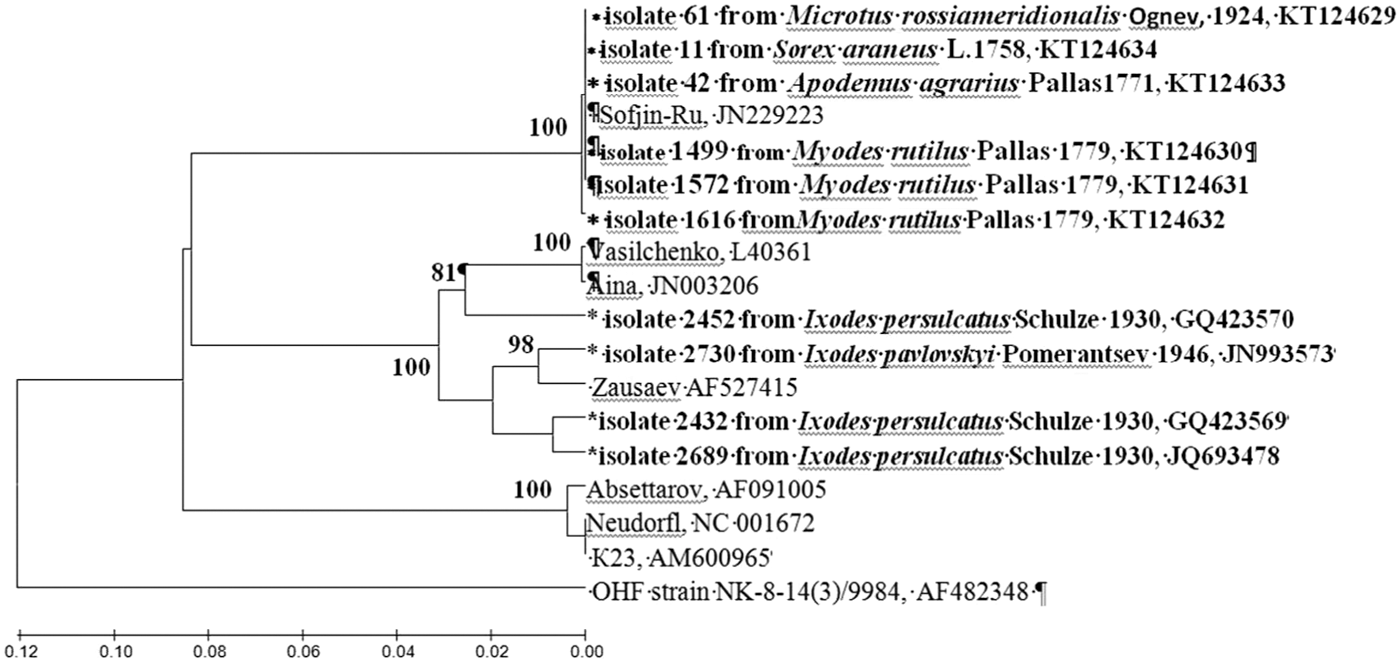
Phylogenetic analysis of nucleotide sequences of the TBEV E gene fragment that is 677 bp long (1223–1899 nucleotides of the TBEV complete genome JN229223). Isolates from ixodid ticks and small rodents in the South-Western Siberia, Russia, described in our article are marked in bold with asterisks. Tree produced using Mega 6.06 (UPGMA, 1000 replications). Outgroup was strain NK-8-14(3)/9984 (GenBank accession number AF482348) that was isolated from gamasid mite Androlaelaps casalis Berlese, 1887 in the same territory of Novosibirsk region in 1991. Reference strains of the TBEV threemain subtypes: Sofjin (the FE); Aina, Vasilchenko, and Zausaev (the Sib); Absettarov, Neudorfl, and К23 (the Eur subtype). OHF, Omsk hemorrhagic fever; TBEV, tick-borne encephalitis virus.
X/n, the absolute number of the ixodid ticks with TBEV RNA (X) among studied samples (n).
Ā, average value.
II, index of invasiveness.
A/B, absolute number of samples containing a certain subtype of the TBEV, A, among studied RT-PCR-positive samples, B.
*, **, statistical significance: p < 0.05, p < 0.01, accordingly.
a** - a**, b* - b*, and c** - c**, compared pairs of values and statistical significance of their distinctions.
However, the proportions of pathogenic virus and the TBEV FE subtype (Table 2), as well as the viral loads with the Sib and the Eur subtypes (Table 3) from I. pavlovskyi were significantly higher than those from I. persulcatus. Mixed infection, mainly with the FE and the Sib subtypes, was found in 93.5% ± 4.5% of ticks with TBEV that was pathogenic for laboratory mice (Table 2). In contrast, monoinfections prevailed among ticks with nonpathogenic TBEV; whereas mixed infections occurred in 14.3% ± 6.7% only, p < 0.001 (Table 2).
Average threshold cycle (Ct) ± SEM were calculated for RT-PCR–positive samples only; organs include brain and spleen samples analyzed separately.
N/A, not analyzed.
TBEV in small mammals
TBEV RNA was detected in 62.1% ± 3.0% samples of brain or spleen of 153 individuals of five species of mammals and in blood cells of 45 Myodes rutilus and 34 Apodemus agrarius screened separately by means of RT2-PCR (Table 4). Differences in TBEV RNA detection frequencies in the organs of M. rutilus (78.1% ± 7.4%) and A. agrarius (35.3% ± 8.3%, p < 0.01) corresponded to the differences of RNA percentages in blood of the species (82.2% ± 5.8% and 47.0% ± 8.7%, respectively; p < 0.001) (Table 4).
X/n, the absolute number of wild small animals with the TBEV RNA(X) among studied (n).
A/B, an absolute number of samples with a certain subtype of the TBEV (A) among studied RT-PCR–positive samples (B).
Mixed infection, TBEV infection was considered as mixed when different viral subtypes were detected in one organ or in different organs of one individual; N/A, not analyzed.
Statistical significance: p < 0.001 of differences between percentages of the Far-Eastern and the Siberian subtypes of TBEV.
Besides that, TBEV protein E was revealed in an additional 8.8% RT2-PCR negative samples using ELISA. Taken together, the TBEV RNA and/or protein E were found in 70.9% ± 3.0% mammals. Detection rates of TBEV RNA alone (62.1% ± 3.2%) significantly exceeded those for individual ticks by 3.4% ± 0.4% (Table 2) (p < 0.001). However, TBEV pathogenic for laboratory suckling mice was isolated only from a few samples of wild mammals. Even in those mice, TBE signs were weak, and they usually did not include paralysis or paresis. It might be caused by virus attenuation after its long-term persistence in wild vertebrates (Pogodina et al., 1986). One should note that the TBEV RNA detection frequencies did not correlate with the infestation rate of different species of small mammals with immature ticks. For S. araneus with the lowest tick infestation rate and minimal abundance of ticks on each animal (Table 1), the TBEV RNA detection rate appeared to be 73.3% ± 8.2%, similar to −78.1% ± 7.4% in M. rutilus and to −77.8% ± 10.0% in Sicista betulina (Table 4).
The Sib subtype appeared to prevail among infected ticks: −84.7% ± 4.7% (for comparison: the FE, −61.0% ± 6.4% and the Eur, −14.0% ± 4.6%) (Table 2); whereas in infected vertebrates, the FE subtype was dominant, −78.5% ± 3.4% (the Sib, −55.6% ± 4.2%; the Eur, −8.9% ± 3.8%) (Table 4 and Fig. 2) (p < 0.001). TBEV infection was considered as mixed when different viral subtypes were detected in one organ or in different organs of an individual animal. The proportion of TBEV mixed infections among wild mammals (36.1% ± 4.0%) was significantly lower (p < 0.01) than among ticks (55.9% ± 6.5%).
Phylogenetic analysis of nucleotide sequences of the TBEV E gene fragment (Fig. 2) revealed the infection of wild hosts with the Sib and the FE subtypes. The data corresponded to RT2-PCR typing (Tables 2 –4). Taken together, our molecular typing of the TBEV isolates from ticks and small mammals confirmed that phylogenetically defined subtypes can be found in each geographic area (Zlobin et al., 1992). Currently available data (Tables 2 –4 and Fig. 2) show co-circulation of multiple flavivirus subtypes (so-called hyperendemicity) in many endemic regions. Genetic heterogeneity of TBEV in surrounding regions was similar to our observations. In Eastern Siberia, the TBEV strains of the FE, the Sib, and the Eur subtypes were isolated from small wild animals (Verkhozina et al., 2007). In Western Siberia, the prevailing Sib and FE subtypes of TBEV were identified (Mikryukova et al., 2014b); strains isolated from Microtus arvalis (GenBank accession number KJ914683) and S. araneus (KJ739731; KC663421) belong to the FE subtype. Both the FE (Lu et al., 2008; KJ755186; JX534167; JF316707; JF316708; JQ650522) and the Sib (KP017248, KJ010811) subtypes were reported in China during recent years. The Eur subtype was detected in ticks and small rodents in South Korea (Kim et al., 2008). In European countries and even in the European part of Russia, the Eur (JQ693479), Sib (JQ693480), and FE subtypes (Mikriukova et al., 2014a) were found.
Quantitative estimations
Average threshold cycles (Ct) of the FE subtype for both tick species were similar, whereas Ct for the Sib and Eur subtypes for I. pavlovskyi were significantly lower (Table 2); consequently, the deduced viral loads were higher than for I. persulcatus. Based on the calibration curve of Ct from quantities of TBEV genome equivalents (Morozova et al., 2012) and the Lukyanov–Matz equation, one might estimate the average number of 3.2 × 10⁴ copies of the FE subtype RNA per tick; the numbers for the Sib and the Eur subtypes were 10 and 100 times less, respectively. For I. pavlovskyi, the viral loads with the Sib (5.7 × 10³/tick) and the Eur subtype (4.7 × 10³) were significantly higher compared with those for I. persulcatus (1.5 × 10² and 1.2 × 101, respectively) (Table 3).
For small mammals, the average Ct were similar with the three main TBEV subtypes (Table 3) and amounted to several thousands of viral RNA copies in both brain and spleen. One should note enhanced viral loads of the FE and Sib subtypes for small rodents compared with shrews (Table 3). Quantities of the TBEV FE RNA and Sib RNA in 1 ml of blood were as high as 2.4 × 10⁵ and 2.4 × 10², respectively. Blood weight consumed by an ixodid tick after many days of feeding on mammals is known to vary from 1.4 to 2.6 mg in I. persulcatus larvae and from 15.9 to 16.5 mg in nymphs (Balashov, 1998). Consequently, larvae might imbibe a few hundred TBEV FE genomic RNA during feeding and nymphs might imbibe up to 4000. For the Sib subtype, only a few viral RNA could be taken during feeding of a larva or a nymph. Our estimates of TBEV in blood of wild small mammals could confirm the virus transmission from mammals to ticks.
Despite the co-circulation of the three TBEV subtypes in the Western Siberian endemic region, both qualitative and quantitative differences in their distribution between vertebrate and invertebrate hosts (Tables 2 –4) might be caused by their life span, innate immunity, or cellular factors of the flavivirus replication. The high TBEV prevalence in wild rodents exceeding the virus rate in ticks (Tables 3 and 4) (Kim et al., 2008; Van Cuong et al., 2015) could be caused by their massive infestation with immature ticks (Table 1). However, the viral loads in individual ticks were significantly higher compared with those in small mammals (Table 3). Selective advantage of the Sib subtype that inclined to life-long persistence in ticks might be explained by their life cycle that is comparable or even longer than that of small mammals and possible diapauses (Filippova, 1985). Dominance of the FE subtype in mammals compared with the other subtypes may be a consequence of its higher replication rate, resulting in elevated quantities in organs and especially in blood cells; thus, it may be significant in the transmission of the virus from wild animals to ticks.
Conclusions
(1) In South-Western Siberia, Russia, TBEV RNA prevalence in small mammals was significantly higher than in ticks. However, only a few viral isolates from small mammals were pathogenic to the laboratory suckling mice.
(2) Molecular typing revealed three main TBEV subtypes in ticks and small mammals as mono- or mixed infection. The Siberian subtype was predominant in ixodid ticks, but in small mammals the FE subtype was more numerous (p < 0.001). European isolates were rare.
(3) The TBEV infection rate in different species of small mammals did not correlate with their infestation rate with ticks. The most important reservoir hosts of TBEV were M. rutilus, S. betulina, and S. araneus. In spite of the high abundance of immature ticks on A. agrarius, the TBEV prevalence was relatively low.
Footnotes
Acknowledgments
This research was supported by grants No 83, 135, and 141 of the Integration Program of the Siberian Branch of the Russian Academy of Sciences and by the Federal Fundamental Scientific Research Program for 2013–2020 (VI.51.1.5).
Author Disclosure Statement
No competing financial interests exist.