




Abstract
Between November and December of 2014, a serosurvey was set up to evaluate the presence of Schmallenberg virus (SBV) antibodies in sheep of Portugal. Sera (n = 1068) were tested using an indirect enzyme linked immunosorbent assay (ID Screen® Schmallenberg virus indirect, IDvet Innovative Diagnostics, Montpellier, France). The estimated occurrence of immunogobulin G (IgG) antibodies against SBV in sheep of Portugal was 12.8% (95% confidence interval 11.0–15.0%). This is the first study reporting the presence of SBV antibodies in sheep of Portugal.
Introduction
B
Since the emergence of SBV in 2011, the virus has spread throughout Europe, with reports documenting infection in Belgium (December, 2011), the United Kingdom and France (January, 2012), and Luxembourg and Italy (February, 2012) (Doceul et al. 2013). Spain reported the disease in a newborn lamb in March of 2012 and in the municipality of Hinojosa del Duque (ProMed-mail 2012). Despite proximity to the Portuguese border, to the best of our knowledge there are no reports of SBV infection in Portugal. However, the Spanish case has alerted us to the possibility of SBV introduction in Portugal. Hence, a serosurvey was set up to estimate the presence of immunoglobulin G (IgG) antibodies against SBV in sheep in Portugal that could allow us to infer the presence of SBV infection in the Portuguese territory.
Materials and Methods
Sample size calculation
The sample size to estimate the occurrence of IgG anti-SBV antibodies in sheep in Portugal was calculated according to previously described methods (Abramson et al. 2011). It was assumed an IgG antibody seroprevalence against SBV of 50% (yielding the highest possible sample size), a confidence in the estimate of 95%, a maximum allowable error in the prevalence of 3%, and a population size of 1,852,940 sheep (Instituto Financiamento da Agricultura e Pescas [IFAP] 2013). These conditions yielded a calculated sample size of 1068 sheep. However, because sheep housed in Portugal are distributed heterogeneously according to region, a stratified random sampling design was set up with the five regions of continental Portugal (north, center, Lisboa and Vale do Tejo, Alentejo, and Algarve) as a stratification level, according to the Nomenclature of Units for Territorial Statistics (NUTS) II. On the basis of the census data of Animal Statistics Portugal of the total population size of ≈1.9 million head of sheep in Portugal, 278,724 sheep are located in the north (15%), 416,355 in the center (22.5%), 32,638 in Lisboa and Vale do Tejo (1.8%), 1,083,449 in Alentejo (58.5%), and 41,774 in Algarve (2.2%) (IFAP 2013). Because no herd level statistics were available, to represent better the five regions of Continental Portugal that were sampled, we collected blood from four farms spread within each region (at the north, south, east, and west).
Enzyme-linked immunosorbent assay screening
Blood was collected from female sheep with 6 months to 10 years of age (average age of 5 years) (n = 1068). All sera were from sheep born in Portugal. Samples were taken from animals randomly selected upon the moment of the official brucellosis control. Collection took place between November and December of 2014 from the five regions of Portugal: 161 samples from the north, 240 from the center, 19 from Lisboa and Vale do Tejo, 624 from Alentejo, and 24 from Algarve. Sera were tested for the presence of IgG anti-SBV antibodies using an enzyme linked immunosorbent assay (ID Screen® Schmallenberg virus indirect, IDvet Innovative Diagnostics, Montpellier, France) (sensitivity of 97.7% and specificity of 99.7%), with a sample-to-positive control serum value of 60% assumed as cutoff (according to the manufacturers' instructions).
Results and Discussion
The seroprevalence of IgG anti-SBV antibodies in female sheep older than 6 months old of Portugal, November–December of 2014 (137 positive, n = 1067) was 12.8% (95% confidence interval [CI] 11.0–15.0%). The seroprevalence found in Portugal is low when compared with the seroprevalence observed among sheep in Belgium (84.3%), a country that underwent a recent emergence of SBV (Méroc et al. 2014).
The occurrence of IgG anti-SBV antibodies in sheep in the north of Portugal (n = 13; 8.1%, 95% CI 4.8–13.3%) was lower than the estimated occurrence of IgG anti-SBV antibodies in the center (n = 34; 14.2%, 95% CI 10.3–19.2%), Lisboa and Vale do Tejo (n = 6; 31.6%, 95% CI 15.4–54%), Alentejo (n = 79; 12.7%, 95% CI 10.3–15.5%), and Algarve (n = 5; 20.8%, 95% CI 9.2–40.5%) (Fig. 1). The occurrence of IgG anti-SBV antibodies in sheep is higher in the central/southern strip of Portugal than in the remaining parts of the country. This finding could indicate that SBV was first introduced into the central/southern part of Portugal. Curiously, this is in the same latitude where the first SBV case in Spain occurred (ProMED-mail 2012). Interestingly, previous studies on the spatial distribution of Culicoides spp. in Portugal have shown that these SBV vectors are mainly conformed to the central/southern regions of the country (Capela et al. 2003), supporting our findings of higher SBV seropositivity in the south of Portugal.
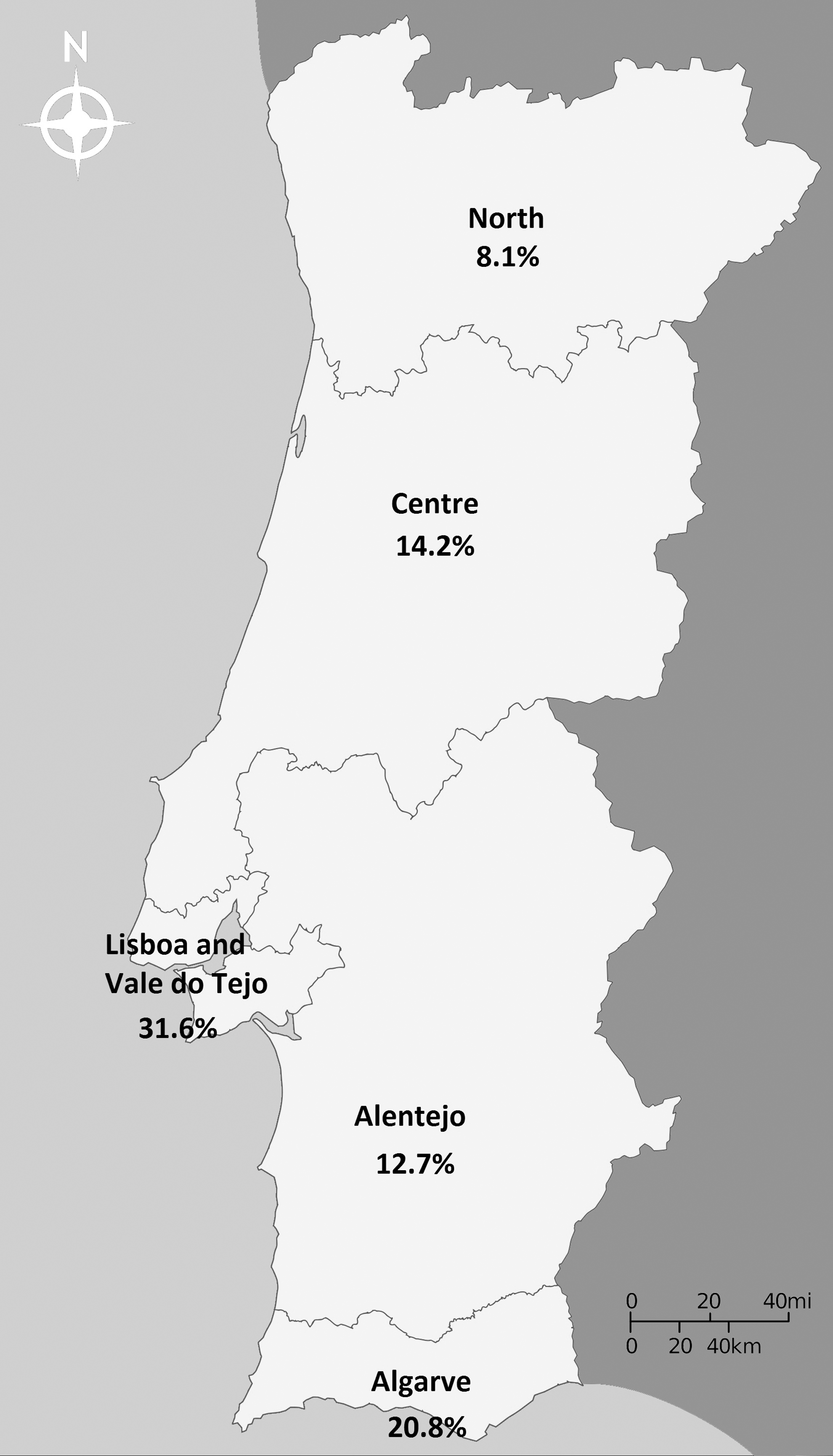
Percentages of immunoglobulin G (IgG) anti-Schmallenberg virus (SBV)- positive sheep in the five regions of continental Portugal, according to the stratification level of Nomenclature of Territorial Units for Statistics (NUTS II).
Our data are inclusively in correspondence with the spatial distribution of Portuguese outbreaks of other Culicoides spp.-borne diseases, such as African horse sickness and bluetongue, which are more prevalent in the southern versus the northern regions (Capela et al. 2003). Caution should be taken when analyzing these results because only four flocks were sampled per region (due to the lack of statistics at the herd level), leading to a cluster sampling approach that might introduce bias. Whether SBV was very recently introduced in Portugal still needs to be confirmed, ideally by seroprevalence studies on archived ruminant sera from 2011 to 2013.
A previous report suggested that the windborne transmission of Culicoides spp. midges from Morocco to the Iberian Peninsula through the Mediterranean Sea by southeast winds could have been responsible for bluetongue introduction (Capela et al. 2003). Studies have shown that the prevailing winds are generally from the northwest and west in summer and from the east and southeast in winter (Sousa et al. 2007). If windborne transport of Culicoides spp. takes place southbound, most likely in the summer, the potential introduction of SBV to North African countries can occur. Emergence of SBV in North Africa is of particular concern because this region is heavily dependent on SBV-susceptible animals (sheep, cattle, and goats) due to cultural and religious reasons.
In conclusion, this is the first study reporting the presence of SBV antibodies in the sheep of Portugal. However, to provide direct evidence of SBV infection in Portugal, further studies on the genetic characterization of SBV in both the vector and sheep are essential.
Footnotes
Acknowledgments
The authors would like to acknowledge IDvet Innovative Diagnostics and AMBIFOOD for providing financial support in the acquisition of the enzyme-linked immunosorbent assay (ELISA) kits. We would also like to thank the farmers who gave access to their animals. This work was supported by European Union Funds (QREN/FEDER) under the project Ovislab ICT-2013-05-004-5314 ID-64757.
Author Disclosure Statement
No competing financial interests exist.