




Abstract
Introduction:
In New York State (NYS), Eastern equine encephalitis (EEE) was first reported in a human in 1971, in horses in 1970, and in pheasants in 1952.
Material and Method:
Following work for the interval from 1970 to 1991, we identified cases in vertebrates from 1992 to 2012, through a passive surveillance system involving veterinarians in clinical practice, county health departments, and the Departments of Agriculture and Markets, Environmental Conservation, and Health, of the State of New York.
Result:
During an 11-year hiatus, from 1992 to 2002, no case in any vertebrate was observed. In a re-emergence, from 2003 to 2012, disease occurred in 12 counties, including 7 counties where disease had never been documented. Vertebrate cases included 4 cases in humans and 77 nonhuman occurrences; in 58 horses, Equus ferus caballus L.; 2 deer, Odocoileus virginianus Zimmermann; 6 dogs, Canis familiaris; 10 birds; and 1 flock of pheasants, Phasianus colchicus L. These were the first reported cases in NYS in white-tailed deer, the domestic dog, and in five species of birds: American crow, Corvus brachyrhynchos Brehm; American goldfinch, Carduelis tristis L.; bald eagle, Haliaeetus leucocephalus L.; blue jay, Cyanocitta cristata (L.); and red-tailed hawk, Buteo jamaicensis Gmelin. One crow was dually infected with EEE virus and West Nile virus. The northern, southern, and southeastern borders of the state were newly affected.
Conclusion:
The geographic area, time periods, and vertebrate species with risk of EEE disease expanded from 1992 to 2012.
Introduction
E
In the New York State (NYS), the first recognized case of EEE in a human was in 1971 (Morris et al. 1973). In nonhuman vertebrates, cases of EEE had been documented in pheasants, Phasianus colchicus L., in Orange County, in southern NYS, in 1952 (Beaudette et al. 1954). It was then reported in ducks and pheasants in the Suffolk County in 1959 (Dougherty and Price 1960, Jamnback et al. 1965) and in three horses in the Suffolk County in 1970 (Bast et al. 1973). Between 1970 and 1991, inclusive, there were 93 cases of EEE in horses (Howard et al. 1994), 89 (96%) of those cases occurred in the four counties, Madison, Oneida, Oswego, and Onondaga, surrounding Oneida Lake in the central region of the state (Morris et al. 1980). Between 1971 and 1991, inclusive, there was a total of two cases of EEE in humans (1971, 1983), in the Oswego and Onondaga counties.
The objectives were to summarize and present cases of EEE in vertebrates reported during 1992–2012 to state departments of agriculture, conservation, and health and to note any changes or trends.
Materials and Methods
Cases in horses were identified through a program of surveillance. Large animal veterinarians in NYS are reminded annually, through a communication issued jointly by the Director of Animal Industry of the Department of Agriculture and Markets and by the Public Health Veterinarian of the Department of Health, of the potential risk of EEE. Local veterinarians investigate illness in animals, and county health departments join veterinarians in investigations when these are cases of suspected encephalitis. Nervous tissue specimens were submitted to the state rabies laboratory and, upon declaration as rabies negative, were forwarded to the Arbovirus Laboratory of the Wadsworth Centers of the Department of Health of the State of New York for testing as described below. Sometimes, blood specimens, in lieu of nervous system tissue, were submitted by veterinarians to other in-state or out-of-state laboratories for testing for arboviral disease. This program of surveillance regarding horses was unchanged during these 20 years of observation.
Cases in humans were identified by reporting to the Department of Health, as required by state public health law (McKinney 2002). Human cases met criteria for EEE, based on laboratory results, in accord with the state public health code (Official Compilation of Codes Rules and Regulations 2008). The serologic tests for vertebrate animals and for humans were unchanged during these 20 years of observation.
Cases in birds were obtained through a program of surveillance, during 2000–2007, to monitor for West Nile Virus (Eidson et al. 2001). Annually, 54–58 counties submitted an annual average of 2603 avians. Dead birds were necropsied by the Wildlife Pathology Unit of the Department of Environmental Conservation of the State of New York and then forwarded to the Arbovirus Laboratory where tissue was tested for West Nile virus by the real-time polymerase chain reaction technique as described (Kauffman et al. 2011). Birds negative for West Nile virus were inoculated onto Vero cells for virus isolation as described (Kauffman et al. 2003). Before 2000, and after 2007, avian specimens were not submitted, except for an occasional captive pheasant die-off.
Cases in dogs, white-tailed deer, Odocoileus virginianus (Zimmermann), and pheasants were obtained through investigations by veterinarians, county health departments, and/or the Department of Environmental Conservation of the State of New York. Tissue specimens were forwarded to the Arbovirus Laboratory where tissue was tested for arboviruses.
Fifty-seven of the 62 counties in NYS were included in this present analysis. The five boroughs of Bronx, Brooklyn, Manhattan, Queens, and Staten Island, which together make up the City of New York, were not included.
Results
There were no cases of EEE in vertebrates from 1992 to 2002 inclusive. Vertebrate EEE results by date, location, and species are shown in Table 1. Epidemiologic graphs are presented in Figure 1 and geographic maps in Figures 2 and 3.
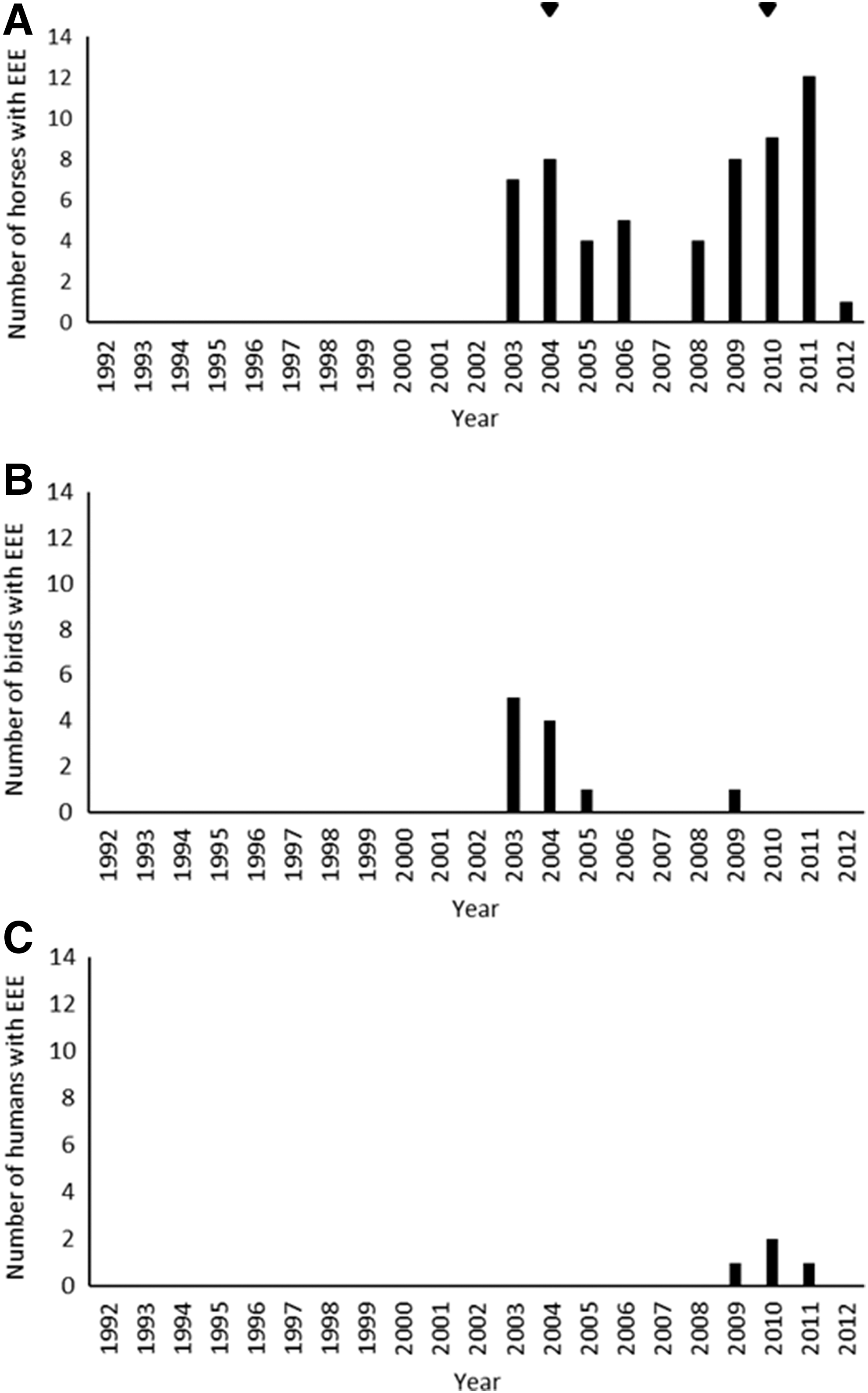
Timing of Eastern equine encephalitis (EEE) cases in New York State (NYS), 1992–2012, in horses
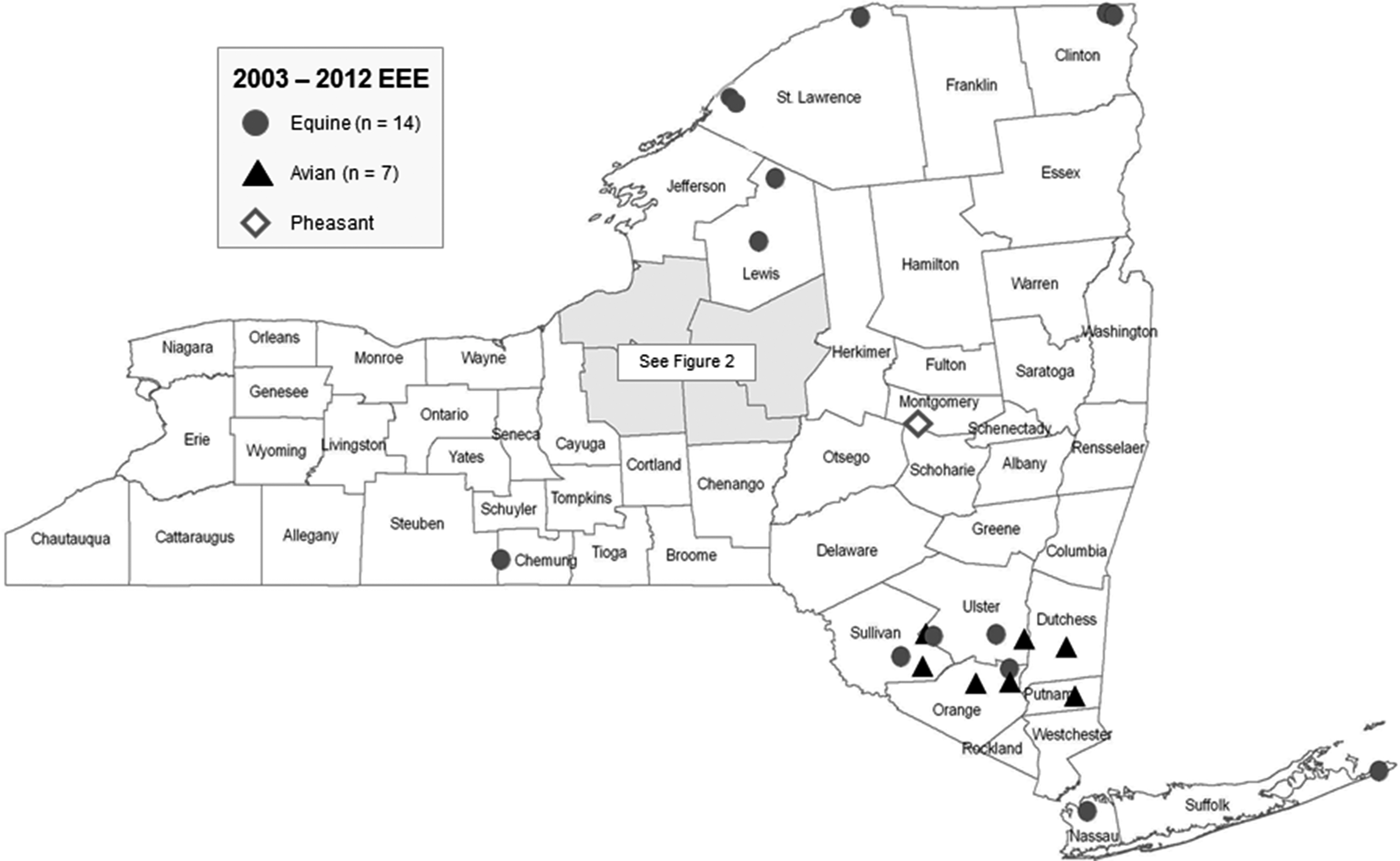
Locations of EEE cases in NYS, 2003–2012.

Locations of EEE cases in vertebrates in four central New York counties, 2003–2012. aOne human with a history of travel to Hastings Township in Oswego County.
Date is when noted to be ill or when found dead.
Numbering is the sequence of cases tallied in horses and humans within each town, beginning in 1970.
In 2003, two horse cases were on one farm in Hastings Township. In 2010, two horse cases were on one farm in Lysander Township.
One of 14 dead horses was tested.
This crow also tested positive for West Nile virus.
Probable site of exposure was in the Oneida County in the town of Camden where pheasants were previously kept.
This human resided in Onondaga County in the town of Lysander, but probable site of exposure was in Oswego County in the town of Hastings.
Six puppies were kept in the same kennel.
Discussion
Chronology
In this present study, there were time intervals without reported cases of EEE disease in vertebrates, of 11 years and 1 year, from 1992 to 2002 and 2007 (Fig. 1). In previous studies in NYS, time intervals without reported cases in vertebrates include the following: 38 years, from 1952 to 1990, between cases in pheasants in the Orange County (Beaudette et al. 1954); 33 years, from 1970 to 2002, between cases in equines in the Suffolk County (Bast et al. 1973, Howard et al. 1994); 13 years, from 1990 to 2003, between cases in equines in the Orange County (Howard et al. 1994); and, in humans, 12 years, from 1971 to 1983 in Oswego and Onondaga counties (White et al. 1971, Howard et al. 1988). In the adjacent state of Massachusetts, there was a time interval of 5 years, from 1985 to 1989, without reported cases in horses (Edman et al. 1993) and intervals of 15, 13, 7, and 5 years, respectively, 1940–1954, 1957–1969, 1975–1981, and 1985–1989, without reported cases in humans (Edman et al. 1993, Hachiya et al. 2007).
In this present study, there were time periods with reported cases of EEE disease in vertebrates, of 4 years, from 2003 to 2006, and 5 years, from 2008 to 2012, during which there was at least one case every year (Fig. 1). The durations of these time periods are similar to the time period of 6 years, from 1971 to 1976, during which there was at least one case every year in NYS (Morris et al. 1973, 1975, Srihongse et al. 1978). The durations of these time periods with cases are also similar to the time periods of 2, 2, 5, 8, and 8 years, respectively, 1938–1939, 1955–1956, 1970–1974, 1982–1984, and 1990–1997, in the adjacent state of Massachusetts (Edman et al. 1993, Hachiya et al. 2007).
In this present study, cases in vertebrates occurred in two chronologic clusters centering on 2004 and on 2010 (Fig. 1, see arrowheads). Cases in horses occurred in two clusters from 2003 to 2006 and from 2008 to 2012 (Fig. 1A). Cases in birds occurred in two clusters from 2003 to 2005 and in 2009 (Fig. 1B). Cases in humans occurred in one cluster from 2009 to 2011 (Fig. 1C).
EEE disease remained seasonal in NYS. For horses, the earliest date of onset for a case of EEE from 2003 to 2012 was 23 July (in 2012) and the latest date of onset was 21 October (in 2003).
Geography
In NYS, no county had a case of EEE in a vertebrate from 1992 to 2002. Following this, 12 of 57 counties had cases of EEE in vertebrates from 2003 to 2012 (Fig. 2). In 1983, the geographic area having EEE virus in mosquitoes or cases of EEE in vertebrates was estimated to be 2600 km2 (Howard et al. 1988). In 2012, the epizootic area having cases of EEE in equines is estimated to be 3600 km2, an increase of 38%.
In NYS, the first case of EEE in a horse was reported in 1970 (Bast et al. 1973). In NYS, there have been 151 cases of EEE in horses from 1970 to 2012 (Morris et al. 1975, Howard et al. 1988, 1996). Four counties, Oswego, Onondaga, Oneida, and Madison, have had 91% of these 151 cases in horses from 1970 to 2012. However, from 2003 to 2012, of the 55 cases of EEE in horses, these same four counties had only 76% of these cases (Fig. 3). From 2003 to 2012, seven counties had their first cases of EEE in horses (Table 1 and Fig. 2). The strain of EEE virus isolated from a horse in the Chemung County in 2004 was genetically similar to EEE virus isolated from vertebrates and mosquitoes in Onondaga, Oswego, and Madison counties in 2003, 2004, and 2005 (Young et al. 2008). One county, Oswego, had all of the cases in white-tailed deer and all of the cases in dogs (Fig. 3).
From 2003 to 2012, seven counties had the all of the cases in birds (Fig. 2). The pheasants with EEE reported from Montgomery County had been transported from the Oneida County, adjacent to the Oswego County, where cases of EEE in a horse and in a deer occurred, during the same year 2009.
Two counties, Onondaga and Oswego, had all of the cases in humans (Fig. 3).
These cases of EEE in vertebrates in NYS occurred simultaneous with cases in the New England region (Armstrong and Andreadis 2013): Massachusetts and New Hampshire in humans in 2005 (Centers for Disease Control 2006); Maine cases of EEE in horses, a llama, Lama glama (Linnaeus); and pheasants in 2009 (Gibney et al. 2011); Vermont white-tailed deer seropositive for EEE virus in 2010 (Berl et al. 2013); and Vermont cases of EEE in farmed emu, Dromaius novaehollandiae (Latham), in 2011 (Berl et al. 2013).
These cases of EEE in vertebrates in NYS were in proximity to cases in Canada. In 2008, cases of EEE in horses in the Clinton County in NYS were ∼24 km from cases of EEE in horses in the Quebec Province (Chénier et al. 2010), where there were also cases of EEE in the flock of emus. In 2011, a case of EEE in a horse in the St. Lawrence County in NYS was within 40 km of cases of EEE in horses in the Ontario Province (
Epizoology
The reported cases of EEE in a bald eagle and a red-tailed hawk were the first known cases in these two species. The reported cases in the American crow, blue jay, and American goldfinch were the first in NYS (Young et al. 2008). One crow was dually infected with EEE virus and West Nile virus. Previously, 69 species of birds, in 26 families, have been identified as infected with EEE virus in the United States (Emord 1983, Emord and Morris 1984, Howard et al. 1996, 2004).
The reported cases of EEE in two white-tailed deer, in 2008 and 2009, were the first recognized in this species in NYS. Cases of EEE in deer have previously been reported in Georgia (Tate et al. 2005), Michigan (Schmitt et al. 2007), and Vermont (Berl et al. 2013). The reported cases in dogs, in 2011, were the first recognized in this species in NYS. Cases of EEE in dogs have previously been reported in Georgia (Farrar et al. 2005). The deer and the dog appear to have a low risk.
The reasons for these changes in EEE timing, location, and affected species may include changes in air and water temperature, humidity and rainfall, land used for livestock or available to wild animals, and habitats suitable for reservoirs or vectors. Risk of EEE disease has been shown to correlate with Cs. melanura infection rates and numbers of mosquitoes captured per night (Hachiya et al. 2007). Such information can be of use in planning the timing and location of prevention and treatment efforts.
Limitations of this study
This study has the limitation of being an observational study of passive surveillance data during a specified time period over a specified geographic area, with historical, but not prospective or randomized, controls. There may have been unknown differences in numbers or locations of reservoir, vector or host species, between the first and second decades of observation. The geographic expansion of rabies virus in 1990 resulted in an enhanced program of surveillance of vertebrates for rabies virus in NYS (Chang et al. 2002) and accordingly enhanced surveillance for EEE virus. Equine cases may be more evident in geographic areas where owners choose not to vaccinate. Equine illness may not be reported by owners, potentially resulting in missed cases. Avian specimen submissions before 2000, and after 2007, were limited to captive pheasant die-offs. The West Nile virus avian surveillance of 2000–2007 was optional for county-based health departments. Nearly all counties participated, all 8 years, and numbers of avian specimens submitted by a county varied over time, influenced by county budget and staffing. Our two white-tailed deer were detected because each was observed in the wild to be ill and suspected to be infected with rabies virus. Specimens from euthanized deer tested rabies negative and EEE virus positive.
Conclusion
Surveillance detected no vertebrate cases of EEE during 1992–2002 and in 2007. The land areas and vertebrate species affected by EEE changed from 2003 to 2012, involving new geographic locations and disease in species not previously reported. Human, veterinary, agricultural, and wildlife disease prevention programs and treatment services may find these results of interest.
Footnotes
Acknowledgments
The authors appreciate members of the county health departments for reporting of suspected cases; the Department of Health of the State of New York for efforts at investigations; and the Wadsworth Center of the Department of Health of the State of New York for viral testing and culture. They thank John Kokas for investigations in Sullivan and Ulster Counties in 2003 and 2004. They thank Courtney L. McCracken, DVM, of the Department of Agriculture and Markets of the State of New York for information from investigations of cases in horses.
Author Disclosure Statement
No competing financial interests exist.