




Abstract
Serum samples from 295 employees of Great Smoky Mountains National Park (GRSM), Rocky Mountain National Park (ROMO), and Grand Teton National Park with adjacent Bridger-Teton National Forest (GRTE-BTNF) were subjected to serological analysis for mosquito-borne bunyaviruses. The sera were analyzed for neutralizing antibodies against six orthobunyaviruses: La Crosse virus (LACV), Jamestown Canyon virus (JCV), snowshoe hare virus (SSHV), California encephalitis virus, and Trivittatus virus (TVTV) belonging to the California serogroup and Cache Valley virus (CVV) belonging to the Bunyamwera serogroup. Sera were also tested for immunoglobulin (Ig) G antibodies against LACV and JCV by enzyme-linked immunosorbent assay (ELISA). The proportion of employees with neutralizing antibodies to any California serogroup bunyavirus was similar in all three sites, with the prevalence ranging from 28% to 36%. The study demonstrated a seroprevalence of 3% to CVV across the three parks. However, proportions of persons with antibodies to specific viruses differed between parks. Participants residing in the eastern regions had a higher seroprevalence to LACV, with 24% (18/75) GRSM employees being seropositive. In contrast, SSHV seroprevalence was limited to employees from the western sites, with 1.7% (1/60) ROMO and 3.8% (6/160) GRTE-BTNF employees being positive. Seroprevalence to JCV was noted in employees from all sites at rates of 6.7% in GRSM, 21.7% in ROMO, and 15.6% in GRTE-BTNF. One employee each from ROMO (1.7%) and GRTE-BTNF (1.9%) were positive for TVTV. This study also has illustrated the greater sensitivity and specificity of plaque reduction neutralization test compared to IgG ELISA in conducting serosurveys for LACV and JCV.
Introduction
O
The current investigation targeted the employees of the US National Park Service (NPS) and US Forest Service (FS), who routinely work in diverse natural habitats and are frequently exposed to wildlife. As a result, this group may be at increased risk of contracting mosquito-borne infections. Two separate serological surveys to investigate exposure to a wide range of zoonotic pathogens were performed in Great Smoky Mountains National Park (GRSM), Rocky Mountain National Park (ROMO) (Adjemian et al. 2012), and Grand Teton National Park with adjacent Bridger-Teton National Forest (GRTE-BTNF) (Geissler et al. 2014). Adjemian et al. (2012) reported baseline seroprevalence of antibodies to viruses of the California serogroup in ROMO and GRSM. In ROMO, 22% of participants were reactive to JCV, while in GRSM, 7% were reactive to JCV and 23% to LACV.
This report further quantifies the data on specific neutralizing antibodies to orthobunyaviruses from the surveys at GRSM and ROMO, introduces serological data from GRTE-BTNF, includes seropositivity data on CVV for all workers, and presents new data on the accompanying LACV and JCV immunoglobulin (Ig) G enzyme-linked immunosorbent assay (ELISA) for all sites.
The specific objectives of our study were to (1) define and compare the seroprevalence of neutralizing antibodies to six mosquito-borne bunyaviruses among NPS and FS employees located at sites in the eastern (North Carolina/Tennessee) and western (Colorado/Wyoming) United States; (2) evaluate antigenic cross-reactivity of human antibodies to orthobunyaviruses; and (3) compare the sensitivity and specificity of plaque reduction neutralization tests (PRNTs) and IgG ELISA to detect antibodies to LACV and JCV.
Materials and Methods
Study sites
GRSM is located in the Blue Ridge Mountains in Tennessee and North Carolina. Altitude ranges from 1000 to 6000 feet, and the park receives an average of 65 inches of moisture annually. The park covers 800 square miles of mountainous terrain covered by deciduous forest, with a variety of plants and animals. Mammals of 65 species were documented in the park, including the white-tailed deer, groundhog, eastern chipmunk, gray squirrel, rodents, and bats of many species. ROMO is located in the Rocky Mountains in north central Colorado. Altitudes range from 7000 to 14,000 feet, and the park receives 13 inches of total precipitation annually. The park contains 150 lakes, 450 miles of streams, pine forests, and grassy hillsides. Elk, mule deer, moose, bighorn sheep, hares, rabbits, and rodents of many species are common. GRTE and the adjacent BTNF cover expansive wilderness areas in southwest Wyoming, with almost 60 species of mammals in the park, including bison, elk, moose, mule deer, white-tailed deer, mountain goat, pronghorn, bighorn sheep, snowshoe hare, and many rodents.
Study participants
Initial serum samples were obtained from 295 participants: 75 employees of GRSM, 60 employees of ROMO, and 160 employees of GRTE-BTNF. Enrollment at the GRSM and ROMO sites was limited to permanent employees, expecting to reside in the same location for at least 1 year from the initial sample collection in mid-2008. In 2009, follow-up sera were collected from 67 (89%) participants in GRSM and 44 (73%) in ROMO. In GRTE-BTNF, eligible study participants included 160 employees who were seasonal workers but were expecting to remain at their current employment location for a minimum of 3 months (June to August) (Geissler et al. 2014). Among these employees, 121 were Wyoming residents, 25 were residents of other western states (Montana, Idaho, and Utah), and 14 were from other parts of the United States. Initial sample collection occurred in spring 2010, and follow-up sera were obtained from 125 (78%) participants in fall 2010. All participants provided informed consent, and the protocols were approved by the CDC Human Subjects Institutional Review Board.
PRNT and viruses used
Details of procedure used for PRNT have been described previously (Lindsey et al. 1976, Beaty et al. 1995, Roehrig et al. 2008). Sera were tested for neutralizing antibodies to six orthobunyaviruses (LACV, JCV, SSHV, TVTV, CEV, and CVV) by the standard PRNT at the CDC Arbovirus Diagnostic Laboratory (Fort Collins, CO). Since CEV has been reported in the western part of the United States and western Canada (Calisher 1983, Eldrige et al. 2001), the PRNT for this virus was performed with sera from ROMO and GRTE-BTNF. The following viruses from the CDC/DVBD virus reference collection were used for performing PRNT: CEV (California, 1943 [BFS-283]), TVTV (North Dakota, 1948 [Eklund]), CVV (Utah, 1956 [6V633]), SSHV (Montana, 1959 [Original]), LACV (Wisconsin, 1960 [Original]), and JCV (Colorado, 1961 [61V2235]).
Sera were tested on the latest available sample for each employee. Any sample with at least one positive result was then tested simultaneously against all bunyaviruses, except CVV, which does not produce cross-reactivity with viruses of California group and was tested separately. Paired sera were tested simultaneously as well. Paired sera of permanent employees in GRSM and ROMO were collected a year apart for determining incidence of infections. Baseline seropositivity was interpreted as prior infection. Among persons seronegative at baseline, seroconversions were considered evidence of incident infections (Adjemian et al. 2012). In GRTE-BTNF, sera of the same employees were collected 3 months apart for measuring seroconversion (Geissler et al. 2014).
Each test was validated with a standardized virus-specific mouse hyperimmune ascitic fluid as a positive control and a standardized normal human serum as a negative control. To rule out plaque overlap, plaque counts in the test system were compared to those that have been back titrated. Virus-specific neutralizing antibody titers were determined by 90% endpoint (PRNT90) in six-well plates containing Vero cells with a 0.5% agarose double overlay and visualized with neutral red staining on the second overlay. Samples were first heat inactivated at 56°C for 30 min to destroy the complement and inactivate adventitious viruses to ensure a valid comparison between paired samples. Fresh nonheat-inactivated normal human serum, pretested negative against all used arboviruses, was added to the serum–virus mixture at the final concentration of 4% as a source of labile serum factor according to the CDC standard protocol. The second overlay was applied 2–3 days after inoculation depending on the virus tested.
The neutralizing antibody titers were expressed as the reciprocal of the endpoint serum dilution that reduced the challenged virus plaque count by 90% based on the back titration. Titers ≥10 were considered as positive for the virus tested. A final serum dilution of 1:10 was used for samples from GRSM and GRTE-BTNF, but because ROMO samples had limited volumes available, a final serum dilution of 1:20 was used. In differential PRNT, in which specimens were tested simultaneously for multiple relative viruses, a neutralizing titer of fourfold higher against one virus compared to others was considered virus specific (Calisher et al. 1989, Walters et al. 1999, Robinson et al. 2010). Extensive antibody cross-reactivity between members of the California group bunyaviruses in the PRNT, denoted by the absence of a fourfold difference between viruses, precluded identification of the specific infecting virus. Paired initial and follow-up sera with a less than fourfold difference in neutralization titers were considered evidence of past infection.
IgG ELISA
All sera from GRSM and PRNT-positive samples from ROMO and GRTE-BTNF were tested for IgG antibody to LACV (strain Original) by ELISA as previously described (Johnson et al. 2000). All sera from GRTE-BTNF and PRNT-positive samples from ROMO were tested for IgG to JCV (strain MN 256–260) by ELISA. LACV PRNT-positive sera from GRSM were depleted, and JCV IgG testing could not be performed. For the specimens to be considered IgG positive to the test, P/N (mean optical density [OD] of the test specimen reacted on viral antigen [P]/mean OD of the negative control serum reacted on viral antigen [N]) had to be ≥2.0. For any test specimen with P/N ≥ 2.0, the value of P had to be at least twice the mean OD of the specimen reacted on normal antigen. If this requirement was not met, it was assumed that nonspecific background was being generated, and the result was reported as uninterpretable.
Results
Among 295 participants tested by PRNT, 91 (30.9%) had neutralizing antibodies to at least one California group virus (Table 1).
One case is acquired infection (initial sample is negative; follow-up sample is LACV positive).
Cal GV, California group viruses; CVV, Cache Valley virus; GRSM, Great Smoky Mountains National Park; GRTE-BTNF, Grand Teton National Park with adjacent Bridger-Teton National Forest; JCV, Jamestown Canyon virus; LACV, La Crosse virus; N, number of persons surveyed (paired/unpaired samples); ROMO, Rocky Mountain National Park; SSHV, snowshoe hare virus; TVTV, Trivittatus virus.
The PRNT90 data of the 91 California group virus-positive participants are summarized in Table 2. In 72 (79.1%) of the 91 participants, the fourfold difference in titers to the viruses tested allowed for identification of the specific infecting virus. Forty-three participants were previously infected with JCV, 17 with LACV (and 1 acquired the infection over 1-year study), 7 with SSHV, and 4 with TVTV. No CEV infections were found during this study. For 13 participants, the titers were broadly cross-reactive between different California group viruses, which prevented further determination of the infecting virus. For six participants, titers against LACV and SSHV were at least fourfold higher than the other viruses; however, the difference in magnitude between the two was insufficient to determine which of them caused the infection.
PRNT90 titers are expressed as reciprocal values of the highest dilution of serum that resulted in ≥90% reduction in plaque number of indicated virus. Seroreactive participants are those who had PRNT results in serum samples with titer ≥10 of indicated virus. Infecting virus is identified when PRNT90 titer is greater than fourfold above titers to other viruses. Broad cross-reactive samples had positive PRNT90 results to different California group bunyaviruses and were at least fourfold less than those of the infecting virus. LACV/SSH cross-reactive participants had the titers against those two viruses at least fourfold higher than the other viruses.
CEV, California encephalitis virus; GMT, geometric mean titer; NT, not tested samples; PRNT, plaque reduction neutralization test.
Overall, the prevalence of neutralizing antibodies to California group viruses was relatively similar between the three parks, with 36% (27/75) in GRSM, 28.3% (17/60) in ROMO, and 29.4% (47/160) in GRTE-BTNF (Table 1). The seroprevalence to certain viruses within the serogroup, however, varied between investigated sites. All 18 participants with LACV infections were from GRSM. Six of the participants with evidence of prior SSHV infection were from GRTE-BTNF, and one was from ROMO. A total of 14.6% (43/295) participants had neutralization titers indicating previous infection with JCV, and JCV-positive participants were identified from all three study sites: 21.7% (13/60) in ROMO, 15.6% (25/160) in GRTE-BTNF, and 6.7% (5/75) in GRSM (Table 1). TVTV neutralizing antibodies were identified in sera from participants of two national parks, with 1.7% (1/60) in ROMO and 1.9% (3/160) in GRTE-BTNF. The sera from 2.7% (2/75) participants of GRSM and 2.5% (4/160) participants of GRTE-BTNF demonstrated cross-reactivity between LAC and SSH viruses. The sera from 4.4% (13/295) of participants from all three parks demonstrated a broad cross-reactivity to all California group viruses tested, with 2.7% (2/75) in GRSM, 3.3% (2/60) in ROMO, and 5.6% (9/160) in GRTE-BTNF.
Overall, 3.1% (9/295) of the employees had evidence of exposure to CVV (Table 1). Antibodies to CVV were detected in sera of 2.7% (2/75) participants from GRSM, 3.3% (2/60) participants from ROMO, and 3.1% (5/160) participants from GRTE-BTNF. Among nine employees neutralizing antibodies to CVV, four also had neutralizing antibodies to one or more California group viruses (Table 3).
PRNT90 titers are expressed as reciprocal values of the highest dilution of serum that resulted in ≥90% reduction in plaque number of indicated virus. Titers ≥10 were considered as positive for the virus tested. CVV does not produce cross-reactivity with viruses of California group.
(−/−), negative samples (<10/<10); NA, not available samples.
Figure 1 illustrates the relative proportion of neutralizing antibodies against tested orthobunyaviruses in sera from employees of the three national parks and national forest with PRNT-positive results.
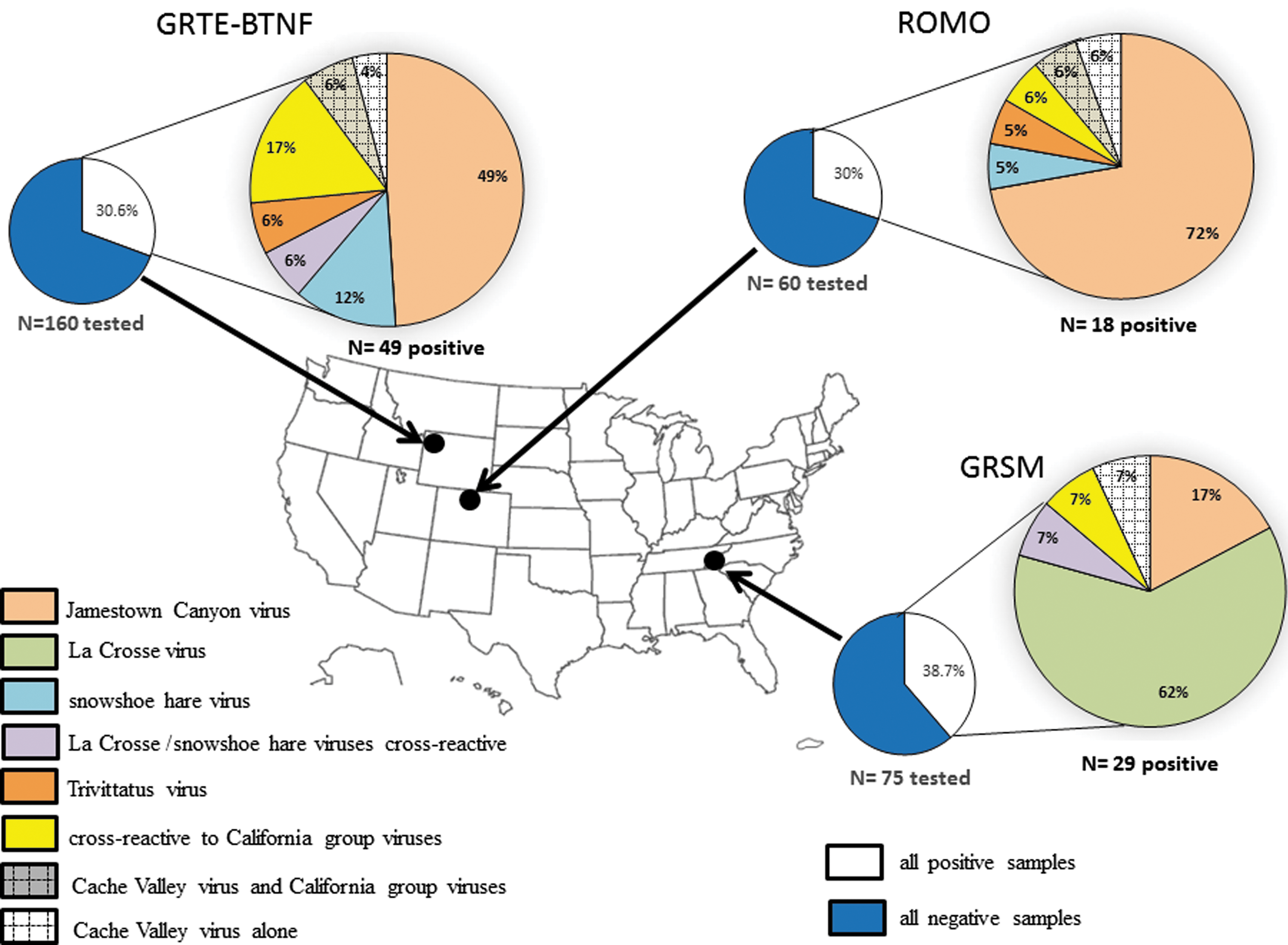
Proportions of employees among the plaque reduction neutralization test-positive participants with neutralizing antibodies to California group viruses in three US national parks and national forest. GRSM, Great Smoky Mountains National Park; GRTE-BTNF, Grand Teton National Park with adjacent Bridger-Teton National Forest; ROMO, Rocky Mountain National Park.
IgG ELISA results and comparison with PRNT
The presence of neutralizing antibodies to LACV and JCV was demonstrated in all sera, which were positive for IgG antibodies against those viruses by ELISA. In contrast, only 10 (55.5%) of 18 LACV PRNT-positive employees demonstrated IgG to LACV, while 5 (27.8%) were negative, and in 3 cases, (16.7%) the results could not be interpreted (Table 4). Among 35 JCV PRNT-positive sera tested by JCV IgG ELISA, only 18 (51.4%) demonstrated IgG to JCV, 10 (28.6%) were negative, and 7 (20%) were uninterpretable. Among seven employees with LACV/SSHV cross-reactive antibodies identified by PRNT, one (14.3%) was LACV IgG positive, and one (14.3%) was JCV IgG positive by ELISA. Among the employees of all parks with broad cross-reactive neutralizing antibodies against California group viruses, only 15.4% (2/13) were LACV IgG positive, and 40% (4 of 10 who were tested by JCV IgG ELISA) were JCV IgG positive. All samples that had neutralizing antibodies to JCV were negative to LAC IgG by ELISA.
PRNT90 titers are expressed as reciprocal values of the highest dilution of serum that resulted in ≥90% reduction in plaque number of indicated virus.
ELISA, enzyme-linked immunosorbent assay; IgG, immunoglobulin G; UNT, uninterpretable.
Although PRNT identified neutralizing antibodies in sera from employees who were negative by IgG ELISA, the PRNT titers were higher for those who were IgG ELISA positive. For LAC virus, geometric mean titers (GMTs) of neutralization antibodies were 427 for IgG positive, 70 for IgG negative, and 100 for IgG uninterpretable. A similar situation was observed for JCV with GMTs of 296 for IgG positive, 65 for IgG negative, and 107 for cases with uninterpretable IgG results (Table 4).
Discussion
One third of participants working in the three study sites, situated in different parts of the United States, had neutralizing antibodies indicative of previous infection with mosquito-borne bunyaviruses. Although we cannot exclude the potential exposure of some employees during travel to or residence in other parts of the country, these serological data suggest that bunyavirus infections occur more commonly, and in a broader geographic distribution, than previously thought (Calisher 1983, Calisher et al. 1986).
Overall, seropositivity to any specific bunyavirus was highest for JCV and was noted in participants from all three sites. Although JCV is widely distributed in animals throughout temperate North America (Grimstad 2001), the first case of human JCV disease was recently reported in the western United States (Lowell et al. 2011). The white-tailed deer (Odocoileus virgianus) is the principal amplification host for this virus, and mosquitoes of Aedes and Ochleotatus species are considered to be the primary vectors in the eastern United States (Issell et al. 1972, Andreadis et al. 2008). In the western alpine ecosystems of the Rocky Mountains, the mule deer (Odocoileus hemionus) is the primary host, and Aedes cataphilla and Culiseta inornata are the most important vectors for this virus (Beaty and Calisher 1991, Murdoc et al. 2010). The results suggest that occurrence of JCV in the western United States may be underestimated, and therefore, the findings of this study have implications in the triaging of diagnostic samples submitted for arboviral testing.
Differences in the ecosystems between the three study sites account for variability in local vertebrate hosts, vectors, and bunyaviruses. Participants working in GRSM, situated in the eastern United States and rich in deciduous forests, had higher rates of seropositivity to LACV. However, seropositivity to SSHV was higher among participants from GTNP-BTNF, situated in the northwestern United States with subalpine coniferous forests. LACV, found primarily in the Midwestern and Appalachian regions, is medically the most important virus of the California group viruses and is the leading cause of mosquito-borne encephalitis in children in the United States (Kappus et al. 1983, McJunkin et al. 1998, 2001, Reimann et al. 2008, Haddow and Odoi 2009). SSHV rarely causes symptomatic infections in humans (Artsob 1983) but has been identified in mule deer (O. hemionus) and elk (Cervus canadensis) in Oregon (Eldrige et al. 1987), in horses in California (Campbell et al. 1990), and in small and large mammals in Canada (McFariane et al. 1981, Goff et al. 2012).
The difference in geographic distribution identified in this study, if infections were acquired locally, would be consistent with differences in the ecological niches necessary to sustain LACV and SSHV transmission. Ecosystems with northern hardwood forest, eastern chipmunks (Tamias striatus), gray squirrels (Sciurus carolinensis), and possibly other small mammals, as well as Aedes triseriatus mosquitoes, are important determinants of the distribution of LACV (LeDuc 1987, Beaty and Calisher 1991). SSHV, in contrast, is more commonly identified in ecosystems with boreal and arctic forests and tundra (Beaty and Calisher 1991, Rust et al. 1999), snowshoe hares, ground squirrels, and Aedes spp. mosquitoes (Beaty and Calisher 1991). Although generally distinct, the typical ecosystems for SSHV and LACV are not entirely mutually exclusive since SSHV has also been isolated from mosquitoes from the northern extent of LACV distribution (Walker et al. 1993, Armstrong and Andreadis 2006).
Serosurveys among native populations and forest workers in Alaska demonstrated evidence of past infections with SSHV (Stansfield et al. 1988, Walters et al. 1999); however, evidence of human exposure to this virus in the other parts of the United States was lacking. Recent serological survey of snowshoe hares in the Greater Yellowstone Area has demonstrated the high prevalence of SSHV antibodies in the animals (Rhyan et al. 2015). The demonstration of possible exposure to SSHV among humans in the northwestern United States is important and novel, although it cannot be regarded as unexpected considering previous reports from Canada and Alaska and a similar distribution of snowshoe hares and wild ruminants among these regions.
The only mosquito-borne bunyavirus of medical importance in the United States that does not belong to the California serogroup is CVV. This virus can cause specific clinical manifestations in sheep and possibly in other ruminants (Edwards 1994). Antibodies against CVV have been reported in humans as well (Calisher et al. 1986, Calisher and Sever 1995, Tauro et al. 2009, Blitvich et al. 2012), but its role as a human pathogen requires further investigation. CVV is geographically widespread in North America among mosquitoes and mammals (Calisher et al. 1986). Our study demonstrated a low seroprevalence to CVV with similar proportions (around 3%) across the three sites.
California group viruses are known to exhibit serological cross-reactivity (Hubalek et al. 1979). This is particularly marked for LACV and SSHV due to their close antigenic relatedness, to the extent that the fourfold criterion does not always allow differentiation between the two viruses (Calisher 1983, Grimstad 1988, Beaty and Calisher 1991), as was the case for six participants in this study. In fact, many authors previously claimed that SSHV was merely a variant of LACV (Grimstad 1988, Beaty and Calisher 1991). However, LACV and SSHV were designated as separate viruses in the 1970s (Karabatsos 1978). Therefore, knowledge of the clinical presentation and geographic area in which a patient may have been exposed could assist in interpreting their serology when PRNT values for LACV and SSHV exhibit less than fourfold difference.
This investigation has provided a valuable opportunity to compare different serological assays for detection of bunyaviruses. Detection of IgG antibodies to LACV by ELISA is widely used for arboviral diagnostics in conjunction with MAC-ELISA (Martin et al. 2000). In the current study, in which a relatively small number of samples were comparison tested, the PRNT appears to demonstrate greater sensitivity and specificity compared to the IgG ELISA in detecting past infections. To validate this finding, a larger number of samples would need to be tested by both methods. In the diagnostic setting, for accurate interpretation of PRNT results, this test should be performed with paired serum samples (acute and convalescent), and only greater than or equal to fourfold change in titers was taken as a valid indication of a recent infection. IgG ELISAs are not intended as stand-alone tests, and recent infections should be identified using a combination of MAC-ELISA and PRNT. Conversely, PRNTs are capable of detecting all classes of neutralizing antibodies.
Some limitations experienced in this serological survey relate to the fact that serum samples were available from two independent studies with marked differences in sample collection designs, for example, paired sera were collected at different intervals apart in GRTE-BTNF versus GRSM and ROMO. Lack of information on the length of employment of these workers at these sites, altitude at what these workers spent the most time during their service, and other epidemiological data prevented analysis of some risk factors for exposure. We cannot claim that all antibody-positive participants were necessarily exposed in the parks where they worked as we have no information about their travel history. Nevertheless, park-specific similarities and differences can be observed and may help guide future research.
This investigation has indicated that people working in natural environments within national parks and forests located in disparate regions of the United States may have higher than expected exposure to mosquito-borne bunyaviruses. Although it was not designed to measure risk of exposure, or to make any recommendations for targeting control measures, the findings suggest the importance of continued education to avoid mosquito bites. The apparent underestimation of distribution and relative prevalence of specific bunyaviruses should inform local diagnostic testing practices and may prompt further research into the associated ecology of mosquito vectors and vertebrate hosts.
Footnotes
Acknowledgments
We wish to thank the staff and management at Great Smoky Mountains National Park, Rocky Mountain National Park, Grand Teton National Park, and Bridger-Teton National Forest for their assistance in conducting the survey. Comments from Amy J. Lambert and Barbara W. Johnson were very helpful for improving the original article.
Author Disclosure Statement
No competing financial interests exist.