




Abstract
Tick-borne diseases cause substantial morbidity throughout the United States, and North Carolina has a high incidence of spotted fever rickettsioses and ehrlichiosis, with sporadic cases of Lyme disease. The occupational risk of tick-borne infections among outdoor workers is high, particularly those working on publicly managed lands. This study identified incident tick-borne infections and examined seroconversion risk factors among a cohort of North Carolina outdoor workers. Workers from the North Carolina State Divisions of Forestry, Parks and Recreation, and Wildlife (n = 159) were followed for 2 years in a randomized controlled trial evaluating the effectiveness of long-lasting permethrin-impregnated clothing. Antibody titers against Rickettsia parkeri, Rickettsia rickettsii, “Rickettsia amblyommii,” and Ehrlichia chaffeensis were measured at baseline (n = 130), after 1 year (n = 82), and after 2 years (n = 73). Titers against Borrelia burgdorferi were measured at baseline and after 2 years (n = 90). Baseline seroprevalence, defined as indirect immunofluorescence antibody titers of 1/128 or greater, was R. parkeri (24%), R. rickettsii (19%), “R. amblyommii” (12%), and E. chaffeensis (4%). Incident infection was defined as a fourfold increase in titer over a 1-year period. There were 40 total seroconversions to at least one pathogen, including R. parkeri (n = 19), “R. amblyommii” (n = 14), R. rickettsii (n = 9), and E. chaffeensis (n = 8). There were no subjects whose sera were reactive to B. burgdorferi C6 antigen. Thirty-eight of the 40 incident infections were subclinical. The overall risk of infection by any pathogen during the study period was 0.26, and the risk among the NC Division of Forest Resources workers was 1.73 times that of workers in other divisions (95% confidence interval [CI]: 1.02, 2.92). The risk of infection was lower in subjects wearing permethrin-impregnated clothing, but not significantly (risk ratio = 0.81; 95% CI: 0.47, 1.39). In summary, outdoor workers in North Carolina are at high risk of incident tick-borne infections, most of which appear to be asymptomatic.
Introduction
T
While a significant body of literature exists defining the occupational risk of Lyme disease, fewer studies have examined SFR and ehrlichiosis in outdoor workers (Smith et al. 1988, Goldstein et al. 1990, Schwartz and Goldstein 1990, Schwartz et al. 1994, Zhioua et al. 1998, Werner et al. 2001). A study of national park workers in the Great Smoky Mountains National Park (North Carolina, Tennessee) and in the Rocky Mountain National Park (Colorado) found that 22% of park workers were seropositive for SFR pathogens and identified incident infection with pathogens of SFR in 5% of park workers (Adjemian et al. 2012). Multiple serosurveys have detected incident infections of SFR and ehrlichiosis pathogens among soldiers at military installations in North Carolina, Arkansas, and Missouri. One commonality among these studies was that not all infections were clinically apparent—subclinical infections accounted for more than 70% of all identified infections (Yevich et al. 1995, McCall et al. 2001).
Large-scale studies of occupational tick-borne disease risk have measured seroprevalence, not incidence, based on a single elevated titer (Goldstein et al. 1990, Graf et al. 2008). Interpretation of single titers is problematic in confirming temporal exposure to tick-borne pathogens—cutoffs vary between studies, assays utilize different immunoglobulin classes, and both IgG and IgM titers may stay elevated for extended periods of time (Openshaw et al. 2010). Paired samples, typically taken 2–4 weeks apart, are necessary to show incident infections but are logistically challenging in large-scale studies. There is a need for smaller prospective studies that include sufficient follow-up to measure incident infections and better characterize exposures to tick-borne pathogens.
The purpose of our study was to identify incident tick-borne infections and investigate risk factors within an existing cohort of high-risk outdoor workers in North Carolina employed by state and county agencies working primarily on publicly managed lands. The results of this study quantify the risk of clinical and subclinical infections caused by various tick-borne pathogens and increase awareness of the occupational risk of tick-borne infection among outdoor workers.
Materials and Methods
A cohort of 159 outdoor workers from the North Carolina Divisions of Forestry, Parks and Recreation, and Wildlife were followed from March 2011 to September 2012 as part of a randomized control trial (RCT) to evaluate the effectiveness of long-lasting permethrin-impregnated (LLPI) clothing. The study design and eligibility criteria are described in detail in Vaughn et al. (2014b). Briefly, eligible workers were employed in eastern or central NC, worked at least 10 h per week outdoors from March to September, were required to wear a uniform during work, and were at least 18 years of age. Serum specimens were collected from workers enrolled in the trial at baseline (T0; n = 130), at the end of study year 1 (T1; n = 97), and the end of study year 2 (T2; n = 84). Additional tests ordered by clinicians (n = 5) were included as available.
All serum samples were tested by indirect immunofluorescence antibody assays for IgG (gamma-specific) antibody titers against Rickettsia parkeri, Rickettsia rickettsii, “Rickettsia amblyommii,” and Ehrlichia chaffeensis using methods described by Dumler (2004) and by Vaughn et al. (2014a) with antigens and positive and negative controls provided by the Rickettsial Zoonoses Branch of CDC (Atlanta, GA). Patient samples were screened at serial twofold dilutions from 1/32 to 1/2048, while positive controls were screened from 1/32 to 1/16,384. Samples were tested in batches at T0, T1, and T2 given the prospective nature of the study, with positive and negative control samples included in each run. Baseline seropositivity was defined as an IgG antibody titer ≥1/128 at T0, a conservative decision made by study investigators to capture stronger antibody responses than the typical ≥1/64 titer. All T0 and T2 pairs (n = 90) were tested in tandem for antibodies to Borrelia burgdorferi by C6 ELISA (Immunetics, Boston, MA), according to the manufacturer's instructions, with positive and negative controls provided by the Diagnostic Reference Laboratory of the CDC Bacterial Diseases Branch (Fort Collins, CO).
Seroconversions among a subcohort of the outdoor workers were assessed for any worker with paired sera available (n = 90), either from T0 and T1 (T0,1; n = 82) or from T1 and T2 (T1,2; n = 74). Seroconversion was defined as a fourfold rise in antibody IgG titer in the paired sera and was assessed for each pathogen and overall seroconversion to any pathogen. Workers with both T0,1 and T1,2 paired sera were considered eligible and at risk for seroconversion during both time periods due to the potential for reinfection and infection by additional pathogens.
Demographic and occupational data were collected from questionnaires at T0, T1, and T2, assessing gender, age, race, state work division, occupation, and region of employment. The questionnaires also assessed presence of fever or rash within 4 weeks after a tick bite. The RCT treatment group, either LLPI treated clothing or untreated clothing, was recorded. Tick exposure data were collected in weekly, self-reported tick bite logs, and workers quantified the number of tick bites, date of and county where the bites occurred, and the number of hours spent outdoors in work and nonwork settings. Clinical signs and symptoms of illness were evaluated by the study personnel for each participant who sought medical care following a tick bite.
Seroprevalence and the risk of tick-borne infections were assessed among workers during the study period. The overall risk of seroconversion to any pathogen was calculated, and bivariate associations with worker characteristics were assessed in unadjusted risk ratios (RRs) and 95% confidence intervals (CIs). Two-tailed Student's t tests assuming unequal variances were used to evaluate associations between the overall risk of seroconversion and the mean number of bites per week and mean number of hours spent outdoors per week. Log-binomial regression was used to model the risk of any seroconversion and adjust for potential confounders or effect measure modifiers, with adjusted RRs and 95% CIs to quantify the magnitude and significance of any effect. Statistical analyses were conducted using SAS ver. 9.4 (SAS Institute, Inc., Cary, NC).
County-level maps were generated for seroprevalence, incident seroconversion, and incident tick bites per person-year based on the reported location of employment. Workers in multicounty jurisdictions were distributed equally in each county to facilitate mapping of denominator data for all counties represented. Counties with insufficient worker data—those with fewer than two workers in a county—were excluded from incidence maps. All maps were generated using ArcGIS ver. 10.2 (ESRI, Redlands, CA).
Results
Worker characteristics
The 90 subjects with paired sera included in this analysis worked at 40 different sites, including 17 NC Division of Forest Resources locations, 13 NC Division of Parks and Recreation locations, 8 NC Wildlife Resources Commission locations, and 2 NC county park locations. There were a total of 155 sets of paired sera, including 82 (53%) for T0,1 and 73 (47%) for T1,2, with sera from 65 workers collected in both periods. The majority of workers included in the subcohort were white males, with a median age of 38 years (range: 25–60). Workers were primarily from the NC Division of Parks and Recreation (39%) and the NC Division of Forest Resources (37%), with others from the NC Wildlife Resources Commission (16%), or local county government or parks in NC (9%). Workers were employed in the central (62%) or eastern (38%) regions of NC. Forestry or park ranger was the most common occupation (42%), followed by supervisor (16%), forester (13%), and wildlife technician (11%). Workers wore either LLPI clothing (48%) or untreated clothing (52%), reported a mean of 0.22 weekly tick bites, and averaged 38 outdoor hours per week in both work and nonwork settings (Table 1). Participants worked in 55 NC counties throughout eastern and central NC, and the number of tick bites was distributed across the study area with the highest incidence of tick bites occurring in central NC, ranging from 0 to 8 bites per person-year (Fig. 1).
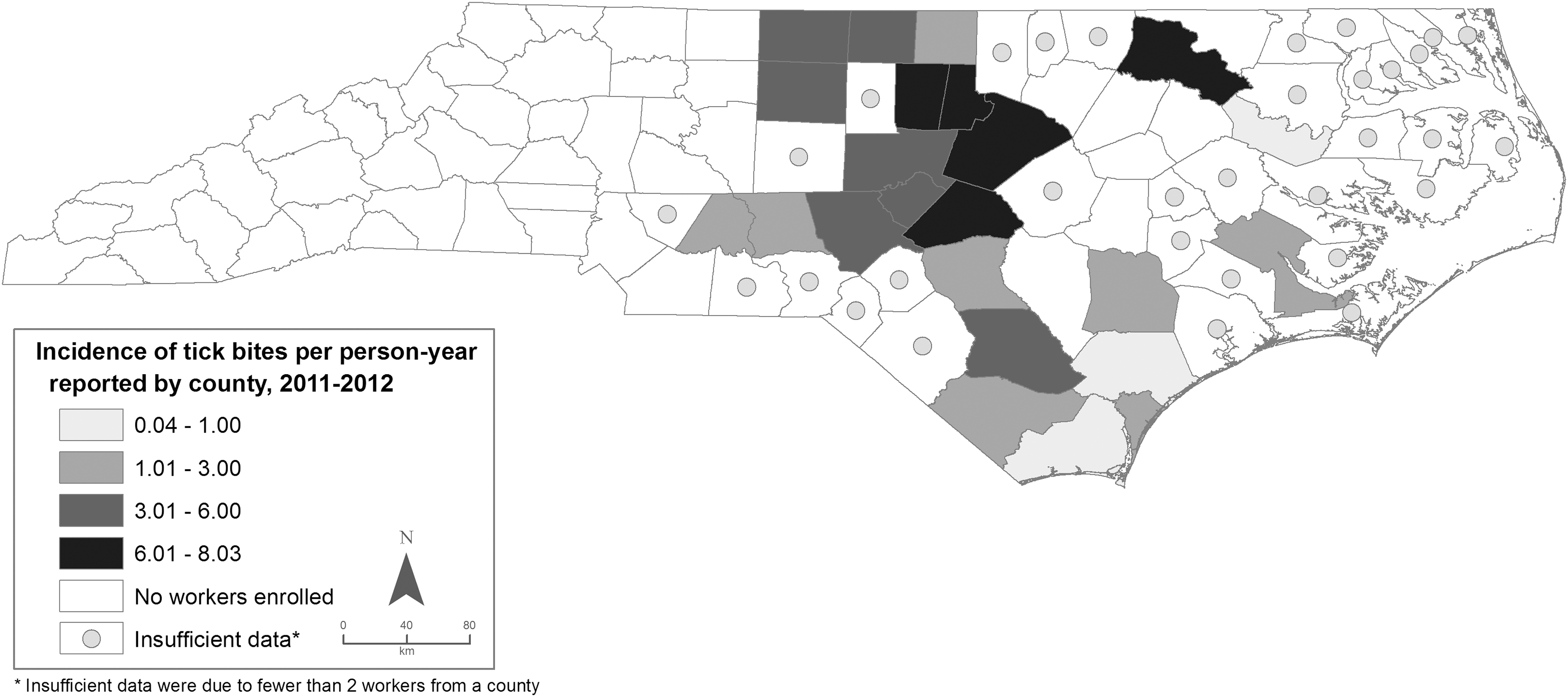
Incidence of reported tick bites among outdoor workers in county acquired, 2011–2012.
LLPI, long-lasting permethrin-impregnated; RCT, randomized control trial; SD, standard deviation.
Outcome assessment
Among the 130 subjects in the RCT cohort tested at baseline, 49 (38%) showed evidence of prior exposure to at least one tick-borne pathogen. The majority (61%) were seroreactive to a single pathogen and 39% were seroreactive to multiple pathogens (Table 2), with 12 reactive to two pathogens, 6 reactive to three pathogens, and 1 reactive to four pathogens (Supplementary Table S1; Supplementary Data are available online at
Antibody titers ≥1:128 were considered seropositive.
Seroconversion was defined as a fourfold rise in antibody titer between paired sera from 1 year to the next year.
Any infection refers to the number of workers with prevalent or incident infection from at least one pathogen.
B. burgdorferi was tested in paired sera from baseline and year two paired sera for the 90 workers.
Within the subcohort, there were 40 incident infections of at least one pathogen from 155 paired tests, a seroconversion rate of 0.26 infections per person-year. Of the 40 incident infections, 6 (15%) were coincident with one other pathogen and 2 (5%) were coincident with two additional pathogens (Table 2 and Supplementary Table S2). Seroconversion was attributed to R. parkeri infection (12%), “R. amblyommii” (9%), R. rickettsii (6%), and E. chaffeensis (5%). There were no incident infections of B. burgdorferi among the 90 T0,2 pairs (Table 2). Two of the 40 seroconversions, both to R. parkeri, occurred in individuals with prior evidence of R. parkeri exposure in baseline seroprevalence testing.
Only two subjects presented to physicians and had laboratory-confirmed infections with SFR and ehrlichiosis pathogens, one with E. chaffeensis and one with R. parkeri. Both reported rash within 4 weeks following a tick bite, and only one reported a fever. Additional clinical signs and symptoms were not collected. These clinical infections were both in park rangers from the NC Division of Parks and Recreation workers from central NC wearing untreated clothing.
The incidence of seroconversion shows infection by various pathogens across the study area. E. chaffeensis, R. parkeri, and “R. amblyommii” all showed similar occurrence in portions of central NC and southeastern NC, with an incidence from 0.01 to 4.00 infections per 10 person-years. The incidence of seroconversion to R. rickettsii was more focal in central NC, including a county with an incidence of over eight infections per 10 person-years. The map of any seroconversion reflects the spatial trends from each pathogen-specific map—high-incidence counties were generally the counties where multiple pathogens were detected. The full spatial trends in the data, however, cannot be deciphered due to insufficient data throughout the study area (Fig. 2).
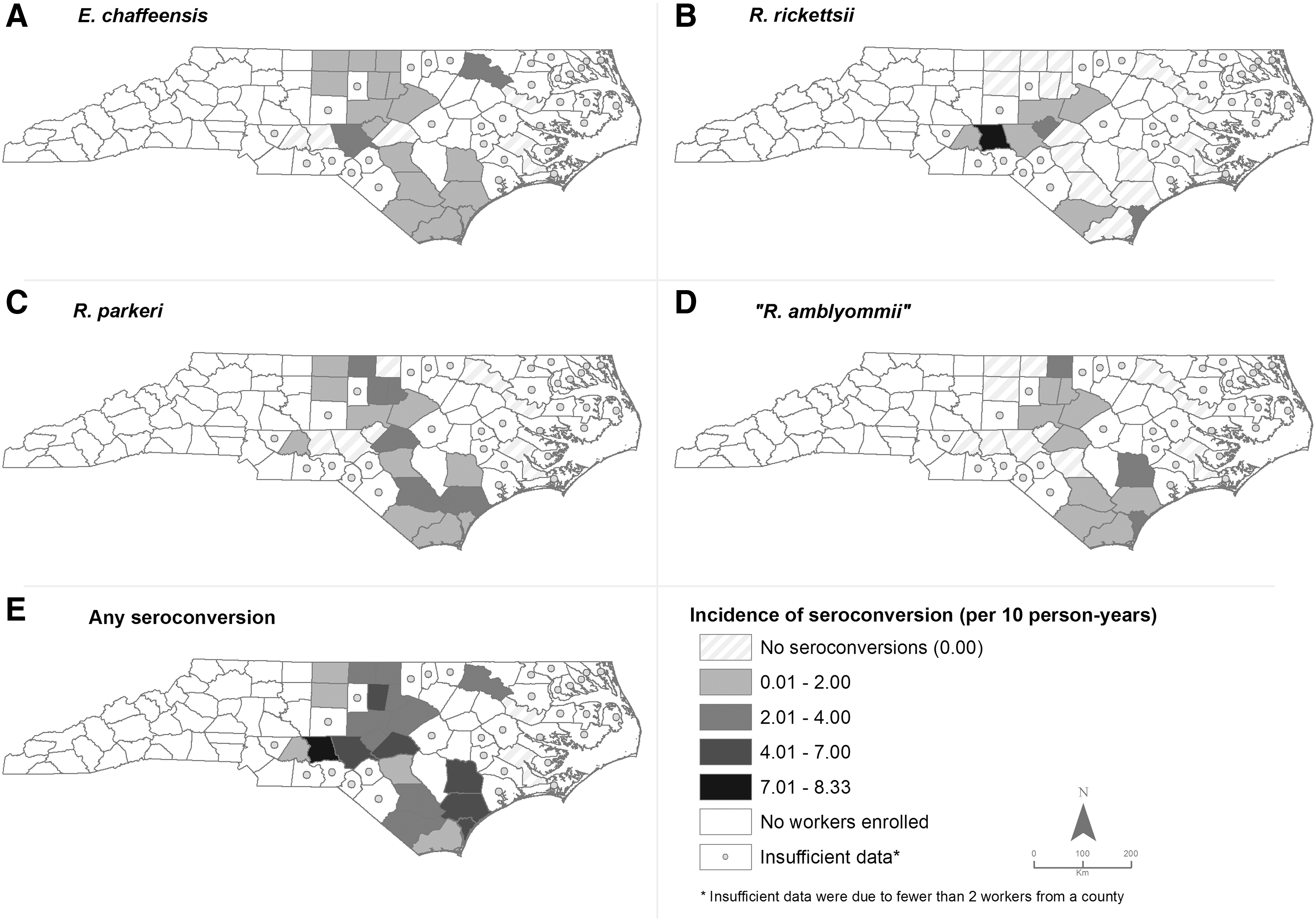
Incidence of seroconversion for specific pathogens
Risk factors for seroconversion
The risk of seroconversion to any tick-borne pathogen over the study period was 26% (40/155). In bivariate associations, seroconversion risk was lower among workers with LLPI-impregnated uniforms when compared to the controls with no treatment (unadjusted RR = 0.81; 95% CI: 0.47, 1.39). Workers from central NC had a higher risk of seroconversion than those in eastern NC (0.28 vs. 0.22). The risk of seroconversion was highest in workers from the NC Division of Forest Resources (0.36), followed by the NC Division of Parks and Recreation (0.24), NC County or local parks workers (0.21), and NC Wildlife Resources Commission (0.13). The unadjusted risk of seroconversion among NC Division of Forest Resources workers was 1.73 times the risk among all other NC work divisions in our study (95% CI: 1.02, 2.93).
Workers who seroconverted reported a higher mean number of tick bites per week than those who were uninfected (0.27 vs. 0.20). Uninfected workers spent about the same amount of time outdoors per week in work and nonwork settings as those who seroconverted (36.6 vs. 38.5). Neither measure varied significantly between groups for the mean time spent outdoors per week (p = 0.55) and the log-transformed mean number of tick bites per week (p = 0.20) (Table 3).
Variables for adjustment were region of employment and work division.
Reported p values align with the adjusted RR, unadjusted RR, or t-tests, as applicable.
CI, confidence interval; RR, risk ratios.
Results from multivariable analysis were similar to the unadjusted findings. After adjustment, the risk for seroconversion in the workers from the NC Division of Forest Resources was significantly higher than the risk among other NC state workers (RR: 1.73; 95% CI: 1.02, 2.92) (Table 3). The risk was higher among workers in central NC than in eastern NC, but not significantly (RR = 1.22; 95% CI: 0.70, 2.15). While the LLPI clothing protected against tick bites in the parent study by Vaughn et al. (2014b), its effect on seroconversion in this study was smaller. The unadjusted and adjusted RRs were 0.81 (95% CI: 0.47, 1.39) and 0.85 (95% CI: 0.50, 1.44), respectively, a consistent but statistically nonsignificant effect.
Discussion
North Carolina accounted for more than 13% of 9000 SFR cases reported to CDC from 2010 to 2012 (CDC 2012, 2013, 2014). These SFR cases were attributable to multiple Rickettsia species found in the state and known or suspected to cause human illness, including R. rickettsii, R. parkeri, and “R. amblyommii” (Billeter et al. 2007, Apperson et al. 2008, Paddock et al. 2008, Lee et al. 2014). North Carolina also reports a high number of ehrlichiosis cases attributable to E. chaffeensis and a small number of autochthonous cases of Lyme disease (CDC 2014, NCDHHS 2014). SFR organisms were most commonly identified in this study, with only a small proportion of E. chaffeensis detected, and no B. burgdorferi exposures identified. One in three workers demonstrated prior infection with at least one tick-borne pathogen, and one in four workers were infected by a tick-borne pathogen during the study period. Our findings confirm that outdoor workers in NC have substantial exposure to tick-borne pathogens.
Among the SFR organisms detected, R. parkeri was the most common in seroprevalence and seroconversions, and “R. amblyommii” was more common than R. rickettsii among the seroconversions. While the pathogenic potential of “R. amblyommii” in humans is unclear, it elicits a strong immune response resulting in serodiagnosis of SFR even in the absence of clinical disease (Rivas et al. 2015). However, evidence for pathogenicity of “R. amblyommii,” and a potential protective effect against R. rickettsii in infected animals, was recently shown in animal models by Rivas et al. (2015). Within our study, the limited number of R. rickettsii infections and the subclinical presentation of most cases provide evidence in support of the emergence of low pathogenic SFR that were historically misclassified as Rocky Mountain spotted fever (Paddock et al. 2004, Whitman et al. 2007, Apperson et al. 2008, Moncayo et al. 2010).
The incidence of infections within this cohort was directly attributable to the host-seeking ticks and their pathogens. In a prior study within this cohort, Lee et al. (2014) examined the prevalence of Rickettsia species in ticks removed from the skin of the outdoor workers and found little evidence of R. rickettsii circulating among ticks in the study area. Over 90% of the host-seeking ticks collected were Amblyomma americanum, with very few Dermacentor variabilis, Ambystoma maculatum, and Ixodes scapularis identified. Although the geographic location of these ticks was not included in this study, “R. amblyommii” represented the majority of organisms detected in A. americanum and other tick species, with some infections by R. parkeri and only single infection with R. rickettsii (in an A. americanum). These entomologic data correspond with the findings of the current study identifying a higher number of incident seroconversions of R. parkeri and “R. amblyommii” compared with R. rickettsii.
The risk of incident infection by SFR or ehrlichiosis pathogens identified among workers in this study was higher than observed in most other studies. A multisite study of soldiers on military installations, including one in NC, detected seroconversions in 2.5% and 1.3% for SFR and ehrlichiosis pathogens. In a serologic study of park workers in the Great Smoky Mountains National Park, Adjemian et al. (2012) reported a comparable seroprevalence of 21% for SFR and 5% for E. chaffeensis, but only a single seroconversion to SFR was identified. These differences in incidence are likely due to site characteristics—central and eastern NC are established areas of SFR endemicity and have more suitable ecologic conditions for ticks than the densely forested, higher elevations of the Great Smoky Mountains.
This study identified a higher risk of seroconversion among NC Division of Forest Resources, which was expected, given their work in the field and likelihood of tick exposure. Seroconversion occurred in 36% of the forestry workers, and they were 73% more likely to have an incident infection when compared with all other work divisions. Although job activities may differ within and among the work divisions, the activities and settings in which foresters work likely increase their exposure to ticks. Within the study by Adjemian et al. (2012), resource managers, who likely have similar roles as foresters, were 6.6 times as likely (95% CI: 1.3, 34.7) to have an incident seroconversion to any mosquito- or tick-borne antigen when compared to workers with administrative positions. The RR in this study was smaller but more precise (RR: 1.73; 95% CI: 1.02, 2.92), likely due to a larger sample size and our restricted enrollment to those working at least 10 h per week outdoors.
No other worker characteristics were identified as risk factors for seroconversion. The use of LLPI uniforms showed evidence of a protective effect, but was not significant. This might be because the uniforms lost efficacy in year 2 or because workers were infected outside of work hours when uniforms are not worn (Vaughn et al. 2014b). The risk of seroconversion based on the number of reported tick bites was also nonsignificant but suggestive of a higher risk of seroconversion among those reporting more tick bites.
We must acknowledge several limitations to this study. First, seroconversion was measured from paired samples collected over a time period during which antibody levels may have decreased to less than a fourfold rise in titer. This outcome misclassification would only increase the number of seroconversions detected. Second, the fourfold rise in antibody titer is assumed to be indicative of infection by a specific pathogen, but we must acknowledge the potential for this rise in antibody titer to be evidence of reinfection by or re-exposure to a pathogen. However, in all but two seroconversions, there was no evidence of prior exposure to the specific antigen at baseline. We also must acknowledge the potential for cross-reactivity within Rickettsia species (Vaughn et al. 2014a). The outcome of any seroconversion, rather than using pathogen-specific outcomes, was used to address this potential misclassification from cross-reactivity. Finally, this study was not sufficiently powered to detect small differences in the risk of seroconversion—the sample size of the current study was limited to the eligible participants from the parent study. The lack of significance in some results, therefore, should not be interpreted as an absence of effect on the risk of seroconversion in this study.
Conclusions
Outdoor workers on publicly managed lands within NC are at significant risk of acquiring tick-borne infections and subsequent exposure to pathogens, and workers from the NC Division of Forest Resources are at an even higher risk of infection. The risk of infection by SFR and ehrlichiosis pathogens is not homogenous across eastern and central NC, and incidence varies in areas of central and eastern NC. While there was little difference in the risk of infection by SFR and ehrlichiosis pathogens based on time spent outdoors and number of tick bites per week, continued recommendations for personal protective measures, including wearing permethrin-treated clothing, will limit the exposure to ticks and tick-borne illnesses. The findings of this study underscore the occupational risks of tick-borne illness among outdoor workers.
Footnotes
Acknowledgments
This research was supported by a grant to S.R.M. from the Centers for Disease Control and Prevention and the National Institute for Occupational Safety and Health (5R01OH009874).
Author Disclosure Statement
No competing financial interests exist.
References
Supplementary Material
Please find the following supplemental material available below.
For Open Access articles published under a Creative Commons License, all supplemental material carries the same license as the article it is associated with.
For non-Open Access articles published, all supplemental material carries a non-exclusive license, and permission requests for re-use of supplemental material or any part of supplemental material shall be sent directly to the copyright owner as specified in the copyright notice associated with the article.
