




Abstract
Trichinella spp. are relevant zoonotic pathogens in Estonia. The aim of this nationwide cross-sectional study was to estimate the seroprevalence of Trichinella spp. in domestic pigs (Sus scrofa domestica) and hunted wild boars (Sus scrofa). Serum samples from 374 pigs, originating from 14 farms, and meat juice samples from 470 wild boars were tested for immunoglobulin G antibodies against Trichinella excretory/secretory antigens using a commercial enzyme-linked immunosorbent assay (ELISA). Antibodies against Trichinella were not detected in the domestic pigs, indicating effective parasite control strategies in the farms. By contrast, 42.1% of the wild boars tested positive, indicating substantial infection pressure in the sylvatic cycle. Further analysis of a subset of the wild boar samples, using another ELISA and Western blot, yielded a confirmed seroprevalence estimate of 17.4%. A substantial proportion of wild boars in Estonia had evidence of exposure to Trichinella spp. and may have carried infective larvae. Undercooked Estonian wild boar meat is a potential source of Trichinella spp. infections to humans and other hosts.
Introduction
T
Trichinellosis is a relevant parasitic zoonosis in Estonia, northeastern Europe. During 1965–2014, 106 cases of human trichinellosis were recorded in Estonia (Health Protection Inspectorate 2005, 2008, Terviseamet 2014). Sixty-four cases were associated with the consumption of wild boar meat, 3 cases with the consumption of meat from an infected backyard pig (Järvis et al. 2002), 2 cases with the consumption of European badger (Meles meles) meat, and the source was not identified for the remaining 37 cases.
Trichinella spp. are often found in wild boars hunted in Estonia—1.5% of tested samples were positive for larvae in 2013 (European Food Safety Authority 2015). The purpose of testing for Trichinella at meat inspection is to prevent clinical Trichinella spp. infections in humans (Nöckler et al. 2000). However, the digestion method, particularly when testing pooled samples, may underestimate how commonly the animals are exposed to Trichinella parasites. Furthermore, the current meat inspection program does not cover animals that are intended for personal consumption. In 2012–2013, less than one-fifth of hunted wild boars were tested for Trichinella spp. using officially recognized methods in Estonia (Keskkonnaagentuur 2013, Veterinary and Food Board 2013).
Serological methods are indirect methods that are suitable for epidemiological studies and monitoring (Gajadhar et al. 2009, Gómez-Morales et al. 2009, 2012). An enzyme-linked immunosorbent assay (ELISA) using excretory/secretory (E/S) antigen has been widely used and is applicable to screening larger numbers of samples, and Western blot (WB) should be used to confirm positive ELISA results (Nöckler and Kapel 2007, Gómez-Morales et al. 2014).
We performed a nationwide cross-sectional seroepidemiological study to estimate the prevalence of specific anti-Trichinella antibodies in domestic pigs and wild boars in Estonia.
Materials and Methods
Ethics statement
No samples were taken for the primary purpose of this study. The data collected were stored confidentially.
Samples had been obtained from domestic pigs for routine serological monitoring of unrelated diseases by the Veterinary and Food Board. Blood samples had been collected by veterinarians from the jugular veins of live pigs during farm visits.
The sampling of wild boars had been designed for a nationwide Toxoplasma gondii study (Jokelainen et al. 2015). Tissue samples had been collected postmortem from wild boars that had been legally hunted for human consumption.
Sample size calculations
Sample size calculations were performed using the Epi Tools software (Sergeant 2015).
The required sample size to estimate the Trichinella seroprevalence in domestic pigs was calculated using an expected prevalence of 0.1%, sensitivity of 93%, specificity of 90% (Gamble et al. 2004), and a population size of 440,000 (Veterinary and Food Board 2013). Clustering of the animals on the farms was not taken into account. The available sample size was evaluated as limited but adequate for this study.
The required sample size to estimate the Trichinella seroprevalence in wild boars was calculated using an expected prevalence of 5%, conservative estimates of sensitivity and specificity of 90% (Cuttell et al. 2014), and a population size of 18,159 (on the basis of the 2011–2012 hunting bag; Keskkonnaagentuur 2012). The available sample size was evaluated to be sufficient for this study.
Samples
Serum samples from 374 domestic pigs were included in the study. The samples had been collected in 2012 and originated from 14 pig herds (range 58–11,295 animals; mean 3,560 animals) from seven counties. Blood samples had been collected into vacutainers without anticoagulant, and the sera were stored at −20°C until analysis.
Meat juice samples from 470 wild boars were included in this study. The samples had been collected during the hunting season 2012–2013 and originated from 14 counties (Jokelainen et al. 2015). The serosanguineous meat juice sample aliquots were stored at −20°C until analysis. Information regarding the gender and age of each individual wild boar, and the location and date of the kill, was provided by the hunters. Age estimates were provided in months or years, or the animal was described as “young” or “old.”
Enzyme-linked immunosorbent assay
The samples were tested for IgG antibodies against Trichinella E/S antigens using ID Screen® Trichinella Indirect Multi-species ELISA kit (ID Vet Innovative Diagnostics, Grabels, France) according to the manufacturer's instructions. Sera and meat juice samples were diluted to 1:20 and 1:2, respectively.
The optical density (OD) was read at 450 nm, and the sample/positive control percentage (S/P%) was calculated for each sample. The mean OD value of duplicate negative control was subtracted from both the nominator and the denominator, the OD value of the sample and the mean OD value of duplicate positive control, respectively.
The results were evaluated according to the criteria provided by the manufacturer. For pig sera, an S/P% over 60 was considered positive and 50–60 doubtful. For meat juice samples from wild boars, an S/P% over 30 was considered positive and 25–30 doubtful. Samples that tested doubtful were retested, and if the second result was also doubtful, the sample was classified as negative.
European Union Reference Laboratory ELISA+WB
A subset of meat juice samples from wild boars (n = 52) was further tested at the European Union Reference Laboratory (EURL) for Parasites (Istituto Superiore di Sanita, Rome, Italy) using EURL in-house ELISA and WB in series (Gómez-Morales et al. 2014; Table 1).
The ELISA results are given as S/P%.
Samples that tested twice as doubtful and were thus classified as negative.
ELISA, enzyme-linked immunosorbent assay; EURL, European Union Reference Laboratory; S/P%, sample/positive control percentage; WB, Western blot.
Statistical analyses
Preliminary statistical analyses were performed using the OpenEpi software (Dean et al. 2015). Confidence intervals (CIs) were calculated using Mid-P exact. Differences between proportions were evaluated using Two-by-Two tables (Dean et al. 2015), and p values <0.05 were considered statistically significant. The R Commander (Fox 2005) software was used for building models.
Wild boars were divided into two age groups—“young,” up to 2 years of age, and “old,” over 2 years of age. Data on the location of the kill were entered into the database as counties (dummy variables) and as latitude and longitude coordinates (continuous variables) with varying degrees of precision depending on the data available. T. gondii serology result was available for each wild boar from a previous study (Jokelainen et al. 2015).
Univariable analyses were used to identify risk factors (age group, gender, county, T. gondii seropositivity) for Trichinella seropositivity (binomial outcome). A multivariable logistic regression model was built stepwise, by combining forward selection and backward elimination.
Results
Enzyme-linked immunosorbent assay
None of the 374 domestic pig sera tested positive for IgG antibodies against Trichinella spp. (0.00%, 95% CI 0.00–0.01) (Fig. 1). Antibodies against Trichinella spp. were detected in 198 of 470 wild boar samples (42.1%, 95% CI 37.7–46.6) (Fig. 1 and Table 1).
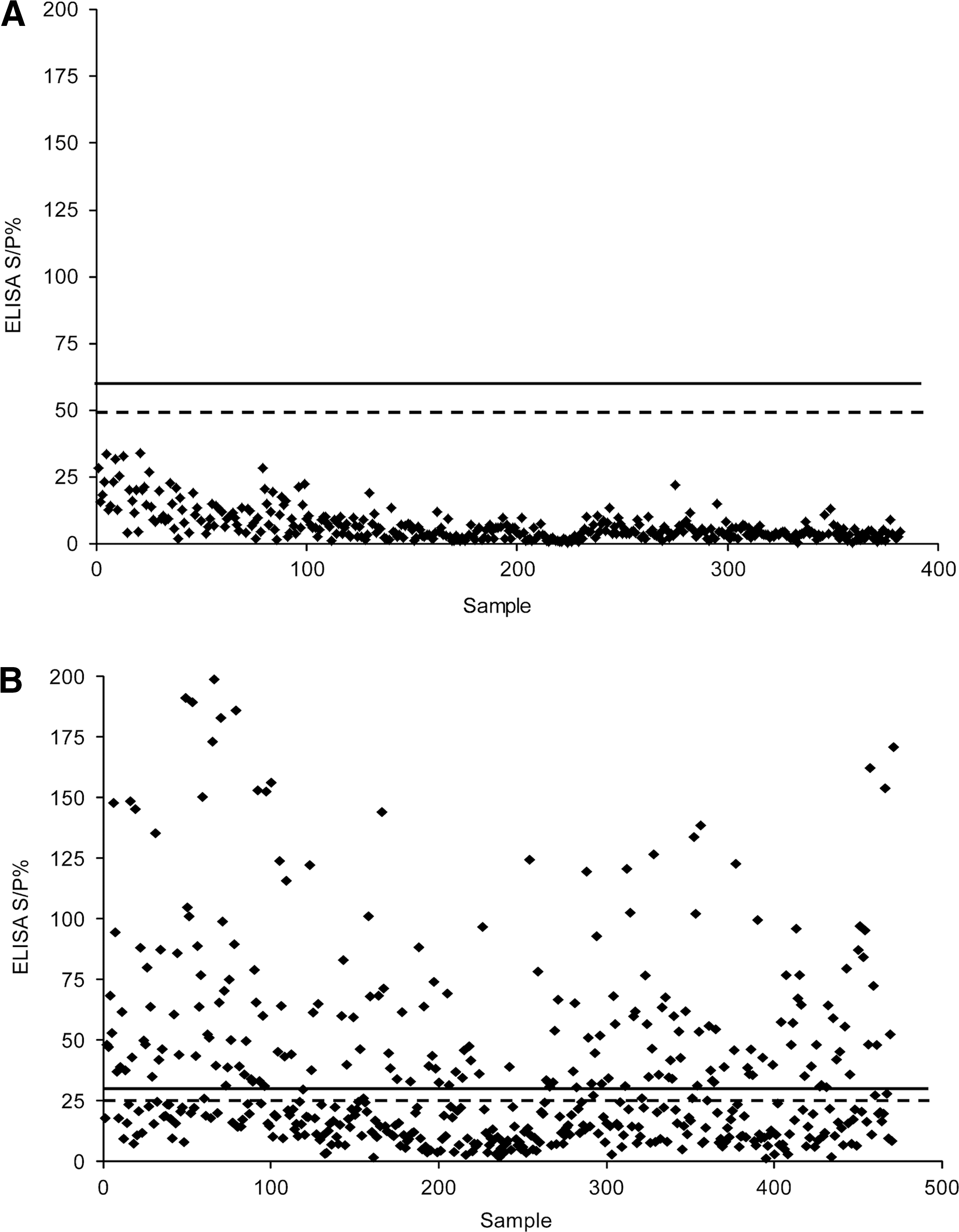
Serological evidence of exposure to Trichinella spp. in domestic pigs
European Union Reference Laboratory ELISA+WB
Of the 34 samples that tested ELISA positive, 14 (41.2%) were confirmed as positive using the EURL ELISA+WB (Table 1 and Fig. 2). Ten ELISA negative samples and eight samples that had tested ELISA doubtful twice tested negative with EURL ELISA+WB. By extrapolating these results to the entire data set, the number of further confirmed seropositives would be 0.412 × 198 = 82, yielding a confirmed seroprevalence estimate of 17.4% (95% CI 14.3–21.1) in wild boars.
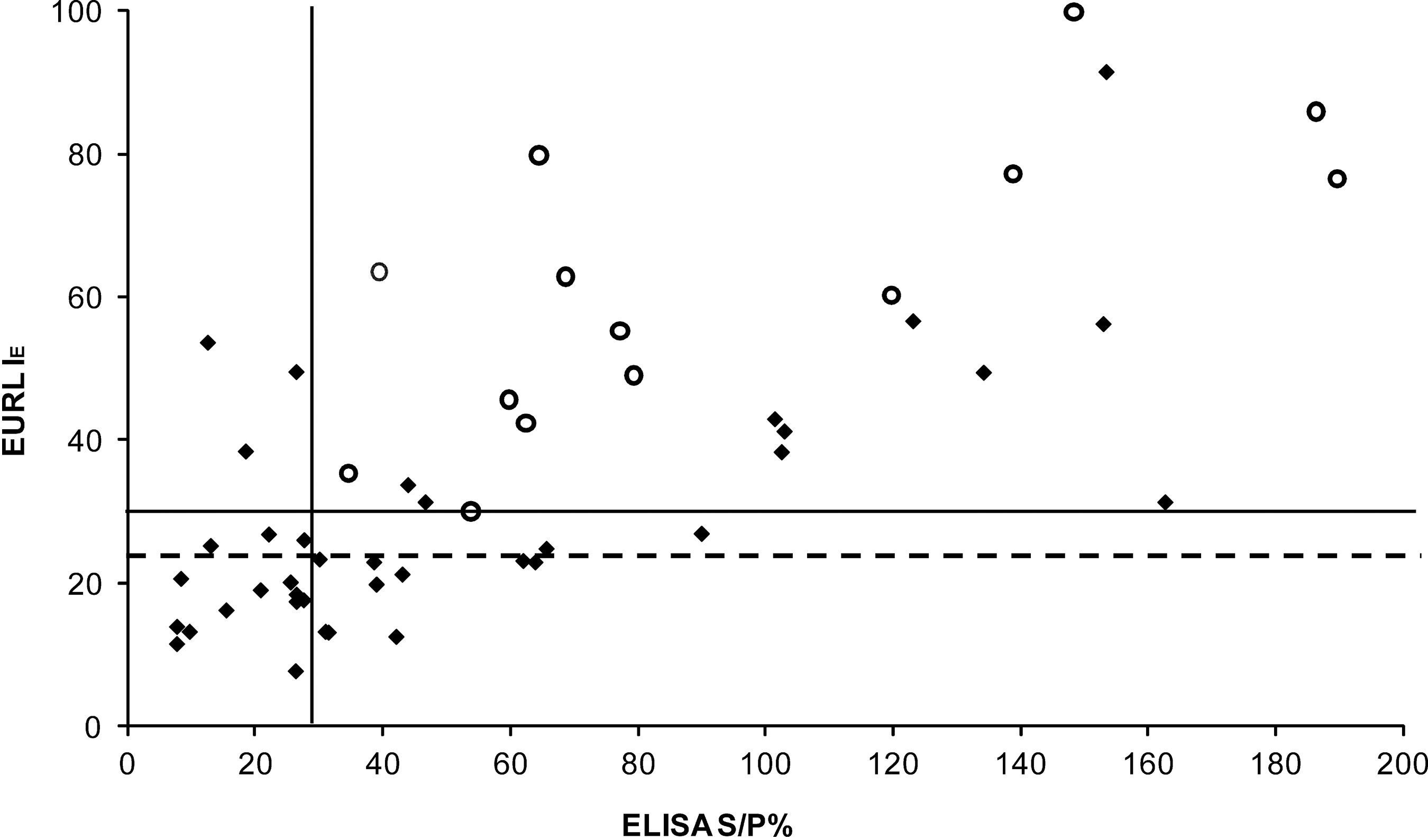
Estonian wild boar samples tested for antibodies against Trichinella spp. using a commercial ELISA, and in-house ELISA and WB at the European Union Reference Laboratory (EURL ELISA+WB). The solid horizontal line is the S/P% cutoff for seropositivity of the commercial ELISA; doubtful results are between the solid and dotted lines. The solid vertical line represents the ELISA index (IE) cutoff for seropositivity of the EURL ELISA. The circles indicate samples that tested positive with WB, the diamonds indicate samples that tested negative with WB. EURL, European Union Reference Laboratory; WB, Western blot.
Risk factors
The seroprevalence and confirmed seroprevalence estimate in wild boars were significantly higher than the seroprevalence in domestic pigs (p < 0.001). No significant difference was observed between genders or age groups in either domestic pigs or wild boars. There was no association between Trichinella and T. gondii (Jokelainen et al. 2015) seropositivity in the wild boars.
The final logistic regression model included only the county variable. The odds of finding Trichinella seropositive wild boars were higher in the counties Saaremaa, Pärnumaa, Raplamaa, and Võrumaa than in the reference county Harjumaa (Table 2 and Fig. 3).
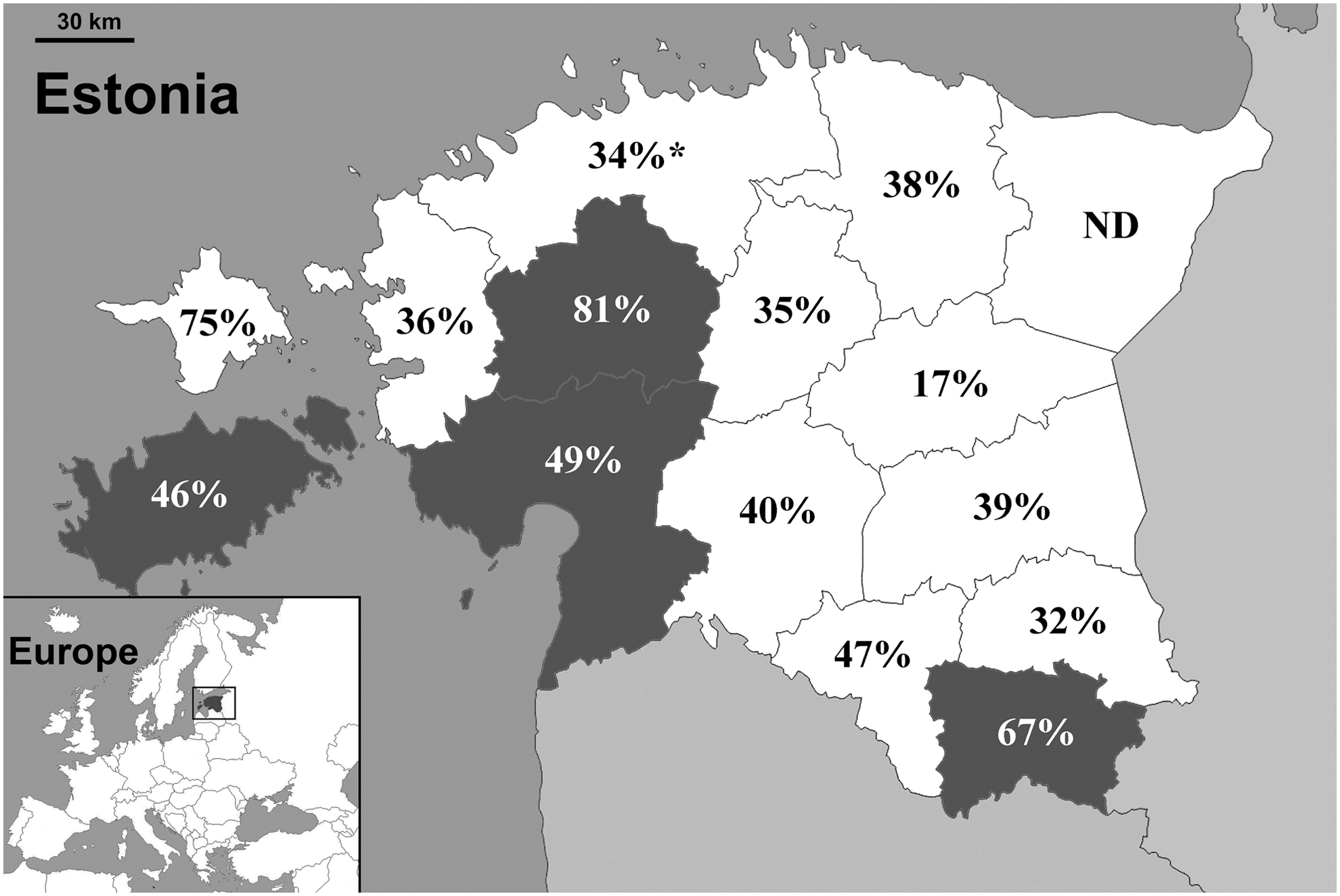
Geographical distribution of Trichinella spp. seropositive wild boars in Estonia, by county. Dark gray indicates counties where the odds of testing seropositive were significantly higher when compared with the reference county Harjumaa (*).
p < 0.05; b p < 0.01; c p < 0.001.
NA, no data available.
Discussion
Our results indicate that Trichinella spp. continue to be endemic in Estonia and call for continuous awareness of this zoonotic parasite.
Anti-Trichinella IgG antibodies were not detected in domestic pigs in this study. This result is similar to several recent reported results from other European countries. No Trichinella-seropositive domestic pigs were found in Finland (Felin et al. 2015). The Trichinella seroprevalence was estimated to be 0.12–0.35% in the Netherlands (Van der Giessen et al. 2007) and 0.81–0.99% in Poland (Bien 2006, 2007). Our result primarily reflects the circumstances in controlled large-scale production systems because the samples did not include samples from small farms or backyard pigs.
In 2012–2013, the wild boar hunting bag was 24,042 animals (Keskkonnaagentuur 2013). In this study, a substantial part of wild boars tested Trichinella seropositive using a commercial ELISA. The Trichinella seroprevalence in wild boars in Estonia was ∼60 times higher than the estimated seroprevalence in hunted wild boars in Poland (0.68–0.74%; Bien 2006, 2007), 20 times higher than that in farmed wild boars in Finland (2%; Jokelainen et al. 2012), and 6 times higher than that in hunted wild boars in the Netherlands (6.8%; Van der Giessen et al. 2001). Lower seroprevalences have been reported also from other European countries (Antolova et al. 2006, Frey et al. 2009, Payne et al. 2011, Boadella et al. 2012, Touloudi et al. 2015); however, the results are not directly comparable due to methodological differences (sample type, antigens, dilutions, cutoffs), the Trichinella species present, and the lifestyle of the wild boars investigated (farmed or free ranging).
The confirmed seroprevalence estimate was 10 times higher than the infection prevalence estimate (1.5%) obtained using artificial digestion (European Food Safety Authority 2015) and substantially higher than the seroprevalence estimates reported from other countries (Van der Giessen et al. 2001, Antolova et al. 2006, Bien 2006, 2007, Frey et al. 2009, Payne et al. 2011, Boadella et al. 2012, Jokelainen et al. 2012, Touloudi et al. 2015).
The regression model indicated higher odds of finding Trichinella-seropositive animals in four counties, when compared with Harjumaa where the capital of Estonia is located (Fig. 3). This result suggests that there are some areas with higher Trichinella infection pressure to wild boars, in contrast to what was observed for T. gondii (Jokelainen et al. 2015). The lack of a difference in seroprevalences between younger and older wild boars indicates that the wild boars are exposed to Trichinella spp. early in life, also suggesting high infection pressure.
The optimal material for the detection of IgG is serum (Gamble et al. 2004), but meat juice samples are considered a practical alternative (Kapel et al. 1998, Gamble et al. 2004). For this study, sera were available from the domestic pigs and meat juice had been the material collected from the wild boars. The use of existing sample banks was both ethical and economical, and the sample sizes were evaluated as adequate to sufficient to answer the research questions.
The EURL ELISA+WB versus the commercial ELISA used for screening appeared to have lowest agreement among samples with the S/P% matching the criteria for “low positive” (Table 1 and Fig. 2). The relatively low agreement between the positive results of commercial ELISA and the corresponding EURL ELISA+WB results, which was significantly lower (p < 0.001) than the full agreement between ELISA negative samples and the corresponding EURL ELISA+WB results (Table 1 and Fig. 2), was likely due to inherent differences of the methods, but could be partly explained by different storage time of the samples before performing the tests (Boadella and Gortazar 2011). Longer overall storage time of the samples before testing with EURL ELISA+WB could have reduced the concentration of antibodies. The meat juice samples tested with EURL ELISA+WB had been thawed and refrozen two or three times, which may have affected the results. We found no effect, however, on the commercial ELISA results in a small subset of samples that we retested after freezing and thawing eight times during a short time period (data not shown).
ELISA is a highly sensitive method to detect antibodies that indicate previous exposure of the host to the parasite (Gamble et al. 2004). In areas where sylvatic Trichinella spp. infections are widespread, animals may be repeatedly infected (Pozio 2000), also with different Trichinella species (Kapel 2001). Other concomitant infections, particularly other nematode infections (Gamble et al. 2004), may also influence the host's humoral immune response (Frontera et al. 2007, Cuttell et al. 2014, Gómez-Morales et al. 2014).
For the seropositive wild boars detected in this study, the infection sources and Trichinella species that caused the detected immunological responses remain unknown. Human behavior could affect the survival and circulation of the parasite, also in the sylvatic cycle. In Estonia, the widespread habit of hunters to leave animal carcasses and offal in the forest (Vaiksoo 2014) may provide Trichinella infection sources to new hosts.
We did not detect any domestic pigs with antibodies against Trichinella, yet a high infection pressure was present in the sylvatic cycle surrounding the domesticated animals that live in the agricultural environment. This calls for continuous biosafety measures to prevent the parasite from entering the production chain.
The seropositive wild boars were hunted and presumably used for human consumption, and they may have carried infective Trichinella spp. larvae. This potential risk to humans merits public health awareness, particularly at present in Estonia where a substantial number of wild boars are hunted to control the spread of African swine fever.
Conclusions
A large proportion of Estonian wild boars had a measurable humoral response against Trichinella spp. antigens, which indicates that they had encountered Trichinella spp. and might have carried infective larvae. Estonian wild boar meat should be considered a potential source of Trichinella infections to humans and other hosts and should only be consumed after thorough cooking.
By contrast, domestic pigs raised in industrial housing systems in Estonia did not show evidence of having encountered Trichinella spp. Prevention of Trichinella infections in domestic pigs in Estonia has been achievable, but the results from their free-ranging wild relatives, which serve as reservoirs and sentinels, show that there is a substantial infection pressure around them. Biosafety is continuously relevant in pork production, and continued surveillance of the situation is needed.
Footnotes
Acknowledgments
The authors thank the Estonian Agricultural Registers and Information Board, Estonian Animal Recording Centre, Estonian Hunters Association, Veterinary and Food Board, and Veterinary and Food Laboratory for their contributions and positive attitude toward our study. This study was financially supported by the Health Promotion Research Program TerVe 3.2.1002.11-0002 EKZE_SS from the Estonian Research Council and by M14143VLVP from the Strategic Development Fund of the Estonian University of Life Sciences.
Author Disclosure Statement
No competing financial interests exist.