




Abstract
Coxiella burnetii is a zoonotic agent and causes coxiellosis, which is a cause of reproductive failure in a range of animal species, including abortion and stillbirth and Q fever, which is most often characterized by an acute flu-like illness, mild pneumonia, and/or hepatitis in humans. While livestock are well recognized worldwide as a source of infection, the zoonotic risk of C. burnetii infection in companion animals such as dogs may be overlooked. For serological diagnosis, indirect immunofluorescent assay (IFA) and enzyme-linked immunosorbent assay (ELISA) are generally considered good methods for prevalence surveys of coxiellosis. In this study, we conducted a nationwide survey of the seroprevalence of previous exposure to C. burnetii in dogs, dairy cattle, and Korean native cattle (a primarily beef breed) in South Korea. Serum samples obtained from 3087 Korean native cattle, 1224 dairy cattle, and 1023 dogs were collected from eight provinces in South Korea, and IFA and ELISA were performed to test for seropositivity. The prevalence of C. burnetii was 1.7% in Korean native cattle, 10.5% in dairy cattle, and 2.9% in dogs. This is the first report identifying previous exposure to C. burnetii in South Korean dogs. Furthermore, the presence of C. burnetii antibodies in companion and feral dogs indicates that dogs can be a potential reservoir species for zoonotic risk of C. burnetii infection in South Korea. Therefore, more detailed studies aiming to clarify epidemiological factors should be performed in the future.
Introduction
C
C. burnetii has both virulent (phase I) and nonvirulent phases (phase II). Phase I C. burnetii is found in infected animals and humans and is extremely contagious, whereas Phase II antigens are isolated from cell cultures or fertilized eggs, which are serially passed. Phase I and phase II antigenic variations are highly valuable for differentiating between acute and chronic Q fever (Fournier et al. 1998). For serological diagnosis of C. burnetii infection, several methods, including complement fixation assay (CFA), indirect immunofluorescent assay (IFA), and enzyme-linked immunosorbent assay (ELISA), have been described (Fournier et al. 1998). The World Organisation for Animal Health recommends CFA for coxiellosis in animals, although it has poor sensitivity. IFA is the reference method for serodiagnosis of Q fever in humans because of its high sensitivity and specificity. ELISA has been described to have a lower sensitivity than IFA for diagnosis using human sera. For ruminants, both methods, that is, IFA and ELISA, have been regarded as screening assays for the presumptive survey of coxiellosis (Meekelenkamp et al. 2012; Muleme et al. 2016).
C. burnetii has been reported worldwide, including Africa, Asia, Europe, and North and South America, and has a broad host spectrum (Maurin and Raoult 1999; Woldehiwet 2004). In South Korea, a low seroprevalence of C. burnetii was detected in healthy people, while a relatively high prevalence was found in dairy cattle (Kim et al. 2006). However, only a limited sample size of animals from a few dairy farms were analyzed in the previous prevalence study, and there is little information concerning the epidemiology of coxiellosis in the country (Kim et al. 2006). Therefore, this study aimed to perform a nationwide survey of the seroprevalence of C. burnetii in dogs, dairy cattle, and Korean native cattle in South Korea.
Materials and Methods
Blood samples were collected from 3087 Korean native cattle (a primarily beef breed) from 362 Korean native cattle farms in seven provinces and 1224 dairy cattle from 171 dairy herds in five provinces in South Korea. A total of 1023 blood samples were collected from pet dogs from small animal clinics and animal shelters housing free-roaming dogs in eight provinces in South Korea. All the sera were stored at −70°C until testing. Protocols for sample collection were reviewed and approved by the Institutional Animal Care and Use Committee of Kangwon National University (Approval number: KW-121120-1). The sampling was performed with permission from the animal owners.
For the testing of cattle samples, a large number of sera were initially screened by IFA. The test was performed according to the previously conducted in-house assay using the Nine Mile strain of C. burnetii that was provided by the Centers for Disease Control and Prevention of Korea (Kim et al. 2006). The cutoff value of the IFA was determined with negative-control sera and positive-control sera included in a commercial ELISA kit (ID Screen Q fever indirect multispecies; ID Vet, Grabels, France). To determine the cutoff value for the IFA, twofold serial dilutions (1:8 to 1:512) of all sera were overlaid on Teflon-printed glass slides (Thermo Fisher Scientific, Waltham, MA) prepared with Nine Mile phase II antigen dots and incubated for 1 h at 37°C in a humid chamber. After washing, fluorescein isothiocyanate-conjugated rabbit anti-bovine IgG (Sigma-Aldrich, St. Louis, MO) was applied for 1 h at 37°C in a moist chamber. The washed slides were examined under fluorescence microscopy. The lowest dilution at which bacterial fluorescence and false-positive responses (background fluorescence) were able to be distinguished with the positive and negative control sera was 1:32. At this dilution, negative control samples displayed no fluorescence (black background), and the dilution was chosen as the cutoff value for a true positive sample.
All samples from Korean native cattle herds and dairy cattle herds were then tested by the previously described IFA procedure at the optimized dilution. For additional confirmation, serum samples tested as positive or tentatively positive by IFA were subsequently examined using a commercial ELISA kit (ID Screen Q fever indirect multispecies; ID Vet) with the manufacturer's stated sensitivity of 100% and specificity of 99.6%. The previously tested sera were serially diluted twofold up to 1:1024, and all steps were conducted according to the manufacturer's instructions.
The dog serum samples were analyzed using a commercial ELISA kit comprising microtiter plates that were precoated with C. burnetii phase I and II purified antigens (C. burnetii canine MIF IgG Kit; Fuller laboratories, Fullerton, CA) with the manufacturer's stated sensitivity of 98% and specificity of 100%. The ELISA was performed according to the manufacturer's instructions. Bound conjugates that were detected by the tetramethylbenzidine substrate and color change reactions were assessed in a microplate reader (Model 680; Bio-Rad, Hercules, CA) at a test wavelength of 405 nm.
Results
The seroprevalence of C. burnetii antibodies in Korean native cattle was 1.7% (52/3087), and the seropositivity rate in different provinces ranged from 0.0% to 7.6%. The prevalence of C. burnetii in Gyeonggi province was the highest (7.6%; 23/304), and Gyeongbuk province revealed a relatively high prevalence of 2.7% (22/801). However, low positive rates, that is <1%, were detected in the other provinces (Fig. 1). In contrast, the overall national seroprevalence in dairy cattle was 10.5% (128/1224), and the prevalence was higher than 10% in four (Gangwon, Gyeongbuk, Gyeonggi, and Jeonnam) of five provinces.
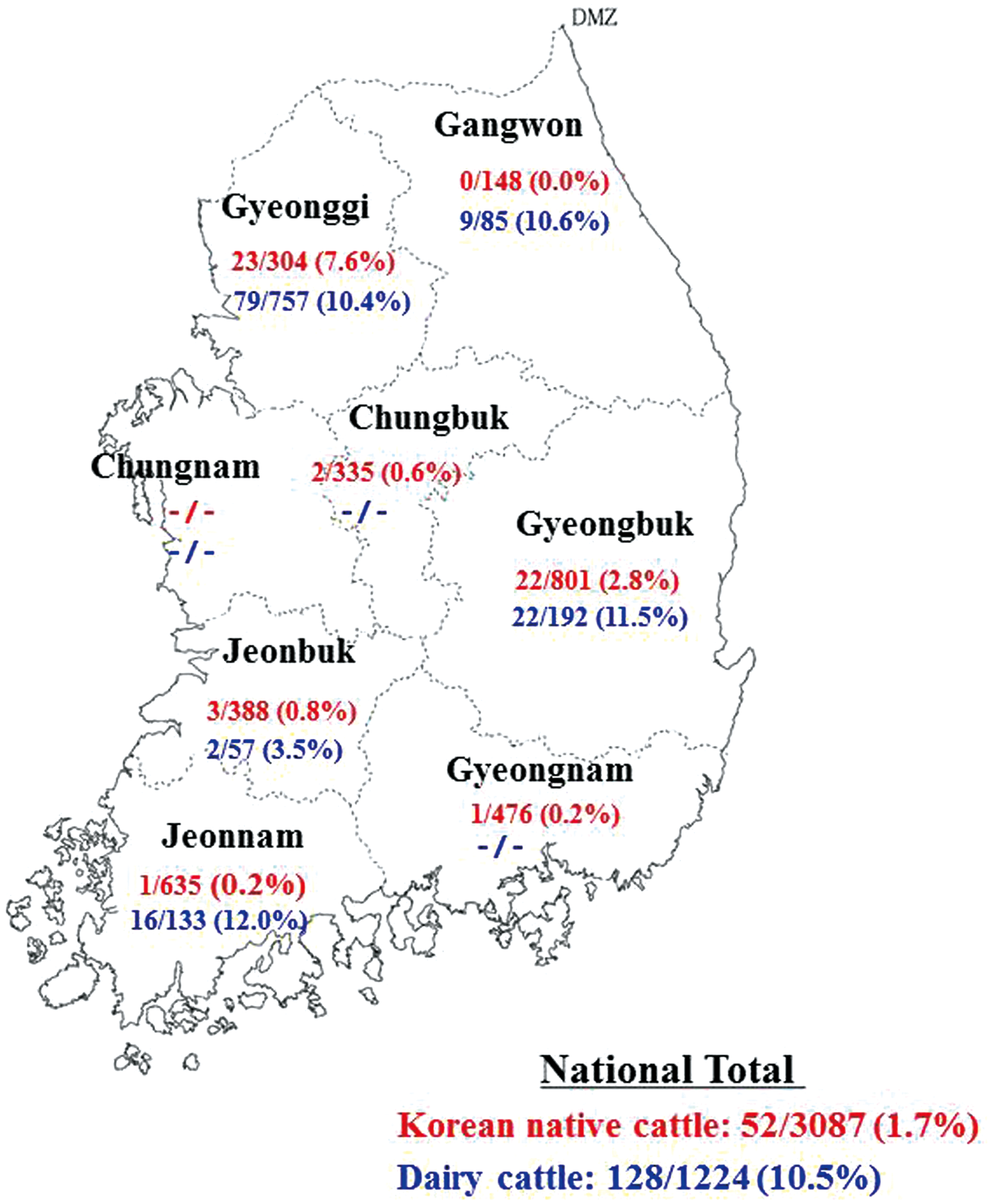
Summary of Coxiella burnetii seroprevalence data across seven provinces in South Korea. Overall, 1.7% of Korean native beef cattle and 10.5% of the dairy cattle herds were seropositive nationwide. Color images available online at
The prevalence of antibodies against C. burnetii in the 1023 sera from dogs in South Korea is shown in Table 1. Overall, anti-phase I and anti-phase II antigen immunoglobulin G (IgG) values were present in 7 (0.7%) and 30 (2.9%) dog serum samples, respectively. All sera with anti-phase I antigen IgG were positive for phase II antigen IgG. The prevalence varied with respect to the area, with the highest prevalence found in the Gangwon province (phase I IgG, 6.4%; phase II IgG, 20.5%); in the low-prevalence areas (Chungnam, Gyeongbuk, Gyeonggi, Gyeongnam, and Jeonnam provinces), seropositivity ranged from 7.8% to 0.7%, and no positive result for anti-phase I or anti-phase II antigen IgG was observed for dog sera from the remaining provinces.
IFA, immunofluorescent assay.
Discussion
In this study, we surveyed the seroprevalence of C. burnetii in Korean native cattle, dairy cattle, and dogs in South Korea. The prevalence of previous exposure to C. burnetii in dairy cattle (128/1224; 10.5%) was approximately six times higher than that in Korean native cattle (52/3087; 1.7%) using IFA and ELISA. Similarly, Paul et al. (2014) reported the significantly higher prevalence of C. burnetii in dairy herds than in beef herds and demonstrated that age is a significant risk factor for the increased seropositivity between herds (Paul et al. 2014).
The higher seroprevalence in Korean native cattle may, at least in part, be due to the difference in expected life span between two breeds of cattle with most Korean cattle being slaughtered at close to 24 months compared to dairy cattle living to 4 or 5 years in South Korea (Lee et al. 2000). It is postulated that living longer enables the dairy cattle to be exposed to C. burnetii to a great degree, resulting in the overall higher seropositive rate overserved in this breed compared to the Korean native beef cattle. Furthermore, higher grazing density on dairy farms compared to that of Korean native cattle farms in South Korea may contribute to an increase in the chance of being exposed to infected animals with subsequent seroconversion.
The seroprevalence of C. burnetii infection was previously reported to be 25.6% in 414 dairy cattle from 31 farms in South Korea (Kim et al. 2006). The prevalence was relatively higher (more than double) compared with dairy cattle samples in this study. Nevertheless, caution is warranted in concluding that the prevalence of C. burnetii is declining in dairy cattle in South Korea. As stated before, small sample sizes of animals and dairy farms are limitations of the previous study; in the present study, a larger serum sample size was obtained from more dairy farms nationwide, and, as a result, the data on seroprevalence in dairy cattle herds in the present study could be considered to be more representative of the state of previous exposure to C. burnetii in South Korea dairy cattle. The antibody response to C. burnetii in cattle was measured using an “in-house” IFA that was developed and described in the previous study (Kim et al. 2006). IFA has been generally described as the reference test for Q fever serodiagnosis (Muleme et al. 2016). However, a few samples showed weak positive results, which were determined to be equivocal. Therefore, for the confirmation and comparison, we further tested both the conclusively positive or weak (equivocal)-positive samples on IFA in a commercial ELISA kit (sensitivity 100%, specificity 99.6%) as recommended by Setiyono et al. (2005) who suggested that serum samples with equivocal results on IFA should be analyzed in an additional serological assay (Setiyono et al. 2005).
To the best of our knowledge, this is the first study describing the detection of antibodies against C. burnetii in dogs in South Korea. Although the seroprevalence (30/1023; 2.9%) was low, dogs from most provinces were infected by the bacterium, and, particularly, phase II C. burnetii antigens were detected. The emergence of C. burnetii among dogs may be a public health concern because companion animals are an integral part of family life and animals infected with zoonotic agents become a potential reservoir through frequent contact with humans (Shapiro et al. 2016). Therefore, these findings can emphasize that intensive monitoring of the active shedding of viable C. burnetii from domestic animals is necessary to determine whether the spread of the bacteria poses a risk to human health in South Korea.
In conclusion, the results of this study indicate that C. burnetii is widespread in dairy cattle herds, Korean native cattle, and dogs across most provinces in South Korea. For cattle herds, high antibody titers were common, suggesting very active immune responses against C. burnetii. In addition, the presence of antibodies against C. burnetii in South Korean domestic and feral dogs was identified for the first time in this study, suggesting that dogs can be a potential reservoir species for human infection in South Korea. Therefore, we suggest that more detailed studies with animal health workers, livestock managers, and veterinarians should be conducted to define the epidemiological factors that potentially contribute to increased risk for human infection.
Footnotes
Acknowledgments
The authors are grateful to Dr. Motohiko Ogawa, National Institute of Infectious Diseases, Japan, for his technical support. This research was supported by the Basic Science Research Program through the National Research Foundation of Korea funded by the Ministry of Science, ICT, and Future Planning (no. NRF-2014R1A1A1005112) and by Veterinary Science Technical Development projects in Animal and Plant Quarantine Agency (QIA), Ministry for Food, Agriculture, Forestry and Fisheries, South Korea.
Author Disclosure Statement
No competing financial interests exist.