




Abstract
Objective:
To organize entomological campaigns to trap sand flies in selected regions of Albania and to test them for the presence of existing or new phleboviruses and for leishmania DNA.
Methods:
Sand flies were collected in 14 locations from May to October 2014 using three different types of traps. Pools with a maximum of 30 individuals were prepared according to gender, trapping site, and trapping date; they were tested for the presence of (1) phlebovirus RNA with three different PCR systems (2) and Leishmania DNA using two different real-time PCR assays.
Results:
A total of 972 sand flies (568 females, 404 males) were aliquoted to 55 pools. Three pools (in two different regions) were positive for Leishmania infantum. Two pools (Kruje region) were positive for phlebovirus RNA and a 575-nucleotide (nt) colinearized sequence of a novel virus most closely related to but clearly distinct from Tehran virus (16% and 3% divergence at nt and amino acid levels). Next generation sequencing analysis indicated that this virus might be transmitted by either Phlebotomus neglectus, Phlebotomus tobbi, or both vectors.
Conclusions:
Visceral leishmaniasis has been clinically recognized in Albania for at least 80 years; however, this is the first time that L. infantum, detected by molecular means, has been reported in sand flies in Albania. At the outset of this study, only Adria virus (Salehabad species) was recognized in Albania. A novel virus, Balkan virus, was identified and genetic analysis revealed that it belongs to the Sandfly fever Naples virus group containing human pathogens.
A
Sand flies are not only vectors of phleboviruses but also flagellate protozoan Leishmania, which causes public health problems in many countries. Although leishmaniasis is highly prevalent in Albania with numerous cases in humans and dogs caused by Leishmania infantum, detection in sand flies has not yet been described in the literature.
Albania is a mountainous South East European country with a Mediterranean climate where adult sand fly activity was recorded from May to early November. Seven species of sand flies are described in Albania: Phlebotomus neglectus is the most prevalent (75.6%), then Phlebotomus perfiliewi (14.4%), Phlebotomus papatasi (4.6%), Phlebotomus tobbi (3.6%), and Phlebotomus similis (1.8%); otherwise Sergentomyia dentate and Sergentomyia minuta were also described, although the latter is the only species to have been found in recent studies (Velo et al. 2005).
Here we present the results of an integrated field and laboratory study consisting of samples collected during entomologic surveillance combined with parasitologic and virologic investigations that discovered a new sand fly-borne phlebovirus and detection of L. infantum in the sand flies.
The collection of sand flies was undertaken in 14 locations in Albania (Fig. 1a) between May and October 2014. Trapping was performed using (1) Centre for Diseases Control and Prevention miniature light traps baited with CO2 and light (Hausherr's Machine Works, Toms River, NJ; Jon Hook Company), (2) Insect -monitoring traps baited with CO2 and light, and (3) CDC-modified traps baited with CO2 and without light. Each day the trapped sand flies were transferred to the laboratory on dry ice and pooled (up to 30 individuals) by gender, trapping site, and trapping date before storage (Table 1). Morphological identification was not performed to avoid virus or RNA degradation. Pools were tested for the presence (1) of phlebovirus RNA with three different PCR systems (Lambert and Robert 2009, Alkan et al. 2015) (2) and Leishmania DNA using two different real-time PCR assays (Wortmann et al. 2001, Mary et al. 2004). Since sand flies were not identified individually at either morphologic or genetic level, virus- and Leishmania-positive pools were subjected to barcoding PCR to amplify cytochrome c oxidase (COI) and cytochrome b (cyt-b) (Folmer et al. 1994, Esseghir et al. 2000). The resulting products were analyzed through Next-Gen Sequencing (NGS) through an Ion-Torrent Personal Genome Machine as previously described (Alkan et al. 2015, 2016).
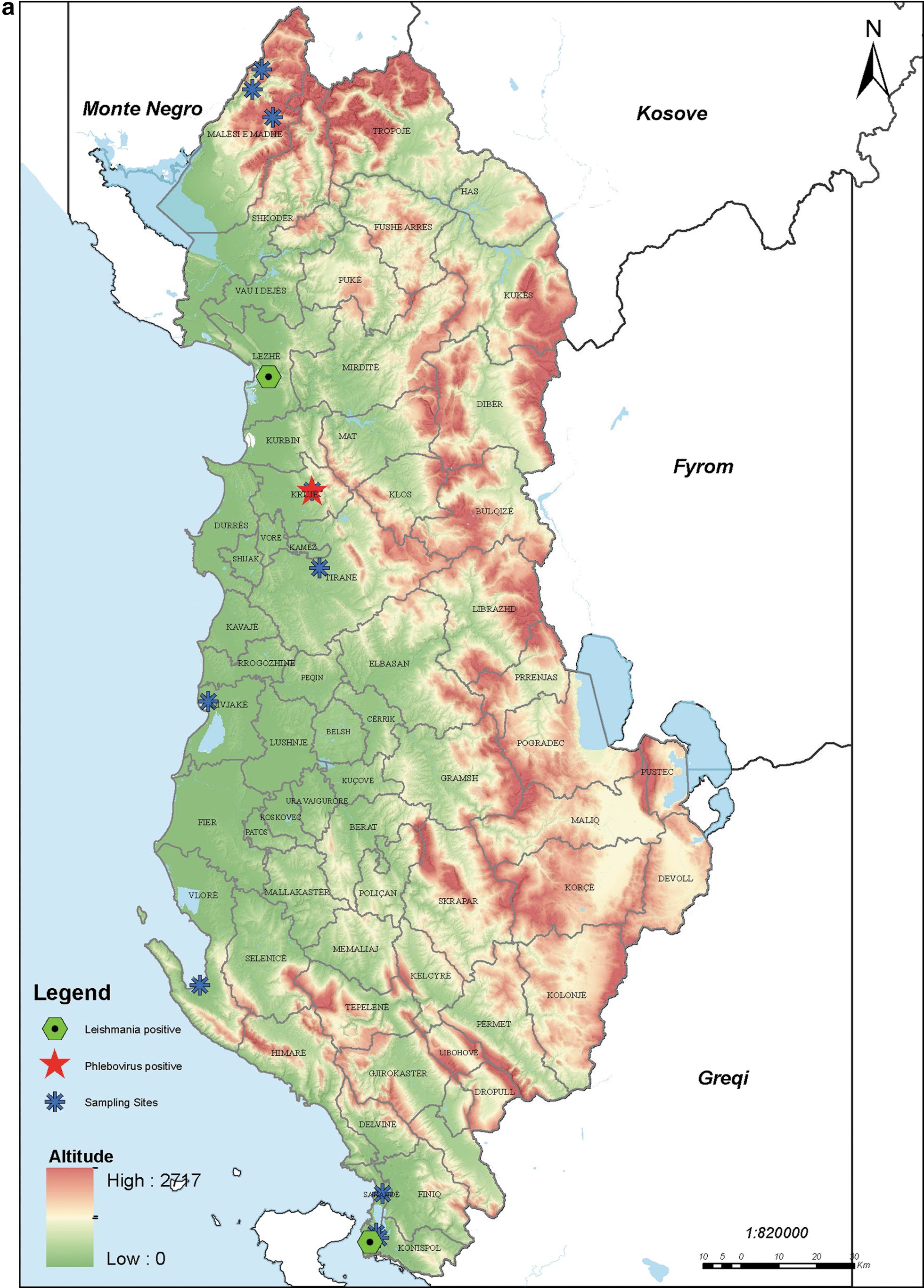
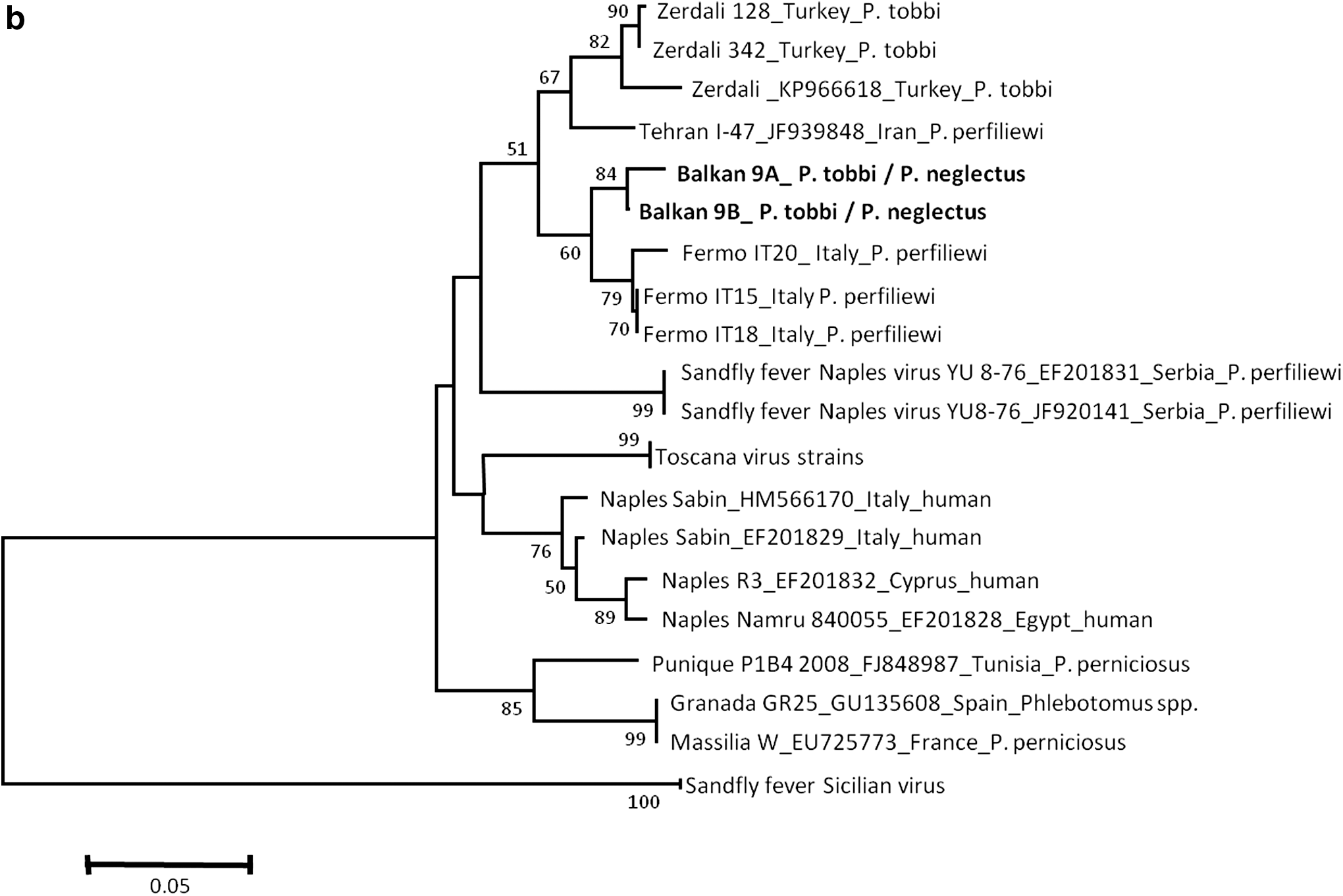
Trapping sites covered almost the entire west, central, and southern parts of Albania (Fig. 1a). A total of 972 (568 females, 404 males) sand flies were trapped (Fig. 1a) and organized into 55 pools (Table 2). Two pools (9A, 9B), each containing 15 sand flies collected in Kruje area (lat. 41.50545N, long. 19.79107E), were positive using two different PCR assays in the N gene; after colinearization, a 575-nucleotide (nt) sequence was used together with homologous sequences retrieved from GenBank for alignment and phylogenetic reconstruction (Fig. 1b). Genetic and phylogenetic data indicated that these sequences were most closely related to, although distinct from, Tehran virus (84% and 97% identity at nt and aa level, respectively). Three different pools (two collected in Lezhe area [lat. 41.78351N, long. 19.63438E], one in Vrine, south of Albania [lat. 49.90312N, long. 19.39721E]) were positive for Leishmania spp. (cutoff threshold [Ct] values ranging from 27.4 to 31.7) (Wortmann et al. 2001) and were all identified as L. infantum (Ct values ranging from 23.2 to 24.7) (Mary et al. 2004). The Ct values showed a significant parasitic load in sand fly pools (4B, 5B, 5E) for L. infantum. Identification of sand flies constituting the positive pools for either phlebovirus or L. infantum provided results that are congruent with the previous knowledge of Phlebotomine fauna of Albania (Velo et al. 2005) (Table 2).
The new phlebovirus identified in this study was provisionally named Balkan virus (BALKV). BALKV clusters in subgroup I of the Sandfly fever Naples complex together with (1) Tehran virus, isolated from P. papatasi in Iran (Palacios et al. 2014), (2) SFNV YU 8–76 isolated from P. perfiliewi collected in Serbia (Palacios et al. 2014), (3) Fermo virus, isolated from P. perfiliewi in Italy (Alkan et al. 2016), (4) Zerdali virus, isolated from Turkey where it is associated with P. tobbi from NGS-based cyt-b and COI barcoding (Alkan et al. 2016) (Fig. 1b). Currently, there are no data to indicate whether any of these viruses are pathogenic to humans. However, the availability of recent virus isolates and complete genome sequences will enable serological studies and molecular assays to be performed to revisit this question.
To date, Adria virus (Salehabad species) is the only sand fly-borne phlebovirus with direct evidence of presence in Albania; Adria virus (1) has been detected in sand flies collected in Kruje and Lezhe regions (Papa et al. 2011), (2) has not been isolated yet, and (3) seroprevalence is unknown in humans and animals. Apart from Albania, in the Balkan region, TOSV was detected using PCR in Croatian patients with meningitis, and seroprevalence results were congruent despite the use of an ELISA test that is notoriously prone to sensitivity for cross-reaction at the species level (Alkan et al. 2013). Seroprevalence studies show that antibodies reactive against Naples and Sicilian viruses were found at rates ranging from 23.6% to 57.6%, and 9.6% to 15.6%, respectively, in Croatia (Alkan et al. 2013). More recently, antibodies against TOSV, Naples, and Sicilian viruses were also reported in Bosnia–Herzegovina, Greece, and Kosovo (Alkan et al. 2013). Sequence analysis showed that TOSV described in Croatia and Greece belongs to a new sublineage C that is distinct from lineages A and B previously reported in western Europe, North Africa, and Turkey (Alkan et al. 2013).
Visceral leishmaniasis has been recorded in Albania since 1939, and despite the number of clinical cases, it decreased recently after a steady increase; the morbidity rate in children is higher than in European countries of the Mediterranean Basin (Lito et al. 2002, Velo et al. 2005, Petrela et al. 2010).
Using a previously described method, our results suggest that BALKV might be associated with either P. neglectus and/or P. tobbi, whereas P. neglectus is a proven vector of L. infantum in Albania (Velo et al. in press). According to the results obtained in this study, the role of P. perfiliewi and/or P. tobbi in transmission of L. infantum requires further investigation (Table 2); in addition, the fact that both pathogens (virus and parasite) might be transmitted by the same phlebotomine species needs to be further investigated in the two regions (Kruje and Lezhe) where possible association was shown in our study.
In conclusion, we provide genetic evidence that BALKV is potentially a new phlebovirus, within the SFNV complex, that is present in sand flies in Albania. Further studies are needed to address its medical importance and possible public health impact.
Footnotes
Acknowledgments
This work was supported through funds received from (1) the EU grant FP7-261504 EDENext and this article is catalogued by the EDENext Steering Committee as EDENext449 (
Author Disclosure Statement
No competing financial interests exist.