




Abstract
Rabies is an acute, progressive zoonotic viral infection that in general produces a fatal outcome. This disease is responsible for deaths in humans and animals worldwide and, because it can affect all mammals, is considered one of the most important viral infections for public health. This study aimed to determine the prevalence of rabies in bats of different species found in municipalities of the state of Pará from 2005 to 2011. The rabies virus was detected in 12 (0.39%) bats in a total of 3100 analyzed, including hematophagous, frugivorous, and insectivorous bats. Of these, eleven were characterized as AgV3, which is characteristic of the hematophagous bat Desmodus rotundus (E. Geoffroy 1810); one insectivorous animal showed a different profile compatible with the Eptesicus pattern and may therefore be a new antigenic variant. This study identified the need for greater intensification of epidemiological surveillance in municipalities lacking rabies surveillance (silent areas); studies of rabies virus in bats with different alimentary habits, studies investigating the prevalence of AgV3, and prophylactic measures in areas where humans may be infected are also needed.
Introduction
R
The rabies virus is transmitted by the saliva of infected animals, most commonly through bites, more rarely when an animal licks cuts or existing skin lesions, and sometimes through healthy or damaged mucous membranes (Kotait et al. 2009, Travassos da Rosa et al. 2013). All mammals are susceptible to the rabies virus infection; however, members of the orders Carnivora and Chiroptera are the main agents responsible for the transmission of the disease and its maintenance in nature. These animals transmit rabies through cycles that are interrelated because they have characteristics such as high population densities, long-distance movement capacity, intense social interactions, and synanthropic habits (Kotait et al. 2003, Velasco-Villa et al. 2006, Barbosa et al. 2007b, De Andrade et al. 2016).
The incubation period of rabies is variable, ranging from days to more than a year (Kotait 1996); this period appears to be related to the proximity of the lesion to the central nervous system (CNS), the pathogenicity of the virus strain, the innervation at the site of the lesion, the severity of the lesion, the amount of rabies virus inoculated, and factors intrinsic to the individual (Jackson 2003). The pathogenesis resulting from infection with the rabies virus is similar in all mammalian species (Jackson 2010, Travassos da Rosa et al. 2013). Following infection, the virus replicates at the site of the lesion until concentrations of the virus are sufficiently high to reach nerve endings (Jackson 2010, Travassos da Rosa et al. 2013); the virus then spreads to the CNS of the host through the peripheral nerves, migrating centripetally and following the retrograde axoplasmic flow of the peripheral nerves at a rate of 100 mm/day (Brito 2008, Jackson 2010, Travassos da Rosa et al. 2013). In the CNS, the virus replicates rapidly, causing acute encephalomyelitis and the death of the individual by cardiac arrest (Jackson 2010, Travassos da Rosa et al. 2013).
Rabies, which is present in all continents except Oceania (Rupprecht et al. 2001, Almeida 2008), remains a major problem for animal health and public health in most of the world (Souza et al. 2005). In Brazil, rabies can be considered endemic to different degrees in different geopolitical regions (Ferreira 2007). The historical data series (2000–2009) analyzed confirmed 1163 cases of rabies in bats, 80% in nonvampire bats and 20% in vampire bats; 163 cases of human rabies were recorded, distributed in 74 cases transmitted by bats (72 cases in rural areas and 2 cases in urban areas) and 89 cases by other transmitter species.
This decade highlights a significant change in the epidemiological profile of rabies, advances in control in the urban cycle, and the expansion of the sylvatic cycle mainly in the North and Northeast of Brazil which reported a higher number of cases in 2004 and 2005 caused by vampire bats in rural areas in the states of Para and Maranhão, which is related with the widespread deforestation and associated environmental impacts that affect this region, while the Southeast and west center region of Brazil presented sporadic cases over the years (Wada et al. 2011, Gomes et al. 2012, De Oliveira et al. 2015).
Records of human rabies outbreaks transmitted by vampire bats in Pará municipalities (Travassos da Rosa et al. 2006, Barbosa et al. 2008) emphasize the need to know rabies in bats, their distribution, and the ways of controlling, thus contributing to the development of strategies to prevent the occurrence of future cases of human rabies in municipalities of Pará.
Following a surveillance program this study aimed to determine the prevalence of rabies in bats of different species found in different municipalities of the state of Pará from 2005 to 2011 and to identify the antigenic variant of the rabies virus in the isolated strains.
Materials and Methods
This study was performed using data from the records of the Laboratory of Rabies Diagnosis of the Evandro Chagas Institute (IEC). With the approval of the IEC Section Chief, an authorization document from the Director allowing the use of the data was obtained, as recommended by Research Ethics Committees Operational Manual/Ministry of Health (Ministério da Saúde - MS). This study was approved by the Animal Research Ethics Committee under technical document no. 0016/2011/CEPAN/IEC/SVS/MS.
A total of 3100 samples recovered from mammals of the order Chiroptera from municipalities of the state of Pará were analyzed in this study. The samples were forwarded during passive surveillance by units of the Health Department of the state of Pará (SESPA) and Municipal Health Department (SESMA) from 2005 to 2011. The Healthcare Units (SESPA and SESMA) capture bats for the control of the hematophagous population and part of them are sent to the Laboratory for diagnosis and/or to investigate the viral circulation. They use as an epidemiological criterion the surveillance of the rabies virus in these animals and the occurrence of aggressions to domestic animals and humans.
Following the recommendations of Vizotto and Taddei (1973), the bats were identified using dichotomous keys, in which external and morphometric characteristics of each taxonomic group were analyzed, including forearm length, head and body, ear, interfemoral membrane, dental arch, fur color, presence or absence of nasal appendix, and other structures, which can be used to distinguish each genus and/or species. During the taxonomic identification, feeding habits were observed and recorded.
CNS fragments were placed on slides for the laboratory diagnosis through direct immunofluorescence assay (DFA) according to the technique described by Dean et al. (1996) for the detection of viral antigens. Suspension of mouse brain infected with the fixed virus “Challenge Virus Standard” (CVS) sample CVS 31/2, adapted to brains of mice, with 105,0DL50/0.03 mL was used for adsorption of polyclonal anti-rabies conjugate (anti-rabies immunoglobulins labeled by fluorescein isothiocyanate) which bind to the viral antigen determining a positive diagnosis.
Suspensions of CNS and salivary gland were used for the biological test through the isolation of the rabies virus as technique recommended by Koprowski (1996). Tissue fragments were macerated and diluted in with solution of 0.75% bovine albumin and phosphate-buffered saline containing antibiotics (penicillin and streptomycin), aiming to prepare a 20% suspension, which was centrifuged at 3000 rpm for 10 min at 4°C; then 0.02 mL of supernatant was inoculated intracerebrally in Swiss albino mice, 2–3 days old, and observed daily for 30 days. Those with typical symptoms of the disease or who died had their brains removed and submitted again to the DFA test to confirm the diagnosis.
The strains isolated from mice were antigenically characterized by indirect immunofluorescence assay using a panel of eight monoclonal antibodies, anti-viral nucleoprotein (C1, C4, C9, C10, C12, C15, C18, and C19), produced and provided by the Centers for Disease Control and Prevention/Atlanta (De Mattos et al. 1999, Favoretto et al. 2002).The test has a reading profile previously established to study the molecular epidemiology of rabies virus in the United States. Strains isolated in Swiss albino mice not compatible with the mentioned panel were identified by genetic characterization (Casseb 2009).
Results
The samples analyzed in this study, belonging to the State of Pará municipalities, were distributed by mesoregions and 312 (10.06%) from Lower Amazon, 482 (15.55%) from Marajó, 98 (3.16%) from Southwest of Pará, 140 (4.52%) from Southeast of Pará, 1264 (40.77%) from Northeast of Pará, and 804 (25.94%) from Metropolitan Region of Belém.
All mesoregions were included in the study, since the epidemiological surveillance of rabies in the state of Pará sends biological specimens of bats for the diagnosis of rabies. However, not all municipalities were represented by these mesoregions; then we listed the total of municipalities by mesoregions and those which forwarded samples: Lower Amazon 14/12 (85.71%), Marajó 16/13 (81.25%), Southwest of Pará 14/09 (64.28%), Southeast of Pará 39/15 (38.46%), Northeast of Pará 49/39 (79.59%), and the Metropolitan Region of Belém 11/09 (81.8%).
The rabies virus was detected in only 12 (0.39%) of the 3100 samples identified and subjected to DFA and biological testing at the IEC Laboratory of Rabies. Of the 3100 bats, 1523 (49.13%) were hematophagous (with seven (0.46%) testing positive for rabies) and 1577 (50.87%) were nonhematophagous (with five testing (0.32%) positive for rabies). There was no significant difference in positivity or total samples between hematophagous and nonhematophagous bats (p ≥ 0.05).
The samples that tested positive (n = 12) for rabies came from seven municipalities belonging to four mesoregions of the state of Pará (Fig. 1) and were found during four distinct periods (Table 1).
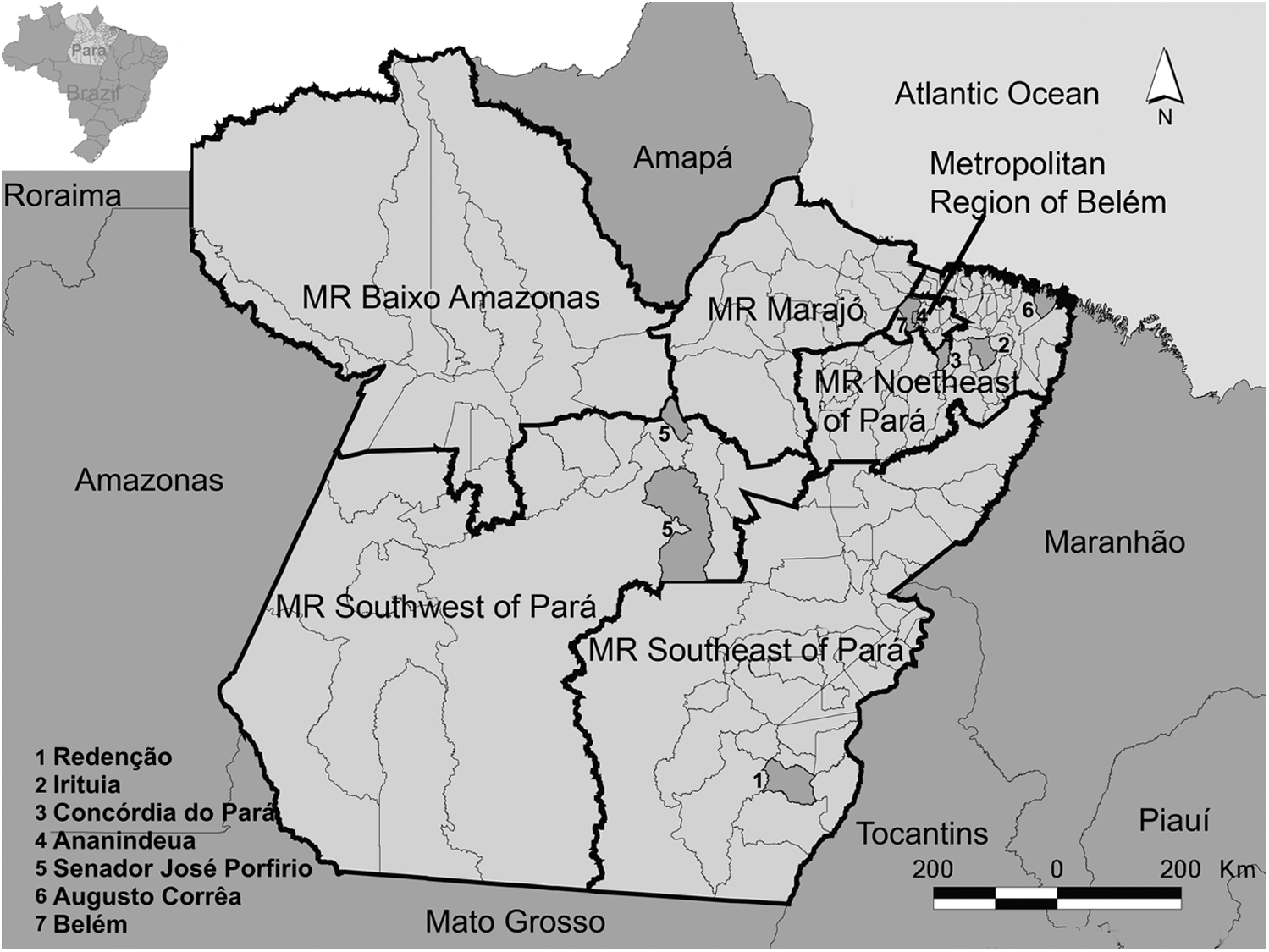
State of Pará, Brazil, indicating mesoregions and municipalities with occurrence of positive bats to rabies virus. MR, mesoregion. Figure 1 can be viewed in greater detail online at
The prevalence by species, percentage, and municipality of origin of the bats positive for rabies virus is shown in Table 2. The positive bats were classified into five different species and three different feeding habits: Family Vespertilionidae, insectivorous (1 Myotis nigricans and 1 Eptesicus brasiliensis); Family Phyllostomidae, frugivorous, and hematophagous (1 Artibeus obscurus, 2 Artibeus planirostris, and 7 Desmodus rotundus).
The prevalence of the rabies virus in bats was similar in 2005 (0.5%) and 2006 (0.6%). As shown in Table 1, this prevalence increased slightly in 2007 (three positive bats, 1.22%). From 2008 to 2010, no samples tested positive for the rabies virus. In 2011, 0.18% of the samples tested positive. During the 7 years of study, the rate of positivity was the same in 2005 (n = 4) and 2006 (n = 4), accounting for 33.3% of all samples; the numbers of positives encountered in 2007 (n = 3) and 2011 (n = 1) accounted for 25% and 8.4% of the positive sample, respectively. The prevalence of the rabies virus was 0.6% in Artibeus planirostris, 4.54% in Artibeus obscurus, 0.5% in Desmodus rotundus, 100% in Eptesicus brasiliensis, and 20% in Myotis nigricans (Table 2).
Eleven rabies virus strains isolated from bats positive for rabies virus exhibited a profile compatible with antigenic variant 3 (AgV3), which is commonly found in Desmodus rotundus bats in Brazil. The rabies virus strain isolated from Eptesicus brasiliensis did not exhibit a reading profile compatible with the panel of monoclonal antibodies; it was later identified by genetic characterization as an antigenic variant of Eptesicus.
Discussion
The municipalities that sent bat specimens for rabies study are distributed in all mesoregions of Pará. The Northeast of Pará was the mesoregion that most sent samples followed by the Metropolitan region of Belém, Marajó, Baixo Amazonas, Southeast of Pará, and Southwest of Pará.
None of the mesoregions had full coverage of their municipalities considering the sending of samples. The mesoregion that most contributed in numbers of municipalities that sent samples of bats was the Baixo Amazonas, followed by Marajó, Metropolitan region of Belém, Northeast of Pará, Southwest of Pará, and Southeast of Pará.
During the study period, the number of samples analyzed by mesoregions experienced constant changes. The period of 2005/2006 was that with the highest contribution in terms of sample and also that presented more positive samples, probably because of the sensitivity of epidemiological surveillance services to capture bats in the municipalities to investigate the rabies virus due to human rabies outbreaks transmitted by vampire bats which occurred in 2004 and 2005 in the State of Pará, in the municipalities of Portel, Augusto Corrêa, and Viseu, Marajó, and in the northeast of Pará, respectively, as described by Travassos da Rosa et al. (2005, 2006), Barbosa (2007a), Barbosa et al. (2007b), and Casseb (2009), considering the epidemiology of rabies in bats and their importance as a direct transmitter of rabies to humans.
In recent years, the rabies virus has been frequently isolated of bats from municipalities of the state of Pará. During the study period (2005–2011), 12 of 3100 bats tested positive for the rabies virus, corroborating the findings reported by Rupprecht (2000), who found that fewer than 1% of bats captured in flight in the United States tested positive. In Brazil, Souza et al. 2005 found also a low rate of infection in bats (0.2%) in the city of Botucatu, São Paulo state (Southeast region) from 1992 to 2000; these results were slightly different from those reported by Scheffer et al. (2007), who found that 6 of 415 (1.45%) hematophagous bats tested positive in the state of São Paulo.
In the present study, nonhematophagous bats accounted for 41.6% of the positive samples, 60% of which were frugivorous and 40% were insectivorous bats. However, the hematophagous bats were the most prevalent, accounting for 58.4% of the positive; this finding was expected, as these bats are chiropterans of greatest epidemiological interest for rabies virus in the state of Pará. These results differed from the data obtained by Queiroz et al. (2009), who found that 70% and 30% of bat rabies virus positive in the northwestern region of the state of São Paulo were obtained from insectivorous and frugivorous bats, respectively.
As shown in Figure 1, in the municipalities of Augusto Corrêa, Irituia, and Concórdia do Pará in the mesoregion of northeast Pará and in the municipality of Redenção in the mesoregion of southeast Pará, the rabies virus was predominantly found in Desmodus rotundus. In the municipality of Senador José Porfirio in the mesoregion of southwestern Pará, the rabies virus was detected only in an Eptesicus brasiliensis bat; in the metropolitan mesoregion of Belém, the rabies virus was detected in a Myotis nigricans bat in the municipality of Ananindeua and in two Artibeus planirostris bats and one Artibeus obscurus bat in the state of Pará capital, the municipality of Belém.
The numbers of bats with rabies have increased in recent years in the state of Pará and in other regions of Brazil. According to Sodré et al. (2010), 41 species of bats belonging to 25 genera and 3 families, Phyllostomidae (43.9%), Vespertilionidae (29.3%), and Molossidae (26.8%), tested positive for rabies virus in Brazil from 1996 to 2009. The results of the present study are in agreement with the results of Sodré et al. (2010), as the positive cases were found in bats belonging to the Phyllostomidae (83.3%) and Vespertilionidae (16.7%) families. However, the results of the present study differ from those reported by Albas et al. (2011) in São Paulo, where the rabies virus was mostly found in members of the Vespertilionidae (63.6%) and Phyllostomidae (36.4%) families.
Eleven (91.7%) of the positive samples subjected to antigenic characterization exhibited profiles compatible with the reading pattern for AgV3, which is commonly found in Desmodus rotundus bats in Brazil. One (8.3%) sample isolated from the insectivorous Eptesicus brasiliensis bat did not show compatibility with the reading profile previously established to study the molecular epidemiology of rabies virus in the United States; it was thus identified by genetic characterization as an antigenic variant of Eptesicus (Casseb 2009).
The results of this study reinforce the need for a strong epidemiologic surveillance to investigate the circulation of the rabies virus in the municipalities of Pará State that currently lack rabies surveillance in silent areas. The presence of the rabies virus in bats in wild and urban environments in the state of Pará provides evidence for the aerial circulation of the virus among hematophagous and nonhematophagous bats, with a higher incidence in the vampire Desmodus rotundus. This result is partially because surveillance teams mostly capture hematophagous bats to study the rabies virus and because the AgV3 is most commonly found in Desmodus rotundus bats (Barbosa et al. 2007b, 2008). The presence of AgV3 in the positive bats is noteworthy and indicates that prophylactic measures should be adopted in areas where humans may be exposed to vampires to prevent human cases or outbreaks of the disease as observed in the past (Travassos da Rosa et al. 2006, Barbosa et al. 2007b).
Footnotes
Acknowledgments
The authors thank the Health Department Units of the State of Pará—Center for Epidemiology, Municipal Health Departments, Center for Zoonosis Control/SESMA, and personnel from the Laboratory of Rabies Diagnosis: Mr. Mário Pinto Ferro and Valeria Carvalho, PhD, for help with translation and everyone who directly or indirectly contributed to the development of this work and the National Council for Scientific and Technological Development (Conselho Nacional de Desenvolvimento Científico e Tecnológico–CNPq) for the financial support (Project No. 301641/2010-2).
Author Disclosure Statement
No competing financial interests exist.