




Abstract
The hard tick-borne relapsing fever agent, Borrelia miyamotoi infection in Ixodes ricinus ticks sampled from Istanbul and the countryside of Kirklareli in northwestern Turkey, was examined by TaqMan-PCR targeting 16S rDNA, nested PCR targeting 16S rDNA, the flagellin gene (flaB), and the 16S and 23S rDNA intergenic spacer (IGS), and sequencing analyses of these amplicons. B. miyamotoi was detected in 1 out of 248 I. ricinus ticks (infection rate 0.4%). The tick infected with B. miyamotoi was collected in Longos, Kirklareli province on the European side of Turkey near the Bulgarian border. The 16S rDNA, flaB, and IGS sequences from the infected tick showed high similarities to those of B. miyamotoi detected in I. ricinus in Europe.
Introduction
B
Materials and Methods
In June 2008, questing adult I. ricinus ticks (248 ticks) were collected from vegetation by flagging at selected Asiatic and European sites including recreational parks in the heavily populated Istanbul metropolitan area and the countryside of Kirklareli in northwestern Turkey (Şen et al. 2011). Captured ticks were identified by morphological features. DNA was isolated from whole tick extracts using the QuickGene-800 Nucleic acid isolation system (Fuji Film, Tokyo, Japan) according to the manufacturer's instructions. The quality of DNA was evaluated by PCR targeting the internal transcribed spacer 2 region of tick-ribosomal DNA genes.
DNA prepared from tick tissues was subjected to TaqMan-PCR targeting borrelial 16S rDNA according to a previously reported method (Barbour et al. 2009) with minor modifications (Takano et al. 2014). TaqMan-PCR was performed using Premix Ex Taq (Takara, Otsu, Japan) on the ABI PRISM 7500 system (Applied Biosystem, Foster City, CA).
TaqMan-PCR-positive samples were subjected to nested PCR targeting 16S rDNA, flaB, and IGS. To amplify 16S rDNA, the first-step primer set, rrs-F1 (5′-ATAACGAAGA GTTTGATCCTGGCT-3′) and rrs-R4 (5′-AAAGGAGGTGA TCCAGCCRCACT-3′) (Takano et al. 2010), and nested PCR primer set, 16S MF (5′-GCGAACGGGTGAGTAACG-3′) and 16S MR (5′-CCTCCCTTACGGGTTAGAA-3′) (Masuzawa et al. 2004),were used. The 16S rDNA-PCR thermal conditions employed were 40 cycles, at 95°C for 30 s, 55°C for 30 s, and 72°C for 90 s. The primer set Bfla-PAD (5′-GATCARGCWC AAYATAACCAWATGCA-3′) and Bfla-PDU (5′-AGATTCA AGTCTGTTTTGGAAAGC-3′) in first-step PCR and Bfla-PBUnest (5′-GCTGAAGAGCTTGGAATGCAACC-3′) and Bfla-PCRnest (5′-TGATCAGTTATCATTCTAATAGCA-3′) in second-step PCR were used to detect flaB (Takano et al. 2010). The flaB-PCR thermal conditions used were 30 cycles, at 95°C for 30 s, 55°C for 30 s, and 72°C for 30 s. IGS was amplified with the first-step PCR primer set, rrs-rrlA IGS F (5′-GTATGTTTAGTGAGGGGGGTG-3′) and rrs-rrlA IGS R (5′-GGATCATAGCTCAGGTGGTTAG-3′), and nested PCR primer set, rrs-rrlA IGS Fn (5′-AGGGGGGTGAAGTCGTA ACAAG-3′) and rrs-rrlA IGS Rn (5′-GTCTGATAAACCT GAGGTCGGA-3′) (Bunikis et al. 2004). The IGS thermal conditions used were 40 cycles, at 95°C for 30 s, 55°C for 30 s, and 72°C for 60 s. These PCR conditions amplified 1269, 294, and 426 bp of 16S rDNA, flaB, and IGS without primer sequences, respectively.
In the DNA sequencing analysis, nested PCR products purified with a Microcon-PCR purification column (Millipore, Bedford, MA) were subjected to a DNA cycle-sequencing analysis using nested PCR primers as the sequencing primer and a BigDye Terminator v3.1 cycle sequencing kit (Applied Biosystems) with an ABI 3130-Avant Genetic Analyzer (Applied Biosystems). The phylogenetic analysis was performed by a Clustal W algorithm using the sequence analysis software, MegAlign (DNASTAR, Inc., Madison, WI). These sequences were deposited into DDBJ/EMBL/GenBank under accession numbers LC136799, LC136800, and LC136801, respectively.
Results and Discussion
I. ricinus ticks were collected in Tasdelen in Asiatic side of Istanbul (24 ticks), in Zekeriyakoy in European side of Istanbul (50 ticks), and in Avcilar (65 ticks), in Hamdibey (45 ticks), and in Longoz (64 ticks) in Kirklareli in northwestern Turkey. TaqMan-PCR targeting 16S rDNA detected relapsing fever borreliae in 1 out of 248 I. ricinus ticks (infection rate, 0.4%). The infected tick (number T177) was sampled in Longos, Kirklareli. The results of the 16S rDNA sequence analysis showed the high similarity of T177 sequence to those of B. miyamotoi detected from I. ricinus in Russia (JF951385, JF951382) and France (AF529085, Fig. 1A). In Europe, the infection rate of B. miyamotoi among I. ricinus ticks varied between 0% and 3.2% (Krause et al. 2015). The infection rates in I. ricinus obtained in this study appeared to be reliable. Furthermore, the flaB sequence of T177 was identical to those of B. miyamotoi detected from I. ricinus in Poland (HM345918-HM345920, FJ823229) and also showed higher similarity with those detected from I. ricinus in European countries. On the basis of IGS, which is a highly variable sequence because of the junk sequence (Fig. 1B), the T177 sequence is identical to those from I. ricinus collected in Austria (KP202177) and Norway (KP988322, KR010388). Before this study, clonal expansion was suggested for B. miyamotoi in ticks (Takano et al. 2014). Our results appear to support the clonal population of B. miyamotoi being widely distributed in European countries in which I. ricinus is common. Although no human case of B. miyamotoi infection has been reported in Turkey, our results will initiate an epidemiological investigation on this spirochete. Further studies are needed to identify human infections caused by this Borrelia species in Turkey.
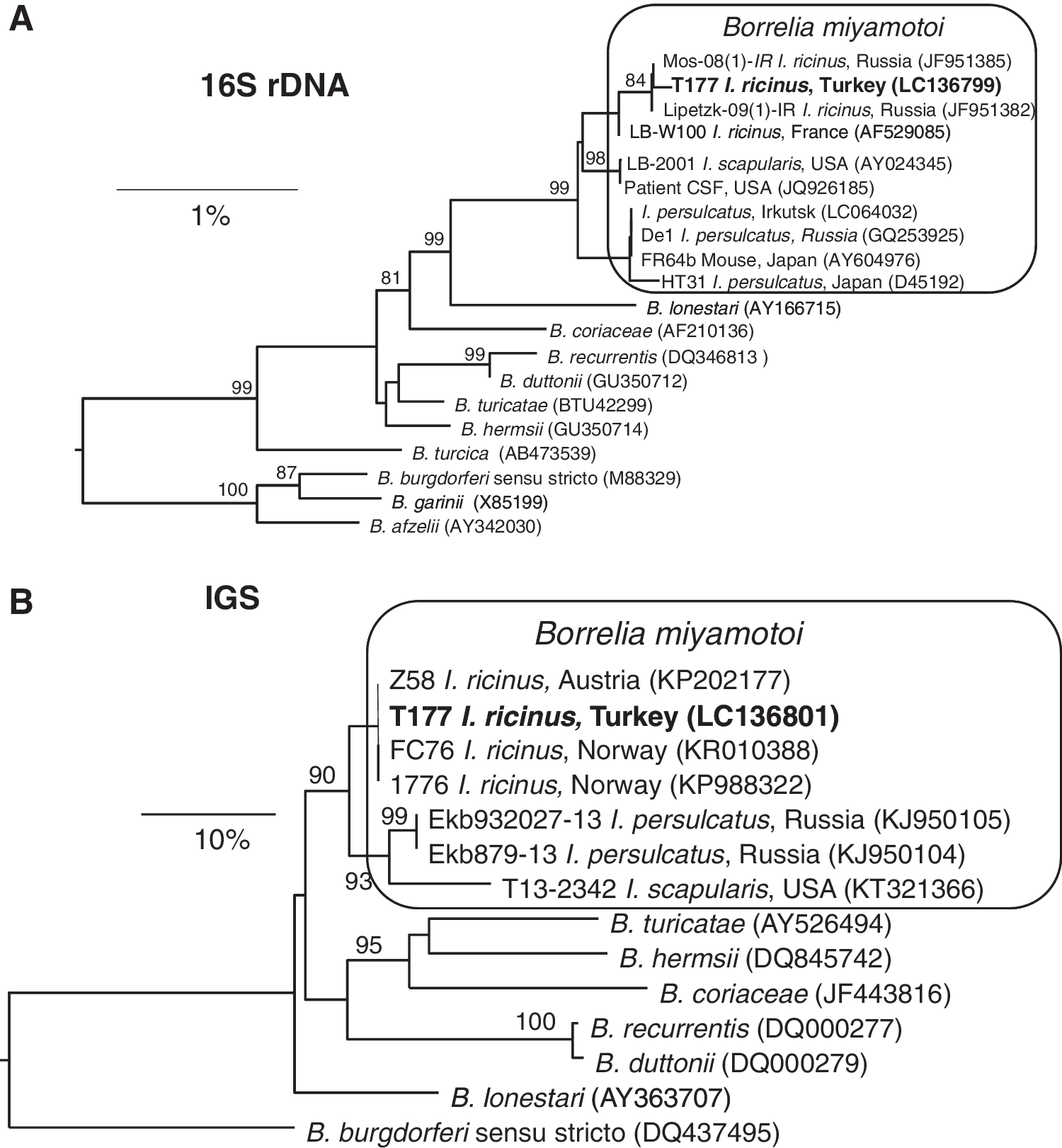
Phylogenetic tree of 16S rDNA
Conclusion
We herein demonstrated for the first time that I. ricinus ticks sampled in Turkey were infected with B. miyamotoi.
Footnotes
Acknowledgment
This research was partially supported by a Grant-in-Aid for Scientific Research B (nos. 23406012 and 20406011) from the Japan Society for the Promotion of Science (JSPS) and the Research Program on Emerging and Re-emerging Infectious Diseases from the Japan Agency for Medical Research and development (AMED).
Author Disclosure Statement
No competing financial interests exist.