




Abstract
Malaria is one of the six major vector-borne diseases in India, the endemicity of which changes with changes in ecological, climatic, and sociodevelopmental conditions. The anopheline vectors are greatly affected by ecological conditions such as deforestation, urbanization, climate and lifestyle. Despite the advent of tools such as Geographic Information System (GIS), the updated information on the distribution of anopheline vectors of malaria is not available. In India, the plan for vector control is organized at subcentral level but information about vectors is unavailable even at the district level. Therefore, a systematic presentation of vector distribution has been made to provide maps in respect of major vector species. A search of the literature for major vector species, that is, Anopheles culicifacies, Anopheles fluviatilis, Anopheles stephensi, Anopheles minimus, and Anopheles dirus sensu lato, since 1927 till 2015 was carried out. Data have been presented as present, absent, and no information about vector species during pre-eradication (1927–1958), posteradication (1959–1999), and current scenario (2000–2015). Vectors' distribution and malaria endemicity were mapped using Arc GIS. Of 630 districts of India, major vectors An. culicifacies, An. fluviatilis, and An. stephensi were present in 420, 241, and 243 districts, respectively. In 183 districts, there is no information on any major malaria vector species although 27 of them from the states of Arunachal Pradesh, Jharkhand, Manipur, and Mizoram are highly endemic for malaria, having incidences of 2–40 cases/1000/year. The identified gaps in vector distribution, particularly in malaria endemic areas, necessitate further surveys so as to generate the missing information.
Introduction
O
Materials and Methods
A systematic search of the literature was made to compile the information about the major vectors of malaria in India at the district level. Of nine reported vectors of malaria in India, An. culicifacies, An. fluviatilis, An. stephensi, An. minimus, and An. dirus, the major vectors in India, were considered for detailed search and mapping. An. sundaicus, which is confined to Andaman and Nicobar Islands (Kumari et al. 1993, Kumari and Sharma 1994, Nandi et al. 2000, Das et al. 2002, Nanda et al. 2004, Alam et al. 2006), was not included in the exhaustive search. Anopheles annularis, Anopheles philippinensis/nivipes, Anopheles pulcherrimus, and An. subpictus (suspected vector), reported as secondary vectors of malaria, which are of minor significance, were not considered for mapping, for which recent reviews on Anopheles annularis (Singh et al. 2013) and Anopheles subpictus (Singh et al. 2014) may be consulted. Of six major malaria vectors species in India An. culicifacies, An. fluviatilis, An. minimus, An. dirus, and An. sundaicus have sibling species complex except for An. stephensi (Subbarao 1998, Dev and Sharma 2013;
The search for distribution of major vectors since 1927 was undertaken through Google and Pubmed, using the keywords—anopheles, malaria vectors, India, rural vector, urban vector, An. culicifacies, An. fluviatilis, An. stephensi, An. minimus, and An. dirus. After getting the title of published work, full articles were downloaded from journals' websites and consulted. The articles not available online were consulted from libraries. The information extracted from published literature ranged from one-time species collection to a long-term study, reviews, molecular and biochemical analysis, etc. More than 50% of the studies were one-time collection of species (studies that did not mention the time period of the survey were considered one-time collection of species), whereas a few only were the part of long-term surveys. In the past 15 years, most of the information about vector distribution emerged from indirect field work other than faunistic surveys. The information was compiled into study area (village/Primary Health Centre/district), periods of study, month/year, author, journal, type of work undertaken, etc. Experts' consultation was also taken for verification and confirmation of vector distribution in the case of unpublished documents/reports. The status of vectors was categorized into three sections, that is, present (studies showing the presence of species), absent (studies were undertaken but particular vector species not available), and no information (where no study has been undertaken). Based on the tabulated information, district-level maps on spatial distribution of each vector species were generated using Esri ArcGIS 10.
District-level epidemiological data of malaria (Plasmodium vivax and Plasmodium falciparum) were also collected for the years 2010–2012 for the whole country from National Vector Borne Disease Control Programme (NVBDCP). District-level map of annual parasite incidence (API) was also created, so as to compare the distribution of malaria vectors with malaria endemicity.
To assess the changes in vector distribution before and after malaria eradication efforts, and during the past 15 years (2000–2015) (when greatest impact on malaria has been seen with renewed malaria control efforts), the distribution maps were divided into three time slices, that is, pre-eradication period (1927–1958), posteradication period (from 1959–1999), and current scenario (2000–2015).
Results and Discussion
Anopheles (Cellia) culicifacies Giles
It is a major vector of malaria in rural areas in India (Nagpal and Sharma 1986, Sharma et al. 1993). An. culicifacies is reported to be sibling complex of five species designated as A, B, C, D, and E (Vasantha et al. 1982, Subbarao et al. 1983); of the five siblings, species B is a non/poor vector of the malaria parasite (Subbarao et al. 1988).
During the pre-eradication period, that is, 1927–1958, surveys undertaken by Covell (1927) in 137 districts showed that An. culicifacies was the major vector found in 128 districts (Fig. 1a). Thereafter, in 1936, Puri found the distribution of An. culicifacies in 38 additional districts. Furthermore, Puri (1948) updated his work and reported the presence of An. culicifacies in 23 more districts. During the posteradication period (1959–1999), additional information about the distribution of An. culicifacies was available from Northeastern states, whereas few studies reported the absence of this species from the state of Odisha and the Himalayan region (Fig. 1b). During the current scenario (2000 onward), An. culicifacies has been reported from almost all the districts of western, southern, and central India; however, gaps in northern states including the Himalayan region still exist, necessitating the need of generation of information. It is to be mention here that during the posteradication period and current scenario, faunistic surveys were rarely undertaken, rather information was added as collateral benefit of studies undertaken for assessing the susceptibility status (Sharma and Prasad 1992, Singh et al. 2002), bionomics, and molecular studies (Singh et al. 2011). An. culicifacies distribution gaps in the states of Jammu & Kashmir, Uttar Pradesh, Bihar, Punjab, and Haryana are clearly visible (Fig. 1c), which have riverine area suitable for An. culicifacies. Altogether, An. culicifacies can be regarded as a highly prevalent malaria vector in India with reports from 420 districts (Table 1). In recent years, its progressive presence in Northeast states is also being reported (Baruah et al. 2004, Prakash et al. 2004, Dutta et al. 2010, Saxena et al. 2014).

Distribution of An. culicifacies during three different periods:
Anopheles (Cellia) fluviatilis James
Anopheles fluviatilis, commonly designated as the forested and foothills vector of malaria in India, has sibling complex of four species, that is, species S, T, U, and form V (Shukla et al. 1998, Mohanty et al. 2007). Of the four siblings, species S is the malaria vector and the status of “form V” is yet to be ascertained in India. During the pre-eradication period (1927–1958) An. fluviatilis distribution was reported in 88 districts by Puri in 1936, which was further updated in 1948 (Puri 1948) to 117 districts, showing the distribution in Western Ghats, central India, the state of Odisha, West Bengal, and districts from northern states (Fig. 2a).
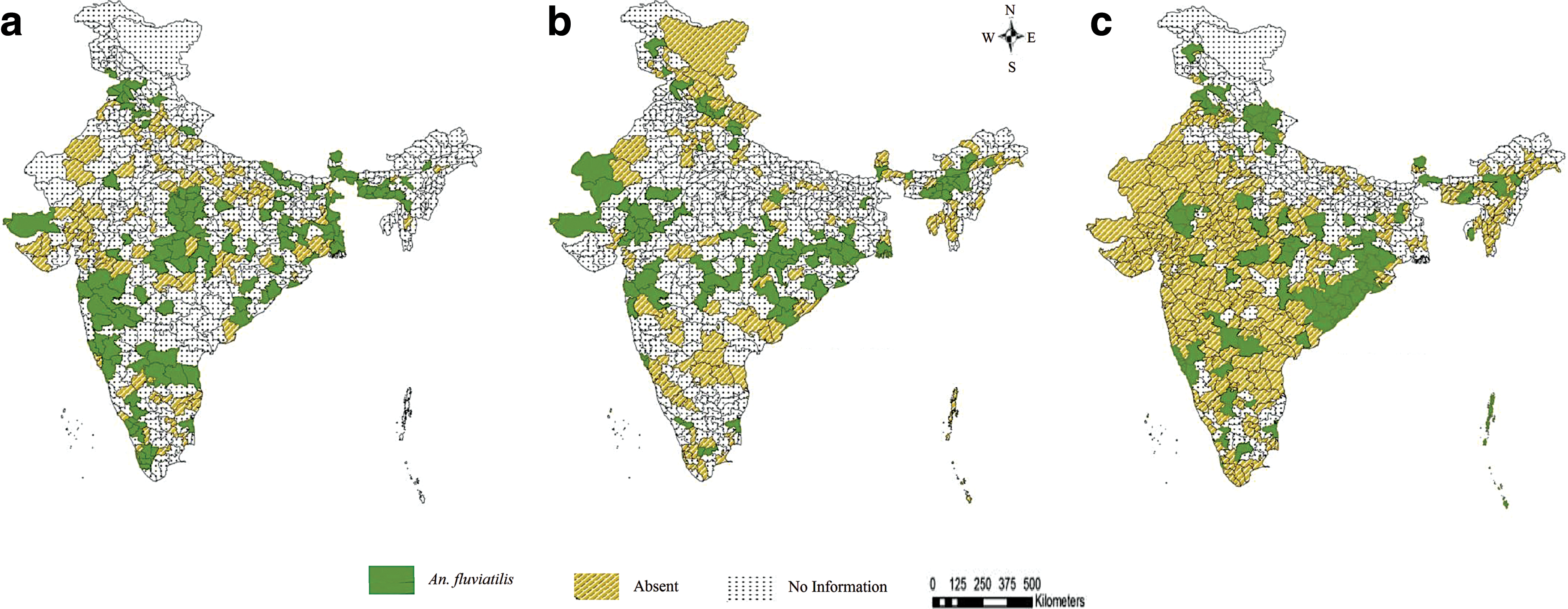
Distribution of An. fluviatilis during three different periods:
During the posteradication period (1959–1999), additional distribution was reported mainly from the districts of Chhota Nagpur Plateau (Nagpal and Sharma 1985), Odisha, and Northeastern states, whereas reduction/absence was reported from Deccan plateau, Western Ghats, West Bengal, and southern India (Fig. 2b). As per current scenario (2000–2015), distribution of An. fluviatilis matches largely with the forested and foothill areas of the country (Shukla et al. 2008, Nanda et al. 2012, Dhiman et al. 2013). Stray reporting from the state of Rajasthan and parts of Haryana and Karnataka suggests that it might be sibling species T, a nonvector (Singh et al. 2004, Ghosh et al. 2005, Mohanty et al. 2007). As An. fluviatilis is susceptible to dichloro diphenyl trichloroethane (Dash et al. 2012, Sahu et al. 2014), a discernible change is expected in the distribution of this species in the country, for example, absence of An. fluviatilis from Bhuj district (Gujarat) during current scenario as compared with pre- and posteradication periods (Fig. 2c).
Anopheles (Cellia) stephensi Liston
An. stephensi, the vector of urban malaria in India, is the second most prevalent vector. This species has been reported to have three variant forms, that is, type form, intermediate, and mysorensis (Chakraborty et al. 1998, Ghosh et al. 2008), of which “type” and “intermediate” are considered as vectors.
During the pre-eradication period, An. stephensi was reported mainly from the parts of Maharashtra, Uttar Pradesh, Haryana, Punjab, Rajasthan, Gujarat, Madhya Pradesh, and Tamil Nadu states (Covell 1927, Puri 1936, 1948) (Fig. 3a). During the posteradication period (1959–1999), additional reporting of distribution of An. stephensi was mainly from the parts of Rajasthan, whereas absence was reported in major parts of the Central and southern Indian states (Fig. 2b). As per the current scenario, An. stephensi distribution has been reported additionally from few districts of Rajasthan, Gujarat, and Uttarakhand states with scattered reporting from southern India (Fig. 3c). In recent years, this species has not been reported from many localities particularly from Central India, warranting further studies.
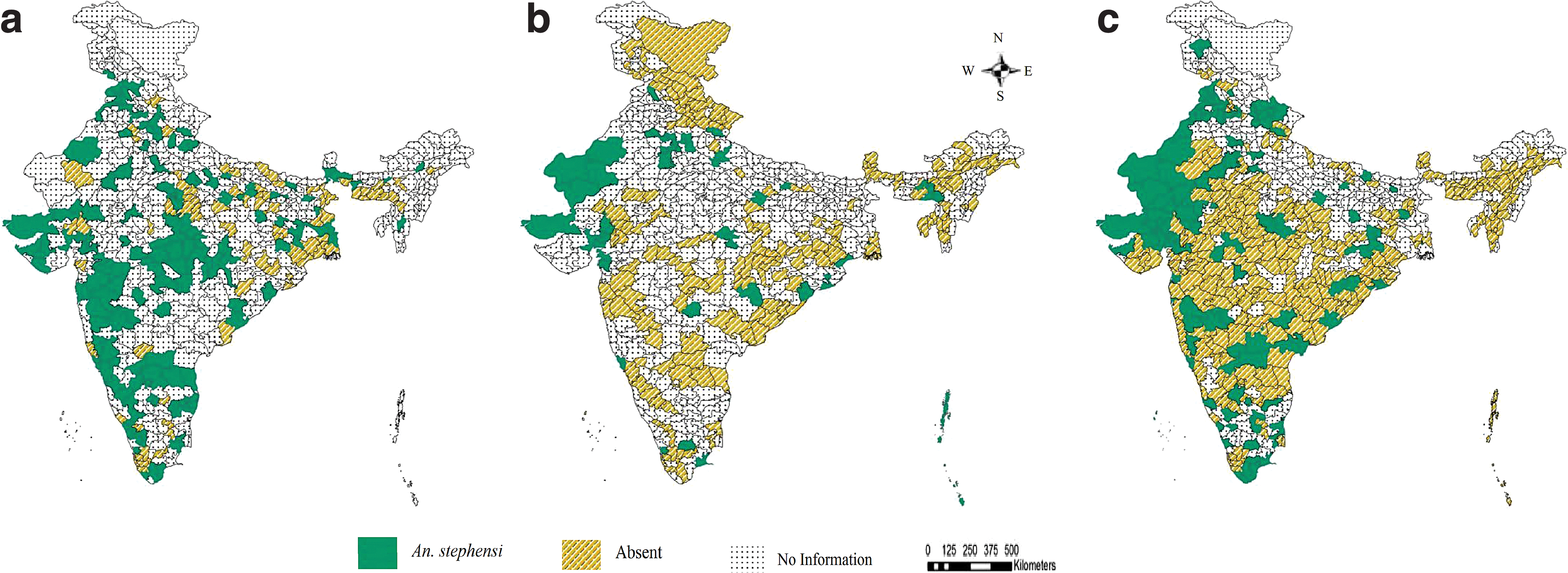
Distribution of An. stephensi during three different periods: (
Overall, An. stephensi has been reported from 243 districts in the country (Table 1) except in Arunachal Pradesh, Sikkim, Mizoram, Nagaland, Manipur, and Tripura states. Of 131 districts identified by NVBDCP as towns/cities under urban malaria scheme (
Anopheles (Cellia) minimus Theobald
An. minimus is one of the main malaria vectors (Bhatnagar et al. 1982, Dev 1996) in Northeastern states of India (Dutta et al. 2013). The species comprises three sibling species namely, An. minimus (species A), An. harrisoni Harbach & Manguin (species C), and An. yaeyamaennsis Somboon & Harbach (species E). During the pre-eradication period, long-term survey undertaken by Covell (1927) showed the presence of An. minimus in 16 districts of Northeastern states followed by Puri (1936, 1948) from 56 districts in 15 states of India. Small-scale studies also reported the presence of An. minimus in Northeastern Himalayan region (Rao 1984), with stray reports from southern India (Ananthaswamy et al. 1952) (Fig. 4a). During the posteradication period, various studies further reported the distribution of An. minimus mainly from Northeastern states (Fig. 4b), with disappearance from the Himalayan region, West Bengal, and parts of southern India owing to high susceptibility status of this vector species toward DDT (Baruah and Lal 2004, Dash et al. 2012) (Fig. 4b). As per current scenario, An. minimus shows the distribution in 54 districts.
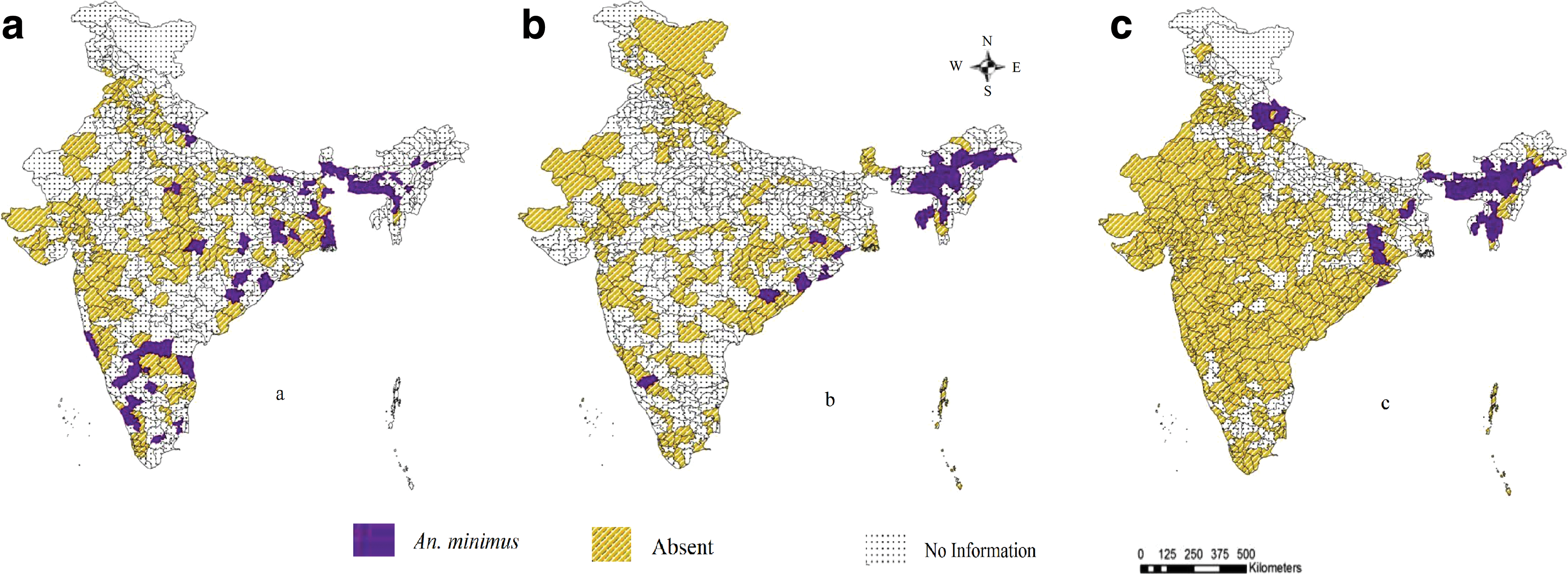
Distribution of An. minimus during three different periods:
Interestingly, An. minimus is distributed mainly in Northeastern states, districts having API >10 (Fig. 6a). Recently, a new focus of An. minimus has been reported from Ranchi district of Jharkhand state (M.K. Das, personal communication). In view of the changing ecological scenario, that is, deforestation in Northeastern states, the spatial distribution and density of An. minimus have reduced (Saxena et al. 2014).
Anopheles (Cellia) dirus Peyton & Harrison
An. dirus is the second most important vector of malaria in Northeastern states of India (Prakash et al. 1997). An. dirus comprises eight sibling species, that is, An. dirus s.s. (species A), An. cracens (species B), An. scanloni (species C), An. baimaii (species D), An. elegans (species E), An. nemophilous (species F), An. takasagoensis, and a cryptic species An. aff. takasagoensis. Of the eight reported sibling species, An. baimaii is the most abundant species available in India (Prakash et al. 2001). During the pre-eradication period An. dirus was reported only from few districts of Northeastern states (Fig. 5a). During the posteradication period, also reports of An. dirus were available only from Northeastern states (Fig. 5b). From the year 2000 onward, surprisingly An. dirus has been reported from districts of Karnataka (year not mentioned) (Acharya et al. 2013), which is probably An. elegans (Tewari et al. 1987, Dev and Sharma 2013), warranting verification (Fig. 5c).

Distribution of An. dirus during three different periods:
Vectors distribution vis a vis malaria endemicity
The endemicity map of malaria in India indicates that the Northeastern states and the states such as Chhattisgarh, Odisha, and Jharkhand are highly malarious (API >40) (Fig. 6a). The western states particularly, Gujarat, Rajasthan, Karnataka, Kerala, and Maharashtra have low malaria endemicity except for few pockets such as Dadra & Nagar Haveli and districts Bikaner, Barmer, and Jaisalmer in Rajasthan (Fig. 6a). There is no information about malaria vectors' distribution in respect of 183 districts, of which 27 districts are from Arunachal Pradesh, Jharkhand, Manipur, and Mizoram having API from 2 to 40 (Fig. 6b).

The distribution of An. culicifacies matches mainly with riverine plains of India, having low malaria endemicity but prone to outbreaks. However, the distribution of An. culicifacies in combination with An. fluviatilis matches with high malaria endemicity in the states of Odisha, Andhra Pradesh, Chhattisgarh, and Jharkhand, which have riverine plains and foothill areas (Figs. 1, 2 and 6a). In Northeastern states, the high endemicity of malaria is because of the presence of An. minimus and An. dirus (Figs. 4 and 5). There are reports of these species from southern India also but malaria endemicity is very low, which needs to be verified as An. minimus and An. dirus are also a complex of sibling species. In contrast, in low endemic areas such as Gujarat, Rajasthan, Maharashtra, and Karnataka, which are prone to malaria outbreaks, An. culicifacies and An. stephensi are prevalent (Figs. 1, 3 and 6a). Mapping of malaria vectors can further be refined from the viewpoint of sibling species complex of vectors and for elucidating their role in malaria endemicity. To analyze the distribution of vectors vis-a-vis landscape changes in different time slices, landscape data derived from high resolution of satellite data would provide the link between landscape and vectors availability, thus obviating the need of repeated faunistic surveys.
Conclusions
The district-level maps of major malaria vectors with updated information till 2015 have been generated based on information extracted from published literature, that is, one-time species collection to a long-term study, reviews, and as an offshoot of field surveys involving studies on insecticide resistance, molecular and biochemical analysis, etc. The maps present spatiotemporal distribution of vector species that draw attention toward changes in vector distribution over different time slices, that is, pre-eradication period (1927–1958), posteradication (1959–1999), and current scenario (2000–2015). The maps highlight the distribution gaps in 183 districts, of which 27 have high malaria endemicity ranging from 2 to 40 API, necessitating the need of faunal surveys. The present review highlights the need for further survey in malaria endemic districts that still do not have information about vector species. Validation and verification for the presence of An. minimus and An. dirus in southern India are also required. The generated maps will guide the national program in the efficient planning of vector control and would serve as a baseline for projecting future scenario of vector distribution in the context of climate change.
Footnotes
Authors' Contributions
P.S. contributed to data collection, preparation, analysis and interpretation, and for writing the article. M.A.L.L. contributed to data collection and compilation. S.S. contributed to data compilation and generation of maps. R.C.D. planned the study, analyzed, reviewed, and wrote the final article. All authors have read and approved the final article.
Acknowledgments
This work was done under Department of Science & Technology (DST) funded project. Our special thanks to DST for funding and to Director, NIMR, for permission for utilization of institutional infrastructure to meet the requirements of the study. Thanks are also due to NVBDCP for providing epidemiological data of malaria.
Author Disclosure Statement
No competing financial interests exist.