




Abstract
Severe fever with thrombocytopenia syndrome, an emerging hemorrhagic fever, is caused by severe fever with thrombocytopenia syndrome virus (SFTSV), a tick-borne bunyavirus. Information regarding SFTSV animal hosts is very limited. In this study, we showed that 64% (9/14) of hedgehogs in Shandong Province, China were seropositive to SFTSV antibody, suggesting that hedgehog could be a vertebrate parasitifer for SFTSV.
Introduction
S
Until now information regarding SFTSV epidemical characteristics is limited. Transmission studies of ticks combined with the tick-bite history of patients confirmed Haemaphysalis longicornis ticks as the arthropod vector SFTSV (Yu et al. 2011, Luo et al. 2015). Domesticated animals such as goats, cattle, dogs, pigs, and chicken and wild animals such as rodents, shrews, hedgehogs, water deer, and boars have been found to be antibody positive to SFTSV (Jiao et al. 2012, Zhao et al. 2012, Cui et al. 2013, Niu et al. 2013, Li et al. 2016, Oh et al. 2016). In this study, we analyzed antibody to SFTSV and SFTSV RNA in hedgehog captured from Shandong Province, which is a high-risk area of SFTS in China (Wen et al. 2014).
Materials and Methods
Hedgehogs were collected in 2014 in Huangdao District of Qingdao City (120° 20′ E, 35° 96′ N) and in 2016 in Changqing District of Jinan City (116° 75′ E, 36° 55′ N), respectively, in Shandong Province, China (Fig. 1). The animals were captured using rodent capture cages (cage size: 14 × 14 × 26 cm) baited with fried bread sticks. Cages were deposited into fields of different villages and collected the next morning. Blood samples were extracted from the hearts after the animals were anesthetized. Sera were obtained after centrifugation and then frozen at −80°C. Animal use and sample collection protocols were approved by the Bioethics Committee of the School of Public Health, Shandong University.
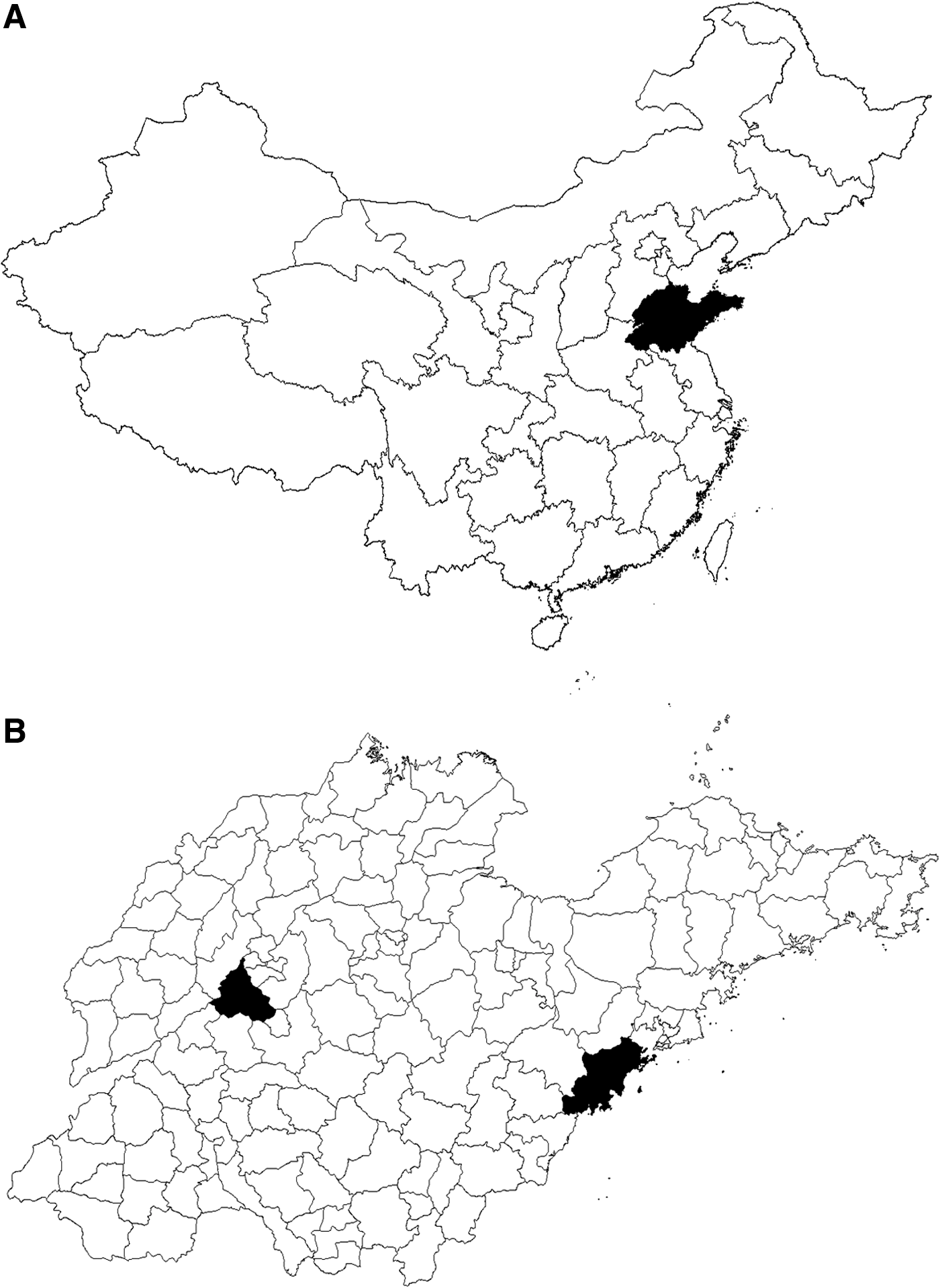
Collection sites of hedgehogs in China.
Serum from the 14 hedgehogs was tested for SFTSV antibody by using an ELISA kit (Wuxi Xinlianxin Biotech Co., Wuxi City, China) for detecting SFTSV total antibody. The plate was coated with SFTSV recombinant nucleoprotein antigen. Each serum sample was diluted with equal volume of sample buffer provided in the ELISA kit and then 100 μL diluted serum was added to the coated plate. Positive and negative controls were also added to a well, respectively. After incubation at 37°C for 30 min, the working solution of horseradish peroxidase (HRP) labeling recombinant virus protein was added to each well and incubated for 30 min at 37°C. Then substrate solution A and B were added to develop color. The optical density (OD) value of each well was read at 450 nm. ELISA showed that 64.3% (9/14) hedgehogs' serum samples were positive for SFTSV IgG and 35.7% (5/14) were negative.
We also performed reverse transcription polymerase chain reaction (RT-PCR) on the RNA samples prepared from both the hedgehogs' sera and spleen tissues. Total RNA was extracted from each serum sample by using the QIAamp Viral RNA Mini Kit (QIAGEN, Hilden, Germany) and the QIAamp RNeasy Mini Kit (QIAGEN, Hilden, Germany). The extracted RNA was reverse-transcribed and amplified with outside primers by using the Access RT-PCR System (Promega, Madison, WI). The product was amplified again with inside primers by using the Taq DNA Polymerase System (Takara, Tokyo, Japan). The primers for nested PCR were designed from the M segment of the SFTSV genome. Outside PCR primers were TCTGCAGTTCAGACTCAGGGA and GACGTGTATTGCTGTTTTCCC; nested PCR primers were TGTTGCTTGTCAGCCTATGAC and CAACCAATGATCCTGAGTGGA. RT-PCR results showed that all hedgehogs were negative to SFTSV RNA.
Results and Discussion
In this study, we captured 14 hedgehogs in total, with 10 from Huangdao District of Qingdao City in the East Shandong Province in 2015 and 4 in Changqing District of Jinan City in the west of Shandong Province in 2016. Except two, hedgehogs were captured in October in Huangdao District, and all hedgehogs were captured in July during the peak season of SFTS (Table 1).
The number of hedgehogs caught in different months and different districts is shown in the Table.
ELISA showed that 64.3% hedgehogs' serum samples were positive for SFTSV IgG, with a positive rate of 60% and 75% in Huangdao and Changqing District, respectively, which indicates that the hedgehogs were infected with SFTSV, suggesting that hedgehog may be a potential animal host for SFTSV. RT-PCR results showed that sera and spleen tissues of these hedgehogs were negative to SFTSV RNA. The majority of the animals were seropositive and viral RNA negative to SFTSV, suggesting that SFTSV may not persistently infect hedgehogs.
Hedgehogs are animal host of several tick species in China, including Dermacentor sinicus and H. longicornis (Yu et al. 1993, Zou et al. 2011). H. longicornis has been demonstrated to be the vector of SFTSV. Epidemiological surveys and laboratory experiment have demonstrated H. longicornis ticks as the SFTSV vector (Yu et al. 2011, Jiao et al. 2015, Luo et al. 2015). Although ticks can transmit SFTSV transovarially, the natural infection rate of SFTSV in ticks is very low (Luo et al. 2015), suggesting that SFTSV may require vertebrate animals to be amplifier hosts. In the epidemiological areas, domesticated animals such as goat, cattle, dogs, and chicken have been demonstrated to be highly seropositive to SFTSV (Jiao et al. 2012, Zhao et al. 2012, Cui et al. 2013, Niu et al. 2013). Small mammals, including rodent and shrew have also been demonstrated to be seropositive to SFTSV (Liu et al. 2014). Recent studies have shown that SFTSV RNA and virus antibodies can be detected in hedgehogs (Li et al. 2016). In this study, we detected seroprevalence of virus antibodies in hedgehogs from Shandong Province in China and further identified that hedgehog may be a potential amplifier host of SFTSV.
Besides, our previous work of the detection of SFTSV antibodies in other small mammals has shown much lower antibody serum positivity with that of 4.5% and 0.9% in shrews and rodents, respectively, other reports also demonstrate a rarely low SFTSV antibody seroprevalence in rodents (Liu et al. 2014, Li et al. 2016). Compared with that, hedgehogs have a relatively high seroprevalence of SFTSV antibody, which suggests that hedgehogs may be the major vertebrate hosts of SFTSV in nature.
Seroprevalence of SFTSV has been detected in many domesticated and wild animals, but SFTSV viral RNA has been rarely detected in these animals (Niu et al. 2013, Jiao et al. 2015). Recent studies showed that the positive rate of SFTSV RNA in serum of hedgehogs is relatively low even during the tick-feeding seasons (Li et al. 2016), and we even did not detect any SFTSV RNA, suggesting that SFTSV viral load is low and/or viremia period is short in hedgehogs. These studies suggest that most animals are not sensitive to SFTSV infection. Further study needs to be done to determine the viremia period of SFTSV infection in hedgehogs. Experimental study is also required to determine which animal is the most effective animal host of SFTSV.
Conclusion
Hedgehog could be a vertebrate parasitifer for SFTSV.
Footnotes
Acknowledgments
This study was supported by the National Natural Science Funds of China (31570167, 81401368), Shandong Province Science and Technology Development Program (2014GSF121004), and Natural Science Foundation of Shandong Province, China (ZR2014HP025).
Author Disclosure Statement
No competing financial interests exist.