




Abstract
Toxoplasma gondii, an obligate intracellular apicomplexan parasite, can infect homoiothermal vertebrate animals, including raccoon dogs (Nyctereutes procyonoides). Regretfully, data on T. gondii infection in raccoon dogs were limited in China. Therefore, to investigate the seroprevalence and to evaluate risk factors for T. gondii infection in raccoon dogs, a total of 1181 raccoon dog blood samples were collected from Jilin and Shandong provinces, China, from September to December 2014. The antibodies of T. gondii were examined using the modified agglutination test. Overall, the seroprevalence of T. gondii infection was 8.64% in the examined raccoon dogs. The prevalences of T. gondii infection were different among cities (ranging from 2.96% in Yantai to 17.62% in Qingdao), genders (female: 7.58%; male: 9.22%), and ages (young: 8.53%; subadult: 7.71%; adult: 7.73%). Region was considered as an important risk factor for T. gondii infection in this study. This is the first report of T. gondii infection in raccoon dogs in China, providing baseline information for prevention and control of T. gondii infection in raccoon dogs in Jilin and Shandong provinces, China.
Introduction
T
Raccoon dog (Nyctereutes procyonoides) is an important economic animal, which can provide better marten for garment industry. The growth and reproduction of raccoon dogs will be seriously affected if infected with T. gondii (Guo and Liang 2008). Regretfully, data on T. gondii infection in raccoon dogs were limited worldwide (Murasugi et al. 1996, Neagari et al. 1998, Gorecki et al. 2012). Therefore, this study was conducted to investigate the seroprevalence of T. gondii infection in raccoon dogs and to evaluate associated risk factors for T. gondii infection in raccoon dogs in Jilin and Shandong provinces, China, aiming to provide fundamental data for the prevention and control of T. gondii infection.
Materials and Methods
Ethics statement
This study was approved before its commencement by the Ethics Committee of the Lanzhou Veterinary Research Institute, Chinese Academy of Agricultural Sciences, and the animals were treated humanely with the good animal practice requirements of the animal ethics procedures. The blood samples were collected from the leg veins by veterinarians without causing any additional harm to raccoon dogs.
Sampling of raccoon dog
A total of 1181 blood samples were collected from leg veins of raccoon dogs from Jilin (n = 106) and Changchun cities (n = 163) of Jilin province (121°38′–131°17′E, 40°52′–46°18′N); Rizhao (n = 188), Yantai (n = 203), Qingdao (n = 227), and Weihai (n = 294) cities of Shandong province (34°22′–38°23′N, 114°19′–122°43′E) (Fig. 1). The period of collecting samples is from September to December 2014. Data of the raccoon dogs (regions, genders, ages, seasons, and diets) were acquired from owners. Sera were separated by centrifugation at 1500 g for 10 min and were stored at −20°C for further test.
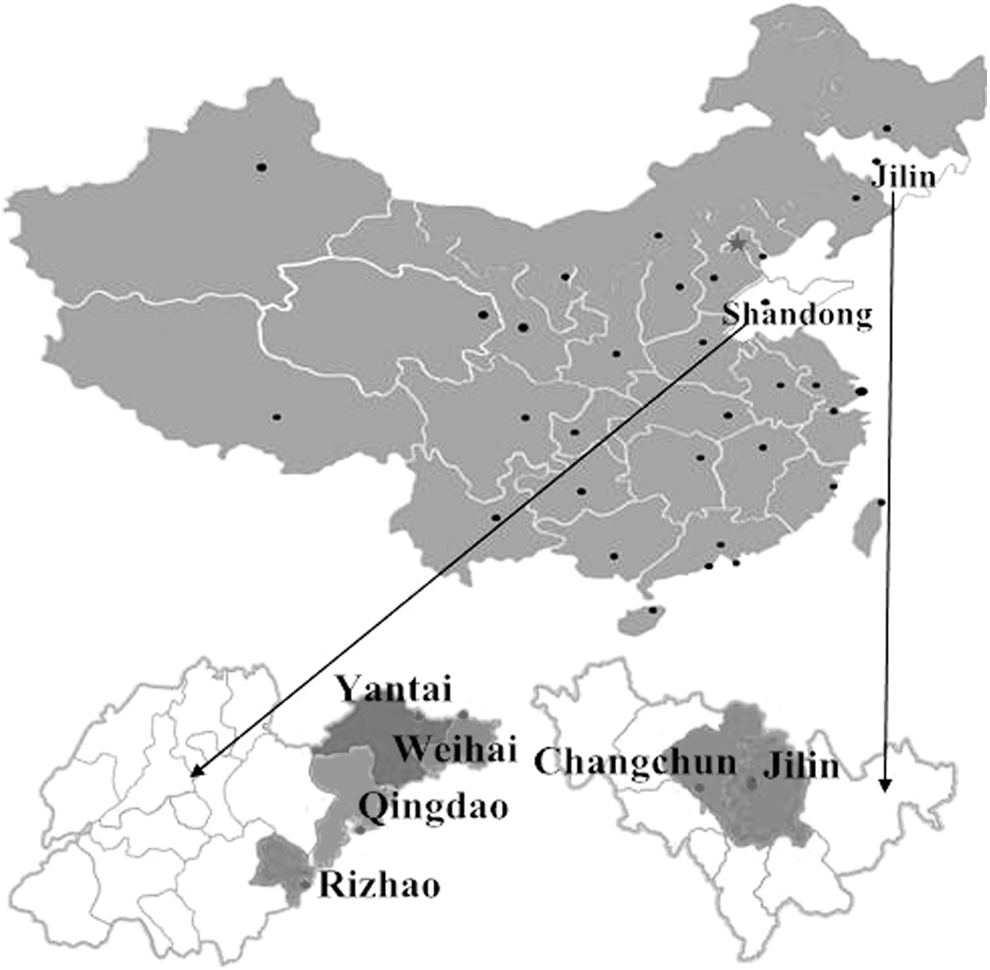
A map of China showing the geographical regions in Jilin and Shandong provinces where farmed raccoon dogs were sampled.
Serological examination
Antibodies to T. gondii were evaluated by the modified agglutination test (MAT). The T. gondii MAT antigen was provided by the Laboratoire de Parasitologie-Mycologie, Centre National de Référence de la Toxoplasmose, Centre de Ressources Biologiques Toxoplasma, Hôpital Maison Blanche, Reims Cédex, France. The negative and positive sera were provided by the Lanzhou Veterinary Research Institute, Chinese Academy of Agricultural Sciences. The procedures of T. gondii antibody detection were carried out as described previously (Dubey and Desmonts 1987, Liu et al. 2013a, Zheng et al. 2016). In brief, each raccoon dog serum was diluted by the MAT serum dilution solution from 1:25 to 1:800, using twofold dilutions in U-bottom 96-well microtiter plates. The T. gondii MAT antigen was added to each well and then shaken gently for 2 min. Subsequently, the 96-well plates were incubated hermetically at 37°C for 12 h. The assay was estimated positive when a layer of agglutination occurred at the bottom surface of the 96-well plates at dilutions of 1:25 or higher. The negative, positive, and blank controls were included in each assay. The results were considered valid when the positive control titers were 1:200 or greater. Sera with dubious results were retested.
Statistical analyses
Data were entered to Excel (Microsoft) and statistical analyses were performed by SAS version 9.1 (Cary, NC). Statistical analyses were implemented to select explanatory variables, which were significantly associated with T. gondii seroprevalence in raccoon dogs in different regions, genders, and ages by chi-square analysis. p Value <0.05 was considered statistically significant. PROC LOGISTIC regression analysis was introduced to estimate the odds ratio (OR) with 95% confidence interval (95% CI) and to determine the direction of each risk factor.
Results and Discussion
Of the 1181 serum samples tested, 8.64% were positive for T. gondii antibody by MAT with titers of 1:25 in 53, 1:50 in 26, 1:100 in 8, 1:200 in 3, 1:400 in 11, and 1:800 in 1, respectively. The prevalences of T. gondii infection were different among cities (ranging from 2.96% in Yantai to 17.62% in Qingdao), genders (female: 7.58%; male: 9.22%), and ages (young: 8.53%; subadult: 7.71%; adult: 7.73%) (Table 1).
95% CI, 95% confidence interval; OR, odds ratio.
In this study, the average seroprevalence of T. gondii infection was 8.64% in raccoon dogs. Some earlier studies revealed an 18.3% seroprevalence in mainland raccoon dogs (Nyctereutes procyonoides viverrinus) in a zoo in Japan by latex fixation tests (Murasugi et al. 1996), 3.3% in suburban areas in Japan (Neagari et al. 1998), and 60% in Poland by PCR (Gorecki et al. 2012). The different positive rates may be caused by the differences in geographic region, climatic conditions, the density of felids, and detection methods.
Remarkably, the seroprevalence of T. gondii infection was similar in the age group (young: 8.53%; subadult: 7.71%; adult: 7.73%) without a statistically significant difference (p > 0.05), which was coincident with previous studies (Tan et al. 2015, Zou et al. 2015) that showed age was not the major risk factor for T. gondii infection. However, it was still evident that young raccoon dogs had a higher seroprevalence than subadult and adult raccoon dogs, indicating that a young raccoon dog was more susceptible to T. gondii. The lack of powerful immune system and healthcare medicine could contribute to the higher positive rate in young animals, which could give farmers a wake-up call that should strengthen the management of young animals and improve animal welfare.
In the gender group, although the male (9.22%) (OR = 1.24, 95% CI = 0.80–1.92) had greater than one-time risk of acquiring T. gondii infection than female (7.58%), which was consistent with other studies (Lou et al. 2015, Qin et al. 2015, Yin et al. 2015) in fox, white yak, and Tibetan sheep, no significant difference was observed. Male raccoon dogs had a wider range of movement space than females, which could increase opportunity of infection with T. gondii.
In the region group, the seroprevalence of T. gondii infection ranged from 2.96% in Yantai to 17.62% in Qingdao. The seroprevalences of different regions were significantly different (p < 0.01). Among these six cities, raccoon dogs in Qingdao (17.62%) were more than seven times (OR = 7.02, 95% CI = 2.91–16.95, p < 0.01) at risk of acquiring T. gondii infection compared with raccoon dogs in Yantai (2.96%). Compared with raccoon dogs in Yantai, raccoon dogs in Rizhao (9.57%) were more than three times at risk (OR = 3.48, 95% CI = 1.35–8.96, p = 0.01) and raccoon dogs in Changchun (7.36%) were more than two times (OR = 2.61, 95% CI = 0.96–7.11, p < 0.05) at risk of infecting T. gondii. From these, we know that region was an important risk factor for T. gondii infection in raccoon dogs in this study. Different climate, the level of animal welfare, and the density of felids could contribute to the different seroprevalences in different regions.
In China, toxoplasmosis had outbroken in some raccoon dog farms, causing serious economic loss (Guo and Liang 2008). Moreover, the raccoon dogs which were discarded without pollution-free treatment may be eaten by felids, posing a threat to the surrounding animals and humans. However, effective prevention and control measures can not be introduced due to short of relevant data of positive rate and risk factor in raccoon dogs, although had some cases of T. gondii infection was reported in China (An et al. 2008, Zhang et al. 2012, Liu et al. 2013b). This is the first report of seroprevalence of T. gondii infection in raccoon dogs in China. Meanwhile, these data given a tocsin that effective measures must be introduced by location authority to solve T.gondii infection in raccoon dogs, according to the actual situation.
Conclusion
The present survey revealed an 8.64% seroprevalence of T. gondii infection in raccoon dogs in Jilin and Shandong provinces. Region was considered the primary risk factor for T. gondii infection for raccoon dogs. Meanwhile, these data indicated that raccoon dogs are susceptible animals of T. gondii, and the bodies of the raccoon dogs should be handled properly. These data provided baseline information for prevention and control of T. gondii infection in raccoon dogs in Jilin and Shandong provinces, China.
Footnotes
Acknowledgments
Project support was provided by the National Natural Science Foundation of China (grant no. 31302085), the Quality Inspection Special Public Welfare Industry Research (grant no. 201410061), and the Agricultural Science and Technology Innovation Program (ASTIP) (grant no. CAAS-ASTIP-2014-LVRI-03). Laboratoire de Parasitologie-Mycologie, Centre National de Référence de la Toxoplasmose, Centre de Ressources Biologiques Toxoplasma, Hôpital Maison Blanche, Reims Cédex, France; thanked for providing the Toxoplasma-modified agglutination test antigen.
Author Disclosure Statement
No competing financial interests exist.