




Abstract
Extended-spectrum β-lactamases (ESBLs) confer bacterial resistance to critically important antimicrobials, including extended-spectrum cephalosporins (ESCs). Livestock are important reservoirs for the zoonotic food-borne transmission of ESC-resistant enteric bacteria. Our aim is to describe the potential role of migratory and resident wild birds in the epidemiology of ESBL-mediated bacterial resistance on dairy farms. Using mist nets, we sampled wild migratory and resident birds either immediately adjacent to or 600 ft away from free-stall barns on three Ohio dairy farms during the 2014 and 2015 spring migrations. Individual swabs were used to obtain both a cloacal and external surface swab from each bird. Samples were inoculated into MacConkey broth containing cefotaxime then inoculated onto MacConkey agar with cefoxitin, cefepime, or meropenem to identify the bla CMY, bla CTX-M, and carbapenemase phenotypes, respectively. Six hundred twenty-three birds were sampled, 19 (3.0%) of which harbored bacteria with bla CMY and 32 (5.1%) harbored bacteria with bla CTX-M from either their cloacal sample or from their external swab. There was no difference in the prevalence of either gene between migratory and resident birds. Prevalence of bla CMY and bla CTX-M was higher among birds sampled immediately outside the barns compared with those sampled 600 ft away. Our results suggest that wild birds can serve as mechanical and/or biological vectors for Enterobacteriaceae with resistance to ESCs. Birds live in close contact with dairy cows and their feed, therefore, transmission locally between farms is possible. Finding a similar prevalence in migratory and nonmigratory birds suggests the potential for regional and intercontinental movement of these resistance genes via birds.
Introduction
B
The link between humans and animals harboring AmpC and ESBL carrying bacteria is primarily a consequence of food-borne transmission. A high level of similarity has been reported for isolates from humans, food animals, and fresh retail food products, providing evidence for the zoonotic transmission of resistant isolates between food animals and humans (Mora et al. 2010, López-Cerero et al. 2011). Current surveillance has indicated that in the United States, 70% and 33.3% of dairy farms have an 80–100% prevalence of AmpC and ESBL colonization, respectively (Davis et al. 2015). Surprisingly, ESBL and AmpC genes have been reported in organic livestock facilities, where antibiotic selection pressure is not being applied (Daniels et al. 2009, Bortolaia et al. 2010). In addition, AmpC and ESBL harboring bacteria are readily found on both conventional and organic or antibiotic-free fresh retail meat products (Mollenkopf et al. 2014). The widespread dissemination of these resistance genes warrants investigation into how these genes are moving and ways the movement and transmission can be slowed.
Dairy farms in the United States frequently attract large flocks of birds to their facilities because of roosting sites and availability of food (Fitzwater 1994, Johnson and Glahn 1994, Brittingham and Falker 1999). The birds most commonly found at livestock facilities are European starlings (Sturnus vulgaris), house sparrows (Passer domesticus), and rock pigeons (Columba livia) (Brittingham and Falker 1999). These birds can be found in high densities and cause economic losses to livestock farms due to their consumption of livestock feed (Fitzwater 1994, Johnson and Glahn 1994, Brittingham and Falker 1999). In addition to direct financial consequences resulting from the presence of wild birds, these birds often defecate on the feed and contaminate the livestock's food supply with fecal material (Daniels et al. 2003). This fecal contamination by wild birds may play an important role in cross-species transmission of enteric bacteria, including zoonotic pathogens such as shigatoxigenic Escherichia coli (Cernicchiaro et al. 2012). Little is known about the role birds play in the movement and transmission of AmpC or ESBL-harboring bacteria. A limited number of studies have been conducted in Europe and Asia, demonstrating a low prevalence of these resistance genes in wild birds, however, very little is known from the United States (Bonnedahl et al. 2009, Dolejska et al. 2009, Literak et al. 2010, Loncaric et al. 2013, Hasan et al. 2014).
Birds play an important role in the ecology of livestock farms. Many birds may come in direct or indirect contact with livestock feces. Subsequent direct contact with livestock feed may contribute to the transmission of enteric bacteria harboring clinically important AmpC and ESBL resistance genes, including transmission between farms. Knowledge of the epidemiology of AmpC and ESBL resistance genes in wild bird populations will better enable the development of interventions to prevent and control the dissemination of ESC-resistant bacteria.
Materials and Methods
Sample collection
Three conventional dairy farms located in Ohio and ranging in size from 250 to 1000 cows were recruited for participation based on the quality of the songbird habitat around the farm. Fifty fresh cow fecal samples were collected from the floor of the free-stall barn at each dairy on four separate visits over a 2-year period. Wild birds were sampled at each dairy on 34 separate visits during spring migration in May and June of 2014 and 2015. Mist nets were set up immediately adjacent to the free-stall barn and 600 ft away, but still on the dairy facility. An external swab was first obtained from each netted bird using sterile gauze premoistened with sterile buffered peptone water (BPW). A cloacal swab or fresh fecal swab was then obtained using a sterile Stuart's liquid media transport swab. Birds were then identified to species level and banded with a unique identifying aluminum band and released. Netting and banding of birds were conducted under United States Geological Survey (USGS) and Ohio Department of Natural Resources Division of Wildlife banding and wild animal permits Nos. 23781 and 18–56, respectively, and following OSU IACUC approval.
Bacterial culture
Cow fecal samples were reduced to a 4 g aliquot and incubated overnight in 36 mL of MacConkey broth modified with 2 μg/mL of cefotaxime. Cloacal/fecal swabs and external swabs were incubated overnight in 10 and 36 mL, respectively, of BPW. A 1 mL aliquot was then incubated overnight in 9 mL of MacConkey broth modified with 2 μg/mL of cefotaxime. MacConkey broth was inoculated onto MacConkey agar modified with 8 μg/mL cefoxitin, 4 μg/mL cefepime, or 1 μg/mL meropenem to identify bla CMY, bla CTX-M, and carbapenem-resistant phenotypes, respectively, and incubated overnight at 37°C.
Isolate characterization
Identification of the bla
CMY (AmpC) and bla
CTX-M (ESBL) genes was performed using standard PCR techniques utilizing primers previously reported (Mollenkopf et al. 2012). bla
CTX-M genes were bidirectionally Sanger sequenced using the corresponding PCR amplification primers and analyzed using BLAST (
Analysis
Logistic regression models were used to determine whether the probability of harboring bla CMY or bla CTX-M genes differed by migratory bird status or distance from the free-stall barn. Two multivariable logistic regression models were used to estimate the probability of bla CMY (model 1) or bla CTX-M (model 2) presence in either cloacal/fecal swabs or external swabs. Independent variables included in both models were the dairy from which the bird was sampled (categorical variable: three levels for the three dairies), distance from the free-stall barn (binary variable: immediately adjacent or 600 ft away), and migratory status of the bird (binary variable: migratory or nonmigratory). Kappa statistics were calculated to determine level of agreement between external and cloacal/fecal swabs collected from the same bird. All statistics were completed using StataCorp software (StataCorp Software, version 13; StataCorp LP, College Station, TX).
Results
Two hundred fecal samples were collected from the floor of free-stall barns over four different visits from each of the three dairy farms, before and after bird sampling for 2014 and 2015. Per visit, our selective culture screening resulted in 98–100% recovery of Enterobacteriaceae expressing second- and third-generation cephalosporin resistance consistent with the phenotype for bla CMY gene, and a subset of at least 6% were PCR confirmed. This molecular characterization resulted in an estimated cow-level prevalence per visit of Enterobacteriaceae harboring the bla CMY gene as 67–100%, 33–100%, and 36–100% for dairy 1, 2, and 3, respectively (Table 1). Similarly, per visit, our selective culture screening resulted in 24–100% recovery of Enterobacteriaceae expressing third and fourth generation cephalosporin resistance consistent with the phenotype for bla CTX-M gene and a subset of at least 6% were PCR confirmed and gene sequenced, resulting in a cow-level prevalence per visit of Enterobacteriaceae harboring the bla CTX-M genotype as 66–100%, 0–80%, and 24–94% for dairy 1, 2, and 3, respectively (Table 1). Among the subset of PCR-confirmed bla CTX-M isolates that were sequenced, from dairy 1, the majority were group 1 with 55% being CTX-M-1 and 27% being CTX-M-15, there were no group 9 isolates, and 18% were other nongroup 1 or 9 CTX-M; on dairy 2, 100% were group 9, specifically CTX-M-27; and on dairy 3, the majority were group 1 with 33% being CTX-M-15 and 22% being CTX-M-1, there were no group 9 isolates, and 45% were other nongroup 1 or 9 CTX-M.
Six hundred twenty-three birds were sampled from three Ohio dairies during spring migration of 2014 and 2015, May and June. One hundred seventy-three were migratory while 450 were nonmigratory birds (Figs. 1 and 2). Two hundred fifty-nine birds were sampled immediately adjacent to a free-stall barn, and 364 were sampled around 600 ft away from any free-stall barn but were still on the dairy premises. The distributions of migratory and nonmigratory birds at these two sampling distances are depicted in Figures 3 and 4. The kappa statistic estimating agreement beyond chance between the external swabs and the cloacal/fecal swabs for both bla CMY and bla CTX-M was 0.26 and 0.29, respectively (Table 2), suggesting limited agreement. Nineteen birds harbored bla CMY bacteria in their cloacal/fecal swab and/or their external swab, three of which were from migratory birds (Table 3). Three birds carrying bla CMY were netted 600 ft from the free-stall barn while 16 were captured immediately adjacent to the free-stall barn (Table 4). Thirty-two birds harbored bla CTX-M in their cloacal/fecal swab and/or their external swab, four of which were from migratory birds (Table 3). Of migratory birds, 3 were carrying CTX-M-1 and 1 had a CTX-M-15; of 37 nonmigratory bird bla CTX-M isolates, 15 were CTX-M-1, 11 were CTX-M-15, 1 was a CTX-M-3, and 10 were other nongroup 1 or 9 CTX-M. Fifteen of these 32 birds were sampled at 600 ft from the free-stall barn while 17 were from immediately adjacent to the free-stall barn (Table 4). Of the 21 isolates from birds sampled 600 ft away from the free-stall barn, 9 were CTX-M-15, 5 were CTX-M-1, and 6 were other nongroup 1 or 9 CTX-M; of the 20 isolates from bird sampled adjacent to the free-stall barn, 12 were CTX-M-1, 4 were CTX-M15, and 4 were other nongroup 1 or 9 CTX-M.
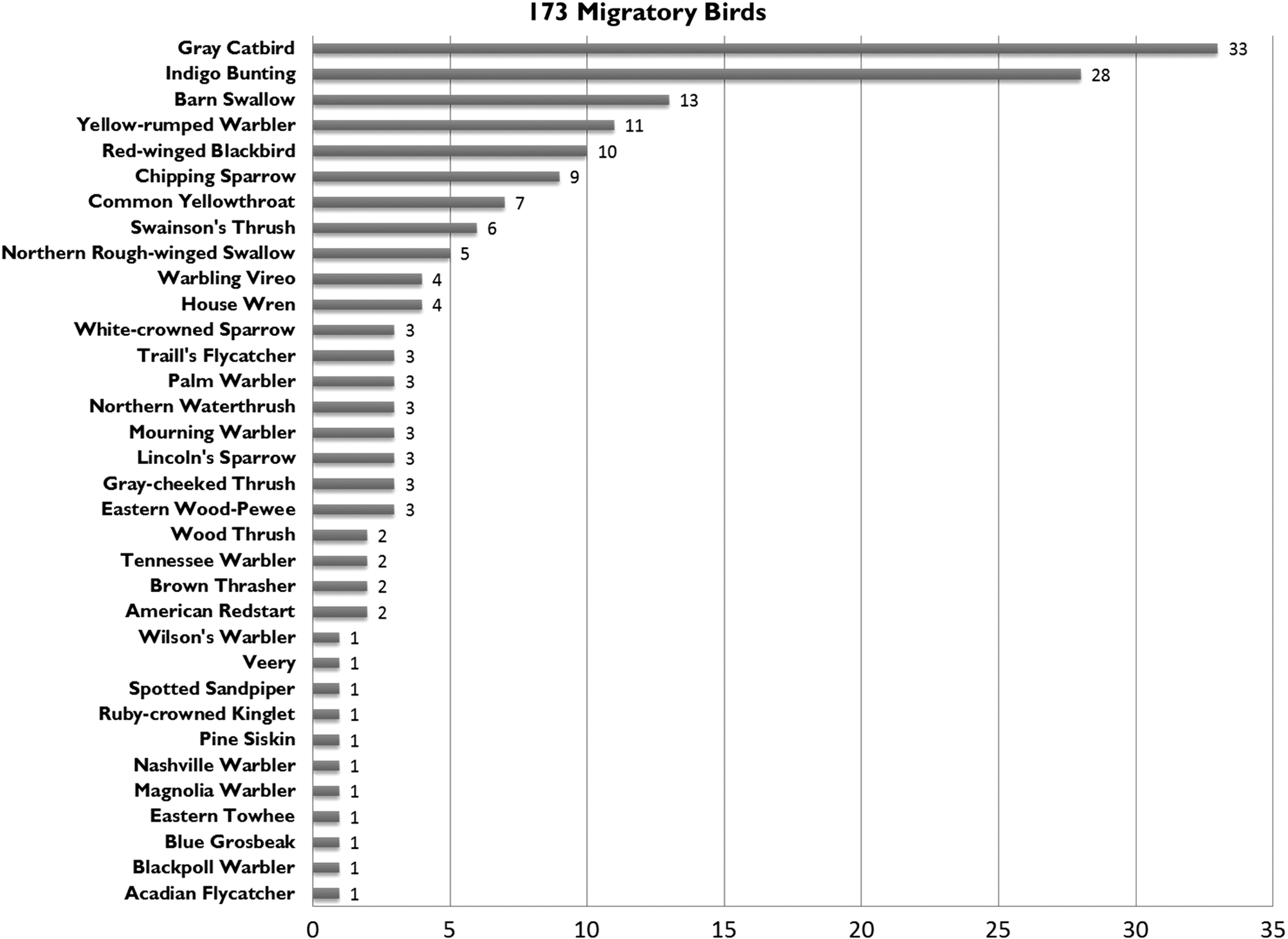
Distribution of bird species among migratory birds.

Distribution of bird species among nonmigratory birds.

Distribution of migratory and nonmigratory birds among those sampled immediately adjacent to the free-stall barn.

Distribution of migratory and nonmigratory birds among those sampled 600 ft away from free-stall barn.
During the 2015 sampling, 10 birds were recaptured from 2014, 7 of which were nonmigratory and 3 were migratory birds. Nine of the 10 recaptured birds maintained a negative status for both bla CMY and bla CTX-M while 1 bird changed from bla CTX-M negative to bla CTX-M positive. The repeated observations resulting from recaptured birds were excluded from the analysis to prevent correlation of observations.
Discussion
Our results indicate that birds can serve as both biological and mechanical vectors for AmpC- and ESBL-harboring Enterobacteriaceae. External swabs and cloacal/fecal swabs had similar rates of harboring bla CMY (AmpC) or bla CTX-M (ESBL) Enterobacteriaceae. There was a low level of agreement between the two sampling methods, based on the small kappa statistics (Table 2). These kappa values indicate that a bird with a positive cloacal/fecal swab did not necessarily have a positive external swab and vice versa. Birds have been implicated as both biological (LeJeune et al. 2008) and mechanical vectors (Hubálek 2004) for bacterial pathogens such as E. coli and Salmonella. However little is known regarding their potential to serve as a vector for antimicrobial-resistant bacteria.
Our overall observed prevalence among all birds sampled was 3.0% and 5.1% for bla CMY and bla CTX-M, respectively. Among migratory birds, there was 1.7% and 2.3% prevalence for bla CMY and bla CTX-M, respectively. Among nonmigratory birds, there was 3.6% and 6.2% prevalence for bla CMY and bla CTX-M, respectively (Table 3). There was no difference between the proportions of either genotype between nonmigratory and migratory birds. Among birds sampled 600 ft away from any free-stall barn, there was a 0.8% and 4.1% prevalence for bla CMY and bla CTX-M, respectively. Birds sampled immediately adjacent to the free-stall barn had a higher (p < 0.01) prevalence of each gene, with 6.2% and 6.6% prevalence for bla CMY and bla CTX-M, respectively (Table 4). This result suggests that birds are more likely to harbor these resistance genes either within their gastrointestinal tract or on their body surface when they have been in close proximity to livestock feces. This indicates that birds can be exposed to enteric bacteria with clinically important antimicrobial resistance genes when in direct contact with cattle compared with birds flying through dairy premises without direct contact with cattle or their feces in the barn.
Our observed cow-level prevalences for bla CMY and bla CTX-M are consistent with recent findings from Washington state dairies, which report 80% of dairies having greater than 20% of cows harboring E. coli with bla CTX-M and 100% of dairies for bla CMY (Davis et al. 2015). Previously, Ohio dairies were reported to harbor ESBL, bla CTX-M, Enterobacteriaceae from about 20% of dairies and bla CMY from 100% of dairies (Mollenkopf et al. 2012). Our findings indicate the herd-level prevalence of bla CTX-M may have increased since 2012, with 100% of dairies being positive for bla CTX-M. We found that dairies 1 and 3 had a mixture of CTX-M-1 and CTX-M15 along with nongroup 1 and 9 CTX-M isolates. However, dairy 2 had CTX-M-27 only from the random subset that was sequenced. Among the birds, we observed a similar mixture of CTX-M-1, CTX-M-15, nongroup 1 and 9 CTX-M isolates, and 1 CTX-M-3. However, no CTX-M-27 isolates were found among the birds, but given that dairy 2 had only one bla CTX-M harboring bird, this finding is not surprising.
An individual house sparrow, which was the most common bird species captured and sampled, can travel on average 1.6 km (Lowther and Calvin 2006). In addition, European starlings associated with feedlots commonly travel between facilities up to 9 km apart and occasionally travel up to 40 km in a single day, with an average of about 19 km (Gaukler et al. 2008, Homan et al. 2010). Because large numbers of these highly mobile birds are routinely found on dairies, they have considerable potential to move ESC-resistant bacteria locally between farms. We found no difference between the prevalence of either genotype between migratory and nonmigratory birds. The migratory birds in this study migrate northward from the southern/southwestern United States and Central and South America during the spring and then return southward in the fall. These results indicate that birds can potentially move antimicrobial resistance Enterobacteriaceae not only locally from facility to facility but also potentially regionally within the United States and internationally.
Footnotes
Author Disclosure Statement
No competing financial interests exist.