




Abstract
In contrast to animals, Crimean–Congo hemorrhagic fever (CCHF) causes a severe disease in humans with a high mortality rate. The etiological agent, CCHF virus (CCHFV), can be transmitted by argasid and ixodid ticks, but arachnids of the genus Hyalomma, followed by Rhipicephalus and Dermacentor serve as the major vectors of this virus. The goal of the study was to assess the epidemiological situation of CCHFV infection in cattle in south-east Poland, and survey for potential tick vector species. A total of 592 bovine blood samples from animals located in the southernmost region in Poland were tested by IgG sandwich enzyme-linked immunosorbent assay. Ticks (n = 993) from south-east Poland were collected from dogs, cats, cattle, and horses and tested by RT-PCR. All 592 serum samples were negative for IgG antibodies to CCHFV. Of the ticks collected, 125 were Dermacentor reticulatus and 868 represented Ixodes ricinus, both species are regarded as potential vectors of CCHFV. All tick samples were negative for the presence of CCHFV. Considering the zoonotic nature, public health importance, and the virus increasing spread, it was prudent to assess the seroprevalence of CCHFV in the south-east area of Poland, bordering with CCHFV endemic areas. It seems unlikely that CCHFV infection will suddenly spread in Poland, but considering the multiple possibilities of the virus introduction, serosurveys and vector biosurveillance should be conducted at regular intervals.
Introduction
C
The goal of the study was to assess the epidemiological situation of CCHFV infection in cattle in south-east Poland bordering with Ukraine, where CCHFV is endemic, and survey for potential tick vector species.
Materials and Methods
A total of 592 bovine blood samples were collected in 2012–2013 from animals on 173 small farms (one or few cows) located mainly in the south-east part of Poland, especially in Subcarpathian Voivodeship that borders Ukraine and Slovakia (Przemyśl, Sanok, Ustrzyki Dolne, Dębica, Krosno, Pilzno counties), Lesser Poland Voivodeship (Tarnów, Gorlice counties), and Świętokrzyskie Voivodeship (Kazimierz county) (Fig. 1). This region of country was selected because it is the southernmost region in Poland–geographic extent of Hyalomma spp. ticks and equally the region close to CCHFV endemic areas. The animals had direct access to the pasture on the farm. Blood samples were collected during routine screening for tuberculosis and bovine leukemia.
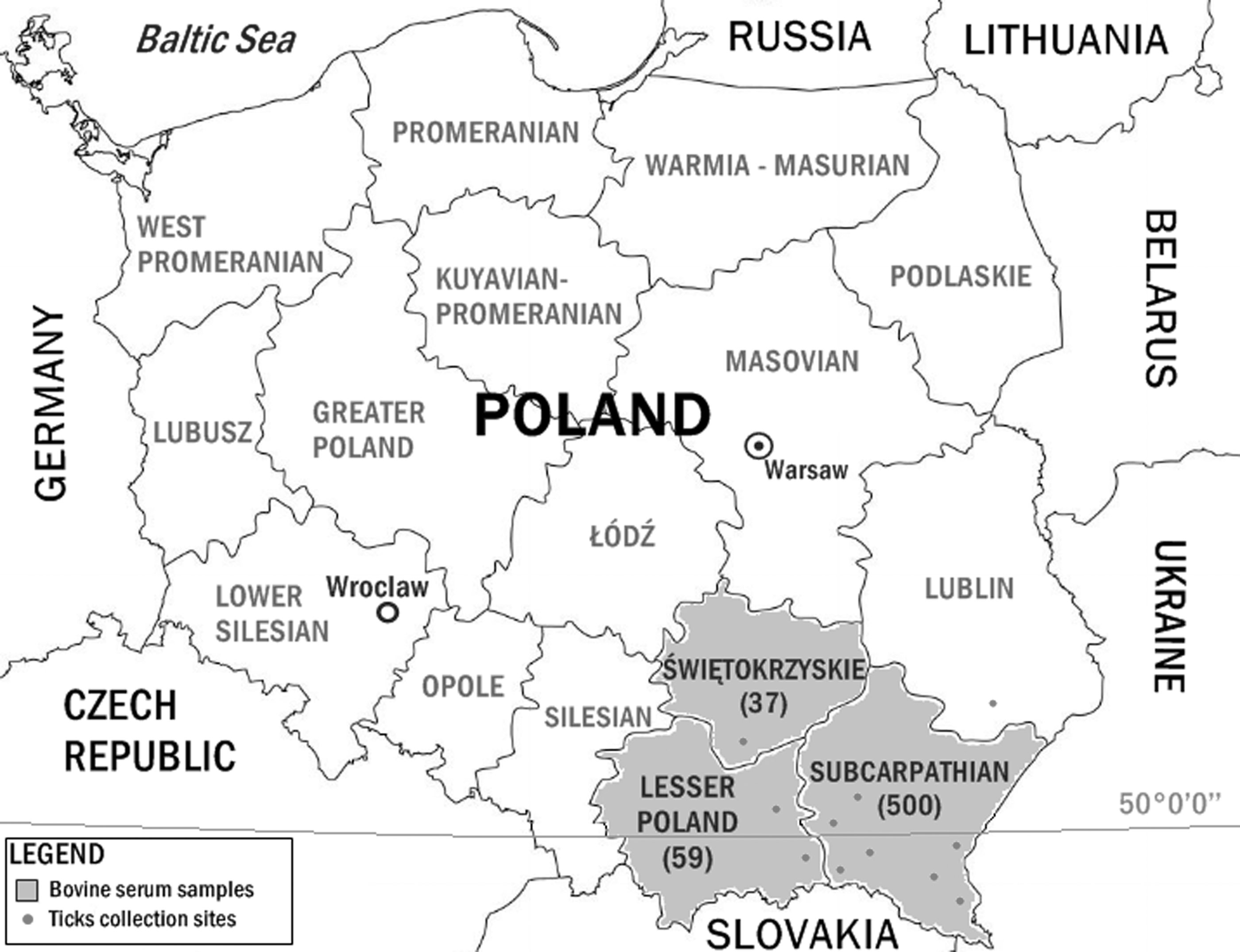
Bovine serum and ticks collection sites.
Cattle sera were tested by IgG sandwich enzyme-linked immunosorbent assay using procedure described by Burt et al. (1993).
Ticks from south-east Poland (close to the Polish–Slovakia's and Polish–Ukrainian borders) were collected mainly during the summer months in Subcarpathian Voivodeship (general area of Przemyśl, Krosno, Sanok, Ustrzyki Dolne, and Bóbrka) and in the autumn in Roztocze National Park (Zwierzyniec). Ticks were removed from infested animals (dogs, cats, cattle, horses) and collected from the environment using the flag method with a flannel flag (Siuda 1993, Skotarczak 2006). Ticks were preserved and identified to species using standard methods (Siuda 1993).
Individual ticks representing 125 Dermacentor reticulatus and 868 Ixodes ricinus were swashed twice with phosphate-buffered saline (PBS, pH 7.4), and homogenized manually in chilled 250 μL PBS using pestle and mortar. Homogenized samples were centrifuged at 14,000 × g for 10 min at 4°C, and five individual supernatants of each tick species pooled into 1.5-mL microcentrifuge tubes. (25 pools of D. reticulatus and 174 pools of I. ricinus). Total RNA was extracted from 140 μL of pooled sample homogenate using the QIAamp UltraSens Virus Kit (Qiagen, Germany) according to the manufacturer's instruction. The extracted RNA was dissolved in 60 μL of AVE Buffer and stored at −80°C until tested.
RT-PCR
Reverse transcription of RNA was performed using the RealStar® CCHFV RT-PCR Kit (Altona Diagnostic, Germany) according to the manufacturer's instruction.
Results
All 592 sera samples were negative for IgG antibodies to CCHFV. Of the ticks collected, 125 were D. reticulatus and 868 represented I. ricinus, both species are regarded as potential vectors of CCHFV (Table 1).
All tick samples tested were negative for the presence of CCHFV.
Discussion
Considering the zoonotic nature, public health importance, and the increasing spread of virus, it was prudent to assess the seroprevalence of CCHFV in the south-east area of Poland, bordering with CCHFV endemic areas. This study is the first major survey of the infection of CCHFV in the country. During the past decade, CCHFV has emerged in new territories of Europe, Africa, Asia, and the Middle East resulting in geographic increase of disease–endemic areas (Lindeborg et al. 2012). Surveys of animals provide information about the circulation of zoonotic agents, thus greatly assist in assessment of the prevalence of an infection and thereby the risk of human exposure to infected vectors and animals (Nalca and Whitehouse 2010, WHO 2013). It is commonly believed that the 50° north latitude is the limit for the geographic distribution of Hyalomma spp. ticks (Formenty et al. 2010). Current risk maps showing the geographic distribution on CCHFV, indicate that in general, Poland is not at risk of establishing CCHFV endemicity. However, southern parts of Poland are located at the 49° north latitude and, therefore, this region of the country requires monitoring for possible introduction of the virus (Formenty et al. 2010, Messina et al. 2015). Admittedly the range of occurrence of Hyalomma marginatum covers Southern Europe, Ukraine, southern Russia, North Africa, and the Middle East, but two cases of natural transfer of H. marginatum on birds (Western yellow wagtail (Motacilla flava)—Podlaskie Voivodeship and sedge warbler (Acrocephalus schoenobaenus)—Świętokrzyskie Voivodeship) into Poland have been recorded to date (Siuda and Dutkiewicz 1979, Nowak-Chmura 2014). Moreover, ticks of genera other than Hyalomma (Dermacentor, Rhipicephalus, Ixodes, Amblyomma, Boophilus) are biologically competent in the laboratory and were shown infected under natural conditions (Burt and Swanepoel 2005, Turell 2010). Results of our survey demonstrate that Dermacentor ticks are present in Poland, thus indicating the potential for establishing CCHFV endemicity. Likewise, the potential vector competence of the widespread I. ricinus in Europe, justify categorizing geographic areas of its distribution as being at potential risk for CCHF introduction (Randolph 2004). Therefore, control measures should be implemented in targeted areas of Poland for regular monitoring. Temperature, humidity, and intermediate hosts in Poland create potentially conducive conditions for survival of CCHFV tick vectors (Randolph and Rogers 2007). Ongoing climate change might further create favorable conditions for ticks. It is currently postulated that the geographic expansion of Hyalomma ticks is highly likely, thus increasing the risk of geographic expansion of the virus. In 2014–2016 African swine fever virus was isolated from dead wild boars during outbreaks of the disease in the coldest part of the country, north-east Poland. In this context, potential outbreaks, caused by viruses currently not endemic to Poland, should be always a consideration. Migratory birds play a role in long-distance dissemination of many dangerous viruses (Reed et al. 2003). CCHFV may be introduced with Hyalomma spp. carried by migratory birds into nonendemic areas (Vorou 2009). During spring 2009 and 2010 Lindeborg et al. screened migratory birds for ticks as they traveled from Africa to Europe (Lindeborg et al. 2012). They showed that a woodchat shrike (Lanius senator senator), which occasionally passes through Poland territory, can act as a long-distance transporter of ticks, including Hyalomma marginatum, whose nymphs were found positive for the CCHFV. Given the fact that many species of birds migrate between Africa and Poland, the risk of introducing CCHFV into the country is real. In addition, livestock trade from endemic to nonendemic areas (legal and potentially through illegal animal transportation) may be a source of infected ticks (Vorou 2009).
Conclusions
Although south-east Poland is potentially at risk for introduction of CCHFV from neighboring Ukraine, results of the present study do not provide any evidence of CCHFV infection in the local population of cattle and ticks. While it seems unlikely that CCHFV infection will suddenly spread in Poland, considering the multiple mechanisms of possible CCHFV introduction, serosurveys and vector biosurveillance should be conducted at regular intervals.
Footnotes
Author Disclosure Statement
No competing financial interests exist.