




Abstract
This study reports the mosquito collections conducted from June to September of 2015 and 2016, in Regional Unit (R.U.) of Drama, East Macedonia-Thrace Region, in Northeastern Greece. A total of 923 specimens were examined based on their morphological characteristics and identified to the species level. Medically important taxa were recognized among the 15 mosquito species recorded belonging to seven genera. All data presented here comprise new distribution records due to lack of previous mosquito faunal surveys in the R.U. of Drama.
Introduction
M
In Greece, during the last few years, vector-borne diseases have been increasing in prevalence. The West Nile epidemic in Central Macedonia (2010) (Danis et al. 2011a, Papa et al. 2011a, 2011b), malaria cases with indications of local transmission (2011–2013, 2015, 2016) (Danis et al. 2011b; Hellenic Center for Disease Control & Prevention), presence of invasive species, and uncontrolled immigrants flow from endemic countries have been recorded in the country and gave rise to growing public concern.
Greece, due to the combination of its geomorphology and other appropriate climatic conditions, favors the development of a large number of mosquitoes especially during the summer months. Extensive rice fields and wetlands adjacent to settlements, combined with favorable temperature conditions, misuse of irrigation water and waste water, create an ideal environment for mosquito development (Hellenic National Meteorological Service).
From 2010 and onward, entomological surveillance programs have been implemented in 12 regions of the country, on an annual basis from May to November, and field studies on Culicids are carried out in a regular basis, collecting data on the mosquito fauna, species composition, and pathogen detection in mosquito pools (Patsoula et al. 2016).
In this study, we present entomological data for years 2015 and 2016 concerning the Drama Regional Unit (R.U.), accumulated both from the entomological surveillance activities with the participation and cooperation of the subcontractors for the vector control programs and from a research thesis study.
The R.U. of Drama (41° 15′ 0″ N, 24° 10′ 0″ E) is one of the most remote administrative areas of Greece, with a total area of 3.468 km2 and belongs to the East Macedonia-Thrace Region. The R.U. is divided into five municipalities: Doxato, Drama-the capital city, Kato Nevrokopi, Paranesti, Prosotsani and its landscape is dominated by extensive and impressive forests, surrounded by mountains (Fig. 1). The southern part mainly has a Mediterranean climate. The climate is more continental with cold winters in higher elevations and in the northern part (Drama Weather Station).
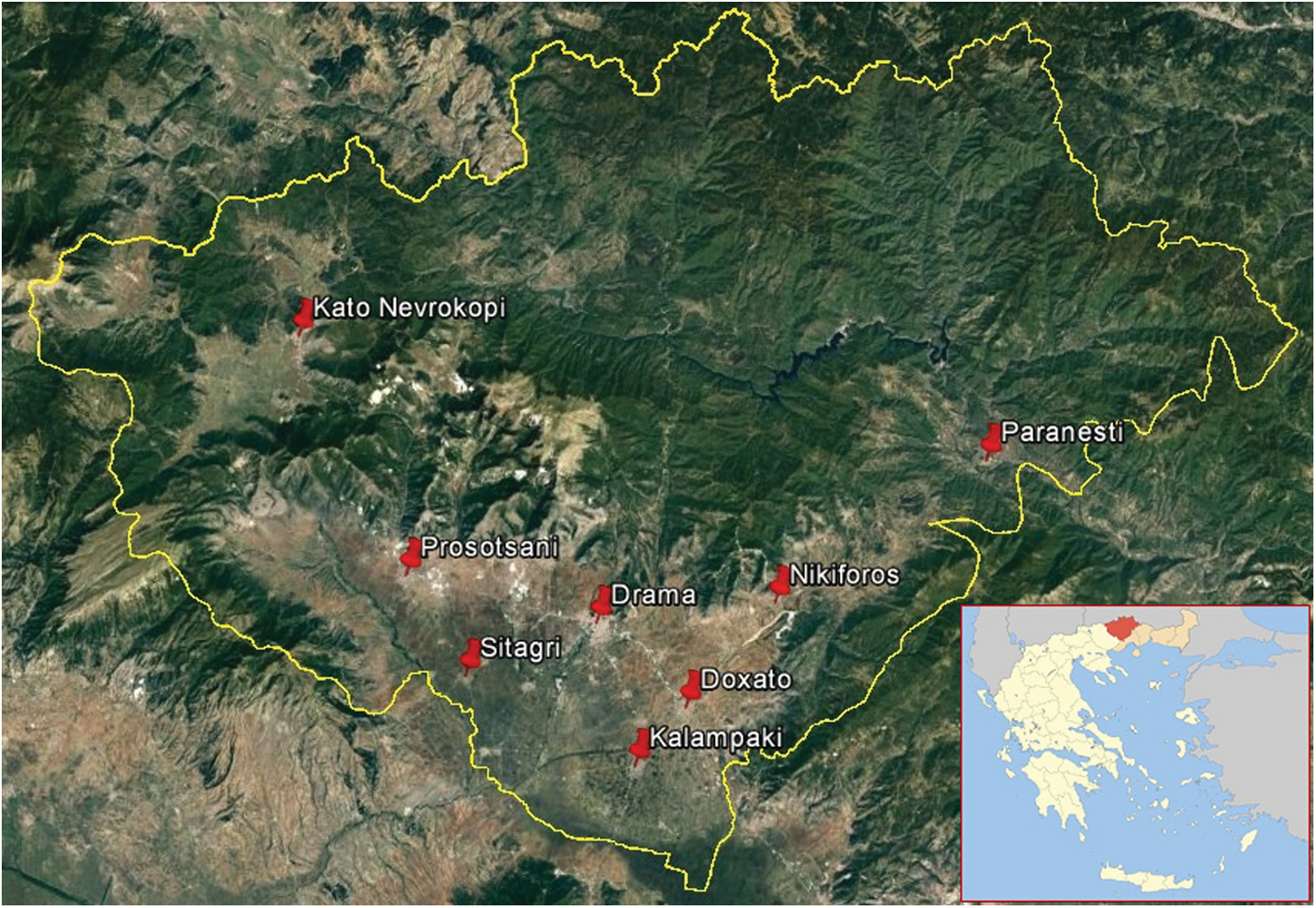
Map of the R.U. of Drama (Region of East Macedonia-Thrace). The red pins represent the five Municipalities and Municipal Units where mosquitoes were collected in this study. In the smaller map of Greece, the location of the Drama R.U. is shown. R.U., Regional Unit. Color images available online at
The Drama R.U. served as the main study area, with sampling sites from all five municipalities. The sampling sites were selected based on presence of vegetation and shading, occurrence of humans or livestock as potential hosts for adults, and proximity to open sources of fresh or still water (Drama Regional Unit).
There is a severe nuisance from mosquitoes in many parts of the R.U. of Drama according to inhabitants complains and relevant control programs are conducted every year. Reported high densities of mosquitoes at certain times of the year led to concerns of the local authorities that the inhabitants of Drama R.U. may be exposed to mosquito-borne diseases.
The primary aims for this short study were (1) to provide baseline data of the mosquito species composition, (2) to determine species imposing risk to public health, (3) to detect the presence of invasive species, and (4) to highlight mosquitoes' breeding sites. Mosquito composition was investigated by (1) adult collections, (2) larval samplings, and (3) a network of ovitraps.
All data presented herein comprise new distribution records of mosquito species, due to lack of previous mosquito faunal surveys in the R.U. of Drama.
The findings of this study can provide baseline information and act as a starting point for further vector studies that will cover a longer time span and include more sampling sites.
Materials and Methods
The data presented in this study were from the mosquito collections performed in the R.U. of Drama with sampling sites from all five municipalities, during 2015 and 2016 (June–September). The sampling sites were selected based on presence of vegetation and shading, occurrence of humans or livestock as potential hosts for adults, and proximity to open sources of fresh or still water. Different mosquito traps and methods were applied. The mosquito specimens examined during the entomological investigation regarding the mosquito fauna were derived from two sources. The contractor company awarded tender for the mosquito management and control program from the East Macedonia-Thrace Region and a research thesis study carried out from a student (S.C.) of the Msc Program in Public Health, National School of Public Health (Thesis Title: Entomological surveillance for mosquitoes in selected areas in the Regional Unit of Drama).
Mosquito collection from the contractor company was performed by using CO2 mosquito traps with dry ice (CDC Miniature Light Trap; BioQuip Products, Inc., Rancho Dominguez, CA, USA). Traps were placed in urban and rural sites according to instructions provided by the East Macedonia-Thrace Region regarding breeding sites, nuisance reported by citizens, representation of both urban and rural sites, and convenience of sampling, at a bi-monthly basis, from June to September 2015 and 2016. Traps were set at dusk from ∼6:00 PM and collected the following morning at 9:00 AM.
The thesis study at the R.U. of Drama was performed in randomly selected areas (rural, urban), in the summer of 2015, based on the increased problem of mosquito nuisance, location, and number of inhabitants. The methods used were a combination of laboratory and field work procedures. During the field work (1) the species composition of mosquito fauna was investigated by the use of adult traps, (2) Aedes albopictus presence in the city of Drama was monitored by the establishment of a network of 37 oviposition traps, and (3) larval samplings were conducted in potential natural and artificial breeding sites.
The monitoring system of ovitraps for the presence of A. albopictus in the city of Drama was established in selected sampling sites. It operated on a weekly basis, and substrates were collected and transferred to the National School of Public Health (NSPH), where they were kept for egg hatching and mosquito identification after adult emergence.
Three different types of adult mosquito traps, BG—Mosquitaire CO2 (Biogents AG, Regensburg, Germany), BG—Mosquitito (Biogents AG), and Mosquito Trap (Skone Electric Appliance Co., Ltd., USA) were placed at sampling sites, in different ecological environments and operated from dawn to dusk with the addition of octenol as lure.
All mosquito samples collected were immediately refrigerated and transported to the Laboratory of Medical Entomology in the Department of Parasitology, Entomology, and Tropical Diseases of the NSPH for further investigation.
The five Municipalities, Municipal Units, and Local Communities from where data collected from selected regions from both the subcontractor company and the postgraduate student are listed in Table 1. In the map (Fig. 1), Municipalities and Municipal Units are presented.
Data are collected from selected regions from both the subcontractor company and the postgraduate student.
Results
A total of 923 mosquitoes were identified to the species level, based on identification keys using morphological characteristics (Samanidou-Voyadjoglou and Darsie 1993a, 1993b, Darsie and Samanidou-Voyadjoglou 1997, Samanidou and Harbach 2001, 2003, Samanidou-Voyadjoglou et al. 2005, Becker et al. 2010, Voyadjoglou-Samanidou 2011).
Even though this entomological survey was of limited duration, the results revealed the presence of 15 species classified in seven genera.
The species composition and the relative abundance of the species in the study area expressed as the corresponding percentages of the total number of mosquitoes collected by all techniques is represented in Figure 2, including the following: Aedes albopictus (Skuse) (n = 399), Aedes vexans (Meigen) (n = 12), Anopheles claviger (Meigen) (n = 8), Anopheles maculipennis (Meigen) (n = 7), Anopheles sacharovi (Favre) (n = 6), Coquillettidia richiardii (Ficalbi) (n = 3), Culex pipiens (Linnaeus) (n = 387), Culex mimeticus (Noe) (n = 28), Culiseta annulata (Schrank) (n = 5), Culiseta longiareolata (Macquart) (n = 5), Culiseta subochrea (Edwards) (n = 2), Aedes caspius (Pallas) (n = 18), Aedes detritus (Haliday) (n = 25), Aedes dorsalis (Meigen) (n = 2), and Uranotaenia unguiculata (Edwards) (n = 16). All adult mosquitoes collected in the five municipalities of the Drama R.U. for 2015 to 2016, according to species and relative abundance are presented in Table 2. Additionally, the total numbers of mosquitoes trapped per species and per sampling method (trap type) are presented in Table 3.
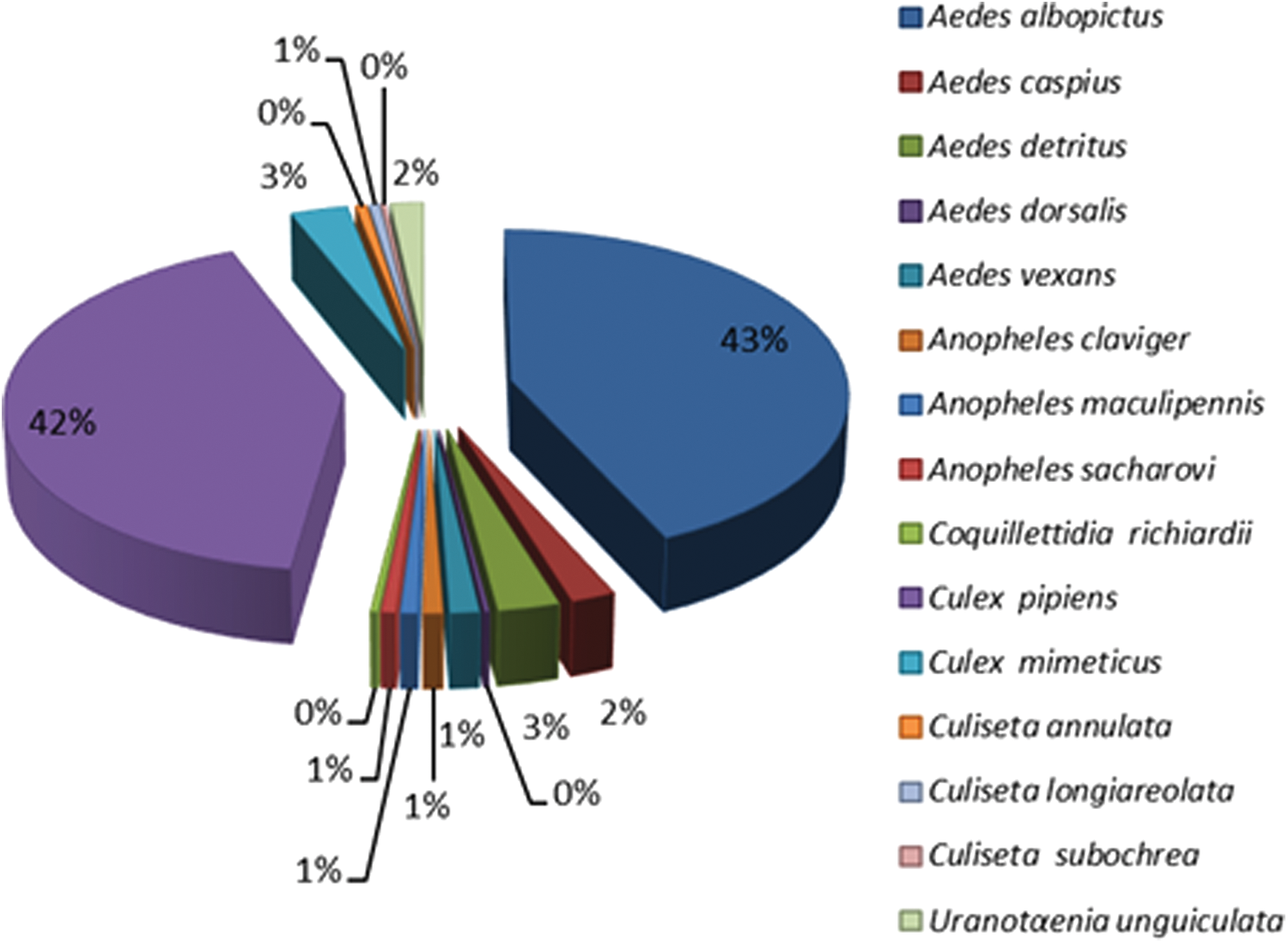
Morphological identification of mosquito species collected in Drama R.U. in June–September 2015 and 2016: the percentage of the single species out of the 923 specimens is reported here. Color images available online at
Aedini denomination according to Wilkerson et al. (2015).
DoA, Doxato/Aghios Athanasios; DoD, Doxato/Doxato; DoE, Doxato/Evripedo; DrA, Drama/Ampelakia; DrC, Drama/Choristi; DrD, Drama/Drama; DrKA, Drama/Kalos Agros; DrM, Drama/Mavrovatos; DrN, Drama/Nikotsaras; DrNA, Drama/Drama (Nea Amisos); KF, Kalampaki/Ftelia; KK, Kalampaki/Kalampaki; KNE, Kato Nevrokopi/Exochi; KNP, Kato Nevrokopi/Perithorio; KP, Kalampaki/Aghia Paraskevi; NA, Nikiforos/Adriani; PK, Prosotsani/Kokkinogia; PP, Paranesti/Paranesti; SA, Sitagri/Argiroupoli; SF, Sitagri/Fotolivos; SM, Sitagri/Mavrolefki; SS, Sitagri/Sitagri.
Adults morphologically characterized as A. maculipennis and A. sacharovi were further examined by molecular amplification methods. DNA was extracted from one leg of individual adult mosquitoes, PCR amplification using both primer pairs (5,8S/28S and C1-J-1718/C1-N-219) and restriction fragment length polymorphism (RFLP) on PCR products followed according to the protocol described in Patsoula et al. (2006, 2007). According to their RFLP profile with both primer pairs, seven (7) adults were further verified as A. maculipennis and six (6) as A. sacharovi.
Also, it is noted that C. pipiens and A. albopictus were by far the most abundant species, followed by C. mimeticus, A. detritus, U. unguiculata, and A. caspius. The other species were not found in sufficient numbers and formed <1% (uncommon) of the total captures. The only species captured in all sampling sites, except for Kato Nevrokopi, is C. pipiens.
Three of the species, A. albopictus, A. sacharovi, and C. pipiens are of major medical importance. Mosquito species collected only as larvae included C. mimeticus and A. maculipennis.
Discussion and Conclusion
Despite research and decades of mosquito control efforts around the world, mosquitoes remain a major global public health problem. Western-world countries have experienced the introduction and establishment of exotic species and mosquito-borne diseases formerly unknown (Schaffner et al. 2013). Many of the diseases transmitted, such as Chikungunya or West Nile fever, are regarded as “emerging vector-borne diseases” and have gained high attention in Europe (Weaver and Reisen 2010, Weissenböck et al. 2010).
Of the 60 species of mosquitoes that have been recorded in Greece (Samanidou-Voyadjoglou and Darsie 1993a, 1993b, Darsie and Samanidou-Voyadjoglou 1997, Samanidou and Harbach 2001, 2003, Kaiser et al., 2001, Samanidou-Voyadjoglou et al. 2005), 15 were identified in the R.U. of Drama in this study. Traps were placed in randomly selected areas in urban and rural sites, representing different types of environment. The survey was conducted in a time period of <6 months for 2 consecutive years, probably resulting in the identification of relatively few taxa. However, the findings are noteworthy, since three species among them are recognized for their medical and veterinary importance: A. albopictus, a cosmopolitan species, potential vector of Dengue and Chikungunya, A. sacharovi, primary vector of malaria, and C. pipiens, important vector of West Nile virus (WNV) (Becker at al. 2010, ECDC 2016a, 2016b).
In Greece A. albopictus (Skuse) and Aedes (Stegomyia) cretinus Edwards have already been recorded and are closely related mosquito species with common morphological features and bio-ecological similarities (Samanidou-Voyadjoglou, 1998, Patsoula et al. 2006, Giatropoulos et al. 2012a, 2012b, LIFE CONOPS 2016). The monitoring system of ovitraps in the city of Drama verified the presence of the invasive mosquito A. albopictus, displaying a trend of increase in the urban environment of the capital city. Also, the specimens collected from adult traps and larval samplings revealed the further distribution of this species to the other municipalities of the R.U. The ability of A. albopictus to adapt to new environments, its predicted spread and establishment in Europe (ECDC 2016a, Walter Reed Biosystematics Unit), and its confirmed involvement in pathogen transmission cycles makes the surveillance and control of this species hugely important. Surveillance programs will also be useful to prevent the introduction and establishment of other invasive container-breeding Aedes species with medical importance (Medlock et al. 2012, Schaffner et al. 2013).
In Greece, large populations of Anopheles mosquitoes, such as A. maculipennis, A. sacharovi, and A. superpictus, have already been recognized (Patsoula et al. 2007, Voyadjoglou-Samanidou 2011). The relative density of the three Anopheles species (A. claviger, A. maculipennis, and A. sacharovi) identified in this study is not very large, however, Anopheles mosquitoes are insects of major medical importance (WHO 2016). A. sacharovi is an important vector of malaria throughout its distribution (Becker et al. 2010, ECDC 2016b). Historically, it is a known vector of malaria in Armenia (WHO 2016, ECDC 2016b) and a proven vector in Turkey, Syria, northern Iraq, Iran (ECDC 2016b), and Greece (Patsoula et al. 2007). This species was responsible for malaria transmission in Greece in 2011, resulting in autochthonous cases of Plasmodium vivax infection (Danis et al. 2011b, ECDC 2012). So far, there is no documented recent study concerning other Anopheles species present in Greece, such as A. hyrcanus and A. claviger, which are also considered to be potential malaria vectors (Vakali et al. 2012).
C. pipiens sensu stricto was the second most prevalent species in this study and is considered a main vector of WNV in Europe (Hubálek 2008). Endemic outbreaks of West Nile fever have been reported in Italy, Greece, France, Romania, Hungary, Russia, and Spain (Engler et al. 2013). In 2012, five human neuroinvasive West Nile fever cases were recorded in the R.U. of Drama (
The most common coastal species Ochlerotatus caspius and O. detritus, causing considerable annoyance in villages have also been identified in the Drama R.U. O. caspius is not considered a very competent disease vector, however, its role in WNV transmission needs to be further studied (Patsoula et al. 2016).
The diversity of mosquito species observed in this R.U., prompts us to conduct further studies on its faunistic composition, and to focus in particular on those species that are of zoonotic relevance. Related studies on mosquito fauna should be performed in bordering R.U. and countries, as data on mosquito populations and species distribution in neighboring areas would be valuable.
It is also suggested to undertake appropriate vector control measures in the region to prevent future cases of mosquito-borne arboviral diseases. The establishment of public education programs in conjunction with the continuous application of integrated vector management practices will contribute progressively to an environmentally compatible and cost-effective solution to the problem. Detailed information on the biology and ecology of the mosquito fauna of the region is necessary for development of ecologically sensitive and efficient mosquito control strategies.
Although this survey represents only a small-scale study of the mosquito fauna of Drama R.U., this represents the only mosquito survey performed so far. These data contribute knowledge to the geographic distribution of mosquitoes in Europe, and is of particular interest to those actively involved in control of mosquito and mosquito-borne diseases in Greece. Furthermore, it highlights the importance of performing entomological surveys in a regular basis, as the knowledge gained is valuable and could be of a great assistance in the implementation of mosquito management programs promoting Public Health.
Footnotes
Author Disclosure Statement
No competing financial interests exist.