




Abstract
Clonorchis sinensis is an important foodborne zoonosis worldwide and prevalent in China for more than 2000 years. According to the experience of controlling Schistosoma japonica, China started to establish the integrated control strategy for C. sinensis in endemic areas. Lou village, the largest village in Shenzhen city in South China was taken as a pilot site. This longitudinal study assessed the infection status of C. sinensis among people and intermediate hosts from 2006 to 2014 in Lou village. After a continuous intervention with the integrated control strategy, the prevalence of C. sinensis decreased significantly to 2.01% in 2014. The infection intensity also reduced significantly with eggs per gram varying from 45.6 ± 3.4 in 2010 to 21.7 ± 1.6 in 2012. There is also a statistically significant decrease of the prevalence of C. sinensis metacercariae in fish hosts from 16.51% in 2008 before the intervention to 5.33% in 2014. All the old-styled toilets were replaced by sanitary ones with a harmless processing design in 2014. No viable parasite eggs were detected in stool samples from the reconstructed toilets. Health education played an important role in changing the eating habits among the local residents, with a significant decrease in the prevalence of eating raw fish from 91.99% in 2008 to 59.87% in 2014. The evaluation suggested that the integrated strategy we have performed in Lou village is effective in controlling the C. sinensis infection and maintaining the infection rate at a lower level, which can be promoted in other endemic areas.
Introduction
C
C. sinensis has been prevalent in China for more than 2000 years, based on the fact that a male corpse of the Western Han Dynasty was excavated and detected with C. sinensis eggs in the intestinal and bile duct contents in 1975 in Jiangling county, Hubei province, China (Wei et al. 1981). Two national surveys in China showed that the standardized infection rate of C. sinensis increased by 74.85% in 2003 compared with the survey in 1990 and the risk was always highest in Guangdong province (Chen et al. 2012). In Guangdong, 62 out of 95 counties or cities were found to be endemic with C. sinensis and the most prevalent areas distributed along the Pearl and Han rivers (Fang 1994, Lun et al. 2005). Shenzhen is located in the east coast of the Pearl River Delta with a low prevalence of C. sinensis, but the threaten of clonorchiasis should not be ignored because of the habit of eating raw fish and the appropriate environment for intermediate hosts in some districts.
Just like C. sinensis, Schistosoma japonicum has been prevalent in China for many years and causes great threaten to human health and social economy. In 2004, a comprehensive strategy of schistosomiasis was adopted to block the contamination of schistosome eggs in water body, focusing on infection resource control and transmission interruption; it brought schistosomiasis under effective control within endemic areas and reduced the estimated infected people by 78.1% after 10 years of the intervention (Xu et al. 2016). The similar integrated control method for C. sinensis has also been advocated by the government and implemented in many endemic areas, but there were few reports that evaluated the effect of the intervention. This study introduced the integrated method carried out in an endemic village in Shenzhen, South China, and also assessed the effect of the method for C. sinensis in this pilot area, which may be instructive and meaningful to the development of control strategy for C. sinensis.
Materials and Methods
Ethical considerations
Our study was approved by the ethics committee in Shenzhen Center of Disease Control and Prevention (Shenzhen, China). All the participants were fully explained with the research contents and signed the informed consents.
Study area and population
Lou village is located in Baoan district of Shenzhen city with largest area and population among all the administrative villages (113°55′E, 22°47′N, Fig. 1). The village has a population of 2662 including 1449 males and 1213 females. The investigation in 2014 included 1144 people of the total population ranging from 6 to 65 years, who were willing to participate in and well cooperated. We also collected the monitoring data of C. sinensis infection in Lou village from Shenzhen Center of Disease Control and Prevention since 2008.

The location of Lou village in Shenzhen city, South China.
Diagnosis of patients with clonorchiasis
Blood samples were collected from 1144 individuals and used to screen C. sinensis infection by enzyme-linked immunosorbent assay (ELISA) using a commercial ELISA kit (Combined 110111, China), following the manufacturer's protocols. The kit uses the solid-phase antigens of adult flukes to detect the specific IgG to C. sinensis in human serum. The samples are considered positive if the absorbance value is 2.1 times greater than the negative control and each control and sample should be assayed with two replicates (Chinese Medical Association 2008). Modified Kato-Katz thick smear methods were then used to detect C. sinensis eggs in the feces of sera positive cases and eggs per gram (EPG) feces were also counted to assess the infection intensity as previously described (Hong et al. 2003).
Freshwater snail investigation
Freshwater snails were collected from the lakes, rivers, and fish ponds in and around the village, including two main species Parafossarulus striatulus and Bithynia fuchsianus. Snails were crushed and examined for cercariae of C. sinensis under the microscope. The cercaria with a long tail, a finely spined tegument, seven pairs of penetration glands, and lots of brownish pigment was identified as that of C. sinensis (Kaewkes 2003, Lun et al. 2005).
Freshwater fish investigation
Ten fish ponds in the village were randomly selected. Freshwater fish with four species were collected from the fish ponds and examined for metacercariae of C. sinensis. The fish were killed and dissected individually to get the flesh after fish deheading, tail cutting, and guts, bones, and skin removal. The homogenates of flesh smashed were then digested overnight at room temperature by ten volumes of artificial digestive juice (HCl 33.7 mL, pepsin 25 g supplemented with distilled water to a total volume of 5000 mL). The digests were filtered by copper sieve with 200 meshes and processed by repeated sinking. The sediments were then mounted on glass slides and examined under the microscope to search for the metacercariae. In some cases to better observe the morphological features, the metacercariae were excysted by pressing on the cover slip until they emerged from the cysts (Thien et al. 2007). The identification of the metacercariae was done by trained technicians according to morphological criteria described previously (Kaewkes 2003, Keiser and Utzinger 2009).
Questionnaire survey
Those who participated in serological investigation were also asked to complete the questionnaire under the instructions of trained investigators. The questionnaire was mainly about the eating habits and awareness of the route of C. sinensis infection (Appendix A1).
The integrated control method
Toilet reconstruction
Sanitary toilets with harmless processing design were built since 2008 to replace the previous ones that were built directly above or beside the fish ponds and allowed unprocessed feces to contaminate the water, which would increase the infection of C. sinensis in snails and freshwater fish. The toilet reconstruction was driven by Patriotic Health Campaign Committee Office (PHCCO) and funded by the government. The upgraded sanitary toilet owns three pools to store and precipitate feces during which the marsh gas is produced and the parasite eggs are killed.
Effect evaluation for toilet reconstruction
The reconstructed toilets of ten peasant households were chosen randomly to be investigated. Fecal samples were taken to detect parasite eggs. Sampling and detection for parasite eggs: we divided the liquid manure into three layers and collected 2000 mL manure per layer by clean harvester into 10,000 mL plastic bucket; fecal samples were taken to the laboratory in Shenzhen Center for Disease Control and Prevention for parasite egg detection, including ascarid egg count, alive ascarid egg count, alive liver fluke egg count, and total parasite egg count; the number of parasite eggs per 100 mL manure in the pool or the outlet was counted separately; and the mortality of ascarid eggs and sedimentation rate of parasite eggs were also calculated to evaluate the effect of toilet reconstruction.
Chemotherapy with praziquantel
A total dose of 75 mg per kg of body weight praziquantel (divided into three doses a day for 2 days) was suggested for people conformed with clonorchis infection (Lun et al. 2005). Six months after the treatment, the patients' stool samples were collected to check for clonorchis eggs.
Monitoring of main hosts
After the sanitary toilets were constructed, the blood and fecal samples of the local residents were collected and examined for C. sinensis every 2 years from 2008 to 2014. Also, two epidemiological surveys were done in 2008 and 2014 to investigate the infection rates of C. sinensis in local intermediate hosts (snails and freshwater fish).
Clonorchiasis prevention education campaign
Health education was conducted with the help of the village committee. Pamphlets, posters, and videos about the transmission route, damages to human body, and prevention methods of C. sinensis were made and distributed to every household. We also gave lectures in local primary school to inform the teenagers to keep away from bad eating habits. In the meantime, for epidemiological investigations, we followed up most families to emphasize the importance of prevention for C. sinensis.
Data analysis
Data were entered into Epidata 3.1 and analyzed by IBM SPSS® 21.0. Statistical analysis was performed with routine descriptive statistics and the chi-squared test (*p < 0.05, **p < 0.01, ***p < 0.001).
Results
Seroepidemiology of C. sinensis infection
The investigation was carried after 6 years of intervention with an integrated control strategy. The results showed that 23 out of 1144 people (2.01%) were positive for C. sinensis by ELISA combined with modified Kato-Katz thick smear methods in 2014, which was a significant lower prevalence compared to 4.75% (70/1473) in 2006 (χ2 = 14.122, p < 0.001). The infection rates for male and female were 1.95% (10/511) and 2.05% (13/633), respectively. No sexual difference was found in the prevalence of C. sinensis. According to the monitoring data from 2008 to 2014 (Fig. 2), the infection rate of C. sinensis for residents in Lou village significantly decreased from 3.40% in 2010 to 1.22% in 2012 (χ2 = 5.161, p < 0.05). The infection intensity also decreased significantly with EPG reduced from 45.6 ± 3.4 in 2010 to 21.7 ± 1.6 in 2012 (p < 0.05). After 2012, both the infection rate and infection intensity maintained at a lower level. Therefore, the integrated method was considered effective in reducing the C. sinensis infection, although there was only a marginal decrease of infection rate in the earlier periods from 2008 to 2010.

The infection rate and infection intensity of Clonorchis sinensis since the integrated method implemented.
The infection rate of C. sinensis in snails
Two species of freshwater snails were collected and detected for cercariae of C. sinensis in 2014, including 670 P. striatulus and 520 B. fuchsianus. The results showed that 8 (0.67%) out of 1190 snails were detected with C. sinensis cercariae (Table 1). Compared to what has been investigated before the intervention in 2008, the prevalence of C. sinensis in the two snails decreased by 44.63% in 2014, but the difference showed no statistical significance. Also, there was no significant difference for the prevalence of cercariae between the two snail species.
The infection rate of C. sinensis in freshwater fish
Four species of freshwater fish collected from 10 fish ponds in Lou village were taken into our investigation and detection, including Ctenopharyngodon idellus, Pseudorasbora parva, Cyprinus carpio, and Cirrhina molitorella. According to the monitoring data in 2008, the total infection rate of metacercariae in four fish species was 16.51%, and it reduced significantly after 6 years of the intervention (χ2 = 55.06, p < 0.001). The investigation in 2014 found that 40 (5.33%) out of the total 750 freshwater fish were detected with metacercariae of C. sinensis (Table 2). Also, P. parva had a higher prevalence over the other species, but the difference did not reach statistical significance.
Questionnaire survey
All 1144 questionnaires were recovered from people being investigated in Lou village. There were 601 males and 543 females included, and the age ranged from 6 to 75 (averaged in 38.6). Of the interviewees included in this survey after 6 years of health education, 59.87% (685/1144) had eaten raw fish during the past year, which was significantly decreased compared with the proportion of 91.99% (1355/1473) in 2008 (χ2 = 386.321, p < 0.001). The households of 859 respondents still used the same utensils for both raw and cooked food in 2014, but the rate of 75.09% (859/1144) was significantly lower than 95.99% (1414/1473) in 2008 (χ2 = 246.527, p < 0.001). Also, the awareness rate of the pertinent knowledge about the transmission route of C. sinensis increased significantly from 15.00% (221/1473) in 2008 to 77.97% (892/1144) in 2014 (χ2 = 1044.571, p < 0.001) (Fig. 3).
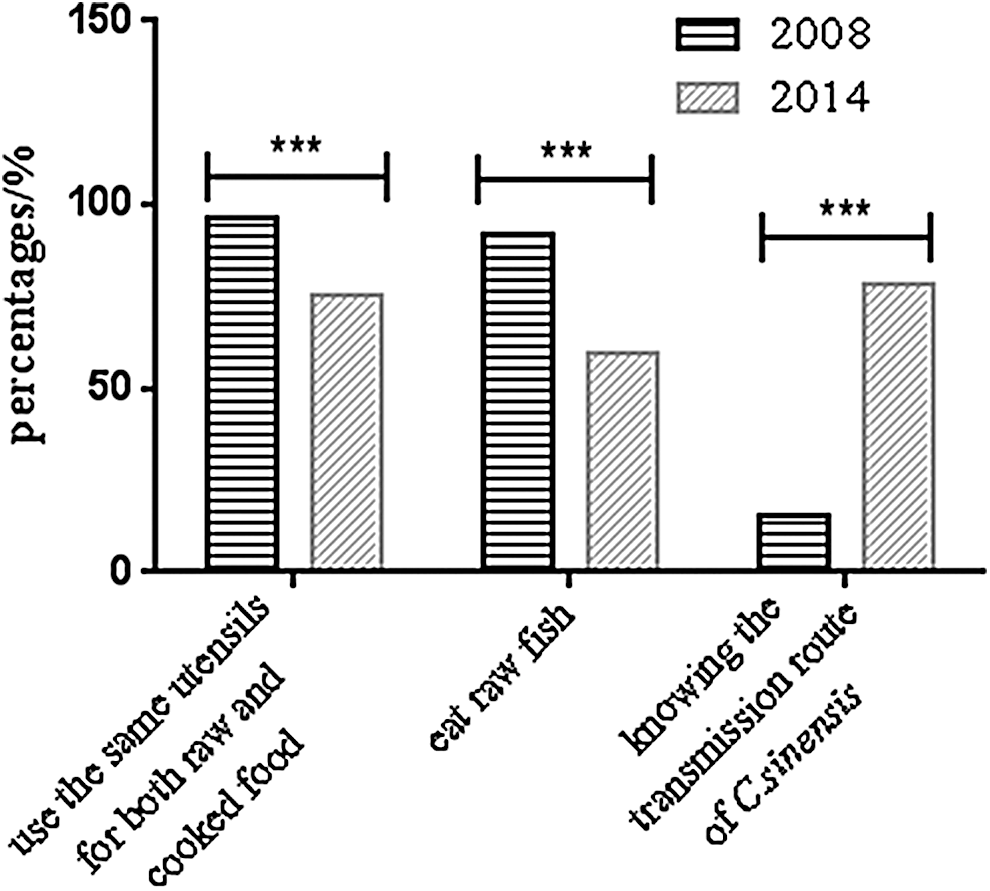
Eating habits and awareness of the route of C. sinensis infection in 2008 and 2014 (***p < 0.001).
Reconstruction of the toilets
The integrated control strategy included the reconstruction of the toilets in Lou village. All the old-styled toilets were replaced by sanitary ones with harmless processing design by 2014 (Appendix Fig. A1). The reconstructed toilet consisted of three interconnected sealed pools. The first pool stores most stools and helps for the precipitation of parasite eggs. Also, the sealed space with low oxygen level contributes to decomposition of stools and producing marsh gas to kill the parasite eggs. The manure after preliminary precipitation would flow into the second pool for further precipitation and decomposition. Then, the manure flowing into the third pool was almost free of parasite eggs and pathogens and could be used for fertilization. The effect of sanitary toilets on killing parasite eggs was evaluated by the detection of parasite eggs in stool samples collected from the reconstructed toilets in Lou village. Stool samples from the first storage pool of six toilets were positive with parasite eggs, while the other four were clear. Five kinds of parasite eggs were detected and identified, including those of roundworms, hookworms, liver flukes, whipworms, and pinworms. Stool samples collected from the third pool of the six toilets were only detected with inviable ascarid eggs and no viable ascarid eggs or other four kinds of parasite eggs. In contrast, before the toilet reconstruction in 2008, 63% of parasite eggs cannot be precipitated effectively and would flow into the fish ponds from the toilet outlets.
Discussion
C. sinensis is one of the most important food-borne trematodes in China and neighboring areas. The strong culture preferences for eating raw and insufficiently cooked infected fish are the greatest risk factor for human infection (Phan et al. 2010). In Northern Vietnam, the habit of eating raw fish increased the risk of C. sinensis infection to 53 times higher (Dang et al. 2008). According to our investigation in Lou village in South China, the habit of eating congee with undercooked freshwater fish was the leading cause for C. sinensis infection (Zhang et al. 2007). The investigation in 2008 showed most of the local residents had eaten raw fish in the recent year and few of them knew the transmission route of C. sinensis. In addition, 16.51% of four kinds of local fish were infected with clonorchis metacercariae, the meat in which there was a high risk for C. sinensis infection and transmission in the local area. According to the epidemiological profile of C. sinensis in Lou village, a comprehensive strategy was developed to try to take C. sinensis under control, including effective treatment for patients, protection of fish ponds from contamination with feces, and implementation of health education.
Freshwater fish, especially cyprinid fish, which act as the second intermediate host for cercariae to penetrate and develop into metacercariae can harbor hundreds to thousands of metacercariae within a single fish and keep the larvae alive in fish muscle for 1 year (Lun et al. 2005, Hong and Fang 2012). The high prevalence of metacercariae in freshwater fish is always consistent with high human infection rate in endemic areas of C. sinensis. In aquaculture systems, the contamination of water environments with trematode eggs from infected hosts is the main risk factor for fish-borne zoonotic parasites (Hedegaard et al. 2012). In Vietnam, local wild-caught fish act as a major fish source of human infection of C. sinensis, and contamination of the reservoir by surface run-off water with human or livestock feces should be responsible for C. sinensis infection in snails and fish (Bui et al. 2016). In some endemic regions in South China, it was custom to build the lavatories at the banks of freshwater fish ponds and use animal and human fecal waste as pond fertilizer (Lun et al. 2005). Similar lavatories were found common in Lou village in our investigation in 2006, which would cause the contamination of water environment with trematode eggs. After the health education about the transmission and harm of C. sinensis, all the residents agreed to reconstruct their lavatories. According to the investigation in 2014, no viable parasite eggs were detected in human stool samples collected from the reconstructed toilets. The sanitary toilets can precipitate and kill the parasite eggs significantly.
Parafossarulus and Bithynia are two main species of the first intermediate snail hosts (Rim 2005). We have found that the snail hosts with highest infection rates in Lou village are P. striatulus and B. fuchsianus. The sanitary toilets can manage the human and domestic animal wastes appropriately and cut off the transmission route of parasite eggs from feces to ponds, which result in a decrease of the infection rates of C. sinensis cercariae in the two snails. By 2014, only 0.67% of the two snails carried clonorchis cercariae. In China, 140 species of fish and three species of shrimp have been recognized as the second intermediate hosts (Lun et al. 2005, Zhou et al. 2008). Our investigation suggested that P. parva accounted for the highest infection rate of C. sinensis metacercariae, which was similar to the surveys in northeast China and the Pearl River Delta (Chen et al. 2010, Zhang et al. 2014). P. parva as a smaller fish species is thought to be more susceptible to C. sinensis and always associated with higher infection intensity (Lun et al. 2005). C. idellus as a bigger domesticated freshwater fish is the most popular edible fish in the Pearl River Delta, including Lou village, although with lower infection rate (Chen et al. 2010). Both of the two fish species have relative high prevalence in Lou village and should be monitored for C. sinensis infection. Under the effective water protection methods, infections to freshwater fish have decreased by 67.72% over 6 years.
However, there was still about 5.33% of fish infected with C. sinensis metacercariae in our research, which may be related to the infections of the reservoir hosts such as cats and dogs. Many animals such as dog, pig, cat, wild cat, marten, badger, mink, and rat can serve as definitive hosts for C. sinensis and play an important role in transmitting parasite eggs (Rim 2005). A survey for C. sinensis infection in reservoir hosts from 13 administrative regions in Guangdong province found that the infection rates of dogs and cats were 20.5% and 41.8%, respectively, and 39.1% of dogs collected from Shenzhen city were positive for C. sinensis (Lin et al. 2011). Some animal hosts, especially cats and dogs in China, wander freely in villages and shed parasite eggs in their feces, and they also get easy access to the raw or undercooked fish in household waste (Lun et al. 2005). The prevalence of C. sinensis in local reservoir hosts has not been involved in our investigation, but should be included in our further research.
Qian et al. thought chemotherapy should be taken to decrease the infection rate and subsequent morbidity, especially for the adults with more improper behavior and higher infection intensity (Qian et al. 2013b). We treated the infected people confirmed in 2006 with praziquantel and 6 months after the treatment, the stool specimens of all patients showed negative detection of C. sinensis eggs. We also emphasized the positive effect of chemotherapy on killing C. sinensis among local residents and encouraged them to seek medical help when they feel at risk for C. sinensis infection. The survey in 2008 suggested a low awareness rate of transmission route and harm of C. sinensis, which should be responsible for the formation of improper eating habits. The Clonorchiasis Prevention Education Campaign was then implemented at the same time of toilet reconstruction. In China, cross-food contamination was also an important risk factor for C. sinensis infection (Hong and Fang 2012). We also found that most of households in Lou village did not separate utensils which prepared cooked and raw foods in 2008. After the health education, there was a significant decrease in the number of residents who ate raw fish and used same utensils for both cooked or raw foods, and a notable increase in the awareness rate among people. Although all infected people were treated with praziquantel in 2006, there were still 23 people detected positive for C. sinensis and 59.87% of the residents ate raw fish in 2014, which suggested that a long term of monitoring and intervention should be implemented. The food culture rooted in the endemic areas is not easy to change. Also, people would not give up seeking delicacy, especially when they have overconfidence in praziquantel treatment and choose to ignore the asymptomatic infection (Oh et al. 2014).
In China, S. japonicum was the most concerned trematode and taken under control with an effective integrated control strategy, including fenced husbandry, water conservancy, sanitation, and safe water, as well as environmental modification (Yang et al. 2016). According to the experience of controlling S. japonicum, the country started to establish the similar integrated control strategy for C. sinensis in endemic areas such as Lou village. However, there were few researches that summarized and evaluated the comprehensive methods. This article took Lou village as a pilot site to introduce the specific methods as well as to evaluate the control effects. After 6 years of intervention, the infection rate and intensity of local residents decreased significantly in 2012 and maintained at a lower level from 2012 to 2014, which was coincident with the statistical decline of the percentage of people eating raw fish and the prevalence of intermediate hosts. Above all, the pilot study presented here shows that control of clonorchiasis is an achievable goal, which requires an integrated strategy adapted to local epidemiological profiles. To achieve further advances in clonorchiasis control, sustainable intervention should be assured.
Footnotes
Acknowledgments
This research was funded by the National Science and Technology Major Project under grant no. 201502021; the authors wish to thank the following people: Dr. Liu Yi who works in Guangming CDC, for contacting Lou village and Dr. Ma Zhicao who works in Baoan CDC, for helping in catching fish and snails.
Author Disclosure Statement
No completing financial interests exist.