




Abstract
The domestic dog is considered the main reservoir of visceral leishmaniasis (VL) in urban areas, but the identification of cats infected by Leishmania suggests the possibility of these animals also acting as reservoirs. The incrimination of a species as reservoir requires the accumulation of epidemiological evidence on the co-occurrence between such species and the infection in question. This is a systematic review of epidemiological studies evaluating the association between exposure to cats and occurrence of VL in humans (HVL) or dogs (CVL). Among the six studies addressing CVL, one showed a higher chance of CVL in the presence of cats, one showed an inverse relationship between the presence of cats and CVL, and four were inconclusive. Among the four studies evaluating HVL, three were inconclusive, and one showed an association between the presence of cats and HVL among patients with renal transplantation. The inconsistency of the results, associated to the methodological weaknesses of the studies analyzed, does not allow a firm conclusion that there is co-occurrence between exposure to cats and VL. Methodologically robust studies should be performed to elucidate the role of cats in VL transmission.
Introduction
V
VL is caused by parasites of the genus Leishmania, mainly Leishmania infantum (syn: L. chagasi) and L. donovani. These parasites are transmitted by phlebotomine sand flies, with Lutzomyia and Phlebotomus being the genera of major epidemiological importance (World Health Organization 2010). There are two forms of VL transmission, the anthroponotic, where humans are the main reservoirs, and the zoonotic, where other mammals are reservoirs (World Health Organization 2010).
Zoonotic VL (ZVL), which prevails in Brazil, in the Mediterranean region and some parts of Asia and the Middle East, has been evidenced as a serious public health problem mainly due to its expansion to urban centers, which has brought new challenges for its control (World Health Organization 2010, Werneck 2014).
The increase in the number of ZVL cases results, among several factors, from environmental, demographic, and behavioral features that, in turn, influence the distribution and interaction between hosts, vectors, and reservoirs (World Health Organization 2010, Belo et al. 2013, Leta et al. 2014). The most commonly used strategies to reduce ZVL transmission are those directed to the control of populations of reservoirs and vectors, but both have not been sufficiently effective to halt disease spread (Quinnell and Courtenay 2009, Romero and Boelaert 2010, Werneck 2014).
The main attribute of a reservoir is to maintain the transmission cycle of an infection indefinitely (Haydon et al. 2002). Therefore, knowledge about reservoirs is a fundamental element for the improvement and implementation of appropriate strategies for disease control, particularly those of zoonotic origin (Haydon et al. 2002).
The domestic dog is considered the main reservoir of ZVL in urban areas, but the parasite has been found in other species of wild and domestic animals (Quinnell and Courtenay 2009, World Health Organization 2010).
A great deal of studies in different parts of the world has demonstrated the infection of domestic cats by Leishmania, suggesting a possible participation of these animals in the ZVL transmission cycle (Vita et al. 2005, Maroli et al. 2007, Solano-Gallego et al. 2007, Sarkari et al. 2009, Ayllón et al. 2011, Millán et al. 2011, Sobrinho et al. 2012, Chatzis et al. 2014, Akhtardanesh et al. 2017, Metzdorf et al. 2017, and Mohebali et al. 2017). This hypothesis is reinforced by results from studies indicating that cats may have the infection even without clinical manifestation (Sarkari et al. 2009, Chatzis et al. 2014), the ZVL vectors feed on the blood of felines (Afonso et al. 2012), and that cats have the ability to infect vectors (Maroli et al. 2007, da Silva et al. 2010, Maia et al. 2010).
Nevertheless, there is no scientific consensus for the definitive incrimination of cats as VL reservoirs. For this to occur, evidence is needed that the putative reservoir is essential for the maintenance of the parasite population, for example, through intervention studies demonstrating that control measures that prevent transmission from this species are effective to interrupt the transmission (Haydon et al. 2002, Quinnell and Courtenay 2009).
In the absence of such information, some criteria have been used to characterize an animal as a VL reservoir, among which the following stand out: abundance and longevity to provide a significant source of food for sand flies; intensity of contact with the vector; high prevalence of infection in the population; long duration of infection in the reservoir; sufficiently nonpathogenic to allow parasites to survive any seasonal periods in which there is no transmission; high parasitic load; bear the same genotypes as the parasites found in humans (Haydon et al. 2002, Quinnell and Courtenay 2009, World Health Organization 2010, Lembo et al. 2013). In this context, the accumulation of epidemiological evidence on the co-occurrence of such species and the infection in question, although not enough, is considered one of the first steps in the identification process of new reservoirs (Haydon et al. 2002).
Dogs play an important role in the transmission of ZVL and, like cats, have a close association with humans, which is characterized by an affective relationship that can exert an important role of psychosocial support (Beck 2013). In this context, the confirmation that the cat acts as a reservoir of VL could lead to a need for a comprehensive modification in the usual control measures of this disease.
This systematic review aims to assess the scientific evidence available on the association between exposure to cats and the occurrence of VL in humans or dogs.
Materials and Methods
This systematic review was elaborated according to the PRISMA recommendations (The Preferred Reporting Items for Systematic Reviews and Meta-Analyses) (Moher et al. 2010).
We searched the published literature up to October 25th 2017 in PubMed/Medline, Scopus, and LILACS (Latin American and Caribbean Health Sciences Literature), without language restriction. The search strategies for each bibliographic database used to capture studies for the systematic review are presented in Figure 1.
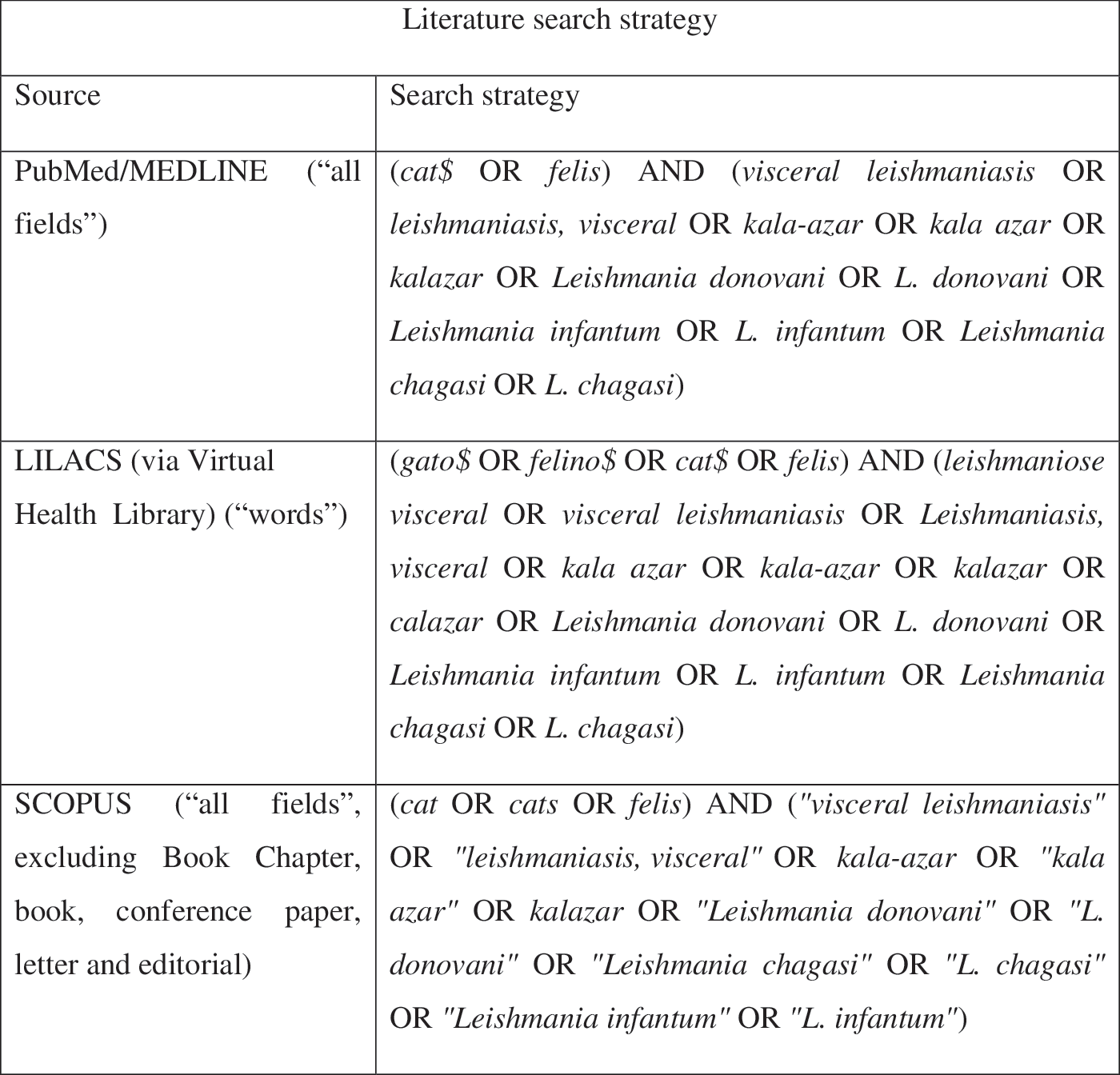
Bibliographic reference databases and the respective search strategies used to capture studies for the systematic review.
All citations extracted from the bibliographic databases were exported to the software EndNote X2, in which duplications were identified and excluded.
To find additional documents for inclusion in the systematic review, we also examined the references of original articles and reviews on the subject identified in the bibliographic search.
The studies were screened for inclusion by two independent researchers (A.P.D. and T.G.) and disagreements were resolved by consensus. In cases where consensus was not possible, the divergence was resolved by a third party evaluator (G.L.W.). First, all the titles and summaries of the documents identified in the search were analyzed and those concerning epidemiological studies evaluating the association between exposure to cats and occurrence of VL in humans (HVL) or dogs (CVL) were selected. Subsequently, the full texts of the documents considered eligible were read and evaluated for inclusion in the study according to the following criteria: (1) Epidemiological studies: Cross-sectional, cohort, case–control, and ecological designs; (2) Outcome: VL in dogs or humans;(3) Exposure: presence or interaction with domestic cats.
Two researchers (A.P.D. and T.G.) independently appreciated the methodological aspects of the selected studies using the STROBE initiative criteria (Vandenbroucke et al. 2007) and the divergences were resolved by consensus.
Results
After excluding 164 duplications, 2227 studies were identified for reading titles and abstracts. Five additional documents were identified by screening references of review articles. Among all these documents, only 25 studies were selected for reading the full text, resulting in 10 meeting the established eligibility criteria (Fig. 2).

Manuscript selection for systematic review of the association between exposure to cats and the occurrence of VL. VL, visceral leishmaniasis.
Regarding study design, our review included five cross-sectional (Julião et al. 2007, Curi et al. 2014, Fernandes et al. 2016, Maia et al. 2016, and Santos et al. 2017), one cohort (Barboza et al. 2006), and four case–control studies (Borges 2006, Cabral 2007, da Silva et al. 2012, and Alves da Silva et al. 2013). Among them eight were articles published in scientific journals (Barboza et al. 2006, Julião et al. 2007, da Silva et al. 2012, Alves da Silva et al. 2013, Curi et al. 2014, Fernandes et al. 2016, Maia et al. 2016, and Santos et al. 2017) and two were Master's dissertations (Borges 2006 and Cabral 2007). All studies selected were carried out in Brazil, four evaluating VL in humans (Borges 2006, Cabral 2007, Alves da Silva et al. 2013, and Maia et al. 2016) and six in dogs (Barboza et al. 2006, Julião et al. 2007, da Silva et al. 2012, Curi et al. 2014, Fernandes et al. 2016, and Santos et al. 2017).
Concerning laboratory diagnosis among studies on dogs, one used the indirect immunofluorescence antibody test (IFAT) (da Silva et al. 2012), two used the enzyme-linked immunosorbent assay (ELISA) (Barboza et al. 2006 and Julião et al. 2007), one used IFAT for screening and ELISA for confirmation (Fernandes et al. 2016), one study used ELISA, IFAT, and the Dual Path Platform-CVL immunochromatographic rapid test (Curi et al. 2014), and one used direct parasitic search in lymph node samples (Santos et al. 2017). Two studies in humans used secondary data to identify clinical cases of VL (Borges 2006, Cabral 2007), but one of them used also data from people searching for health services and had an ELISA test (Cabral 2007). The other human studies used a combination of techniques, one using ELISA and the leishmanin skin test (Maia et al. 2016) and the other using PCR, serological (IFAT and ELISA) and parasitological (myelogram) tests (Alves da Silva et al. 2013).
Studies defined the exposure variable (“exposure to cats”) as the presence or coexistence with cats in the house (Barboza et al. 2006, Cabral 2007, Julião et al. 2007, da Silva et al. 2012, Alves da Silva et al. 2013, Curi et al. 2014, Maia et al. 2016, and Santos et al. 2017), in the neighborhood (Borges 2006 and Cabral 2007) or simply “contact with cats” (Fernandes et al. 2016). Some characteristics of the studies included are presented in Table 1.
CVL, visceral leishmaniasis in dogs; ELISA, enzyme-linked immunosorbent assay; HVL, VL in humans; IFAT, immunofluorescence antibody test.
Concerning the six studies among dogs, one study found a 58% increased odds of CVL in the presence of cats (da Silva et al. 2012), one found a 2.8-fold increased prevalence of infection in dogs only in an univariate analysis (Fernandes et al. 2016), one found that the exposure to cats was associated with a 37% decreased prevalence of CVL (Curi et al. 2014), and three found no statistically significant association between exposure to cats and CVL (Barboza et al. 2007, Julião et al. 2007, and Santos et al. 2017).
Among the four studies evaluating human VL, one study found a six-fold increased odds of VL among renal transplant patients exposed to cats (Alves da Silva et al. 2013) and three found no statistically significant association between exposure to cats and HVL (Borges et al. 2006, Cabral 2007, and Maia et al. 2016).
The evaluation of the methodological quality of the studies using the STROBE checklist (Vandenbroucke et al. 2007) indicated that most of the selected studies met the recommendations concerning the description of the background, rationale, and objectives of the study (Introduction), and also adequately presented the study design, setting, participants, definition and measurement of variables, and data sources.
The main weaknesses in the methods were related to the inadequate dealing with potential biases and the lack of appropriate statistical methods for dealing with losses to follow up and missing data. Regarding the results section, most studies did not give characteristics of study participants and information on exposures and potential confounders or indicate the number of participants with missing data for each variable of interest. One study provided no measure of association and only p-values and another study provided no numerical results, only described in the text the absence of a statistically significant result. Most studies did not provide the methods used for sample selection and sample size calculations. Information on funding was also absent in most of the studies.
Discussion
This systematic review sought to identify the available evidence on the association between exposure to cats and the occurrence of VL in humans and dogs. Among the 10 studies identified, 6 evaluated the outcome among dogs and 4 among people. Although not sufficient for establishing a definite role of cats as reservoirs of Leishmania, investigating both outcomes are relevant to provide epidemiological evidence of a link between cats and the infection in question, which is considered one of the first steps in the process of incriminating a new reservoir (Haydon et al. 2002).
However, since dogs have been already incriminated as reservoirs, studies designed to establish the association between infection in cats and infection in dogs and humans in the absence of or controlling for the presence of other infected dogs would be necessary for isolating the potential role of cats as reservoirs. Unfortunately, among the selected studies only one study implemented partially such strategy in the statistical analysis, estimating the effect of exposure to cats controlling for history of CVL cases in the house (da Silva et al. 2012).
The results of this systematic review do not provide any definite evidence for the role of cats as reservoirs for Leishmania. Among the 10 studies evaluated, only 3 found a statistically significant increased odds of Leishmania infection in the presence of cats (one in humans and two in dogs), 6 found no statistically significant association (two in humans and two in dogs) and 1 found a decrease odds of infection in dogs in the presence of cats. It should be noted that one of the studies among dogs found a significant increased prevalence of infection in dogs exposed to cats only in the univariate analysis (Fernandes et al. 2016).
There are many possible explanations for such discrepancies in the results of the studies. First, none of the studies actually evaluated infection in cats, but only their presence in the environment. Therefore, in this context “exposure to cats” does not indicate “exposure to infected cats.” In infectious disease epidemiology, however, exposure to infection is considered a necessary condition for establishing a potential transmission link between a source of infection and a susceptible host (Halloran and Struchiner 1995). Second, most of the studies assessed prevalence of infection and not incidence, an essential condition for suggesting causal relationships. Even the studies that assessed the outcome as incidence of clinical VL in humans did not adequately consider the long latency period of VL for trying to establish a temporal relationship between cat ownership and the appearance of the disease. Finally, most studies showed important methodological fragilities. Studies showing nonsignificant results had small sample sizes, which might have impaired their power to detect an association as statistically significant. All studies, in different degrees, did not use appropriate methods for dealing with confounding factors, losses to follow-up and missing data, casting doubt on the validity of the measures of association estimated.
The role of cats as a putative reservoir of Leishmania is an issue of public health importance due to their pervasive presence in the domestic environment, closely related to humans and dogs, and their behavioral characteristics, moving between their residence and peridomestic areas to hunt and potentially establishing a connection between sylvatic and urban cycles of transmission (Soares et al. 2016). However, establishing with certainty their status as reservoirs is difficult.
The demonstration that domestic cats can be infected by Leishmania (Vita et al. 2005, Maroli et al. 2007, Solano-Gallego et al. 2007, Sarkari et al. 2009, Ayllón et al. 2011, Millán et al. 2011, Sobrinho et al. 2012, Chatzis et al. 2014, Akhtardanesh et al. 2017, Metzdorf et al. 2017, Mohebali et al. 2017), sand flies feed on the blood of felines (Afonso et al. 2012), and that cats have the ability to infect vectors (Maroli et al. 2007, da Silva et al. 2010, Maia et al. 2010) are important indicators that cats might have a role as reservoirs in ZVL. However, the lack of solid evidence from epidemiological studies connecting infection in cats and infection in dogs and humans, as shown in this review, casts doubts on the ability of cats to act as reservoirs for maintaining the transmission cycle of the infection (Haydon et al. 2002).
An alternative hypothesis to be further explored is that cats may participate in the transmission cycle in urban areas only sporadically, not being able to sustain transmission in the absence of dogs. The putative lower susceptibility of cats to arthropod-borne infections due to some differential immune function could give support for such hypothesis (Day 2016).
The control of ZVL is a challenge, particularly in the Americas, and calls for new insights on the mechanisms underlying the introduction and maintenance of ZVL in previously unaffected areas. Investigating the potential role of cats in this context is important, but need to be approached using robust epidemiological methods. Such research needs to use longitudinal study designs with valid diagnostic methods for infection in cats, dogs, and humans; large sample sizes and adequate statistical techniques for dealing with confounding factors and biases due to loss to follow-up and missing data.
In particular, one needs to consider the role of infected dogs as a potential confounding factor for the association between infection in cats and infection in humans and dogs. If this link could be confirmed by such studies, then the next step would be to develop some type of community intervention trial to check whether controlling infection in the cat population, by means, for instance, of insecticide-impregnated collars or topical insecticides, has any effect of the prevalence levels of infection in the dog and human populations.
Footnotes
Acknowledgments
GLW was partially funded by Conselho Nacional de Desenvolvimento Científico e Tecnológico—CNPq (#311507/2014-0) and Fundação Carlos Chagas Filho de Amparo à Pesquisa do Estado do Rio de Janeiro–FAPERJ (#E-26/202.948/2015–CNE)
Author Disclosure Statement
No competing financial interests exist.