




Abstract
In Brazil, visceral leishmaniasis is caused by the protozoan Leishmania infantum, primarily transmitted by Lutzomyia longipalpis and with the dog as its main urban reservoir. This study aims to evaluate the effectiveness of 4% deltamethrin-impregnated dog collars (DMC) DIC, Scalibor® 65 cm model and MSD manufacturer, on the prevalence and incidence of canine visceral leishmaniasis (CVL) and on the rate of infection of sandflies by L. infantum. The research was conducted in two areas of the municipality Mossoró, State of Rio Grande do Norte in Northeast of Brazil. Two semiannual serosurveys, followed by culling seropositive dogs, and searches for phlebotominae were performed in the control area (CA), whereas in the collar intervention area (IA), aside from those procedures, DMC were fitted to dogs every 6 months. CVL was diagnosed by the Dual Path Platform rapid test (TR-DPP®) and the Immunoenzymatic assay (EIE). The sandflies were collected monthly, identified, and the females were submitted to Quantitative Real-Time Polymerase Chain Reaction for detection of L. infantum DNA. The use of collars was associated with a 53–59% reduction in the incidence of CVL. The most abundant phlebotomine species were L. longipalpis (81.8%). Positive pools of L. longipalpis were obtained in the IA only in the first survey, whereas the presence of the DNA of the parasite in the vector was observed in the CA in both surveys. We conclude that the continuous use of these collars may have the potential to reduce both the incidence of CVL and the rate of infected phlebotomine sandflies.
Introduction
V
The control of VL in Brazil has focused mostly on the diagnosis and culling of seropositive dogs (Costa et al. 2014) rather than on vector control. For years, this approach has been the main preventive strategy, although several epidemiological and mathematical modeling studies have shown its low effectiveness in reducing both canine and human VL cases (Courtenay et al. 2002, Coura-Vital et al. 2014b, Werneck et al. 2014).
The use of 4% deltamethrin-impregnated collars (DMC), whose protection is based on the topical insecticidal effect of deltamethrin on sandflies, has been considered as an individual preventive measure for canine visceral leishmaniasis (CVL) (Killick-Kendrick et al. 1997, David et al. 2001, Ferroglio et al. 2008). These dog collars present an insecticidal effect that lasts 6–8 months (David et al. 2001).
On a large scale, DMC could act as a control measure for humans, owing to their protective effect on the canine reservoir population, preventing the infection by the vector (David et al. 2001, Mazloumi-Gavgani et al. 2002). Because DMCs prevent dogs from getting infected or to be infectious to sandfly vectors, DMCs could be an effective control strategy for both canine and human VL, particularly in sites of intense transmission (Maroli et al. 2001). This study aimed to assess the effectiveness of DMC on the prevalence and incidence of CVL and on the rate of infection of sandflies by L. infantum in an endemic area in Northeastern Brazil.
Materials and Methods
Experimental design of the study areas
The effectiveness of DMC for the control of canine VL was assessed based on the comparison between two areas of intense VL transmission in the municipality of Mossoró, State of Rio Grande do Norte, Northeast Brazil. The endemic areas selected had similar CVL prevalence and comparable socioeconomic and environmental characteristics, according to information obtained from the city Health Department. The intervention area (IA) had around 23,463 inhabitants and 3343 dogs and the control area (CA) had 17,572 inhabitants and 2103 dogs, 4,7 km distant from each other.
The study area, where dog collars were used, was defined as the IA and the study area, where collars were not used, was named CA. The determination of the areas occurred randomly using the SPSS 13.0 software.
In both areas, two semiannual canine serological surveys were conducted to assess the prevalence of CVL, starting in May 2014. Based on these surveys, it was also possible to evaluate the incidence of infection in seronegative animals in the first survey, which were present in the second survey, that is, animals that were individually monitored in a 6-month interval.
Concerning sample size for assessing the effect of DMC on the incidence of canine VL, we estimated that a minimum of 466 dogs in each arm of the study (intervention and CA) was needed, considering a significance level of 5%, a power of 80%, and an incidence of infection of 10% and 5% in the control and IAs, respectively (Fleiss 1981).
At the time of the first survey, concurrent with blood collection, a form was filled out for obtaining information on general characteristics of dogs, such as sex, age, breed, and time living in the household. In the second survey, a second form was completed, specifying whether the animal was using the collar at the time of the visit, in case it belonged to the IA.
Canine serosurveillance and intervention using DMC
The serological diagnosis of CVL was performed according to the recommendations of the Brazilian Ministry of Health using the Dual Path Platform (TR-DPP®) and the Immunoenzymatic assay (Arruda et al. 2016) (EIE). We used soluble and purified antigens of L. infantum obtained from in vitro culture. For the EIE, a test was considered positive based on the optical density (OD) for controls, >0.500 OD for positive controls and between 0.050 and 0.120 OD for negative controls (Brasil 2011). Dogs were considered positive when seropositive in both tests (TR-DPP® and EIE).
Two surveys of canine VL were conducted with a 6-month interval between May 2014 and April 2015. In the first survey, we sought to analyze the baseline prevalence of CVL in animals of both areas. The second survey was conducted after 6 months aiming to evaluate (i) the incidence of disease in all dogs, which tested negative in the first survey and (ii) the seroprevalence, considering that new animals were included in the study areas. Each survey lasted 3–5 months.
In the IA, the insecticide-impregnated collars, Scalibor® 65cmmodel, purchased with project funds, were attached to the dogs according to the manufacturer's (MSD) package insert immediately after blood collection for the diagnosis of infection with L. infantum. Pet owners were instructed not to remove the collars before 6 months—the protection expiration time. In case of occurrence of allergic reaction or accidental ingestion, the owners were instructed to remove the collars and contact a member of the research team. Collar loss was not monitored between surveys, so there were no replacements of collars between surveys.
Collection and identification of phlebotomine sandflies
Searches for phlebotomine sandflies were conducted in both areas, in the same period as the surveys, for identification of species, abundance of the vector population, and diagnosis of infection with L. infantum in these insects.
Three households were selected in each study area, totaling six households. The selection criteria were related to environmental conditions favorable to the emergence of the vector, such as recent history of capture of L. longipalpis, proximity to forests and garbage in the open air, as well as animal husbandry, and accumulation of debris and organic matter in the peridomicile (Brasil 2006).
For the entomological survey, CDC miniature light traps were installed in the homes of families. The captures occurred monthly along the study period for three consecutive nights; two traps per house, one indoors and one in the peridomestic area, both assembled at 6 p.m. and removed at 6 a.m. We assembled the indoor traps in dark rooms nearby bedrooms. In the peridomestic area, the traps were assembled preferentially in animal shelters or nearby places with accumulation of organic matter.
The phlebotomines were clarified and mounted on slides and identified in accordance with Young and Duncan's (1994) taxonomic key. After identification, sandflies were stored in Eppendorf tubes containing isopropyl alcohol, separated by species and month of capture in pools up to 10 insects. The females were used for the diagnosis of natural infection by L. infantum using Quantitative Real-Time Polymerase Chain Reaction (qPCR), whereas the males were used as negative control of reactions.
Research of natural infection of phlebotominae by L. infantum for qPCR
To perform the qPCR, DNA was initially extracted from the insects in pools of 10 specimens using the Illustra™ Tissue and Cells Genomic Prep Mini Spin Kit (GE Healthcare®, Illinois, EUA) following the manufacturer's recommendations.
Quantitation was conducted using the Qubit® 2.0 Fluorometer (Invitrogen®, by Thermo Fischer Scientific®, Massachusetts, EUA) platform and the Qubit dsDNA HS Assay Kit (Invitrogen, by Thermo Fischer Scientific), the curves were accomplished using the kit standards with working solution of 199:1 μL for the sample.
DNA was subjected to qPCR using the TaqMan® system for amplification of samples on the StepOne™ (Applied Biosystems®, (Invitrogen, by Thermo Fischer Scientific) platform. Each sample was performed in duplicate. The LEISH-1 (5′-AACTTTTCTG-GTCCTCCGGGTAG-3′) and LEISH-2 (5′-ACCCCCAGTT TCCCGCC-3′) primers and the TaqMan MGB (FAM-5′AAAAATGGGTGCAGAAAT-3′- NFQ -MGB) (Applied Biosystems, by Thermo Fischer Scientific) probe were used as previously described in the protocol by Francino et al. (2006).
Positive controls extracted from L. chagasi (syn L. infantum) culture in the stationary phase (MHOM/BR/1974/PP75) and negative controls were used in each amplification. For the inhibition test, the entire qPCR technique was repeated, with the addition of 5 μL of 106 DNA of L. infantum to each sample with a negative result.
Ethical aspects
The procedures involving human beings, regarding the research on phlebotominae, and those involving dogs, regarding the serosurveys and the fitting of collars, were approved by the Ethics Committee for Research of the State University of Rio Grande do Norte according to report no.: 37460814.6.0000.5294, and by the Ethics Committee on Animal Uses of Oswaldo Cruz Foundation (report no. LW-70/20).
When a dog was confirmed as seropositive for canine VL, the team of the Zoonosis Control Center was oriented to remove and cull the infected dog in accordance with the protocol recommended by the Brazilian Ministry of Health. The average time between the diagnostic and the culling was 1 month.
Data analysis
Initially, we compared the characteristics of the dogs (sex, age, breed, type of fur, and time living in the household) and the prevalence of infection in the initial and final surveys in the IA and CA. In this context, we used the mean and proportions of the analyzed characteristics and the tests for differences of mean (t test) and proportions (chi-square), where appropriate.
Subsequently, we estimated the incidences of infection in the IA and CA using the chi-square test to evaluate the difference in incidence rates between the areas. We used logistic regression models to assess the association between the use of collars and incidence of infection, with Odds Ratio as the measure of association with respective 95% confidence interval. Such association was evaluated without considering other variables (crude analysis) and adjusting for sex, age, breed, and time living in the household (adjusted analysis).
Results
In the first serological survey, 1209 dogs from the IA and 1050 dogs from the CA were evaluated for CVL (Fig. 1). Table 1 shows that characteristics of animals, such as age, type of fur, and sex differ between the areas (p < 0.05).
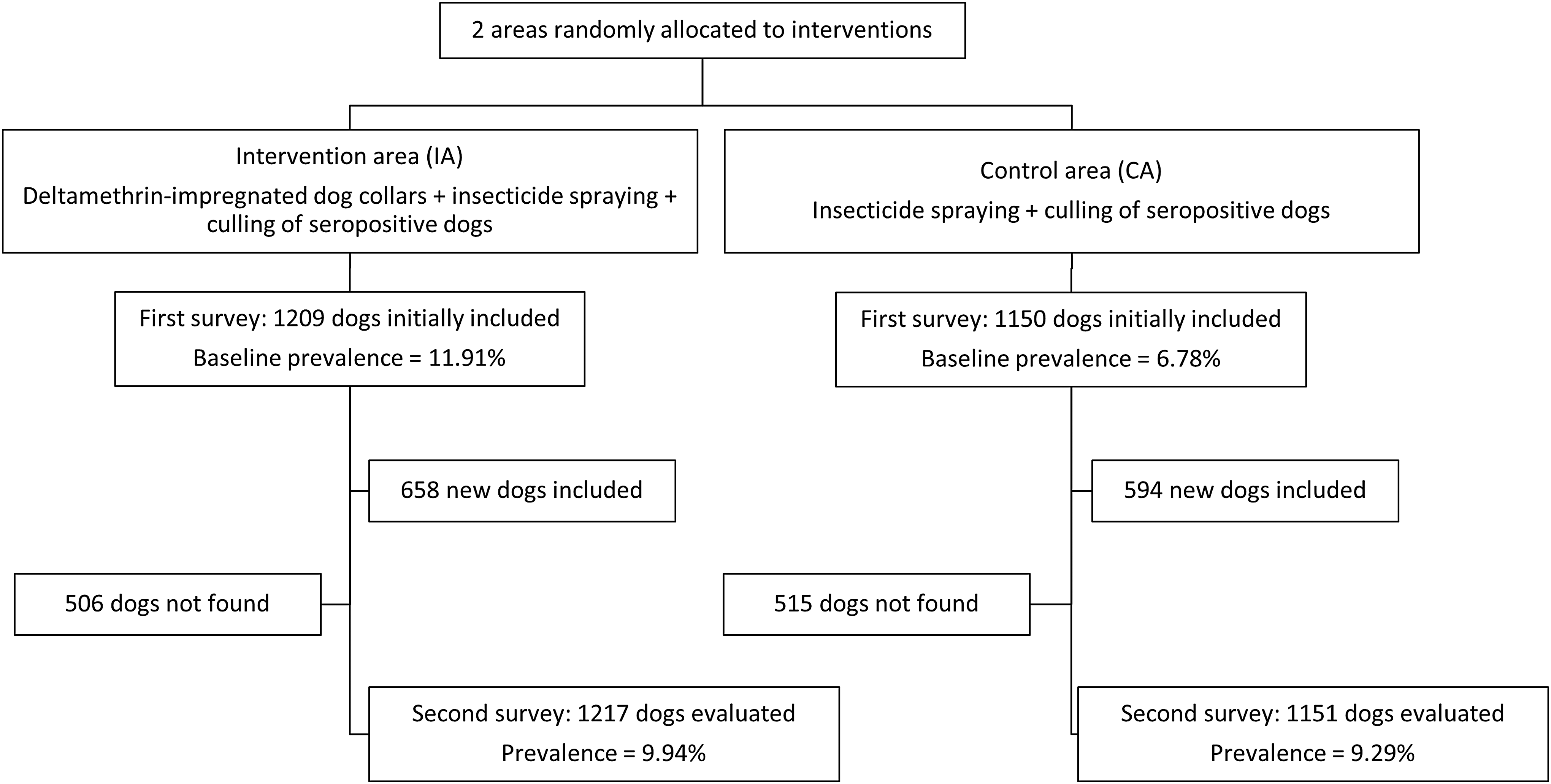
Number of dogs included in each survey, number of dogs lost to follow-up, new dogs entering the study, and prevalence of infection in the first and second surveys in the intervention and control areas.
The number of dogs can vary depending on the characteristics analyzed owing to missing values in the variables.
A total of 1217 dogs from the IA and 1151 dogs from the CA were analyzed in the second survey (Fig. 1); in both areas the total sample included dogs that had been analyzed in the first survey and also new dogs that were identified only in the second survey (Table 2). The difference in prevalence for CVL between the first and second surveys showed a significant decrease in the prevalence rate only in the IA (p < 0.05).
Dogs with valid results for DPP and enzyme-linked immunosorbent assay.
The agreement between serological tests was assessed using the Kappa index and evaluated as fair (κ = 0.56) (Landis and Koch 1997). We evaluated 4743 serum samples, with 86% overall agreement (502 positives and 3601 negatives) with 640 disagreements.
With respect to the animals that were present in the two surveys, that is, those which were individually monitored, 518 dogs were from the IA and from the CA (Table 2). In this population, the prevalence of CVL significantly increased in the second survey only in the CA (p < 0.05). Still regarding individually monitored dogs, a higher CVL incidence rate was observed in the CA. A decrease of 53% (p < 0.05) in the CVL incidence rate was observed in the IA as compared with that of the CA; this reduction reached 59% (p < 0.05) when the characteristics of dogs, such as sex, age, breed, and time living in the household, were controlled (Table 3).
Dogs without infection in the first survey.
Adjusted for the following variables: gender (male/female), age (continuous), breed (mixed breed/other), type of fur (long/medium/short), born in the neighborhood (yes/no), time in household (less than 1 year/1–2 years/longer than 2 years).
Regarding the entomological survey, 1709 sandflies were captured during the course of the two surveys, 58.6% (1002/1709) in the IA and 41.4% (707/1709) in the CA; the largest number of insects was obtained in the peridomiciliary environment in both areas.
A larger number of males, 72.4% (1237/1709), were captured compared with females. Among females, L. longipalpis was the most abundant species and was present in all collection months, corresponding to 81.8% (386/472) of the identified females. It is worth highlighting the first record of Lutzomyia migonei in the municipality, which occurred in the IA during the second survey. Other species captured in the entomological survey were Lutzomyia evandroi and Lutzomyia cortelezzii (Table 4).
It was not possible to identify all the males and flies due to loss of limbs and other anatomical structures; therefore, these data are not presented quantitatively. Males of the following species were identified: L. longipalpis, L. evandroi, and L. cortelezzii; with a predominance of the first over the others, similarly to what was observed for females.
For the diagnosis of L. infantum in phlebotomine sandflies using qPCR, 472 captured females were divided into pools ranging from 1 to 10 specimens. These insects were sorted by species, month, collection area, and site of capture, totaling 96 pools, and there may be positive pools for more than one species of phlebotomine sandflies. Positive pools were obtained for L. longipalpis in both study areas: in the IA a positive result was observed only in the first survey, whereas in the CA, infected insects were present in the first and second surveys. Other results for the infection of phlebotomine sandflies are shown in Table 4.
Discussion
Different results have been reported by several authors in Brazil with respect to characteristics of dogs, such as age, sex, time in the household, born in the neighborhood, type of fur, and breed and their possible influence on the occurrence of CVL (Coura-Vital et al. 2014a, Werneck et al. 2014, Oliveira et al. 2015, Brito et al. 2016). The initial prevalence rates of CVL obtained in both areas, despite differing from each other, are similar to those obtained by other authors in researches conducted in areas endemic to VL (Coura-Vital et al. 2014b, Barbosa et al. 2015). The verification of the prevalence of canine VL infection and the decision to perform the study in areas endemic to VL, is relevant, considering that previous studies that examined the effect of DMC indicate their use, preferentially, in areas with high prevalence of the disease (Reithinger et al. 2004, Ferroglioet al. 2008).
Comparing the difference between prevalence rates separately in each of the IAs for all the animals included in the study, the decreased prevalence rates of CVL with the use of DMC (p < 0.05) have also been reported in other studies conducted in the country (Camargo-Neves et al. 2004, Reithinger et al. 2004).
Comparable results found in Brazilian cities of distinct regions, with different environmental characteristics, and with a time gap of at least 10 years, underscore the importance of this study and contribute to validate the current results. The study by Reithinger et al. (2004), conducted in Minas Gerais state, Brazil, also found that the incidence of CVL was reduced by 50% in the area with collars. Camargo-Neves et al., (2004) in a study carried out in the city of Andradina, state of São Paulo, detected a reduction in both the prevalence of canine infection and the incidence of human cases in areas using collars impregnated with deltamethrin, when associated with dog elimination. A study carried out in the municipality of Aquiraz, Ceará, Northeast Brazil, identified that the use of collars impregnated with 4% deltamethrin proved to be more effective than canine elimination as a measure to prevent the transmission of the parasite between dogs, finding an incidence of CVL two times greater in the area where euthanasia was implemented (Oliveira-Lima et al. 2002). A mathematical modeling study developed in the Brazilian setting, estimated that insecticide-impregnated collars is highly effective and with coverage above 90% might eliminate the infection among dogs and humans (Sevá et al. 2016).
When the same dogs were analyzed in both serosurveys (individual monitoring) in the same area of intervention, the increase in the prevalence of CVL in the IA was lower than that observed in the CA. Consistent with this finding, there was a reduction of more than 50% in the incidence of CVL in the IA compared with that of the CA.
Other field trials using the same type of collars, conducted in Italy and Iran, also showed good results for reduction in the incidence rate of CVL, ranging from 46% to 86% (Mazloumi-Gavgani et al. 2002, Ferroglio et al. 2008). If we consider the methodological differences between these studies, as well as the differences in epidemiology with those of Brazil, the use of DMC has been effective and it is promising to prevent the occurrence of new cases of VL regardless of the vector species involved.
Also, a larger number of sandflies were collected in the peridomicile, as in other studies (Michalsky et al. 2009, Jeraldo et al. 2012). The peridomestic environment often presents characteristics that may favor the establishment of natural breeding sites for the vector (Brasil 2006), such as the presence of organic matter and shelters, besides the presence of animals that end up attracting them to these sites (Barata et al. 2005, Morais et al. 2013), allowing the transmission of VL to occur mainly in these environments.
With respect to the species captured, L. longipalpis remained as the main, most abundant species, similar to the data reported in previous studies in the same area (Ximenes et al. 2007, Amora et al., 2010a, 2010b, Amorim et al. 2015).
Still, with regard to the species captured, the present study reports the first capture of L. migonei in the municipality, both in the intra- and peridomiciles, indicating a possible urbanization process of this species, (Silva et al. 2014). Similarly, L. cortelezzii, which was also identified in this study, was first reported in the municipality recently (Amorim et al. 2015), not having been captured in previous studies in the same area (Amora et al. 2010a, 2010b).
L. infantum DNA was also detected in L. evandroi for the first time. This indicates the importance of further research on the possible vector competence of this species for VL, considering that almost 20 years ago, Sherlock (1996) had already suggested the possible role of this insect in the transmission of VL in Bahia state, Brazil. The risk factor of this insect is its anthropophilic (Rebêlo et al. 2010) and opportunistic (Pereira-Filho et al. 2015) characters, in addition to presenting behavior, life cycle (Ximenes et al. 2001), and geographic distribution similar to those of L. longipalpis (Ximenes et al. 2007, Costa et al. 2014, Pereira-Filho et al. 2015).
L. infantum DNA was also detected in L. cortelezzii, which has already been reported in other studies, and its possible role has been conjectured as that of an alternative vector for VL (Saraiva et al. 2009, Lara-Silva et al. 2015). Nevertheless, it is known that intimate physiological changes in the insect are required for the establishment of a parasite–vector relationship, to ensure the survival of both and the subsequent transmission of the parasite (Agrela and Feliciangeli 2015). Therefore, before attesting the possibility of the performance of these species as alternative vectors, vectorial capacity studies are needed to verify whether, in fact, they would be acting in disease transmission.
As expected, the largest number of positive pools for L. infantum originated from L. longipalpis, following the standard of other studies conducted in the country (Missawa et al. 2010, Lara-Silva et al. 2015). The fact that positive pools for L. infantum were obtained in the IA only during the period of the first survey, whereas results were obtained in both surveys in the CA, suggests that deltamethrin-impregnated dog collars (DMC) may reduce the infection rate of sandflies through a repellent effect. Indeed, as demonstrated in controlled trials with sandflies present in the same environment with collared dogs (Killick-Kendrick et al. 1997, David et al. 2001, Ferroglio et al. 2008), the use of these collars over time can have the potential to reduce the rate of infected sandflies within the vector population. However, the results of our study should be interpreted with caution due to the small sample size and the study design comparing just two areas.
Conclusions
The results of this study suggest that field intervention using 4% deltamethrin-impregnated dog collars (DMC) might reduce the prevalence and incidence of CVL by nearly a half. Therefore, the use of DMC, associated with the other currently proposed measures, might be considered as a control measure for CVL in Brazil, although cost-effectiveness studies should be performed before its incorporation as a large-scale intervention.
Footnotes
Acknowledgments
The authors gratefully acknowledge the Department of Health Surveillance and Zoonoses Control Center Mossoró/RN, in the person of Allany Medeiros Fernandes, Edinaidy Moura Rocha, and Endemic Disease Agents for their efforts, commitment, and support. The authors acknowledge the Brazilian Ministry of Health for funding part of the research project by providing the 4% deltamethrin-impregnated dog collars for the study. They acknowledge the Federal University of Semi-Árido for all logistical support and efforts. They gratefully acknowledge the Clinical Research Laboratory in Domestic Animals Dermatozoonosis, Oswaldo Cruz Fundation, the entire collaborative work. The authors also acknowledge CAPES for the benefit in this research. F.B.F. holds a grant from CNPq for productivity in research. G.L.W. was partially supported by CNPq (#311507/2014-0).
Author Disclosure Statement
All the authors agree with all information in the present article and disclose the absence any actual or potential conflict of interest, including any financial, personal, or other relationships with other people or organizations within 3 years of beginning the submitted work that could inappropriately influence, or be perceived to influence, in the present work.