




Abstract
Genetic strategies for large scale pest or vector control using modified insects are not yet operational in Africa, and currently rely on import of the modified strains to begin preliminary, contained studies. Early involvement of research teams from participating countries is crucial to evaluate candidate field interventions. Following the recommended phased approach for novel strategies, evaluation should begin with studies in containment facilities. Experiences to prepare facilities and build international teams for research on transgenic mosquitoes revealed some important organizing themes underlying the concept of “facilities readiness,” or the point at which studies in containment may proceed, in sub-Saharan African settings. First, “compliance” for research with novel or non-native living organisms was defined as the fulfillment of all legislative and regulatory requirements. This is not limited to regulations regarding use of transgenic organisms. Second, the concept of “colony utility” was related to the characteristics of laboratory colonies being produced so that results of studies may be validated across time, sites, and strains or technologies; so that the appropriate candidate strains are moved forward toward field studies. Third, the importance of achieving “defensible science” was recognized, including that study conclusions can be traced back to evidence, covering the concerns of various stakeholders over the long term. This, combined with good stewardship of resources and appropriate funding, covers a diverse set of criteria for declaring when “facilities readiness” has been attained. It is proposed that, despite the additional demands on time and resources, only with the balance of and rigorous achievement of each of these organizing themes can collaborative research into novel strategies in vector or pest control reliably progress past initial containment studies.
Introduction
L
Several scientific expert groups have recommended a stepwise approach to genetic strategies beginning with studies in containment facilities, before field cages or confined field studies are employed to answer further research questions that may support open field release (NAPPO 2007, Benedict et al. 2008, AHTEG 2010, James et al. 2010, EFSA 2011, WHO/TDR, and FNIH 2014, National Academies of Sciences, Engineering, and Medicine 2016).
A component of the work leading up to the Target Malaria project § was to develop the infrastructure and capacity for containment studies in African settings. Containment studies of modified insects take place within authorized facilities designed to restrict exposure of people and the environment to the study organism. Unlike biological containment for materials known to be infectious (OECD 2007, CDC 2009, Homer et al. 2013), containment for initial studies of transgenic organisms is due to lack of experience or knowledge at the early phases of research or technology development. In the case of novel mosquito strains, a phased approach also allows progressively more realistic conditions in which hypothesis-driven studies on safety, quality, and efficacy would be difficult to complete in field conditions (Ferguson et al. 2008), in part due to higher recapture rates than in open field studies, and thus more accessible data (Madakacherry et al. 2014).
Early involvement of research teams in countries with the targeted insect population is a critical part of this phased approach to evaluation of potential field interventions. This is especially true for interventions in public health that require some form of community consent, in this case targeting malaria vector species (Chu et al. 2014, Kolopack et al. 2015). We describe broad principles that supported our research consortium's preparation for containment studies of transgenic mosquitoes in four African settings.
Preparing for Containment Studies
Within this context, the collaboration described in this study—a discovery laboratory team moving toward an international research consortium—began working toward what we refer to as “facilities readiness” to prepare for containment studies with transgenic mosquitoes in Burkina Faso, Mali, Uganda, and Kenya. An important aspect of our preparation was to discuss and agree on some fundamental concepts. As with any good project management, early discussions about containment studies included agreements on data collection, analysis, and ownership; presentation and publication of results; and harmonized use of key terms. Early discussions with regulatory authorities also ensured that plans would be made within the national regulatory frameworks. (The process of establishing two-way dialog with stakeholders to achieve codevelopment of the technology is described in forthcoming publications.)
Early on we concluded that neither “Good Laboratory Practice” at the level of certification, nor a single international standard, such as ISO/IEC 17025 (ISO 2005), fits with the studies planned. There is no “one standard” that covers all aspects of the objectives of preparing containment facilities to study modified insects. The Arthropod Containment Guidelines developed over time by the American Committee of Medical Entomology (ACME/ASTMH 2003), however, proved invaluable guidance for preparations. These guidelines describe that Arthropod Containment Levels (ACLs) related more appropriately to containment of arthropods (including mosquitoes) than is found in descriptions of Biosafety Levels based on microbiological and pathogenic hazards (Scott 2005, Tabachnick 2006, CDC 2009). The guidelines recommend ACL-2 for uninfected transgenic mosquitoes. ACL-2 indicates several design features and stringent procedures to physically isolate the study organism from the open environment and guard against release of any viable life stages from the facility. The key components of ACL-2 and specific corresponding measures are shown in Figure 1.

Key components of arthropod containment level 2 containment and example measures relevant to transgenic mosquitoes.
Although the guidelines were useful, there was no single standard or even term that gave the sense of reaching the point in preparations when an import permit could be sought. Biosafety implies the management of risks associated with the use of “any living organism that possesses a novel combination of genetic material obtained through the use of modern biotechnology” (UNEP 2000). However, biosafety is a term used differently in various contexts, and translated differently among languages (Waage and Mumford 2008, WHO and CBD 2015, Quinlan et al. 2016a). We adopted a new term, “facilities readiness,” to express three underpinning concepts: “compliance,” “colony utility,” and “defensible science.” Each concept supported our efforts toward being confident and reliable researchers of a novel technology, beginning with studies in containment.
Compliance
We approached the concept of “compliance” as the fulfillment of all legislative and regulatory requirements—and the underlying intentions of the requirements—for studies on novel or non-native living organisms; in this case, transgenic malaria vector mosquitoes. For research on and use of transgenic organisms, a separate biosafety framework was established in the majority of the signatory countries to implement the Cartagena Protocol on Biosafety to the Convention on Biological Diversity (UNEP 2000). ** This often operates through the National Biosafety Authority (NBA) responsible to make decisions under the national biosafety framework, for example the Agence Nationale de Biosécurité and the Comité National de Biosécurité in Burkina Faso and Mali, respectively. We talked about intentions of regulations because biosafety frameworks generally were developed in the context of crop biotechnology and aspects of the regulations may not apply to mosquitoes, whereas the underlying principles remain relevant. Once a specific study or import approval is granted, compliance includes the fulfillment of any terms and conditions of approval by the NBA for facilities or studies therein. This may be at the time of the import or studies, or subsequently, as indicated by the regulatory authorities.
In addition to regulations under the biosafety framework, there are multiple laws, decrees, and guidelines relating to research, public health interventions, biotechnology businesses, and so forth, before importing or studying a novel mosquito strain, including: research permits for originating and/or recipient institutes; shipping requirements for biological material; material transfer agreement specifications of the country or exporting/importing institute; intellectual property control; regulations on collecting, rearing, and releasing mosquitoes that are a potential vector of human disease; and non-native species restrictions.
Because the NBA often works through a committee comprised of representatives from the various ministries and authorities, such additional requirements will probably be highlighted in the course of reviewing an application for import or studies of a transgenic organism. These other regulations may not be rationalized with a biosafety framework, however, because the Cartagena Protocol came into force much later than many other national regulatory requirements. Therefore, we chose to obtain advice from legal and regulatory experts in the region before submitting an application, to identify any gaps in compliance with national regulations during our preparations. Local or subregional requirements might also be imposed (Beech and Miller 2014), although most of these will be related to construction of a facility.
The requirements for hosting a containment facility (availability of land for the construction, connection to water and electricity services, and existing emergency and security services) are generally linked to an institution and a prerequisite to applying for a research or import permit; permits for field studies also require a local hosting institution. Under the biosafety framework in many countries, there would need to be an Institutional Biosafety Committee (IBC), with its membership notified to the country's NBA. In Kenya, for example, the IBC serves as a communication liaison to consult with the NBA in preparation of applications for containment studies. Once authorization is granted, the IBC may be further involved to perform internal audits and document overall compliance with the terms and conditions of authorization. This may be scheduled to target certain critical activities, or be conducted without notice as “spot audits” to monitor ongoing activities. If the principal investigator (PI) of the study is a member of the IBC, it may facilitate answering questions, but the PI should avoid conflict of interests in that role. Additional members of an IBC may be needed to add expertise on mosquito biology, vectored disease control, and public health research.
While some countries may certify a facility to a specific containment level and allow annual reporting of studies, other countries require that an application detailing each study to be conducted in the facility be submitted to the NBA for review and approval. Whatever the framework, our experience is that, to a large degree, ongoing monitoring of compliance with terms and conditions of approvals relies heavily on the researchers themselves, or the IBC. This is an approach followed in parts of Europe as well. This responsibility further indicates the usefulness of proper documentation of monitoring and compliance, or “defensible science,” hereunder discussed, to justify the trust placed in the research institution for this role. Some aspects of compliance are also relevant to “colony utility,” including maintaining the integrity of study organisms in terms of genetic identity as well as not losing any material under study.
Compliance may include formal notification of activities and public engagement, under the terms of regulations. While public engagement on a regulatory decision is less often required for work inside containment (versus field trials), good practice may include providing opportunities for public education to support more informed participation as the technology moves into the next stages (Quinlan et al. 2016b), as well as stakeholder engagement aimed at genuine two-way dialog, and not only compliance.
A final aspect of compliance is good stewardship of the project resources, financial transparency, and progress reporting. Detailed requirements for this aspect generally appear in the funding or collaboration agreement.
Colony Utility
A perhaps obvious, but not often articulated, concept is that of “colony utility.” We defined this as maintaining and monitoring the identity and quality of mosquitoes being produced so that results of studies may be compared across time (through generations, and over months or years), sites (various laboratories), and strains or products. Comparable results are not always harmonized. A collaborative effort has to contend with differences between facilities and work styles of already-existing research teams that may not have previously worked together. Natural variation within the same species of Anopheles influenced by the wild-type stock being used could cause variation in study results. Such variations may affect subsequent field outcomes as well as early phase study results (Yeap et al. 2013).
We decided to systematize the culturing methods to the degree possible while allowing for local procurement of diet, despite diet being a significant factor (Gilles et al. 2011). Although the vector species under study require a set range in temperature (Bayoh and Lindsay 2003, 2004) and humidity in the insectary, attempting to replicate with precision a narrow range of all of the environmental conditions in each containment facility was rejected as unnecessarily onerous and costly; studies requiring this could be done in more expensive facilities with environmental chambers. Instead, each site aims for similar output quality indicators (Mumford et al., 2018). The most manageable yet informative indicators were selected over the course of 2 years' discussion and trials and are now incorporated into a bespoke insectary database covering every generation produced.
Even when aligning quality assurance, diverse facilities may be working with field-caught populations that naturally vary in some phenotypic if not always genetic characteristics (Paton et al. 2013). To establish the relationship among these indicators for each population colonized for studies, a benchmarking procedure was established (Valerio et al. 2016a). Each laboratory population may be compared on different diet regimes by measuring wing length and development rate. This initial benchmarking will tell the research team whether significant differences are inherent to the various populations, whether they are related to something other than diet and larval density, and whether study results may be analyzed without adjustment across sites. Consistent differences could be expressed in calibrations to adjust findings across sites. Once benchmarking is completed, it is important for routinely used laboratory consumables such as diet to be procurable locally, and from a consistent source, for ease of laboratory management and standardization.
A further factor in colony utility, which was noted for compliance as well, is whether one actually knows with certainty the identity of the mosquitoes used in any given study, at any given location, for any given time. To address this, our consortium adhered to a two-step colony establishment procedure following field collection. Field-caught gravid females are kept separate past egg laying, and sample progeny from the same family are submitted for species confirmation using PCR to eliminate the small possibility of hybrids in the colony. Routine sampling every few generations continues to confirm identity of the colonies, although in most cases facilities are single use and possibility of strain contamination is low. Monitoring for free-flying mosquitoes, with identification at genus level to determine if entering from outside or from the research colony, is recorded in the same database for quality indicators. This could be increased to species identification of all free fliers if the distinction is not clear. Another way to ensure cross-site harmonization is to agree a single method of polymerase chain reaction (PCR), or alternative validated method for genetic identification, such as loop mediated isothermal amplification (LAMP), for species and strain identity, and to compare interpretation of results. To maintain “defensible science,” all of these steps toward colony utility should be documented for clear understanding into the future.
The utility factor is, of course, closely linked to enabling researchers to adequately answer questions, or verify predictions and assumptions (Valerio et al. 2016b), to then properly select the best transgenic strain to take forward into a multilaboratory study or confined field trial, with introgressions into each local wild-type strain. The expense of later-stage studies would prohibit progressing numerous candidates.
Defensible Science
We understand “defensible science” as providing evidence of maintaining identity of the biological materials; agreeing and managing the documentation of compliance, study designs, methods, and results; and maintaining training and staffing records. All of these should be accomplished in a manner that can be traced back to each transgenic insertion event, but also each step in product development, such as shipping strains. The objective is to provide clear, repeatable, reliable, and accessible evidence appropriate to the interests and concerns of various stakeholders, over the long term. This concept also is not entirely new (Guindo et al. 2012 describe documentation for preparation for clinical trials), although not always articulated sufficiently in research consortia. This requires staff who are well trained and committed to achieving a standard beyond what is generally practiced. However, given the anticipated use of the transgenic or otherwise-modified mosquito itself as the intervention technology, the necessity of documentation of the colonies in use increases dramatically from the level of data compilation undertaken for research alone.
At the beginning of the collaboration, agreement was sought on what type, timing (in relation to other events and in frequency), and level of documentation would be needed to achieve defensible science. A simple template was elaborated in Excel®, the wild-type colony record, to record and organize details about the establishment of colonies from the target populations of mosquito vector species (Quinlan et al. 2016c). Similarly, a certificate of analysis was developed that covers all aspects considered important for material transfer, confirmation, and maintenance of research strains. These certificates are in addition to the conventional material transfer documentation required for shipping mosquito eggs in secure, tracked, and environmentally maintained conditions. Data on samples from the field population, the field-caught colony established in the laboratory, and the transgenic strain were included in the insectary database. The key quality indicators to show the maintenance of colony utility were also incorporated into the database (Mumford et al., in this issue), to be recorded with the setup of each cage. A standard operating procedure (SOP) was prepared to harmonize use of laboratory notebooks, while SOPs on other methods and study protocols instruct the teams on data management, templates, and electronic backup.
The choice of parameters reflected not only the need for answering study questions that would allow researchers to move on to the next phase, but also covered data useful for regulatory purposes and to populate or validate models used for internal risk assessments and management. Our aim is that all decisions during development of the ultimate goal technologies or product(s) are documented and the reasoning for the decisions are clear; methodologies are always described; and all data can be traced back to laboratory notebooks, field notes, or original data templates for at least 5 years into the future. Finally, when hands-on training is complete or the actual studies begin, use of data templates and timely data review and analysis further support work standards and expectations on a daily basis. Shared access to data and timely analysis can provide further insurance against misunderstandings or disjointed work plans more efficiently than further meetings or discussions after the foundation for collaboration has been laid. The defensible science aspect of the preparation of the facilities and the research teams is illustrated in Figure 2.
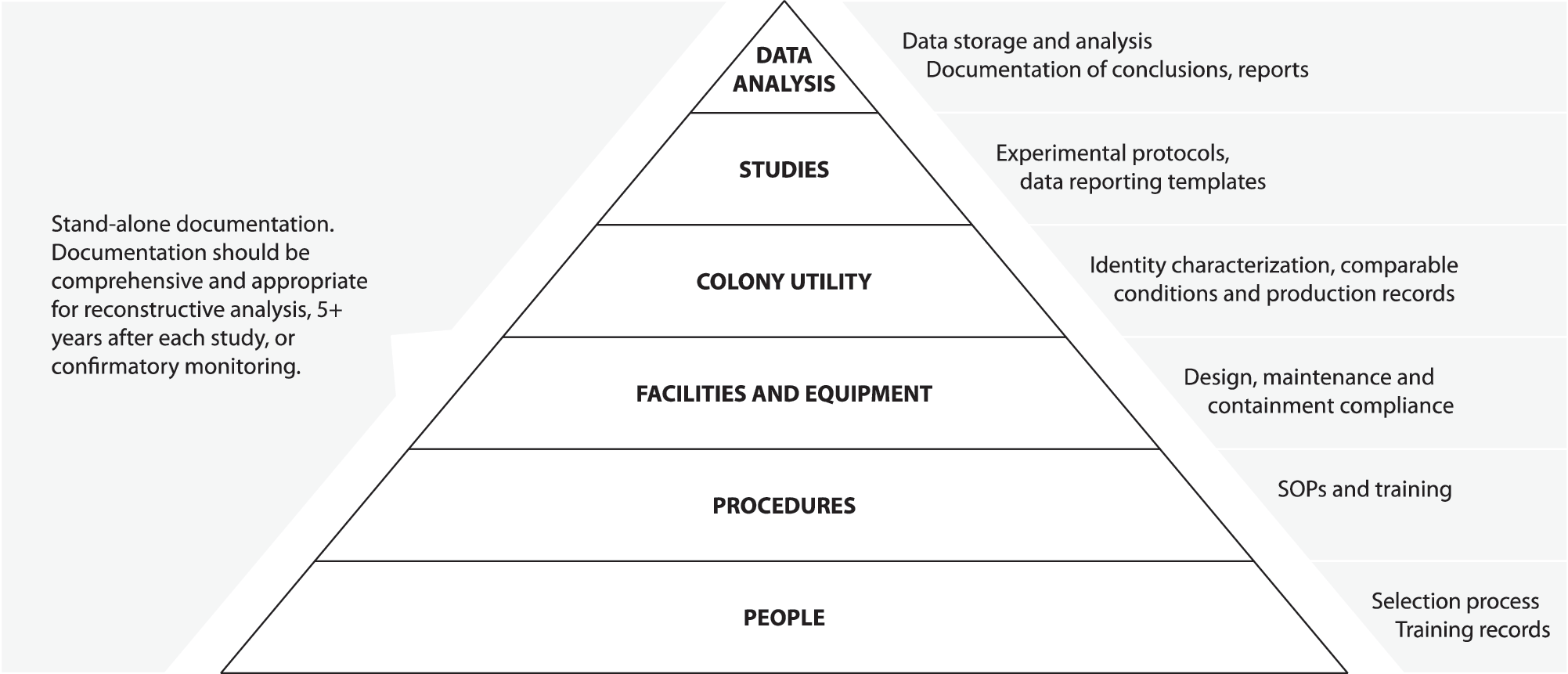
Components of facilities readiness preparations leading to reliable study results and defensible science.
The documentation of these components does not leave them static, but rather each adjustment made during operations should be documented and explained. Choices made in terms of procedures, equipment, and even facility design should be reviewed over time to ensure their effectiveness to reach the targeted objectives in terms of containment and colony utility. This also means that such objectives should be clearly described at the very beginning, based on a detailed risk analysis, thereby tying defensible science back to compliance and colony utility.
Discussion
We describe in this study, and in another article focusing on operational details (Quinlan et al., 2018), a process of preparing for studies in containment and achieving “facilities readiness,” before import of transgenic mosquitoes to a sub-Saharan Africa site. The process described is an example of moving from a discovery laboratory team to an international partnership with African research teams and facilities. There are a number of design features and procedures in an authorized facility to ensure achieving a suitable level, such as ACL-2 (Fig. 1). However, it is through shared learning and recognition that, as highlighted in Figure 2, people are the foundation of such a preparation that real progress was made. Reaching agreement on appropriate indicators for colony utility and the necessary documentation for defensible science takes time, yet can build trust and prevent later misunderstandings. Planning for and monitoring compliance also requires rigorous attention, resources, and time. If the practices learned from this experience are followed, however, the preparation process in other locations or for other genetic strategies may be facilitated.
Careful and considered preparations for the broad concepts of compliance, colony utility, and defensible science have laid a foundation for future progression of promising technologies from laboratory to field. It is proposed that, despite the additional demands on time and resources, only with the balance of and rigorous achievement of each of these organizing themes can collaborative research into novel strategies for vector control reliably progress past initial containment studies.
Footnotes
Acknowledgments
This collaborative work was largely funded by a grant from the Foundation for the National Institutes of Health (FNIH) through the Vector-Based Control of Transmission: Discovery Research (VCTR) program of the Grand Challenges in Global Health (GCGH) initiative of the Bill & Melinda Gates Foundation (BMGF). All authors confirm there is no conflict of interest regarding reporting on this experience or carrying out the work, and that the funder did not limit their ability to develop the approach described. The authors also wish to thank Rebecca Murphy for editorial support and John Mumford for article review.
Author Disclosure Statement
No competing financial interests exist.
†
These pilot and field programs have taken place at various times in Ethiopia, Kenya (Lounibos 2003, McDonald et al. 1977), Libya, Mauritius (Seewooruthun et al. 2000), Morocco, Nigeria (Oladunmade et al. 1990), Reunion, Senegal (Dicko et al. 2014), South Africa, Sudan, Tanzania (Vreysen et al. 2000) and Tunisia (Chakroun et al. 2015) against various spp. of tsetse fly, New World screwworm (Lindquist et al. 1992), Mediterranean fruit fly (Enkerlin  ), date or carob moth, codling moth, diamond back moth, and vector spp. of mosquitoes (Anopheles arabiensis and Aedes aegypti).
‡
TALEN are transcription activator-like effector nucleases and CRISPR are clustered regularly interspaced short palindromic repeats. While this article focuses on transgenic mosquitoes, most of the commentary applies to other methods employed in genetic strategies, although risks may vary.
§
Target Malaria (
**
A separate framework is not a requirement of the Protocol, but advocacy groups and considerable funding encouraged this approach. Some countries are considering a more comprehensive risk-based framework that could address other sources of biological risks, particularly in light of emerging techniques and technologies that are not strictly covered by the Protocol and generally have encountered a gap or uncertainty in the regulatory pathway.