




Abstract
Until recently, Chlamydia psittaci was considered to be the only etiological agent of avian chlamydiosis, but two new avian species, Chlamydia gallinacea and Chlamydia avium, have recently been described in poultry and pigeons or psittacine birds, respectively. The aim of this study was to explore the occurrence of C. psittaci and C. gallinacea in backyard chickens in Italy. Cloacal swabs were taken from 160 asymptomatic chickens reared in 16 backyard farms. Samples were tested for C. psittaci and C. gallinacea by specific real-time polymerase chain reaction assays, with 24 (15%) of the 160 chickens resulting positive for C. gallinacea. To attempt chlamydial isolation, new samples were obtained from two farms harboring a high prevalence (60% and 70%, respectively) of C. gallinacea-positive chickens. In total, eight C. gallinacea and one C. psittaci isolates were successfully recovered from 13 chickens. C. gallinacea was confirmed to be the endemic chlamydial species in chickens, with a high ompA intraspecies diversity.
The presence of viable C. psittaci and C. gallinacea demonstrated by isolation from chickens in backyard farms poses a potential public health problem.
Introduction
A
C. avium has been found in asymptomatic or sick pigeons but also in psittacines (Hölzer et al. 2016). C. gallinacea was first identified in poultry flocks that had been linked to human chlamydiosis, and it is suspected to be a zoonotic pathogen (Laroucau et al. 2009). Its virulence for birds is still unclear, although persistent infection has been linked to reduced body weight gain in broiler chickens (Guo et al. 2016).
In Italy, epidemiological studies on avian chlamydiosis have mostly been performed on wild birds such as pigeons (Magnino et al. 2009), collared doves (Donati et al. 2015), and corvids (Di Francesco et al. 2015). To our knowledge, no systematic investigations on chlamydiosis using highly specific diagnostic assays have been performed in poultry. The aim of this study was to explore the occurrence of C. psittaci and C. gallinacea in backyard chickens in Italy.
Materials and Methods
From March to June 2016, cloacal swabs were collected from 160 asymptomatic backyard chickens (Gallus gallus), reared in 16 farms located in six Italian regions (Table 1). The main races were Siciliana, Romagnola, Moroseta and Livorno, reared for ornamental purposes and/or self-consumption of meat. In July 2016, 13 chickens from the two farms, where the highest number of chickens tested positive, were sampled to attempt chlamydial isolation, according to Donati et al. (2010).
Genomic DNA was extracted from the cloacal swabs and the chlamydia-positive cell cultures using the QIAamp DNA Mini Kit (Qiagen, Hilden, Germany) following the supplier's recommendations. DNA was screened by a Chlamydiaceae-specific real-time polymerase chain reaction, targeting a region of the 23S rRNA gene conserved among all Chlamydiaceae (Ehricht et al. 2006). Samples with Ct values <40 were considered positive and reanalyzed by a C. psittaci-specific real-time PCR targeting the incA gene (Ménard et al. 2006) and C. gallinacea-specific real-time PCR targeting the enoA gene (Laroucau et al. 2015).
The polymorphism of C. gallinacea in the backyard poultry studied was investigated by amplifying the ompA gene of C. gallinacea-positive samples using the new primers CG3 (5′-GGAGATTATGTTTTCGA-3′) and CG4 (5′-CTTGCCATTCATGGTATT-3′). The primers targeted a fragment of ∼600 base pairs that included ompA variable domains (VDs) I-II-III (Kaltenboeck et al. 1993). C. gallinacea 08-1274/3 type strain was used as positive control. The PCR products were purified using a QIAquick PCR Purification Kit (Qiagen), and both DNA strands were sequenced (Bio-Fab Research, Rome, Italy). The sequences were compared to each other and to the ompA sequence of the C. gallinacea 08-1274/3 type strain using the BLAST server from the National Center for Biotechnology Information (
Then, the C. gallinacea ompA sequences obtained in this study were edited, obtaining a gene fragment of 337–370 bp in length corresponding to nucleotides 210 to 582 of the ompA gene of C. gallinacea type strain 08-1274/3 (GenBank acc. no. NZ AWUS01000004), including the ompA VDs I-II. The gene fragments were compared with other C. gallinacea corresponding sequences, and phylogenetic relationships were evaluated.
Results
The results are reported in Table 1. Twenty-four of the 160 (15%) samples collected in the first sampling were chlamydia-positive by 23S real-time PCR. All the chlamydia-positive samples reacted positively to enoA-based real-time PCR for C. gallinacea. In the second sampling, nine chlamydial isolates were successfully obtained and identified as C. gallinacea (n = 8) and C. psittaci (n = 1) by the specific real-time PCRs. The 32 C. gallinacea ompA nucleotide sequences from field samples and isolates showed 83–100% similarity between them and 86–96% to the corresponding sequence of the 08-1274/3 C. gallinacea type strain. Nucleotide alignment distinguished the 32 C. gallinacea ompA sequences in 12 different ompA types (01–12). Phylogenetic comparison showed that some ompA types were closely related to some C. gallinacea ompA sequences from France or Asia (Fig. 1). Some ompA types were highlighted in geographically distant backyard farms and several ompA types were highlighted in the same farm (Table 1).
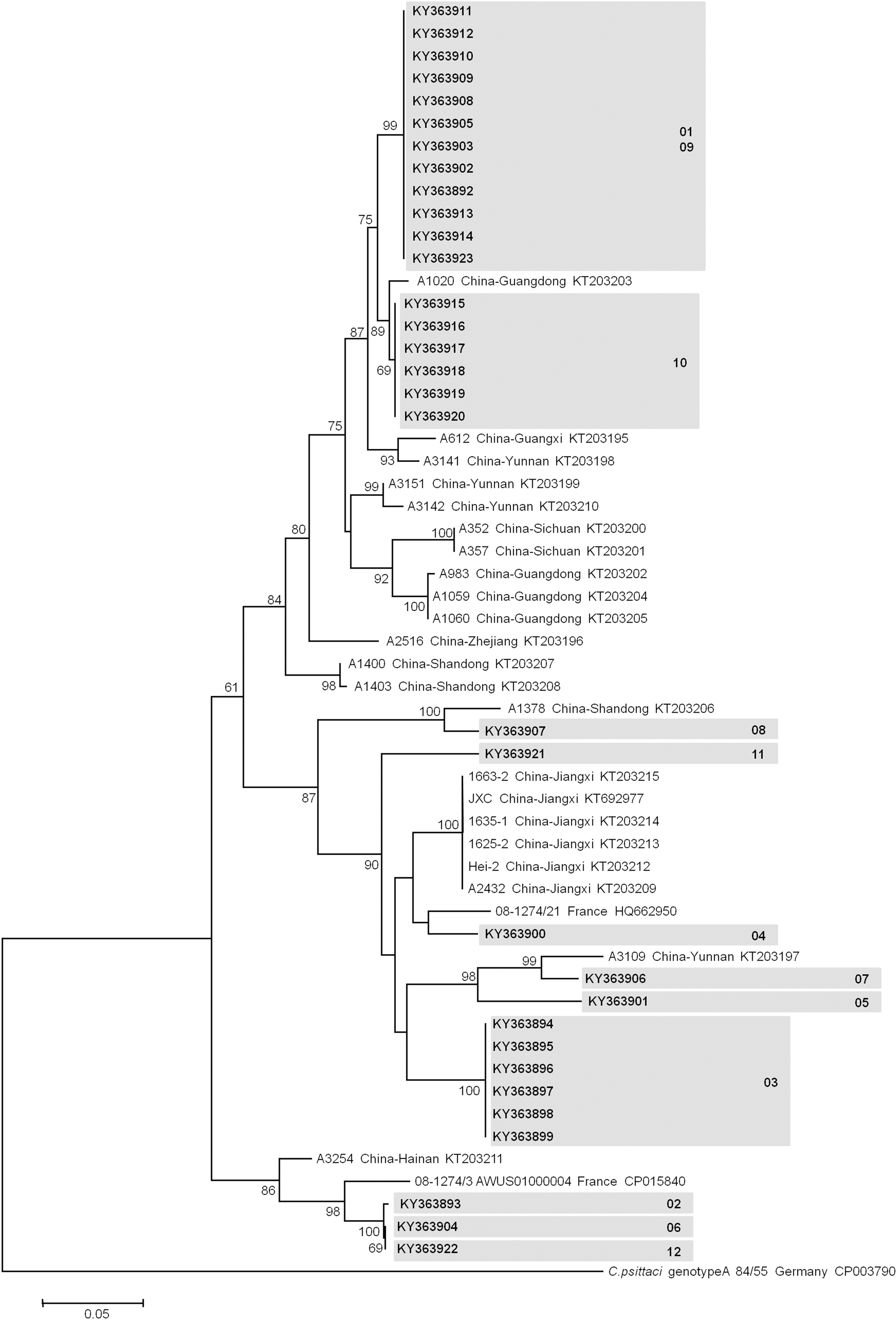
Phylogenetic comparison of Chlamydia gallinacea from backyard poultry in the present study. Phylogenetic relationships among the C. gallinacea ompA variable domains I-II obtained in this study and other C. gallinacea corresponding sequences from poultry in France and China were evaluated using MEGA 6.0. A phylogenetic tree was constructed by the neighbor-joining method using the Tamura 3-parameter model with gamma distribution. A reference sequence of Chlamydia psittaci (GenBank acc. no. CP003790) was used as outgroup. Bootstrap values were determined by 1000 replicates to assess the confidence level of each branch pattern and values ≥60% were reported. OmpA sequences obtained in this study are shown in bold type.
Discussion
The present study detected C. gallinacea in 100% of the PCR chlamydia-positive chickens and in 89% of the chlamydial isolates. These results are consistent with those of previous reports suggesting that C. gallinacea is the endemic chlamydial species in chickens (Zocevic et al. 2012, Hulin et al. 2015, Guo et al. 2016, Li et al. 2017). The flocks examined were very similar in terms of zootechnical characteristics (free-range farms) and chicken races (Mediterranean light chicken breeds). The high chlamydia prevalence (60% and 70%) observed in two flocks, compared with others, could be explained by the higher chicken turnover in these two farms. Sequence analysis of the C. gallinacea ompA gene fragments confirmed the high intraspecies diversity previously reported (Guo et al. 2016, Li et al. 2017), although the value of phylogenetic comparison based on partial gene sequences of ompA is limited (Li et al. 2017). The presence of the same ompA type in different farms as well as several ompA types in the same farm and the close relationship of some C. gallinacea strains with European or Asiatic strains are not surprising considering the features of the farms tested, which commonly introduce animals from Italian farms and from European or extra-European countries and participate in Italian or foreign exhibitions.
Nine chlamydial isolates were obtained, eight of which identified as C. gallinacea and one as C. psittaci. To our knowledge, this is the first isolation of C. gallinacea in Italy. The detection of viable bacteria confirmed the results of the PCR assays on chlamydia circulation in the tested farms, raising a potential public health problem. While the principles and practices of on-farm biosecurity may be familiar to commercial farmers, hobbyists and backyard farmers may not be aware of the steps required to keep infectious diseases out of their flock and prevent their spread. Unlike C. psittaci, the zoonotic potential of C. gallinacea has yet to be investigated. In a previous study (Laroucau et al. 2009), three workers at a French slaughterhouse who had handled C. gallinacea-infected chickens showed signs of atypical pneumonia, even though previous exposure of these individuals to C. psittaci cannot be ruled out. Until recently, C. psittaci was considered the only agent of avian chlamydiosis. In the past, mainly before the common use of molecular assays, the diagnosis of some human cases of chlamydiosis could have stopped at genus level, disregarding other potential etiological agents. Taking into account the complex etiology of avian chlamydiosis and the endemic circulation of C. gallinacea in poultry, highly specific diagnostic methods should be systematically used both in birds and in humans to explore the potential zoonotic role of this new chlamydial species.
Footnotes
Author Disclosure Statement
The authors of this article do not have personal or financial relationships with people or organizations that could inappropriately influence the content of the article.