




Abstract
In central Europe, at least three flaviviruses circulate among vectors and vertebrate hosts. West Nile virus (WNV) and Usutu virus (USUV) are mosquito-borne viruses maintained in the nature by enzootic cycle between mosquitoes and birds. Tick-borne encephalitis virus (TBEV) is a flavivirus causing annual human cases in Slovakia. The aim of this study is the prevalence assessment of flavivirus infections in horses (n = 145) and birds (n = 109) by enzyme-linked immunosorbent assay (ELISA) and confirmation by neutralization test (VNT). WNV antibodies have been detected in 11.7% of tested horses and 11.9% of tested birds and confirmed in 6.9% of horse and 9.2% of bird samples. None of the WNV seropositive or dubious horses had WNV IgM (ELISA), and none of the tested horses had USUV neutralizing antibodies. Autochthonous WNV infections have been confirmed in 16.7% of horses without international travelling history. Most of them were from western Slovakia with known endemic WNV transmission. An autochthonous WNV infection in a horse from highland area of Kremnické vrchy (central Slovakia) with unknown data of WNV circulation and without travelling history was detected. TBEV antibody was detected in 6.2% of horses and in 3.4% has been confirmed. In two horses, WNV and TBEV infection could not be distinguished. Confirmed WNV seropositive were eight raptors showing nonspecific signs or suffering from trauma, one white stork, and one house sparrow. The sparrow was caught in a locality in eastern Slovakia, where WNV RNA had been previously detected in sparrows. USUV neutralizing antibodies were present in pooled sample from four Eurasian great tits. Because of insufficient volume, TBEV VNT was not carried out in birds. Results further prove the endemicity of WNV and other vector-borne flaviviruses in natural and accidental hosts in Slovakia, giving better insight in flavivirus epidemiology in European countries in general.
Introduction
A
In the 1960s, WNV was considered as a pathogen with low importance causing subclinical infections and sporadic outbreaks in horses and humans (Dauphin et al. 2004). Before 1999, cases of equine encephalomyelitis have been noticed in Egypt, France, Morocco, and Italy (Bunning et al. 2002). Most of the equine infections had mild or subclinical course. However, the introduction of WNV to an immunologically naive horse population indicated the opposite. After 1999 in Long Island (Suffolk County, NY), high morbidity and mortality rates have been noticed in horses. Forty-three percent of tested horses had WNV antibodies, among them 42% had clinical attack and 36% of them succumbed to infection (APHIS 2000). Since then, WNV became resident in the United States and spread southward (Komar and Clark 2006).
After the detection of lineage 2 WNV in Hungary (Bakonyi et al. 2006), the virus became endemic in central Europe. Later, a moderate geographic spread of infection was observed, and in 2008, this strain showed massive dispersal west- and southwards. Increased mortality was observed in birds of prey, and the number of reported infections of CNS in horses increased too (Bakonyi et al. 2013). WNV neutralizing antibodies were present in nonvaccinated horses living in southern counties of Slovakia sampled between 2008 and 2011 (Hubalek et al. 2013). The time of sampling coincides with the outbreaks in Hungary, but no clinical case of WNV infection in horses was reported.
USUV, another member of the Japanese encephalitis serocomplex, has been probably introduced to Europe (Italy) in 1996, or before (Weissenbock et al. 2013). In 2001, USUV caused an episode of increased wild bird mortality around Vienna, Austria (Weissenbock et al. 2002). From that time, USUV infection was found in several European countries like Hungary, Germany, Switzerland, Spain, Italy, Belgium, England, Czech Republic, Poland, and Greece (Ashraf et al. 2015). As for WNV, birds are the main reservoirs, but USUV was also detected in bats (Cadar et al. 2014, 2015) and serologically in horses and dogs (Durand et al. 2016).
The zoonotic potential of USUV reflects in two neurological cases in Italy in 2009. One virus strain showed 98% identity with the Austrian (Vienna-2001) and Hungarian (Budapest-2005) strains isolated from dead birds (Pecorari et al. 2009). The other strain (Bologna-2009) based on the entire ORF sequence was identical in 99% to Austrian, Hungarian, and Italian (Italia-2009) strains (Ashraf et al. 2015).
A retrospective study in Italy focused on USUV and WNV RNA and antibody prevalence in human cerebrospinal fluid (CSF) and serum samples collected between 2008 and 2011 from individuals with or without neurologic impairments in the area of municipality of Modena. None of the CSF or serum reacted positively for WNV RNA. On the other side, 8 out of 306 (2.6%) of CSF and 2 out of 609 (0.3%) of sera contained USUV RNA with high pairwise identity of partial nucleotide sequence in comparison with USUV isolates from central Europe. WNV neutralizing antibodies in 2.96% (18/609) samples and in 6.57% (40/609) USUV neutralizing antibodies have been present (Grottola et al. 2017).
In Croatia in 2013, three serologically confirmed neuroinvasive human USUV infections have been described during a WNV outbreak; however, no USUV sequences have been detected (Santini et al. 2015). Recent studies carried out in Germany and Austria confirmed USUV RNA in blood donations. In both cases, blood donations have been routinely screened for WNV RNA by the cobas TaqScreen WNV Test (Roche). In Germany on 28 September 2016, one out of 13,023 blood donors had been tested positive, but subsequent analysis revealed an acute USUV infection (Aachen strain). Deep sequence analysis of approximately 60% of the USUV polyprotein gene revealed a 99% homology of the Aachen strain with strains found in birds during the 2016 epizootics in the same region from where the donor originated (Cadar et al. 2017).
In Austria between July and August 2017, seven out of 12,047 blood donors have been positive for WNV RNA. Further analysis showed USUV nucleic acid in six of them. Based on the genetic analyses of complete coding sequences and partial NS5-3′UTR sequences, all Austrian blood donor derived sequences cluster within the USUV Europe 2 lineage (Bakonyi et al. 2017). Results of the abovementioned studies point out the need of awareness of blood transfusion services, public health authorities, and clinicians for possible human USUV infections.
TBEV is a tick-borne flavivirus circulating in ticks and small mammals. Ruminants and humans act as accidental hosts; however, TBEV infection in monkeys, horses, dogs, and birds have been also described (Pfeffer and Dobler 2010, Klaus et al. 2013, Csank et al. 2016). From its first isolation in the 1940s (Rampas and Gallia 1949), TBEV is endemic in central Europe. In Slovakia, it causes annually clinical infections in humans after tick bite or consumption of raw milk or milk products (Kerlik and Avdičová 2015).
Being rapid, reproducible, and relatively inexpensive, enzyme-linked immunosorbent assay (ELISA) is a widely used method of first choice in diagnostics of many virus infections. Nevertheless, serological diagnostics of flavivirus infection hamper the high rate of cross-reaction. Hence, the results are not always convincing, especially in areas where several flaviviruses co-circulate (Joó et al. 2017). In such cases, the confirmation relies on neutralization methods.
The aim of the present study was to assess the prevalence of WNV, USUV, and TBEV infections in horses and the prevalence of WNV and USUV infections in birds from Slovakia by ELISA and the virus neutralization test.
Materials and Methods
Serum samples
Horse sera (n = 145) were collected during 2013 in counties Banská Štiavnica (n = 11), Bratislava (n = 30), Košice (n = 4), Levice (n = 16), Myjava (n = 14), Pezinok (n = 27), Prešov (n = 2), Prievidza (n = 1), Rožňava (n = 14), Spišská Nová Ves (n = 10), and Žiar nad Hronom (n = 16; Fig. 1). None of the tested horses have been vaccinated or have clinical signs of any flavivirus infection. From the total number of tested horses, thirty were born in Slovakia and have no travelling history abroad, forty-three have been travelling within and have been abroad Slovakia (Poland, Hungary, Austria, Germany, Italy, Netherlands, Russia, France, Great Britain, Ukraine, and Unites States; Supplementary Table S1; Supplementary Data are available online at
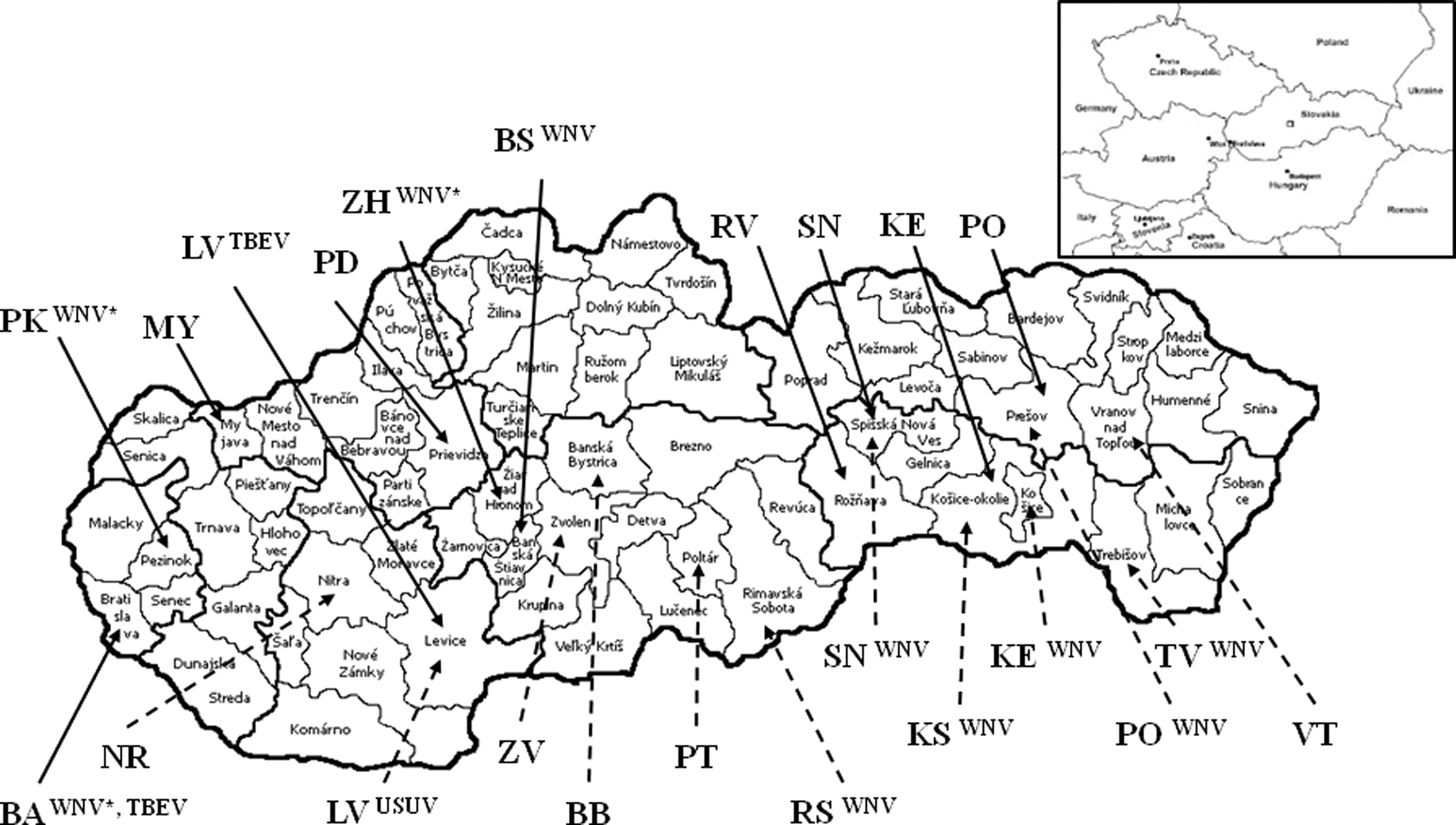
The insert in the top right corner depicts the geographic location of Slovakia and its neighboring countries. Full lines–the origin of horse sera by counties. Dashed lines–the origin of bird sera by counties. WNV–WNV infection confirmed by ELISA and VNT. TBEV–TBEV infection confirmed by ELISA and VNT. USUV–USUV infection confirmed by VNT. *–autochthonous infections. BA, Bratislava; BB, Banská Bystrica; BS, Banská Štiavnica; KE, Košice; KS, Košice-okolie; LV, Levice; MY, Myjava; NR, Nitra; PD, Prievidza; PK, Pezinok; PO, Prešov; PT, Poltár; RS, Rimavská Sobota; RV, Rožňava; SN, Spišská Nová Ves; TV, Trebišov; VT, Vranov nad Topľou; ZV, Zvolen; ZH, Žiar nad Hronom.
Bird serum samples collected (Fig. 1) between 2012 and 2014 from caught birds (n = 73) or patients (n = 36) in the Clinic for birds and exotic animals, UVMP, Košice have been tested for WNV and USUV antibody presence by ELISA and VNT. The blood of some caught birds (n = 49) have been pooled into 13 pools (Supplementary Table S2). Each pooled sample contained serum of up to five birds of same species. Serum samples of other caught birds (n = 24) were tested individually (Supplementary Table S3). The origin and species proportion of bird patients are listed in the Supplementary Table S4. Information on mist netting localities is available in Csank et al. (2016), and information on patients is available on request. Due to the low volumes of blood collected from birds, sufficient amounts of serum samples were not available for testing of TBEV neutralizing antibodies.
Enzyme-linked immunosorbent assay
Horse and bird sera were tested for WNV by blocking ELISA Kit INGEZIM WNV COMPAC (Ingenasa, Spain) following the manufacturer's protocol. Positive and dubious horse sera were further tested for the presence of WNV IgMs by capture ELISA Kit INGEZIM WNV IgM (Ingenasa). TBEV antibodies in horses were detected by competitive ELISA Kit EIA TBEV Ig (TestLine, Czech Republic) without modifications.
Microvirus neutralization test
Horse and bird sera were inactivated at 56°C for 30 min and diluted to 1:10 in EMEM. Serial twofold dilutions in EMEM were prepared in duplicates in a volume of 25 μL. An equal volume of 100 TCID50 of virus strains WNV 578/10 and USUV 939/01 (kindly provided by Professor Norbert Nowotny, University of Veterinary Medicine, Vienna) was added into each well. Each serum sample had a control of cytotoxicity, where instead of virus 25 μL of EMEM had been added. After 1-h incubation at 37°C a 50 μL of 10% EMEM supplemented by antibiotics containing 1 × 10⁴ Vero E6 cells were added into each well. In Slovakia TBEV is endemic so along with WNV and USUV, horse sera were tested for the presence of neutralizing antibodies against the Hypr strain (kindly provided by Dr. Mária Takács, National Center for Epidemiology, Budapest, Hungary). In this test, A549 cells (generous gift of Professor Gerhard Dobler, Institut für Mikrobiologie der Bundeswehr, München, Germany) were added to each well in the same concentration as in the case of WNV and USUV VNT. During each sample batch, virus inocula were back-titrated. Plates were incubated for 5 days at 37°C at 5% CO2 atmosphere. Positive result in cross-reactive samples was assigned if the neutralizing antibody titer of the certain virus was at least fourfold higher.
Results
WNV, USUV, and TBEV infection prevalence in horses
In each back-titration, the titer of virus inocula ranged between 3.2 × 101 and 3.2 × 10² TCID50 in 25 μL. Seventeen out of 145 (11.7%) horse serum samples reacted positively in WNV ELISA, and 10 (6.9%) were confirmed by VNT (Table 1). None of the WNV positive or dubious horse serum had WNV IgMs. WNV VNT confirmed horses were from counties Banská Štiavnica (n = 2), Bratislava (n = 5), Pezinok (n = 2), and Žiar nad Hronom (n = 1) with titer ranging from 1:20 to 1:640 (Fig. 1 and Table 1). Five sera (135, 151, 180, 348, and 351) had border PI values in WNV Ig ELISA and were negative in WNV VNT; however, two (135 and 351) samples with border PI values were positive in the TBEV Ig ELISA and one of them (135) in TBEV VNT with titer 1:80–1:160 (Table 1).
WNV Ig ELISA–positive (+) if percentage of inhibition (PI) ≥40%, negative (−) if PI ≤30%, and dubious (D) if PI 30–40%. TBEV Ig ELISA–positive (+) if % N/S > 200, negative (−) if % N/S < 150, and dubious (D) if % N/S is 150–199. −, negative.
Horse without travelling history.
Horse with known travelling history.
Not available information of international travelling.
CT, cytotoxicity; BA, Bratislava; RV, Rožňava; BS, Banská Štiavnica; LV, Levice; KE, Košice; PK, Pezinok; ZH, Žiar nad Hronom; WNV, West Nile virus;. USUV, Usutu virus; TBEV, Tick-borne encephalitis virus.
Twenty-six (17.9%) horse sera have been evaluated in the WNV Ig ELISA as dubious, among which three (287, 344, and 350) reacted positively in the TBEV Ig ELISA and TBEV VNT with titer ranging from 1:80 to 1:640 (Fig. 1 and Table 1).
Autochthonous WNV infection from the total number of tested horses was detected by both serological methods in five (3.5%) horses; in the group of horses without travelling history (n = 30) it represents 16.6% prevalence. The animals were from counties Žiar nad Hronom (211), Pezinok (395 and 399), and Bratislava (413 and 423; Fig. 1). In the group with travelling history (n = 43), WNV neutralizing antibodies have been proved in three (7%) horses from Bratislava County (258, 259, and 410). These animals visited Czech Republic and Germany (410). Two (2.8%) horses (330 and 339) both from Banská Štiavnica County with unknown travelling history (n = 72) were confirmed positive for WNV neutralizing antibodies.
Nine (6.2%) horse sera from counties Bratislava (n = 3), Levice (n = 4), Košice (n = 1), and Pezinok (n = 1) were positive in TBEV Ig ELISA. Five (3.4%) of them reacted positively in TBEV VNT with titer ranging from 1:40 to 1:640 (Table 1). Ten (6.9%) serum samples reacted dubiously in the TBEV Ig ELISA, out of which three (258, 330, and 395) have been positive in WNV Ig ELISA and WNV VNT with titer 1:320, 1:160, and 1:640, respectively (Table 1).
Dubious reaction in both VNTs occurred in two horse serum samples (352 and 353) originated from Levice; hence, the antibody specificity could not be differentiated (Table 1). A 1:10 USUV antibody titer has been detected in one horse (259), but based on the titer difference it seems to be partial neutralization by WNV neutralizing antibodies (1:640).
WNV and USUV infection prevalence in birds
One hundred and nine pooled and individual bird serum samples had tested for WNV and USUV antibodies. Thirteen (11.9%) individual samples reacted positively in WNV Ig ELISA (Table 2), and 10 (9.2%) of them were confirmed by WNV VNT with titer ranging from 1:10 to 1:160 (Table 2). These were from counties Košice (n = 3), Košice-okolie (n = 2), Prešov (n = 1), Rimavská Sobota (n = 1), Spišská Nová Ves (n = 1), and Trebišov (n = 2; Fig. 1). Overall, WNV antibodies have been detected by ELISA and VNT in eight raptors, one white stork, and one house sparrow. The most abundant raptor species were the northern goshawk and the common buzzard (Supplementary Table S4). Three out of 8 (37.5%) goshawks from counties Rimavská Sobota (214), Košice-okolie (274), and Spišská Nová Ves (448) and 1 out of 6 (16.7%) buzzards from Košice-okolie County have been tested positively for WNV antibodies by both methods. The WNV seropositive house sparrow has been caught with five others in the locality of Zemplínska Teplica in Trebišov County (Table 2 and Supplementary Table S3). It represents 16.7% WNV seroprevalence among tested house sparrows. None of the pooled serum samples had detectable WNV antibodies. Serum of a goshawk (214) was positive by WNV Ig ELISA and WNV VNT, but contained also USUV neutralizing antibodies. However, the fourfold titer difference confirmed WNV infection. The WNV seropositive golden eagle (528) has been living in captivity in the locality of Kráľovský Chlmec in Trebišov County and showed signs of aspergillosis (Table 2). The rest of the WNV seropositive bird patients were found in nature showing apathy or had some kind of trauma.
WNV Ig ELISA–positive (+) if percentage of inhibition (PI) ≥40%, negative (−) if PI ≤30%, and dubious (D) if PI 30–40%.
Patient.
Caught bird.
KE, Košice; RS, Rimavská Sobota; KS, Košice-okolie; BB, Banská Bystrica; LV, Levice; SN, Spišská Nová Ves; PO, Prešov; NR, Nitra; TV, Trebišov.
Dubious PI values in the WNV Ig ELISA, negative WNV VNT, and USUV VNT results have been observed in three bird samples from gyrfalcon (Falco rusticolus), hawfinch (Coccothraustes coccothraustes), and lesser-spotted eagle (Clanga pomarina) originated from counties of Nitra, Košice-okolie, and Trebišov.
A pooled serum sample (372) of four Eurasian great tits caught in the locality of Krškany–Zajačia dolina in Levice County had neutralizing USUV antibody titer 1:40, but was negative for WNV neutralizing and WNV total (PI = −7.1) antibodies (Fig. 1 and Table 2).
Discussion
A former equine serosurvey carried out in Slovakia during 2008–2011 showed an 8.3% WNV neutralizing antibody prevalence in unvaccinated animals, out of which 4.8% were autochthonous infections (Hubalek et al. 2013). Eleven of those animals lived in districts of Komárno, Bratislava, and Pezinok, which lie in southwest in the Podunajská nížina (Danube lowlands; Southern Slovakia), and are close to Slovak-Hungarian border. In 2008 in Hungary, WNV caused several equine and human clinical cases (Krisztalovics et al. 2008, Kutasi et al. 2011).
In this serosurvey, autochthonous WNV infections were detected in four horses sampled during 2013 from county of Bratislava. This region lies in western Slovakia in the Danube lowlands. The possibility of regular WNV circulation in western Slovakia has been suggested based on its isolation from the brain of Clethrionomys glareolus captured near Gic village in Veszprém County in north-west Hungary (Molnár et al. 1976) and from Aedes cantans mosquitoes in western Slovakia (Labuda et al. 1974). Neutralizing antibodies in birds, lagomorphs, free-living ungulates, and particularly in small mammals in the natural focus also indicates the presence of WNV (Kožuch et al. 1980). Taken together, it is likely that WNV circulates in enzootic cycle in certain localities of Danube lowlands from long time ago.
In the present study, based on the travelling and serologic results an autochthonous WNV infection was detected in a locality of Kremnické Bane (Kremnické highlands, County of Žiar nad Hronom; central Slovakia) with no previous data on WNV occurrence. A 6-year-old male horse (data not shown) without travelling history was positive for WNV neutralizing antibodies. The owner did not observe any signs of neural abnormalities. The horses are used only for agritourism in the local region and have not been moved from that locality. The absence of IgM and the high titer (1:320–1:640) of neutralization antibodies indicate an overcome infection. It is important to note that the difference in the height above sea level between the Danube lowlands (ranging from 150 to 250 meters) and the Kremnické Bane (∼780 meters) is around 500 meters. They are separated by each other by Tribeč, Vtáčnik, and Štiavnické highlands. To prove the existence of endemic transmission in Kremnické Bane, study on the prevalence of WNV infection in horses, birds, and vectors is necessary to carry out.
TBEV clinical infections in horses are rare, and the incidence is low; however, the strong seroconversion against TBEV makes them suitable as sentinels in monitoring of natural foci (Rushton et al. 2013). In endemic areas, the prevalence of TBEV infection in horses may vary. In Hokkaido (Japan), TBEV neutralizing antibodies have been detected in 0.4% (Takeda et al. 1999). However, in Austria and Germany, a 26.1% and 20–30% seroprevalence in horses have been noticed, respectively (Klaus et al. 2013, Rushton et al. 2013). In this study, we had no information on TBEV circulation in localities where the tested horses lived. TBEV VNT confirmed a 3.4% seroprevalence, which is similar to results of Müller et al. (2006). In that study, 2.9% of horses living in the endemic region of Marburg-Biedenkopf had TBEV neutralizing antibodies.
Serological diagnosis of flavivirus infections in TBEV endemic areas can be problematic because of cross-reaction in both WNV and TBEV dubious samples. In such results, confirmation is based on neutralization tests (Klaus et al. 2014). However, VNT could not distinguish WNV and TBEV infections in samples 352 and 353. The low titer of neutralizing antibodies against both viruses and the absence of USUV antibodies may indicate coinfection by WNV and TBEV. Samples 151, 180, and 348 had border PI values in the WNV ELISA and were negative in the VNTs for all three flaviviruses. It would be advisable to test serum samples of these horses repeatedly to check the elevation of antibody for exact diagnosis.
During an outbreak between 2008 and 2009 in Hungary and Austria, wild bird and domestic pigeon serum samples were submitted for testing. Specific WNV antibodies were present in 28% of wild bird and in 71.4% of domestic pigeons, from which most were originated from the location of the first emergence of the lineage 2 WNV strain in 2004 (Bakonyi et al. 2013). In 2008 in Austria, almost 44% of bird sera were found positive for WNV antibodies in ELISA, and 66% of the ELISA positive sera had been verified by VNT (Wodak et al. 2011).
In Poland, WNV neutralizing antibodies were detected in overall seropositivity in 5.2% of all birds sampled. The birds belonged to 10 species from different areas of Poland; three juvenile (hatching-year) white storks (titer 1:320, 1:160, and 1:20) in a wildlife rehabilitation center, one free-living mute swan (titer 1:20), and one hooded crow (titer 1:20). USUV antibodies were present in one black-headed gull (Hubalek et al. 2008b). In another study from Poland, 13.3% of wild birds reacted positively in WNV ELISA and VNT (Niczyporuk et al. 2015).
In Southern Moravia (Czech Republic), antibodies against WNV have been not detected in domestic waterfowl, but 5.9% free-living birds showed positive response. These were the common coot, common kingfisher, reed warbler, sedge warbler, marsh warbler, Savi's warbler, reed bunting, blackcap, penduline tit, blue tit, and starling. The antibody titer was comparatively low (1:20–1:40), and the only high titer (1:160) was found in an adult marsh warbler. When fourteen of the sera reacting with WNV were titrated in parallel with USUV, twelve were interpreted as having specific antibodies to WNV, one coot had a higher titer against USUV, and another one could not be attributed to either of the two viruses (Hubalek et al. 2008a).
In this study, ten (9.2%) bird serum samples had been tested positive in WNV ELISA and WNV VNT. Eight of them belonged to raptors, one to a white stork, and one to a house sparrow. One pooled serum sample of four Eurasian great tits reacted positive only with USUV and was negative in WNV ELISA and WNV VNT. High proportion of WNV seropositive raptor patients probably had been influenced by their predatory nature. Cases of encephalitis or mortality due to natural WNV infection in wild birds have been sporadic and observed mainly in raptors (Zeller and Schuffenecker 2004, Gamino and Hofle 2013).
In a previous study, WNV infection in house sparrows in the locality of Zemplínska Teplica (Trebišov County) showed the occurrence of WNV lineage 2 (Csank et al. 2016). In this study, house sparrows in Zemplínska Teplica have been caught 1 year later, and one out of six had WNV neutralizing antibodies. It is also important to say that house sparrows show high degree of natal and breeding site fidelity. Their populations in Europe are sedentary. In Slovakia, the house sparrow is widespread species restricted to human settlements. Recoveries of ringed birds showed that juveniles and adults stay at the ringing places all year round (Klvaňová 2008). This behavioral pattern with the previous detection of WNV infection in house sparrows together with positive serological finding supports the existence of another locality with endemic WNV transmission in eastern Slovakia.
Conclusion
In this study, we detected autochthonous WNV infection in a highland locality Kremnické Bane in central Slovakia with unknown history of WNV circulation. The results also indicate the existence of a new locality in eastern Slovakia with endemic WNV occurrence in house sparrows. The first information on the presence of USUV antibodies in Eurasian great tits indicates its circulation in Slovakia. To get deeper insight into the epidemiology of WNV and USUV in central Europe, detailed studies aimed on the virus prevalence in vectors, reservoirs, and accidental hosts are necessary. Along survey of ticks, sheep, goats, and cattle in the mapping of TBEV foci, the role of horses seems to be useful as sentinel animals.
However, the serological diagnostic of flavivirus infections in central European countries where WNV, USUV, and TBEV co-circulate has to take into account antibody cross-reaction. Monitoring of antibody prevalence in reservoirs and accidental hosts is still not enough for depicting a complex picture of occurrence of arboviruses; hence, it is important to survey and characterize arboviruses in vectors.
Footnotes
Acknowledgments
This work was supported by the project VEGA 1/0729/16 and the grant NKFIH K-120118.
Author Disclosure Statement
No competing financial interests exist.
References
Supplementary Material
Please find the following supplemental material available below.
For Open Access articles published under a Creative Commons License, all supplemental material carries the same license as the article it is associated with.
For non-Open Access articles published, all supplemental material carries a non-exclusive license, and permission requests for re-use of supplemental material or any part of supplemental material shall be sent directly to the copyright owner as specified in the copyright notice associated with the article.
