




Abstract
An organic salt and four metal complexes derived from azole were evaluated against embryonated Toxocara canis eggs (TCE). The new organic salt, (
Introduction
T
On the other hand, Magaña et al. (2016) reported that minerals such as Ag, Cu, Zn, Ti, and Fe showed activity against TCEs. Their results are attributed to structural injury caused by the mechanical stress from the interaction of the minerals with the surface of the TCEs. It has been shown that the combination of albendazole (ABZ) and Cu nanoparticles has potent activity against Setaria cervi, a filarial nematode (family Onchocercidae) that inhabits the peritoneum of bovine. In this research, it was concluded that a nanocomposite leads to greater DNA destruction and concomitant apoptosis than is caused by free ABZ (Zafar et al. 2016). Metal complex derivatives of azole have shown greater antimicrobial activities than free azoles, and the increase in the antimicrobial properties of these compounds is associated with their higher pharmacological lipophilicity (Gammal et al. 2015, Keshia et al. 2016).
The increase in the number of bioactive metal complexes bearing N-donor and other ligands is a positive and important advance in the search for antiparasitic and antimicrobial metal-containing drugs. Based on the great interest in the design of anti-TCE substances, we focused our attention on the use of metal complexes and compounds derived from azole. To the best of our knowledge, the use of complexes derived from azoles for altering the morphology and viability of TCEs has not yet been reported.
Materials and Methods
General procedures
The synthesis of the ligands and metal complexes was performed under an inert atmosphere (nitrogen) using standard Schlenk techniques, including the pretreatment of reagent-grade solvents, which were dried, distilled, and stored under the same inert atmosphere. These compounds were prepared according to previous reports: the ligand 3,5-bis(3,5-dimethylpyrazole-1-ylmethyl)toluene (
To characterize the new organic salt, 1-(3-((3,5-dimethyl-1H-pyrazole-1-yl)methyl)-5-methylbenzyl)-3,5-dimethyl-1H-pyrazole-2-ium}FeCl4
− (
{1-(3-((3,5-Dimethyl-1H-pyrazole-1-yl)methyl)-5-methylbenzyl)-3,5-dimethyl-1H-pyrazole-2-ium}FeCl4 − (5)
To Schlenk flask was added 3,5-bis(3,5-dimethylpyrazol-1-ylmethyl)toluene
X-ray structural determination of 5
Recrystallization of
Anti-Toxocara canis eggs activity
Parasites and eggs
The nematodes were obtained from naturally infected pups at the canine control center in the city of Guadalupe, Nuevo Leon, México. To obtain the parasites, we administered a commercial dewormer (pyrantel pamoate, Pfizer) to the pups. Adult parasites were transported in a container with physiological saline solution at room temperature to the Laboratory of Parasitology of the Faculty of Veterinary Medicine and Animal Science of the Universidad Autonóma de Nuevo León. The female parasites were selected and the distal region of the uterus was dissected; this zone contains the largest number of fertile eggs that are needed for the experiment. The obtained eggs were placed in sterile containers that contained 5% sodium hypochlorite solution (Clorox®) for 10 min and then were washed by centrifugation thrice with 5 mL of saline solution. We visualized the specimens with an inverted microscope (Zeiss Invertosko) every third day to determine the embryonic development and rule out possible bacterial or fungal contamination. The culture medium for egg maturation was 0.1 N H2SO4 (sulfuric acid) solution. When the number of eggs reached 1 × 10⁶, they were placed in 5 mL culture dishes and kept under constant hydration with the same H2SO4 solution until they reached maturity (45–60 days) (Tiersch et al. 2013).
In vitro activity
The in vitro assay was carried out in 96-well microplates (30 embryonated eggs/well) with the ligands (bdmpzm and
Mobility index (MI) = Σn Nn/ΣNn, where Nn: number of larvae with the score of n (1). Relative mobility (RM) = MI sample/MI control 100 (2).
Toxicity study of ligands and compounds
To establish a measure of cytotoxicity for the ligands and compounds, 96-well cell culture dishes were prepared with a murine cell line of hepatocyte BpRc1 (ATCC® CRL-2217™). This cell line was cultured under optimum conditions for growth, that is, the cells were maintained at a temperature of 37°C, a relative humidity of ≈82%, and an atmosphere of 95% air and 5% CO2 in an incubator (Thermo Scientific). The recommended culture media (GIBCO®) supplemented with penicillin/streptomycin (GIBCO) and fetal bovine serum (FBS; GIBCO) were used. This cell line was maintained according to the information provided by the corresponding ATCC guide. The cell line was in contact with the compounds at the same concentrations used in the in vitro assay. Cells were seeded in 96-well tissue culture plates with 5 × 10⁴ cells/well, and 24 h after platting, they were supplemented in triplicate with each compound. All dilutions were prepared with fresh culture media, and plates were incubated for an additional 24 h. Cells in plates were washed with PBS pH = 7.4 to remove dead cells, and the surviving cells were then used to estimate the cytotoxic effect relative to a mock preparation. The neutral red method was used to determine the cell viability (Repetto et al. 2008).
Results and Discussion
Synthesis and characterization of {1-(3-((3,5-dimethyl-1H-pyrazole-1-yl)methyl)-5-methylbenzyl)-3,5-dimethyl-1H-pyrazole-2-ium}FeCl4 − (5)
The organic salt was obtained in good yield after the reaction of
Crystal structure of 5
The molecular structure is shown in Figure 1a. This organic–inorganic hybrid crystallizes in a monoclinic P21/c space group. The compound is characterized by the protonation of the N6 atom in one of the two pyrazole rings (N7−N6−C27−C26−C24) to form a NH+ group giving a residual positive charge. This phenomenon allows the interaction with a tetrahedral counterion FeCl4 −, forming an organic–inorganic ionic pair in the asymmetric unit with the Fe(III) surrounded by four Cl−. This sort of interactions has been already reported in similar compounds such as [(HL1)2(ZnCl4)].H2O, [(HL1)2(CuCl4)], [(HL2)2SnCl6], and [(HL3)FeCl4] (with L1 = 2-methylquinoline, L2 = 6-bromobenzo[d]thiazole-2-amine, and L3 = 5,7-dimethyl-1,8-naphthyridine-2-amine) (Jin and Wang 2012)
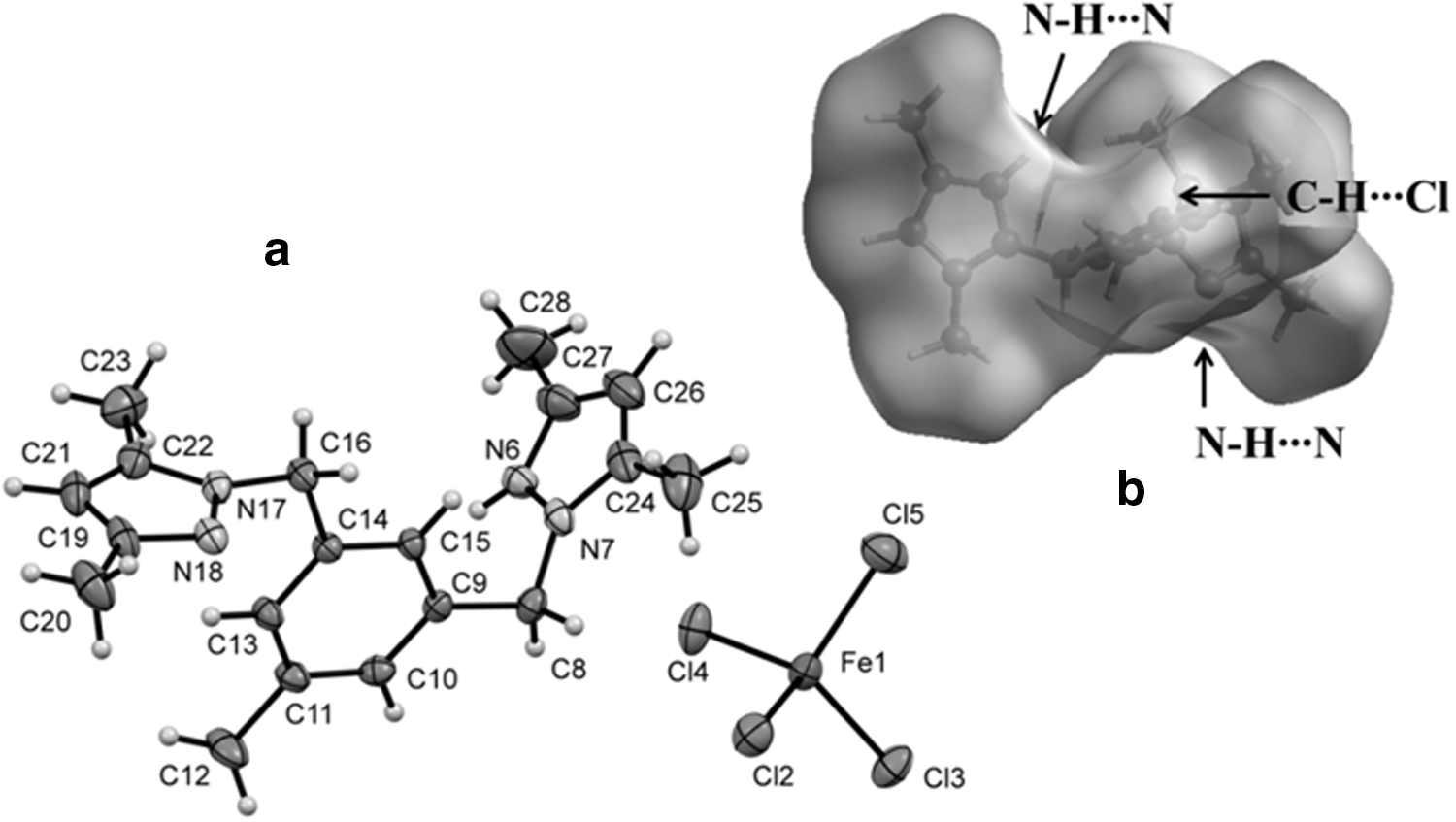
The molecular structure contains a central six-membered ring with trans five-membered ring substituents (with a dihedral angle of 49.7(3)° between them). The dihedral angles between each pyrazole ring and the central benzene ring are 84.7(2)° for the (N17−N18−C19−C21−C22) ring and 85.2(3)° for the (N7−N6−C27−C26−C24) ring. The FeCl4 − counterion is in a tetrahedral arrangement and has an average volume of 5.394 Å3 and a mean tetrahedral quadratic elongation of λ = 1.000, which is characteristic of a nondistorted polyhedron (Robinson et al. 1971). The lack of distortion was confirmed by the observed Fe−Cl distances of Fe1−Cl2 2.2029(15), Fe1−Cl3 2.1777(15), Fe1−Cl4 2.1933(16), and Fe1−Cl5 2.190(2), which are almost equal.
The supramolecular assembly is mainly controlled by N6−H6···N18i (symmetry code: (i) x,1/2-y,1/2+z) hydrogen bonds with an H···N distance of 1.82(5)Å. However, the weaker interactions of C(16, 10)−H(16A, 10)···Cl(14, 13), with H···Cl distances of 2.83 Å and 2.85 Å, respectively, help to define the three-dimensional array. The N−H···N hydrogen bond is also observed in the Hirshfeld (HF) surface analysis performed using Crystal Explorer 3.1 software (Wolff et al. 2012) mapped over dnorm (analysis of the contact distances (di and de ) from the HF surface to the nearest atom inside and outside, respectively), where the bright red spots indicate the intermolecular interactions (Fig. 1b). A weak red spot was observed over the aromatic C−H···Cl interaction, indicating the weakness of the interaction.
In vitro anti-TCE activity
Metal azole complexes have shown antimicrobial and antiparasitic activities (Keshia et al. 2016, Hurtado et al. 2017). However, the efficacy of these compounds against TCEs has not been studied. In this work, we tested the anti-TCE activities of the ligands, metal complexes, and compounds derived from azole at different concentrations. The results showed that the free ligands do not have anti-TCE activity, probably because the azoles have higher antifungal activities since they inhibit some of the steps in the synthesis of ergosterol in fungal cell walls (Van den Bossche et al. 1983, Herbrecht 2014). While the RM of larval eggs was low after exposure to different concentrations of compounds
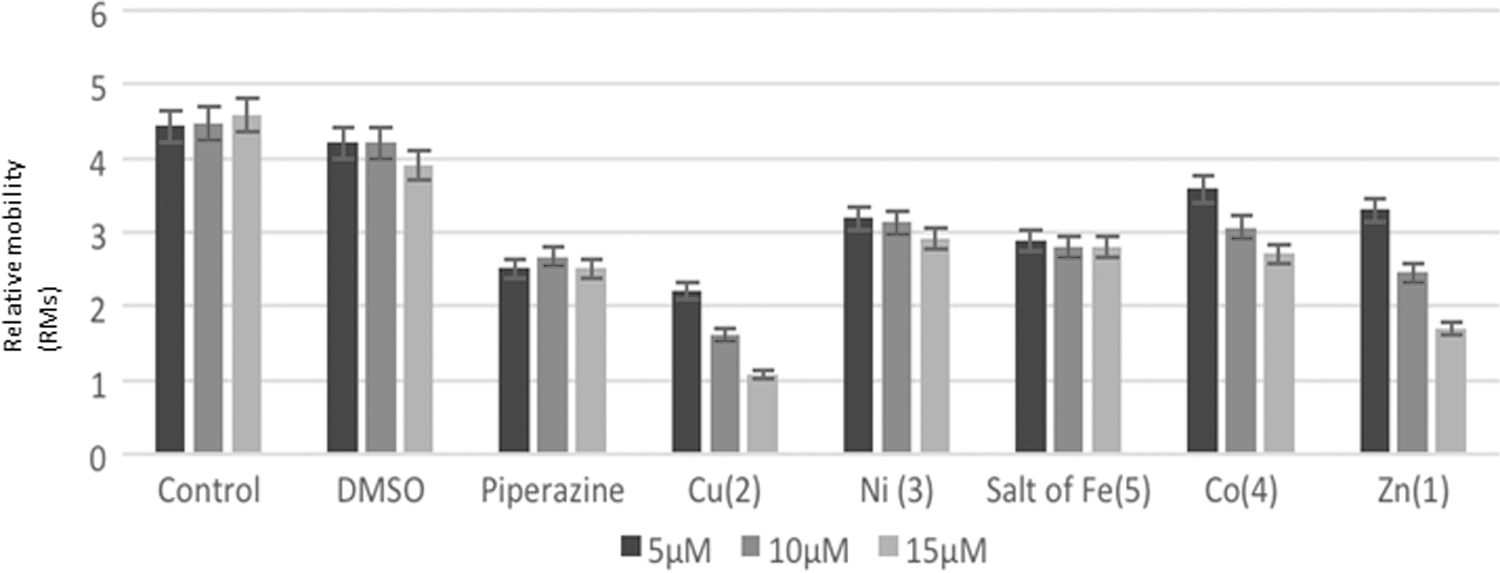
RMs of parasites within the egg exposed to compounds
This result is likely associated with the superior solubility, bioavailability, and contact with DNA through intermolecular interactions (An et al. 2008, Patel and Patel 2010). In addition, it is promising that increasing the lipophilicity of compounds lowers the permeability barrier of the TCEs and slows the normal cellular activity of the microorganisms, causing an increase in antiparasitic bioactivity.
The efficacy of the combination of copper oxide nanoparticles with ABZ has been shown; the enhanced synergistic cytotoxicity of the nanocomposites against nematodes resulted in a greater amount of DNA fragmentation than was caused by the free ABZ; and this fragmentation increases the generation of ROS and consequently apoptosis (Zafar et al. (2016). With
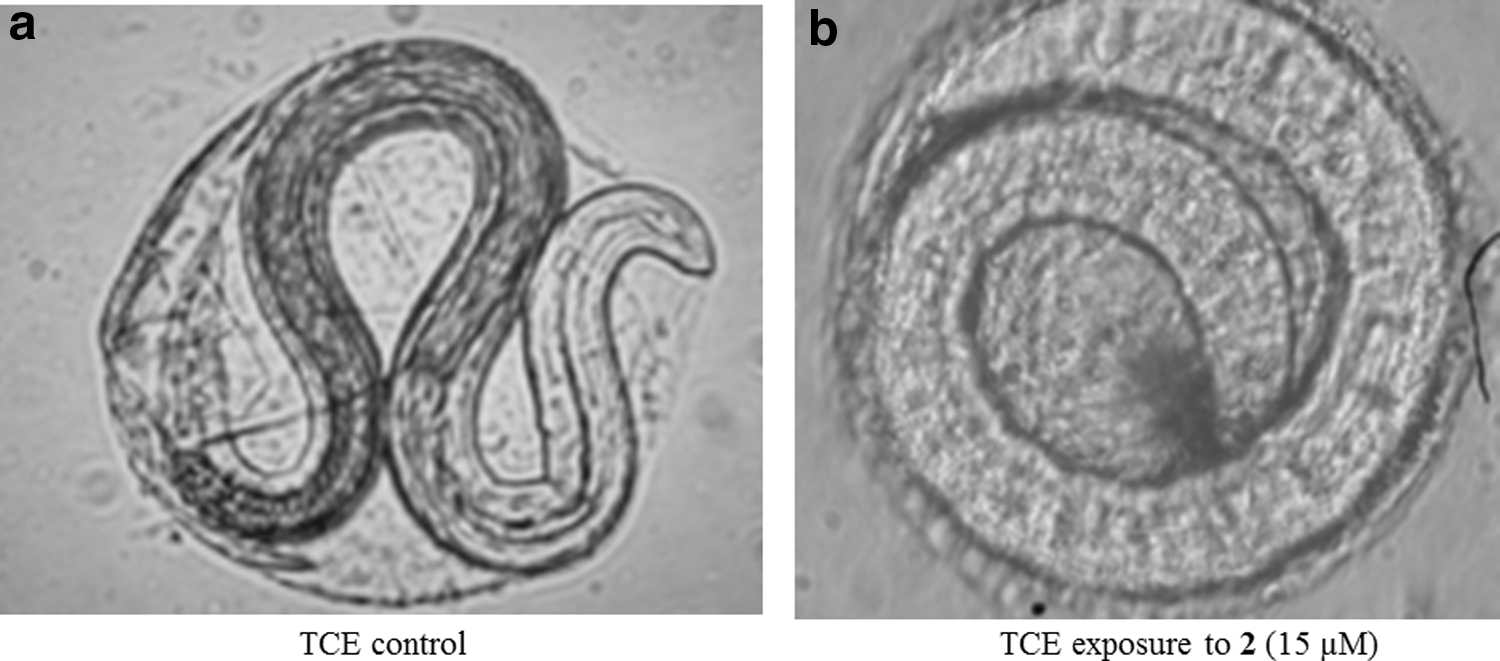
Morphology of parasites within the egg
The morphology of the TCEs was another characteristic that was considered in this study. The control test showed a TCE with intact structures (Fig. 3a), and clear delineation, homogeneity, and differentiation were observed in each organism.
The TCEs exposed to
These observed structural changes may be due to the presence of the azole complexes since they inhibit some of the steps in the synthesis of tubulin in parasite cell walls. The exact mechanism by which the metal azole complexes generate this anti-TCE activity remains unclear.
Cytotoxicity
The cytotoxicities of these compounds toward hepatocytes cells were evaluated. In the cytotoxicity studies, the compounds did not show notable cytotoxicity in the first 24 h (Fig. 4). The viability of the hepatocytes was always higher than 60% for all compounds independent of the concentration.

Cytotoxicity of
This is the first time metal compounds derived from azole have been used against TCEs. Interestingly, the compounds did not show signs of cytotoxicity against the murine cell line; therefore, they could be potential anti-TCE substances.
Conclusion
In summary, we have synthesized and characterized a new organic salt derived from azole. The effects of this salt and four metal complexes derived from azole on the larval motility of Toxocara canis eggs (TCEs) were evaluated. The in vitro assays showed that the compounds in general have moderate anti-TCE activities. The low motility of the larvae and morphological damage indicated that compound
Footnotes
Acknowledgments
J. Hurtado wishes to thank the Universidad de los Andes and the science faculty and Chemistry Department for providing funding. K. Vazquez wishes to thank the Universidad Autónoma de Nuevo Leon and Facultad de Medicina Veterinaria y Zootecnia for providing funding.
Ethical Approval
This article does not contain any studies with human participants performed by any of the authors.
Database Linking
CCDC 1565069 contains the supplementary crystallographic data for C19H25Cl4FeN4. These data can be obtained free of charge from the Cambridge Crystallographic Data Centre, Cambridge, UK.
Author Disclosure Statement
No conflicting financial interests exist.
References
Supplementary Material
Please find the following supplemental material available below.
For Open Access articles published under a Creative Commons License, all supplemental material carries the same license as the article it is associated with.
For non-Open Access articles published, all supplemental material carries a non-exclusive license, and permission requests for re-use of supplemental material or any part of supplemental material shall be sent directly to the copyright owner as specified in the copyright notice associated with the article.
