




Abstract
Introduction:
Anaplasma/Ehrlichia species are tick-transmitted pathogens that cause infections in humans and numerous domestic and wild animal species. There is no information available on the molecular characteristics and phylogenetic position of Anaplasma/Ehrlichia spp. isolated from tick species from different geographic locations in Iran. The aim of this study was to determine the prevalence, molecular characteristics, and phylogenetic relationship of both Anaplasma spp. and Ehrlichia spp. in tick species isolated from different domestic animals from two different geographical locations of Iran.
Methods:
A total of 930 ticks were collected from 93 cattle, 250 sheep, and 587 goats inhabiting the study areas. The collected ticks were then investigated for the presence of Anaplasma/Ehrlichia spp. using nested PCR based on the 16S rRNA gene, followed by sequencing. Sequence analysis was done based on the data published in the GenBank on Anaplasma/Ehrlichia spp. isolates using bioinformatic tools such as the standard nucleotide BLAST.
Results:
Genome of Anaplasma or Ehrlichia spp. was detected in 14 ticks collected in Heris, including 5 Dermacentor marginatus, 1 Haemaphysalis erinacei, 3 Hyalomma anatolicum, and 4 Rhipicephalus sanguineus, also in 29 ticks collected in Chabahar, including 14 R. sanguineus, 8 D. marginatus, 3 Hyalomma Anatolicum, and 4 Hyalomma dromedarii. Partial analysis of the 16S rRNA gene sequence of positive samples collected from goats and sheep showed that they were infected with Anaplasma/Ehrlichia spp. that were 94–98% identical to ovine Anaplasma and 91–96% identical to Neoehrlichia and Ehrlichia spp.
Conclusion:
The various ticks identified in this study suggest the possible emergence of tick-borne diseases in animals and humans in these regions. R. sanguineus and D. marginatus seem to be predominant vectors responsible for anaplasmosis in these regions. Partial sequence analysis of the 16S rRNA gene showed that A. ovis is genetically polymorphic in these regions. Furthermore, an association between the genetic heterogeneity of this microorganism and the geographical regions of Anaplasma strains was found. This study also showed that those ticks that were collected from the same geographical origin were infected with closely related strains of Anaplasma.
Introduction
T
Several species of Anaplasma have been detected in domestic animals, including A. marginale, A. ovis, A. centrale, A. bovis, A. phagocytophilum, and A. platys (Dumler et al. 2001). Ixodid ticks play a critical role in maintaining Anaplasma species in nature. The important role of Ixodes ricinus in the cocirculation of A. phagocytophilum in different habitats has been previously demonstrated (Sytykiewicz et al. 2012; 2015). It has been reported that Ixodes, Rhipicephalus, Dermacentor, and Amblyomma genera are the main vectors of Anaplasma and/or Ehrlichia bacteria in different regions of the world (Rar and Golovljova 2011). These pathogens have been previously found on sheep, cattle, goats, humans, and ticks in several parts of Iran. Rhipicephalus sanguineus and two I. ricinus tick vectors for Anaplasma have been reported from Iran (Hosseini-Vasoukolaei et al. 2014).
Nested PCR (nPCR) has been shown to be a highly sensitive and specific test for diagnosis of anaplasmosis (Ramos et al. 2009). Anaplasma/Ehrlichia spp. contain one ribosomal RNA operon, where the 16S rRNA gene is separately located from the gene pair 23S–5S rRNA (Dunning Hotopp et al. 2006). DNA sequences of 16S rRNA genes of Anaplasma/Ehrlichia spp. are amplified using PCR and used as molecular approaches for phylogenetic analysis. Differentiation of the Anaplasma genera is based upon genetic analyses of 16S rRNA and surface protein genes (Liu et al. 2005). In spite of well-characterized Anaplasma species, a number of new Anaplasma genetic variants have been increasingly detected in ticks and vertebrates using molecular techniques (Yang et al. 2016).
There is no information available on the molecular characteristics and phylogenetic position of Anaplasma/Ehrlichia spp. isolated from tick species of different geographic locations in Iran. This study was conducted to determine the prevalence of Anaplasma/Ehrlichia spp. and to investigate molecular characteristics of Anaplasma/Ehrlichia spp. in tick species isolated from different domestic animals in southeastern and northwestern regions of Iran for the first time.
Additionally, the genetic characteristics of detected Anaplasma/Ehrlichia spp. were investigated in comparison with other Anaplasma/Ehrlichia spp. in various hosts. To identify the species within the genera Anaplasma/Ehrlichia circulating among animals in the southwest and northeast of Iran, phylogenetic analysis was performed based on the partial 16S rRNA gene of any Anaplasma/Ehrlichia isolated from sheep, cattle, and goats in these regions.
Materials and Methods
The survey was performed between June 2015 and September 2015 in rural areas of Chabahar and Heris situated in the southeast and northwest of Iran, respectively.
Heris is the center of one of the weaving areas in the Iranian part of East Azerbaijan and located in northwestern Iran at 38°14′50′′N 47°06′59′′E. The climate of East Azerbaijan is affected by Mediterranean continental as well as cold semiarid climate. Chabahar is located on the Makran coast of the Sistan and Baluchestan province of Iran at 25°17′31′′N 60°38′35′′E. The county of Chabahar has hot humid weather in the summer and warm weather in the winter, giving it a hot desert climate. Western winds in the winter bring about scattered rainfalls in this region, and very occasionally winds from the Indian monsoon affect the region.
The sampling was done through 2015 in a period corresponding to seasonal tick activity. Inclusion criterion to select animals was that they had no clinical signs of illness. Tick sampling was carried out using a forceps from the whole body of each animal at different time intervals. The samples were kept in dry tubes containing 70% alcohol. Tubes were labeled with the geographic origin and the origin of the animals such as sheep, goats, and cows. Specimens were transferred to the Entomology Laboratory, School of Public Health, Tehran University of Medical Sciences. Collected ticks were identified based on their morphological characteristics, including the shape of the capitulum, festoon, and hypostome, scutum, eyes, spiracle, genital groove, adanal shield, spur of coxa, and other characteristics (Saghafipour et al. 2014).
Totally, there were 93 unengorged ticks; at least three collected ticks, taking into account tick species or by animal species, were randomly selected and tested for the presence of Anaplasma or Ehrlichia DNA using nPCR.
DNA extraction
Total DNA was extracted using the G-spin™ Genomic DNA Extraction Kit (iNtRON Biotechnology, Korea) by grinding each tick in an Eppendorf microtube after maintaining 5 min of incubation in a liquid nitrogen tank and using a glass pestle, according to the method previously described by Khazeni et al. (2013).
nPCR assay
The extracted DNA was resuspended in sterile distilled water and stored at −20°C until used in nPCR. The 16S rRNA gene of Anaplasma/Ehrlichia species was amplified with two rounds of nPCR. The primers for the first round were Ehr1 (5′-GAACGAACGCTGGCGGCAAGC-3′) and Ehr2 (5′-AGTA [T/C]CG[A/G]ACCAGATAGCCGC-3′) and, for the second round, they were Ehr3 (5′-TGCATAGGAATCTACCTAGTAG-3′) and Ehr4 (5′-CTAGGAATTCCGCTATCCTCT-3′). A total of 20 μL PCR first-round reaction mixture was prepared, containing 10 mM Tris-HCl (pH 9.0), 30 mM KCl, 1.5 mM MgCl2, 250 mM of each deoxynucleoside triphosphate (Roche, Penzberg, Germany), 0.5 μM of each primer (CinnaGen, Tehran, Iran), 1 U Taq DNA polymerase (CinnaGen, Tehran, Iran), 2 mL of DNA, and nuclease-free H2O to bring the volume up to 20 μL. All the thermal stages were performed using a thermocycler (Eppendorf AG, Humburg, Germany). The thermocycler was set to 3 min at 94°C, followed by 35 cycles, each consisting of 1 min at 94°C for further denaturation, 1 min at 57°C for annealing, and 1 min at 72°C for extension, and then a final extension for 5 min at 72°C. The products of the first round of PCR were diluted 1:9 in ultrapure water and 2 μL of this dilution was then used as the template for the second round of PCR, which was carried out under the same conditions and reaction mixture as the first round except that Ehr3 and Ehr4 were used as the primers (Rar et al. 2008). The PCR products were electrophoresed on 1.5% agarose gel. Anaplasma DNA obtained from the Department of Parasitology, Faculty of Veterinary Medicine, University of Tehran, was also run on each gel as the positive control and double distilled water was used as the negative control. The size of each PCR product was estimated using a 100–1500-bp molecular weight ladder (Roche, Germany) run on the same gel as the marker.
DNA sequencing and phylogenetic analysis
Positive PCR products obtained from the 16S rRNA gene (three samples for each region) were purified using the Roche High PCR Purification Kit (Bioneer). The purified PCR products were directly subjected to sequencing by Seqlab (GmbH, Germany). Sequence analysis was performed considering Anaplasma spp. Iranian isolates published in GenBank (GenBank accession No: KM517580.1, KT601343.1) by applying bioinformatic tools such as the standard nucleotide BLAST (Altschul et al. 1990). Sequences were aligned with the ClustalW program (Thompson et al. 1994). To have a global and clear visualization of the strains' genotypes and their relationships, phylogenetic trees were constructed based on sequencing of 16S rRNA by treetop software using two algorithms, including clustering and topological algorithms. The phylogram was presented in the PHYLIP format (Misawa and Tajima 2000). The GenBank accession numbers of the 16S rRNA gene sequences used to analyze percent identity and to construct a phylogenetic tree were as follows: KM517580.1, KT601343.1, JQ839010.1, KU686794.1, KU865475.1, AY098730.1, and KP830113.1.
Results
A total number of 3000 animals, including 950 sheep, 1550 goats, and 500 cattle, were inspected for tick infestation. A total number of 930 ticks of various species were collected from the inspected animals in the study areas (Table 1). The prevalence of ticks infesting animals in both regions is shown in Table 1.
Molecular findings
A total of 93 unengorged ticks were randomly selected and tested for the presence of Anaplasma and Ehrlichia DNA. Since the pair of primers used in this study could amplify a target fragment in both species, nPCR and gel analysis revealed that 46.2% (43 of 93) of examined ticks were positive for either Anaplasma or Ehrlichia species.
The amplicon size was found to range between 480 and 484 bp corresponding to the 16S rRNA gene of Anaplasma/Ehrlichia species. No amplification product was detected in the negative controls (Fig. 1). Genome of Anaplasma or Ehrlichia species was detected in 51.16% (22/43), 34.89% (15/43), and 13.95% (6/43) of ticks collected from goats, sheep, and cattle, respectively. Anaplasma or Ehrlichia DNA was detected in 29 ticks in Chabahar, including 14 R. sanguineus, 8 D. marginatus, 3 Hyalomma Anatolicum, and 4 Hyalomma Dromedarii, as well as in 14 ticks in Heris, including 5 D. marginatus, 2 Haemaphysalis erinacei, 3 Hyalomma Anatolicum, and 4 R. sanguineus.
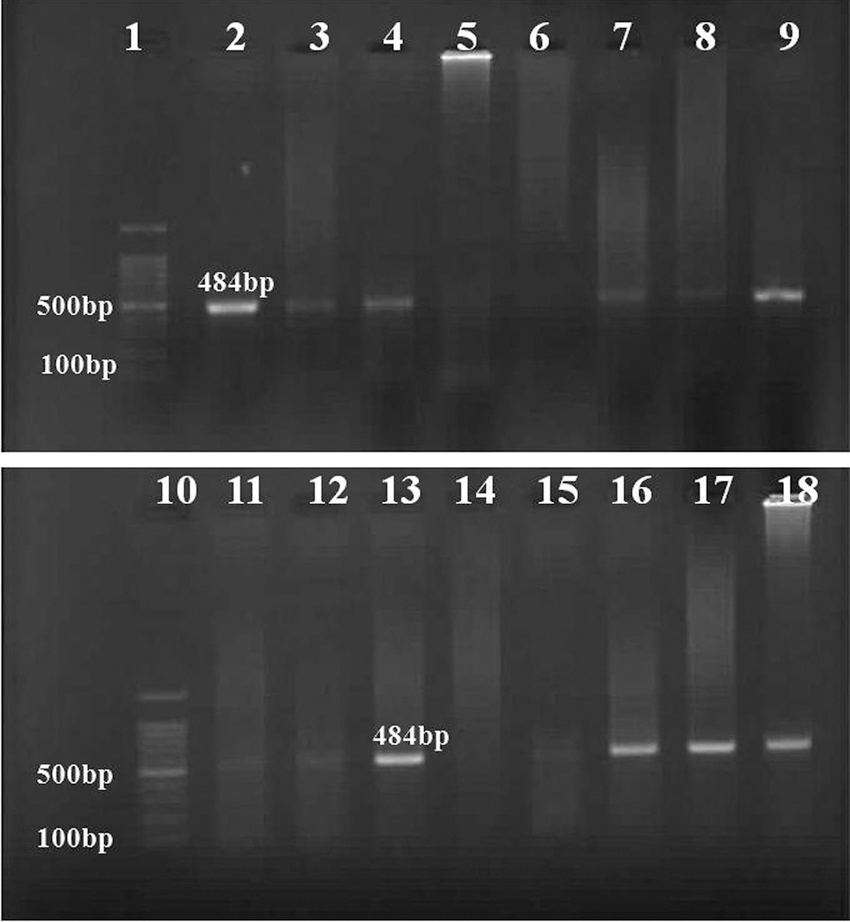
Results of the electrophoresis of products of nested PCR-based amplification of 16S rRNA extracted from various ticks. The 18 lanes contain a molecular weight ladder (lanes 1 and 10), the products from Anaplasma/Ehrlichia (lanes 3, 4, 7, 8, 9, 11, 12, 13, 15, 16, 17, and 18), a negative control (lane 6), a positive control (lane 2), and negative samples (lanes 5 and 14).
To characterize the Anaplasma or Ehrlichia species detected in ticks from various animals, all the 12 positive PCR samples against Anaplasma or Ehrlichia in ticks collected from 4 sheep, 4 goats, and 4 cattle from both Heris and Chabahar (six samples for each region) were randomly sequenced using both the forward and reverse primers and the consensus sequences were submitted to GenBank and subsequently analyzed. All the 12 amplicons were sequenced and 6 good quality sequences were obtained, while the other 6 sequences were of poor quality. The poor quality sequences were excluded from further analysis. This is usually because some sequences were not clearly generated, often because of poor separation of the fragments in the gel electrophoresis steps. The good quality consensus sequences were submitted to the GenBank and analyzed subsequently.
The partial 16S rRNA gene sequence analysis showed that two of D. marginatus and one of H. erinacei collected from goats in Heris with 482–484 bp length were infected with Anaplasma spp. that was 94–98% identical to Iranian A. ovis present in the GenBank database (GenBank accession No: KM517580.1 and KT601343.1).
Furthermore, two of the R. sanguineus, collected from sheep in Chabahar, with 480–490 were infected with Anaplasma spp. that was 92–95% identical to A. ovis present in the GenBank database (GenBank accession No: KM517580.1). Additionally, the partial 16S rRNA gene sequence analysis of one of the Hyalomma anatolicum amplicons collected from goats in Chabahar showed infection with Ehrlichia spp. that was 96% identical to Neoehrlichia and 91% identical to a Ehrlichia spp. present in the GenBank database (GenBank accession No: KU865475.1, AY098730.1). These sequences were also aligned with those of Anaplasma existing in the GenBank database and their similarity percentages were calculated. The results of BLAST search of Anaplasma 16S rRNA sequence against those published previously for other Anaplasma spp. revealed the highest similarity with those of ovine Anaplasma.
Based on partial sequencing of 16S rRNA patterns, the phylogeny tree grouped the six genotypes into five clusters (Fig. 2). Cluster I contained isolated strains 1, 2, and 3 from ticks collected from the same geographical region (from Heris) as well as cluster II that contained strains 4 and 5 (from Chabahar). Cluster III contained Anaplasma spp. present in the GenBank database. Isolated strain 6 contained Ehrlichia belluno (GenBank accession No: AY098730.1) and Neoehrlichia mikurensis (GenBank accession No: KU865475.1) located in cluster IV. Rhipicephalus sanguineus (Accession No: KP830113.1) that was used as an outgroup isolate was located in cluster V.
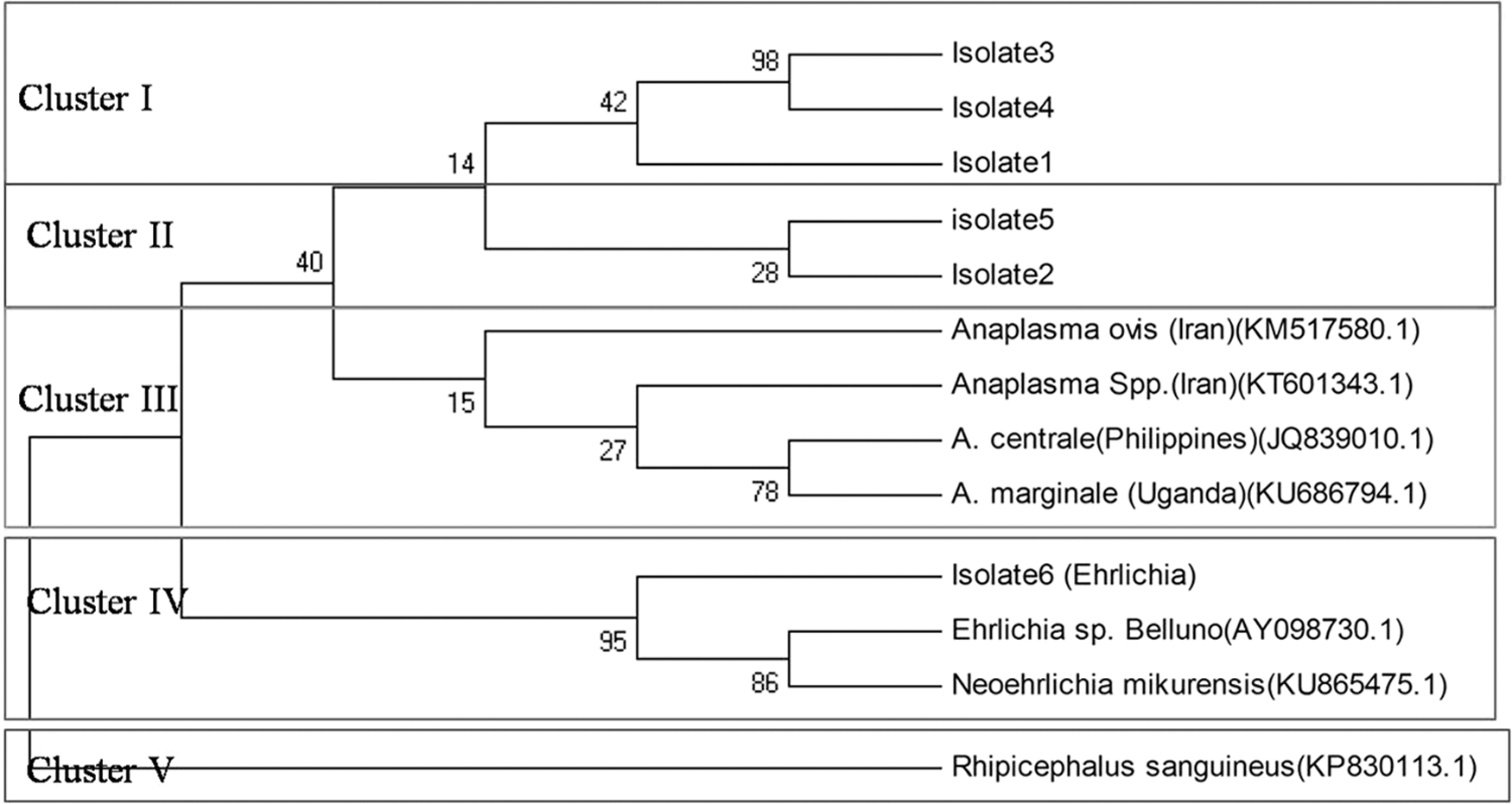
A phylogenetic relationship between all Anaplasma/Ehrlichia isolates, using the average distance algorithm. Rhipicephalus sanguineus (accession no: KP830113.1) was used as the outgroup to root the tree. Only bootstrap values higher than 50% are indicated on each branch.
Discussion
The primary aim of this study was to determine the prevalence of Anaplasma/Ehrlichia Spp. as well as molecular characterization of the detected microorganisms from various tick species isolated from different domestic animals in two different geographical regions of Iran, including the southeast and northeast. Previous studies have investigated the presence of Anaplasma spp. in a limited geographic area of Iran (Razmi et al. 2006, Hosseini-Vasoukolaei et al. 2014, Saghafipour et al. 2014). Additionally, the genetic characteristics and phylogenetic analysis of the 16S rRNA gene of any isolated Anaplasma/Ehrlichia from sheep, cattle, and goats in these regions were investigated. Molecular techniques, including PCR and sequence analysis, have been effectively applied for epidemiological study and phylogenetic analysis of tick-borne pathogens, such as Anaplasmataceae family (Rar et al. 2008). It has been shown that a comprehensive molecular survey can identify the coexistence of two or three different organism genospecies in adult ticks. In this study, nPCR was used to detect the Anaplasma and Ehrlichia DNA targeting the 16S rRNA gene as previously described by Rar et al. (2008). A broad-range 16S rRNA gene nPCR assay, followed by partial sequencing of this gene, has been successfully used to identify and classify several previously unknown Anaplasma and Ehrlichia parasites (Noaman et al. 2009). The target fragment of the 16S rRNA gene of Anaplasma/Ehrlichia species was amplified in 42.6% (43/93) of ticks. The results showed that 32.55% (14 of 43) of infected ticks belonged to Heris, which is situated in the northeast of Iran, and the others were collected in Chabahar (67.45%, 29/43), which is situated in the southeast of Iran. In Heris, 57.6% of goats, 26.8% of sheep, and 15.6% of cattle were infested with various species of ticks, while the percentages of tick-infested sheep, goats, and cattle in Chabahar were 26.9%, 66.6%, and 6.5%, respectively. Based on the findings of this study, Anaplasma or Ehrlichia species was detected in 85.57% (37 of 43) of collected ticks from goats and sheep.
The partial 16S rRNA gene sequence analysis showed that two of the D. marginatus and one of the H. erinacei collected from goats in Heris as well as two of the R. sanguineus in Chabahar were infected with Anaplasma spp. that was 92–98% identical to Iranian A. ovis present in the GenBank database. Expression of the 16S rRNA gene was only detected in samples that belonged to the Hyalomma anatolicum tick collected from goats in Chabahar. Based on the findings of this study, R. sanguineus and D. marginatus are the predominant vectors responsible for anaplasmosis in these regions. A. ovis is a tick-borne pathogen of sheep, goats, and wild ruminants. Anaplasmosis is an important disease causing high economical losses (Yabsley et al. 2005). Dermacentor spp. and Rhipicephalus spp. ticks are the main vectors of A. ovis (Rar and Golovljova 2011). It was shown in our study that the prevalence of A. ovis was different between sheep and goats, with higher prevalence for goats in the southeastern region and for sheep in northwestern Iran. To identify the genetic diversity of the species within the genus Anaplasma circulating among animals in two regions of Iran, the sequence of the 16S rRNA gene of any isolated microorganisms from various ticks was analyzed. The 16S rRNA gene is a ubiquitous molecular marker for identification of bacterial species, and the ever-expanding databases of sequence information are useful tools for bacterial strain identification (Srinivasan et al. 2015). Intra- and interspecies genetic variations and evolutionary relationships within genera of Rickettsiales bacteria have been also characterized using 16S rRNA gene sequences, especially in the case of those bacteria causing human and animal diseases (Rar and Golovljova 2011). The different strains of A. ovis in this study are designated as 1–4. The similarity among sequence types 1–4 ranged from 94% to 99%, showcasing the genetic diversity of A. ovis in these regions of Iran. The Hyalomma anatolicum collected from goats was infected with Ehrlichia spp. that was 96% identical to Neoehrlichia and 91% identical to a Ehrlichia spp. present in the GenBank database (Labbé Sandelin et al. 2015, Rar et al. 2015). The genera Anaplasma and Ehrlichia have been recently defined in cluster Candidatus Neoehrlichia comprising all bacteria of the family that are transmitted by ixodid ticks to mammalian hosts (Rar et al. 2015). Based on partial sequencing of 16S rRNA patterns, the phylogeny tree grouped the six genotypes into five clusters. Cluster I contained isolated strains 1, 2, and 3 from ticks collected from Heris as well as cluster II that contained strains 4 and 5 collected from Chabahar. Isolated strain 6 contained Ehrlichia belluno and Neoehrlichia mikurensis located in cluster IV. In this study, sequencing of 16S rRNA was used for identification in phylogenic analysis. The 16S rRNA amplicon sequencing technique is based on amplification of small fragments of one or two hypervariable regions of the 16S rRNA gene and used for taxonomic identification (Galan et al. 2016).
The data obtained in this study revealed that those ticks that were collected from the same geographical origin were infected with closely related strains of Anaplasma. These findings showed a possible correlation between the genetic heterogeneity of Anaplasma and the geographical origin.
Conclusion
The various ticks identified in this study suggest the possible emergence of tick-borne diseases in animals and humans in these regions. D. marginatus and R. sanguineus are the predominant vectors responsible for anaplasmosis in these regions. The demonstration of Anaplasma in these tick species collected from goats and sheep implies the possible role of domestic ruminants in the epidemiology of the disease in these areas. The results reported herein have important implications for the control of Anaplasma/Ehrlichia spp. in northeastern and southwestern regions of Iran. The information about Anaplasma/Ehrlichia outbreak and genotypes in different hosts and regions helps the establishment of surveillance and control programs for these pathogens. It was shown in our study that the prevalence of A. ovis was different between sheep and goats, with higher prevalence for goats in the southeastern region and for sheep in the northwestern region of Iran. The sequence analysis of the 16S rRNA gene showed that A. ovis is genetically polymorphic. The results of this study showed heterogeneity and polymorphism in A. ovis in southeastern and northwestern Iran. This study also showed that those ticks that were collected from the same geographical origin were infected with closely related strains of Anaplasma.
Footnotes
Acknowledgment
The authors would like to thank Chabahar Gulf Marine Company for its support.
Author Disclosure Statement
No competing financial interests exist.