




Abstract
Brucellosis and chlamydiosis are important zoonotic diseases and bluetongue virus (BTV) is an arthropod-borne viral disease of ruminants. They are widely distributed around the world, cause large economic losses, and significant harmful effects on humans. However, epidemiological information relating to transmission from commercial sika deer in China is limited. Therefore, from 2016 to 2017, 458 sika deer blood samples were collected from three cities in Jilin Province in China. The Brucella antigen and specific antibodies to Chlamydia and BTV were examined using RT-PCR, indirect hemagglutination assay, and ELISA, respectively. The prevalence of Brucella was found to be 12.9% (59/458) and the seroprevalence of Chlamydia and BTV was 14.4% (66/458) and 17.0% (78/458), respectively. Seasonality was considered a risk factor for the presence of Brucella or BTV in sika deer and the region was considered a risk factor for Chlamydia infection. These data provides reference values for both further research and disease control.
Introduction
B
Chlamydiosis is an important zoonotic disease caused by various Chlamydia spp. Chlamydia are obligate intracellular pathogens with a wide range of hosts, including humans (Di Francesco et al. 2012). These pathogens can be transmitted to humans through inhalation of the agent dispersed in dust particles and air. Chlamydia infection can cause a wide range of diseases in mammals and birds, such as polyarthritis, conjunctivitis, enteritis, atypical pneumonia, encephalomyelitis, and abortion (Ni et al. 2015). Owing to the zoonotic potential of these organisms, animal diseases associated with Chlamydia should be given more attention.
Bluetongue (BT) is an arthropod-borne viral disease of ruminants, which is caused by BT virus (BTV). BTV is a member of the Orbivirus genus of the family Reoviridae. BTV is widely present in sheep and some wild ruminants, and can cause febrile disease. Goats and cattle are most often subclinically infected with BTV, and often asymptomatic, while transmission occurs throughout the herd. In addition, BTV can infect deer populations resulting in a fatal hemorrhagic disease. It can cause huge losses for those who breed livestock worldwide. Therefore, it is listed by the World Organization for Animal Health (OIE) as a notifiable disease in international trade.
The breeding of domestic sika deer (Cervus nippon) as an animal of important economy is very prevalent in the Northeast of China. Many sika deer products are consumed by humans, including deer blood, penises, and embryos. However, there is limited information on the prevalence of Brucella, Chlamydia, and BTV infections in sika deer in China. Therefore, we surveyed the prevalence of these pathogens in sika deer in Jilin Province, Northeast China, and evaluated potential risk factors.
Materials and Methods
Ethics approval and consent to participate
All operations were handled in strict accordance with the Good Animal Practice requirements of the Animal Ethics Procedures and Guidelines of the People's Republic of China. This study was approved by the Animal Ethics Committee of Jilin Agricultural University.
Sample collection
Between June 2016 and August 2017, a total of 458 blood samples of sika deer were collected from three cities (Changchun, Liaoyuan, and Dunhua) in Jilin Province, Northeast China (Fig. 1). All samples were selected randomly in accordance with the permission from each of the farm owners. Each blood sample was divided into two parts: one part was used for the extraction of genomic DNA from Brucella spp. using a commercially available TIANamp Genomic DNA Kit (TIANGEN BIOTECH CO., LTD, Beijing, China), whereas the other part of the sample was centrifuged at 1000 × g for 5 min to separate the serum from cells.
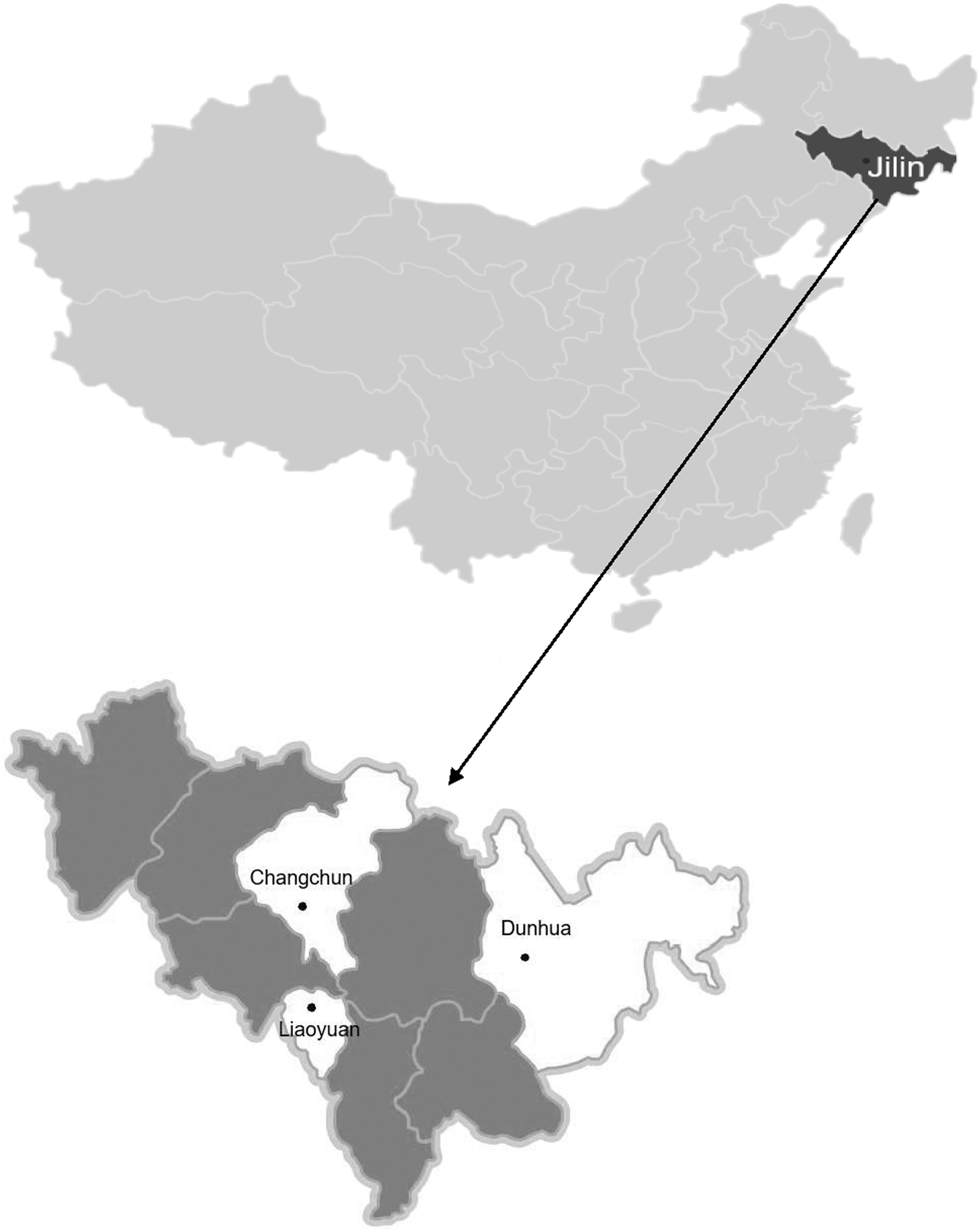
Geographic distribution of sika deer sampled regions in China.
Detection of Brucella spp. in blood samples
The DNA samples were tested by real-time PCR using the primers specific for IS711 of Brucella spp. reported in a previous study (Hinić et al. 2008). The real-time PCR system and program for IS711 of Brucella spp. were also referred to in this study.
Serological examination of Chlamydia and BTV
The serological examination of Chlamydia was performed using the commercial indirect hemagglutination assay (IHA) kit (Lanzhou Veterinary Research Institute of the Chinese Academy of Agricultural Sciences, Lanzhou, Gansu Province, China) following the recommended protocol (Ni et al. 2015). The sensitivity and specificity of the experiment are 100% and 95%, respectively (Qin et al. 2014). Samples, which reacted at dilutions of 1:16 or higher, were considered positive for Chlamydia antibodies. Those samples that were positive at dilutions of between 1:4 and 1:16 were retested. Positive and negative controls were included in each test.
The BTV-specific IgG antibodies in sera were detected using a commercially available ELISA kit (Veterinary Medical Research and Development Inc., Pullman, WA) following the manufacturer's instructions. The used ELISA kit has a better sensitivity and specificity, and also used to detect the BTV infection in other ruminants (Ma et al. 2017).
Data analysis
The variation in prevalence of Brucella and seroprevalence of Chlamydia and BTV in sika deer for different variables (region, gender, and season) were analyzed by a chi-squared test using SAS version 9.1 (SAS Institute, Inc.). If the p value of the variable was <0.05, this variable was considered a risk factor.
Results
Prevalence and risk factor analysis of Brucella
Fifty-nine (12.9%, 95% CI = 9.8–16.0) out of 458 DNA samples were Brucella positive according to real-time PCR amplification of the IS711 gene fragment. Brucella-positive sika deer were found in all herds and the prevalence in Dunhua, Changchun, and Liaoyuan regions were 9.3%, 13.4%, and 15.3%, respectively. Female deer had a higher prevalence (16.6%) than male deer (11.1%). Sika deer had a higher prevalence of Brucella during summer (15.5%) than during autumn (8.9%). Moreover, there was a significant difference by seasonality (p < 0.05) according to conditional forward stepwise logistic regression (Table 1).
CI, confidence interval; OR, odds ratio.
Seroprevalence and risk factor analysis of Chlamydia
Out of the 458 sika deer, 66 (14.4%, 95% CI = 11.2–17.6) tested positive for Chlamydia antibodies by IHA. Different levels of seroprevalence were detected in Dunhua, Changchun, and Liaoyuan regions, with respective prevalence of 8.6%, 19.4%, and 17.0%. Male deer had a slightly lower seroprevalence (14.0%) than female deer (15.2%). For different seasons, seroprevalence was higher during summer (16.2%) than during autumn (11.7%). In addition, analysis showed that gender and season were not significant risk factors for Chlamydia (p > 0.05). However, region was considered to be a risk factor for Chlamydia infection in sika deer (p < 0.05) (Table 2).
Seroprevalence and risk factor analysis of BTV
Antibodies to BTV were detected in 78 of 458 (17.0%, 95% CI = 13.6–20.5) sika deer by indirect ELISA test. BTV seroprevalence in deer ranged from 14.8% to 18.3% in different cities. Female deer had a higher seroprevalence (19.9%) than male deer (15.6%). Seroprevalence of deer sampled during summer (20.1%) was significantly higher than that during autumn (12.2%), and season was considered to be a risk factor (p < 0.05) (Table 3).
Discussion
Brucellosis and chlamydiosis are important zoonotic diseases and BTV is an arthropod-borne viral disease of ruminants. They have worldwide distribution and can cause large economic losses and significant harmful effects on humans.
This is the first study to investigate the prevalence of Brucella and seroprevalence of Chlamydia and BTV in commercial sika deer in China. A total of 458 blood samples were collected from sika deer and tested using real-time PCR, IHA, and ELISA, respectively. We observed a Brucella prevalence of 12.9%, and seroprevalence rates of 14.4% for Chlamydia and 17.0% for BTV in Jilin Province, Northeast China. Our data demonstrate that these diseases are widespread in Northeast China.
The prevalence of Brucella in sika deer in this study (12.9%) was lower than the reported prevalence in dairy cattle (18.0%) in Tanzania (Mathew et al. 2015), and that in cattle (16.0%) and humans (27.3%) in Mongolia (Zolzaya et al. 2014). However, the rate observed in our study was much higher than the 0.5% reported in cows from Kazakhstan, the 1.1% reported from dairy cattle in China (Ning et al. 2013), and the 6.3% reported from cattle and buffalo in Pakistan (Ali et al. 2017).
Chlamydiosis is an important zoonotic disease and requires further attention. The Chlamydia seroprevalence in this study of 14.1% was lower than the seroprevalence of 17.9% observed in domestic rabbits in China (Ni et al. 2015), 17.6% in dogs in China (Tian et al. 2014), and 19.6% in sheep in Croatia (Spičic et al. 2015). Similarly, this rate was higher than 0.9% in buffalo, 4.7% in cattle, and 9.8% in sheep in India (Chahota et al. 2015), whereas it was also lower than the 7.3% observed in wild birds in Poland (Krawiec et al. 2015). Moreover, the Chlamydia seroprevalence in this study was similar to the seroprevalence of 13.9% noted in roe deer in France (Aaziz et al. 2015).
Even though there is no evidence that BTV infects humans, it has caused a large number of economic losses for those who breed livestock worldwide and thus it should not be ignored. We demonstrated that the seroprevalence of BTV was 17.0% in commercial sika deer. This result was slightly lower than the 17.3% seroprevalence noted among Tibetan sheep and yaks in China (Ma et al. 2017), and much lower than the 95.9% noted in cattle in Madagascar (Andriamandimby et al. 2015). However, the seroprevalence rate was higher than the seroprevalence noted in deer in Ireland, which was 0% (Graham et al. 2017).
These differences could be due to a large number of factors including the diagnostic methods, geographic differences, species, feeding conditions, and sample sizes. Thus, it is difficult to provide specific reasons for these noted differences by country.
Moreover, this study has shown that the prevalence of both Brucella and BTV was significantly different during summer and winter in sika deer and seasonality should be considered a risk factor. The sika deer had a 1.9-fold higher risk for infection with Brucella during summer than during autumn (odds ratio [OR] = 1.9, confidence interval [95% CI] = 1.0–3.4). Similarly, sika deer had a 1.8-fold higher risk of infection with BTV during summer than during autumn (OR = 1.8, 95% CI = 1.1–3.1). These may be associated with the mode of transmission of Brucella and BTV. Furthermore, deer living in Changchun had a 2.6-fold higher risk of being infected with Chlamydia than those living in Dunhua (OR = 2.6, 95% CI = 1.1–5.8), and deer living in Liaoyuan had a 2.2-fold higher risk of infection than those living in Dunhua (OR = 2.2, 95% CI = 1.1–4.2). This is an indication that farmers within Changchun and Liaoyuan should pay more attention to prevention and control of Chlamydia in deer and other animals, where possible.
In conclusion, this is the first study to investigate the prevalence of Brucella and seroprevalence of Chlamydia and BTV in commercial sika deer in China. We demonstrated that Brucella, Chlamydia, and BTV are widespread. The results of this study revealed that seasonality was a significant risk factor for brucellosis and BTV infection, whereas region was a significant risk factor for Chlamydia. It is important to carry out integrated control strategies and measures to prevent and control these infections in sika deer in China. These data provided baseline information for the control of these diseases and such bacteria should be considered in diagnosis of deer diseases, whereas regular testing of animals would detect subclinical or asymptomatic BTV.
Footnotes
Acknowledgments
This work was supported by the National Natural Science Foundation of China (grant no. 31672577) and the Science and Technology Support Program of Science and Technology Agency of Jilin Province, China (grant no. 20160209006YY).
Author Disclosure Statement
No competing financial interests exist.