




Abstract
Rickettsia species are obligate intracellular Gram-negative bacteria that can infect a wide range of vertebrate hosts, including humans, through arthropod vectors such as Ixodid ticks. These ticks are a threat to humans and animals because they are the primary vectors or reservoirs for rickettsiae, which is of public health importance. In this study, we report the identification and percent of positive of Rickettsia spp. in ticks collected from Cangxi County, Southwest China. Haemaphysalis longicornis comprised 48.4% of the 188 ticks collected followed by Haemaphysalis flava (29.3%), H. doenitzi (12.2%), and Haemaphysalis hystricis (10.1%). A total of 63 (33.5%) ticks were positive with Rickettsia spp., with 48 (57%) of those being H. longicornis and 15 (27.3%) being H. flava. The other two tick species, however, did not have any ticks positive for rickettsial DNA. In addition, two different Rickettsia spp. were identified using gltA and ompA as molecular markers. The sequence of Rickettsia sp. infecting H. longicornis ticks was found to be identical to the Rickettsia sequences from Northeastern China and Japan (KF728367, AB516964). Phylogenetic analyses using these molecular markers support the notion that Rickettsia species from H. flava is the most close to a member of the Candidatus Rickettsia gannanii subgroup. The high percentage of Rickettsia positive in this Southwest China region suggests potential public health threat in the future and warrants to be monitored.
Introduction
R
Rickettsia sp. are transmitted by hematophagous arthropods that need repeated blood feedings for their reproductive and metabolic needs, thus allowing them to be vectors of numerous devastating infectious diseases (Attardo et al. 2005, Hou et al. 2015, Wang et al. 2017). Ticks are obligate ectoparasites of vertebrates and are distributed worldwide in various natural environments. The Ixodid ticks continue to be a threat to human and animal health because they are the primary vectors or reservoirs of an array of rickettsiae species. In Asia, Haemaphysalis longicornis, Haemaphysalis flava, Haemaphysalis concinna, Ixodes persulcatus, Ixodes nipponensis, and Dermacentor silvarum have been reported to be infected with R. japonica, R. conorii, Rickettsia honei, Rickettsia sibirica, Rickettsia monacensis, Rickettsia heilongjiangensis, and several unclassified Rickettsia spp. (Chung et al. 2006, Speck et al. 2012, Tian et al. 2012, Shin et al. 2013, Cheng et al. 2016, Igolkina et al. 2016, Yang et al. 2016, Noh et al. 2017). Recently, more Rickettsia species causing Spotted fever group (SFG) rickettsioses have been detected in China (Wei et al. 2015, Guo et al. 2016). However, research on the species associated with tick-borne rickettsial diseases is still limited in less developed regions of China.
In Cangxi County, Sichuan Province, Southwest China, a H. concinna tick outbreak was reported in 2005 (Sun et al. 2006). This species was found in 97.4% of the county, consistent with previous reports, and no new Rickettsia species were reported in the region. Following the availability of molecular techniques, new Rickettsia species have been identified in places where no rickettsioses were reported (Dobler and Wolfel 2009). In this study, a preliminary investigation was conducted to identify the presence and prevalence of Rickettsia spp. in ticks collected from Cangxi County, Sichuan Province, Southwest China.
Materials and Methods
Tick collection
Cangxi County is located in northern Sichuan province and belongs to Guangyuan City. This county is spread from N31°37′ to 32°10′ and from E105°43′ to 106°28′ and is a low mountain area. During May 2014, ticks were collected from three sites around this county (Table 1). All ticks were collected using drag cloth or removed from animals. Then, all collected ticks were identified based on morphological characteristics visualized through a light microscope (Lu and Wu 2003). Morphological identification was confirmed by sequencing the mitochondrial 16S ribosomal RNA (16S rRNA) gene as described previously (Rydkina et al. 1999). The ticks were stored at −80°C until DNA extraction.
Tick Collection Information
DNA extraction
Genomic DNA from individual adult or nymph tick was isolated using the MasterPure DNA Purification kit (Epicentre Biotechnologies) with a modified protocol. Briefly, whole body of the arthropod was mixed with 5-mm stainless steel beads and 50 μL of Tissue and Cell Lysis Solution. Samples were disrupted using a Tissuelyser-24 (Jingxin, Shanghai, China) and then centrifuged for 1 min. To each sample, 250 μL of Tissue and Cell Lysis Solution containing 1 μL of Proteinase K (50 μg/μL) was added. Samples were then incubated at 65°C for 60 min, and placed on ice for 5 min. Then, 150 μL of MPC Protein Precipitation Reagent was added and vortexed. After centrifugation, supernatants were transferred to clean tubes and DNA was recovered using ice-cold isopropanol and resuspended in DNase-free water.
Molecular detection
Extracted DNA was screened for the presence of Rickettsia spp. using two-step PCR assays. The first step was a PCR screen for genus Rickettsia by amplifying a 381 bp fragment of the rickettsial citrate synthase (gltA) gene (Roux et al. 1997) by using RpCS.877p (5′-GGGGGCCTGCTCACGGCGG-3′) and RpCS.1258n (5′-ATTGCAAAAAGTACAGTGAACA-3′) primers. Then, all samples were screened by a nested PCR assay, which amplified a fragment of rickettsial outer membrane protein A (ompA) gene (Regnery et al. 1991, Blair et al. 2004) by using SFG Rickettsia-specific outer primers, Rr190.70 (5′-ATGGCGAATATTTCTCCAAAA-3′) and Rr190.701 (5′-GTTCCGTTAATGGCAGCATCT-3′), and inner primers Rr190.FN (5′-AAGCAATACAACAAGGTC-3′) and Rr190.RN (5′-TGACAGTTA TTATACCTC-3′). To avoid cross-contamination, a dedicated clean room was used for PCR assays and another room for DNA extraction.
Sequencing and phylogenetic analysis
The PCR products were purified using the QIAquick (Qiagen) kit and directly sequenced. Sequences of ompA, and gltA (Blair et al. 2004) genes retrieved from GenBank (National Center for Biotechnology Information, Bethesda, MD) were used to align and identify those from unknown SFG Rickettsia species. Sequence alignment and neighbor-joining phylogenetic analyses were conducted using MEGA version 7 (Kumar et al. 2016). Tree support was evaluated by bootstrap with 1000 replications.
GenBank accession numbers
The gltA and ompA sequences of Rickettsia from Haemaphysalis ticks are deposited in GenBank with the accession numbers MF590724 to MF590727, respectively.
Results
In total, we collected 188 ticks: 92 from hosts and 96 from vegetation (Table 1). The majority of those collected were H. longicornis 89 (48.4%), followed by H. flava 55 (29.3%), H. doenitzi 23 (12.2%), and Haemaphysalis hystricis 19 (10.1%). Notably, only H. longicornis was collected from all three sites.
Among the 188 ticks collected, 63 (33.5%) were positive for Rickettsia spp. in PCR screening assays. A large proportion of those positive for Rickettsia spp. were H. longicornis (48, 52.7%), followed by H. flava (15, 27.3%). However, other two tick species were not positive in the Rickettsia PCR screening assays. In Tongan Village, 16 out of 26 (61.5%) H. longicornis ticks collected from goats and 31 out of 55 (56.4%) ticks collected from plants were positive for Rickettsia spp. In Longquan Village, 13 out of 44 (29.5%) H. flava ticks collected from dogs and 2 out of 11 (18.2%) ticks collected from plants amplified Rickettsia spp. DNA.
Two different Rickettsia spp. were identified by sequencing gltA and ompA genes. The gltA sequence (MF590724) from H. longicornis was 100% identical to those from Northeastern China and Japan (KF728367 and AB516964). The ompA sequence (MF590726) from H. longicornis tick was 99.8–100% identical to those obtained from Southern China and Korea (KC888951, AF169629).
The gltA (MF590725) and ompA (MF590727) sequences were 98.98% identical to uncultured Rickettsia sp. clone Y27-1 (KT921891) and 98.1% identical to uncultured Rickettsia sp. clone Y27-1 (KT921894), respectively. Uncultured Rickettsia sp. clone Y27-1 was isolated from Haemaphysalis qinghaiensis ticks from Gannan, China.
Topology of the phylogenetic tree produced from the gltA gene sequence is similar to the ompA tree (Figs. 1 and 2). The Rickettsia spp. in H. longicornis from Cangxi County clustered together with other Rickettsia isolated from H. longicornis collected from several different locations in East Asia. The Rickettsia spp. in H. flava from Cangxi County clustered with the clade containing Rickettsia from H. qinghaiensis, and this clade was separate from other known SFG Rickettsia spp. (Yang et al. 2016).
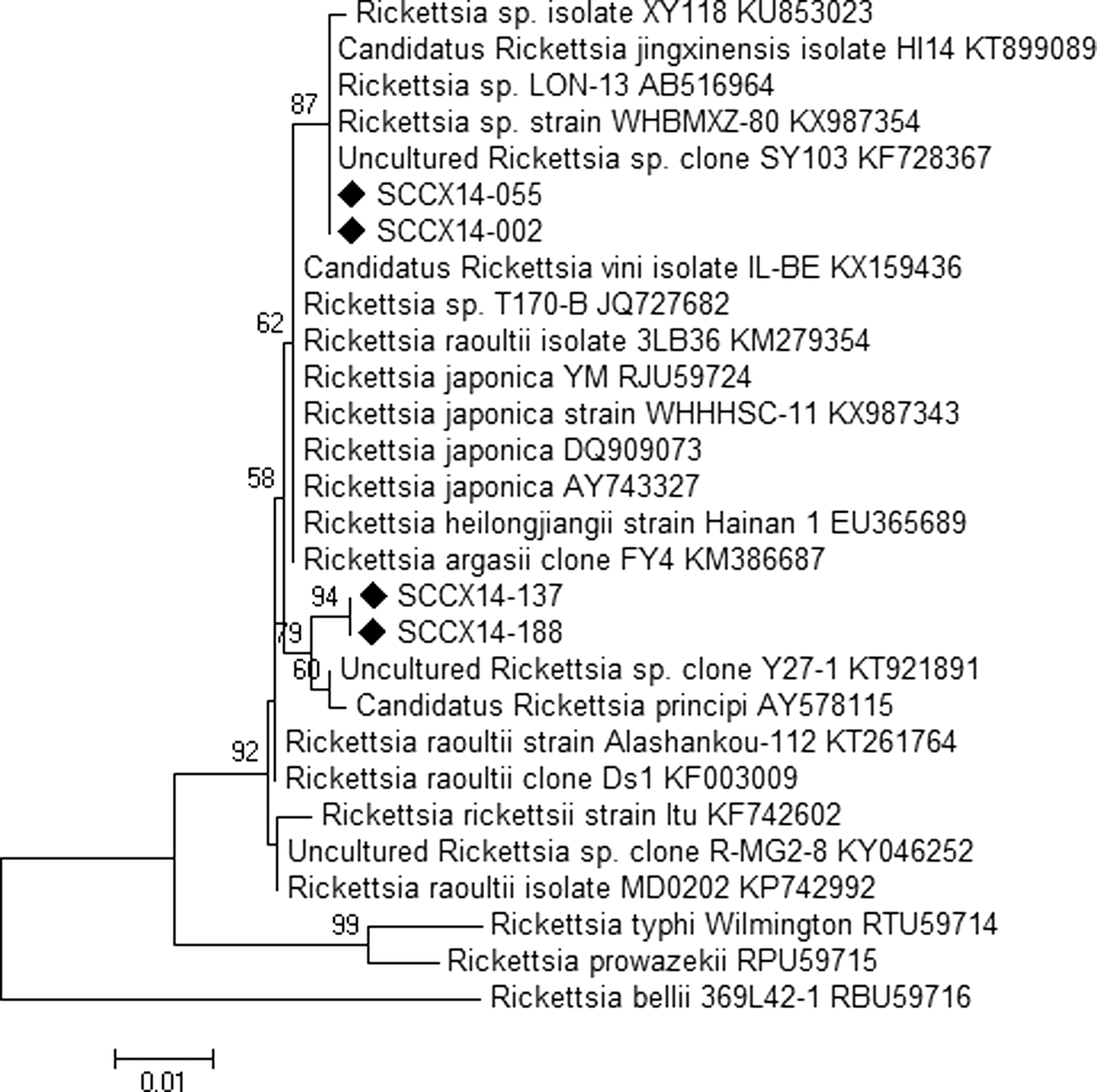
Phylogenetic analysis of Rickettsia spp. in Haemaphysalis ticks. The tree was constructed by NJ method based on gltA gene sequences. Bootstraps analysis was performed with 1000 replicates. Rickettsia spp. MF590724 (SCCX14-002 and SCCX14-055 from Haemaphysalis longicornis) and MF590725 (SCCX14-137 and SCCX14-188 from Haemaphysalis flava) obtained in this study are denoted with “♦.” The sequence uncultured Rickettsia sp. clone Y27-1 KT921891 is from Haemaphysalis qinghaiensis.
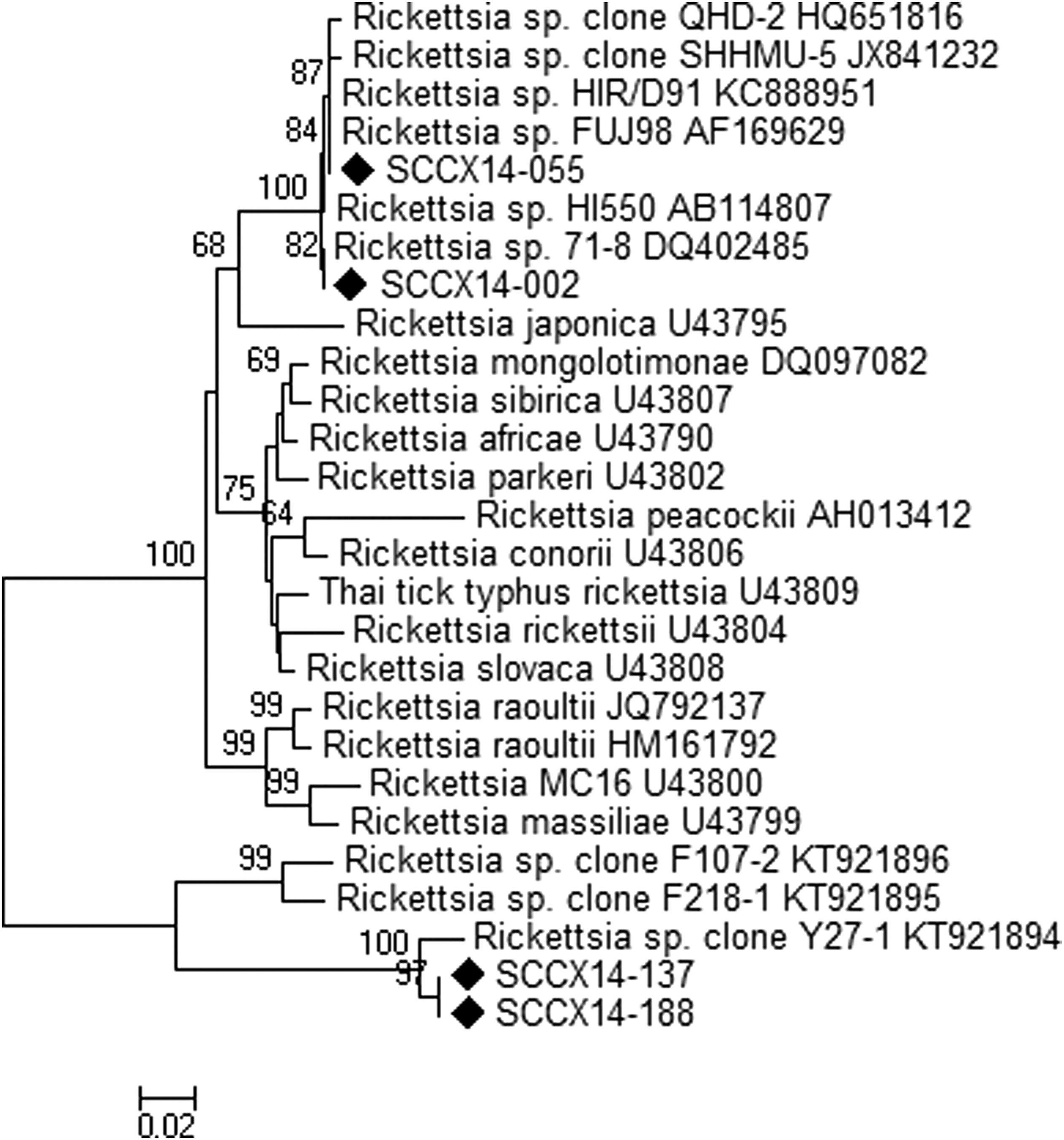
Phylogenetic analysis of Spotted Fever Group Rickettsia spp. in Haemaphysalis ticks. This tree was constructed based on ompA gene sequences by NJ method. Bootstraps analysis was performed with 1000 replicates. Rickettsia spp. MF590726 (SCCX14-002 and SCCX14-055 from H. longicornis) and MF590727 (SCCX14-137 and SCCX14-188 from Haemaphysalis flava) obtained in this study are denoted with “♦.” The sequences uncultured Rickettsia sp. clone Y27-1 KT921894, clone F107-2 KT921895, and clone F218-1 KT921896 are from H. qinghaiensis.
Discussion
In this study, we collected four different tick species belonging to the genus Haemaphysalis from Cangxi County. The results showed a highly diverse tick species in this region, although H. concinna, which were reported to be the cause for the 2005 outbreak, was not found in our collection. It is likely that in the past 10 years, this species may have moved from this area, or simply due to the different collection time warranting a more intensive survey. Currently, H. longicornis is the most abundant tick species in this region from this study. Three tick species were collected from the Longquan Village, likely due to its well-conserved ecological environment. Tourists visiting this area should be alerted about tick bites as this village is a popular tourist area.
We report a relatively high percent of Rickettsia spp.-positive H. longicornis in the Tongan Village. The 58% in our study is higher than 5.5% reported in H. longicornis ticks from Zhejiang province (Sun et al. 2015) and 6.9% from Hebei province (Zou et al. 2011). Such high prevalence could be due to our tick collection from a goat farm, where Rickettsia spp. could be transferred between ticks in goats and ticks in the Tongan Village. The Rickettsia species detected in H. longicornis ticks remains unclassified and is not associated with any known rickettsiosis yet. However, visitors to this area should be cautioned due to the high percent of Rickettsia spp. that may cause a future public health concern.
The percent of Rickettsia species DNA in H. flava was also relatively high. The 27% of positive rate is higher than 1% in H. flava reported in Korea (Noh et al. 2017), but similar to H. qinghaiensis (18.5%) (Yang et al. 2016).
Based on our results, the Rickettsia species from H. flava is the most close to a member of the Candidatus Rickettsia gannanii subgroup. Both gltA and ompA phylogenetic trees show this Rickettsia species clustered in a clade with “Candidatus Rickettsia gannanii.” Yang et al. (2016) reported that the novel SFG Rickettsia species from H. qinghaiensis has three clusters (Fig. 1, e.g., clone Y27-1, F107-2, and F218-1), and that they formed a distinct new subgroup out of SFG, TG, and R. bellii in genus Rickettsia. The Rickettsia species in H. flava from Cangxi County is likely a new member of the Candidatus Rickettsia gannanii subgroup. The Cangxi County, Sichuan Province, and Gannan District, Gansu Province, are separated by ∼500 km. The relationship between the two Rickettsia species needs additional investigation.
Conclusions
We detected a high percent of H. longicornis and H. flava ticks collected from Cangxi County, Sichuan Province, with Rickettsia DNA. We have also shown a Rickettsia species from H. flava and its close relationship with Candidatus Rickettsia gannanii subgroup from Gannan, China.
Footnotes
Acknowledgments
The authors thank Jianhan He (Chengdu City Center for Disease Control and Prevention), Yongchao Jia and Yan Yang (Guangyuan City Center for Disease Control and Prevention), and Nan He and Deming Wu (Cangxi County Center for Disease Control and Prevention) for help with tick collections. This study was supported by National Science Foundation of China (no. 31672291) and Presidential Fund of University of Chinese Academy of Sciences. We would like to thank LetPub for providing linguistic assistance during the preparation of this article.
Author Disclosure Statement
No competing financial interests exist.