




Abstract
In recent years, there has been an increasing risk of hematophagous bat attacks in Latin America, where livestock production is a basic source of food for local populations. In Ecuador, livestock represented an important part of agricultural output. Some cases of cattle bitten by bats in the province of Santa Elena have been reported; however, no previous studies have been conducted to determine the magnitude of the attacks and the associated risk factors. In this research, a cross-sectional descriptive study was performed recording attacks of hematophagous bats (Desmodus rotundus) through visual inspection of livestock and the capture of specimens by mist nets. Generally, the prevalence of D. rotundus attacks on farms was 69%, whereas attacks on bovine had 24% of prevalence. From the captured specimens, 93% were identified as D. rotundus and within the 30% of the captured D. rotundus, no infections for rabies virus were diagnosed. The univariable analysis used for estimating the risk factors associated with bat attacks showed that corrals away from populated centers present the highest risk (odds ratio [OR] = 19.864; p = 0.0004), followed by tree density >30 per hectare (OR = 16.313; p < 0.0001) and predatory birds of bats (OR = 15.375; p < 0.0001); a binary logistic regression model showed “corrals away from populated centers” (OR = 23.47; p = 0.006) as the main risk factor. Linear regression analysis showed good correlation between the number of bovines attacked and the number of bites (R2 = 0.977; p < 0.0001) suggesting some feeding patterns of D. rotundus. This study could be used as a starting point for understanding the feeding habits of D. rotundus and factors governing their attacks in coastal regions of Ecuador, and potential occurrences of rabies infections. With this knowledge, surveillance and control programs can be supported to improve rabies transmission monitoring.
Introduction
Hematophagous bats (Order: Chiroptera) are widely distributed in Latin America, comprising three species (Desmodus rotundus, Diphylla ecaudata, and Diaemus youngi) (Scheffer et al. 2015). In Ecuador, the best known species is D. rotundus (Pinto 2009). It feeds exclusively on vertebrate's blood and has a gregarious habit that allows them to coexist with other species (Carollia perspicillata, Phyllostomus hastatus, Saccopteryx bilineata, Trachops cirrhosus, Noctilio albiventris, Lonchophyla thomasi, Uroderma bilobatum, Artibeus lituratus, and Molossus molossus) inside hollow trees, caves, and abandoned mines (Villa 1976, Almansa and Garcia 1980, Quintana and Pacheco 2007, Sampedro et al. 2008, Castro et al. 2016).
Unlike other bats, Desmodus has excellent abilities to move by walking or jumping on the ground (Quintana and Pacheco 2007). Its feeding habits depend on prey accessibility and prey location by smelling feces of target animals. The buccal cavity of Desmodus poses heat sensors that allow the location of hottest spots (superficial blood vessels) in their prey (Scheffer et al. 2015). The feeding process starts with painless bites from adapted teeth, the segregation of saliva mixed with anticoagulant substances (e.g., draculin, desmodontina), and suckling time between 10 and 40 min (∼20 mL of blood per day) (Fernandez et al. 1998).
In the twenty-first century, attacks produced by the common vampire (D. rotundus) have affected the economy in Latin America. A decline in livestock production has been caused by nonlethal effects such as weight loss, skin damage, and reduction of dairy products (Anderson et al. 2014, Scheffer et al. 2014). Furthermore, zoonotic diseases such as rabies virus can be transmitted by Desmodus bites, causing potential lethal effects in both animals and humans (Ormaeche and Gomez 2007, Quintana and Pacheco 2007, Galicia et al. 2014). Previous studies have stated the transmission of diseases from this species in Ecuador (AGROCALIDAD 2014, Romero et al. 2014), Chile (Ministerios de Salud Pública Chile 2015), Perú (Ministerio de Salud Pública LIMA 2012), Brazil (Mialhe 2014), Venezuela (Caraballo 1996), and Mexico (Mendes et al. 2009) among others. However, the knowledge about the factors increasing the attacks and the potential transmission of diseases from hematophagous bats is still insufficient (Fahl et al. 2015).
In Ecuador, bovine rabies transmitted by hematophagous bats has had disturbing levels of incidence in the provinces of the Amazon Region, and recently other provinces such as El Oro, Esmeraldas, Guayas, Loja, Manabí, and Tungurahua are considered at risk because of the presence of endemic hematophagous bats (Vizcaíno et al. 2016b). The epidemiological surveillance system of the official veterinary service of the Santa Elena province has registered the presence of hematophagous bat shelters and reported constant attacks on cattle, producing significant economic losses in this area (AGROCALIDAD 2014).
Few investigations about the ecology, distribution, and rabies transmission of D. rotundus in the coastal region of Ecuador are available. Therefore, the objective of this study was to identify the presence of D. rotundus for showing the prevalence and distribution of attacks on cattle in communes from Simón Bolívar parish—Santa Elena province. This study also intended to understand the attacking patterns of D. rotundus through the influence of some environmental factors and land use practices. In addition, the presence of rabies virus was analyzed in captured bats to estimate the risk of transmission to cattle and humans. Finally, the present study aims to contribute to the creation of baseline information for improving management and intervention methods, hence prioritize areas to prevent diseases transmitted by this species to animals and humans.
Materials and Methods
The study was carried out in the Simón Bolívar parish—Santa Elena province, from January to May 2014. The area was selected according to reports of bat attacks on cattle. Four communes were chosen as sampling locations (Limoncito, Cristo Rey, La Frutilla, and Los Vergeles) covering an area of 19,960 ha, which includes 65 farms with 1195 bovines (Fig. 1).
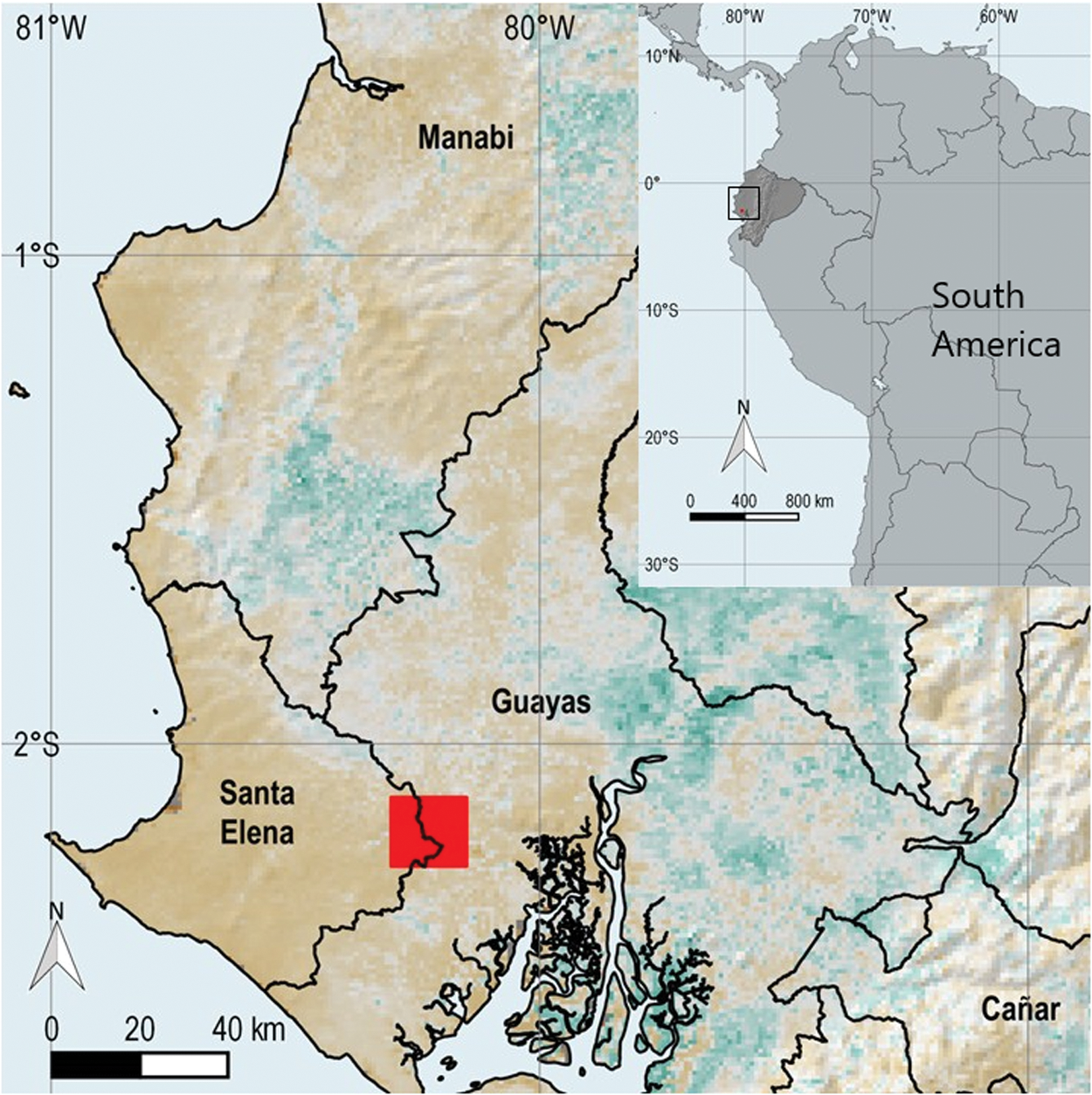
Study area. Red box comprises the four sampling locations. Color images are available online.
Farms within the study area were visited with technicians from the monitoring and control program of D. rotundus. A macroscopic inspection was performed on all cattle, identifying typical lesions from bat bites. In addition, an epidemiological survey was prepared based on previous studies (Moya et al. 2015). The survey was answered by farm owners for assessing the risk factors of bat attacks (Table 1).
Description of Data Collected
According to protocols used by the official veterinary service (Vizcaíno et al. 2016a), three mist nets were placed in each of the communes during the phase of the new moon, to capture bats and proceed with their taxonomic identification. The program of bat surveillance and control applies an anticoagulant (warfarin) to all D. rotundus for decreasing the population (Flores 2003). For this study, this treatment was not done in 30% of the captured hematophagous bats. Untreated bats were sent to the laboratory for the diagnosis of rabies to explore the virus circulation in reservoir populations.
Laboratory analysis
Analyses were done at the National Reference Center of Zoonoses of the National Institute of Public Health (INSPI). Tests of direct immunofluorescence and inoculation in suckling mice were performed for the detection of rabies virus (López et al. 2011).
Data analysis
Data were entered into a database, and univariate analysis was used to estimate proportions and measures of risk (odds ratio [OR]); in addition, a multivariate analysis was also performed using a binary logistic regression model. Correlation of risk factors for bat attacks in farms and quantitative regressions were also calculated. These analyses were performed using the Epi InfoTM 7 software and the IBM SPSS Statistics Data Editor (demo version).
Georeferenced information was used for spatial analysis considering the vegetative index and hematophagous bat attacks. The vegetation index was estimated by using satellite images (MYD13Q1.A2014041V005, MODIS sensor, Aqua satellite) corresponding to the sampling week (Didan 2015). The obtained data were processed in the Geographic Information System TerrSet (Eastman 2016).
Results
A total of 57 bats were captured. According to morphological characteristics 53 (93%) were identified as hematophagous bats (D. rotundus), and the other 4 individuals (7%) were not identified due to time constraints in the field. In the 30% (16/53) of the captured hematophagous bats tested for rabies virus, all specimens were rabies-negative. Farms attacked by hematophagous bats represented 69% (45/65), where at least one attack to bovine occurred, whereas the percentage of attacked bovines in all farms was 23.3% (278/1195) (Table 2).
Percentages of Attacked and Not Attacked Farms from Hematophagous Bats in the Four Communes of the Simón Bolívar Parish—Santa Elena Province
To establish predictive patterns of bat's attacks, linear regressions were performed. Correlations were found between the number of bovine attacked and the herd size (R2 = 0.57, p < 0.0001) (Fig. 2) and the number of bites with the number of cattle attacked (R2 = 0.97, p < 0.0001) (Fig. 3).
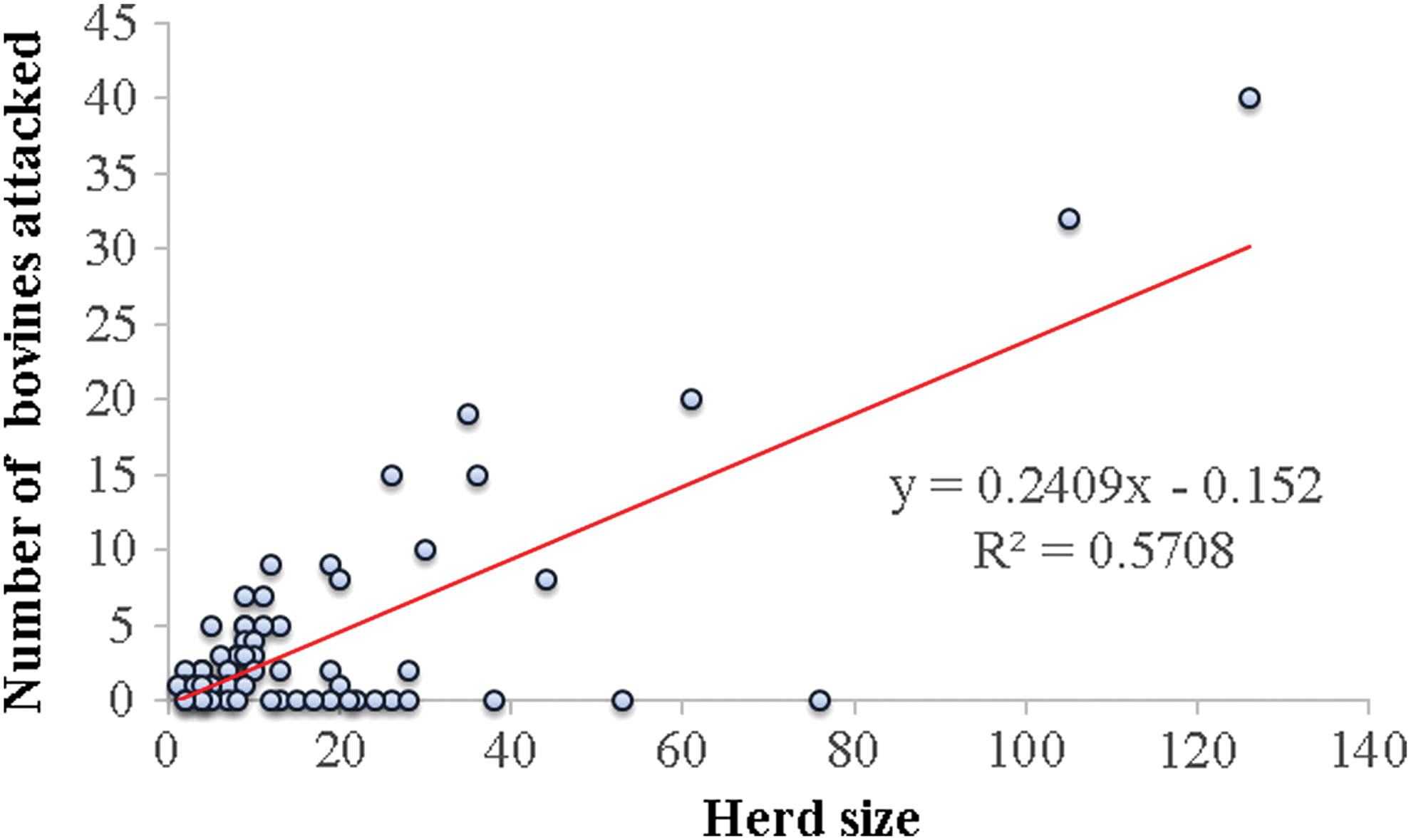
Relationship between the number of bovines attacked and herd size. Color images are available online.
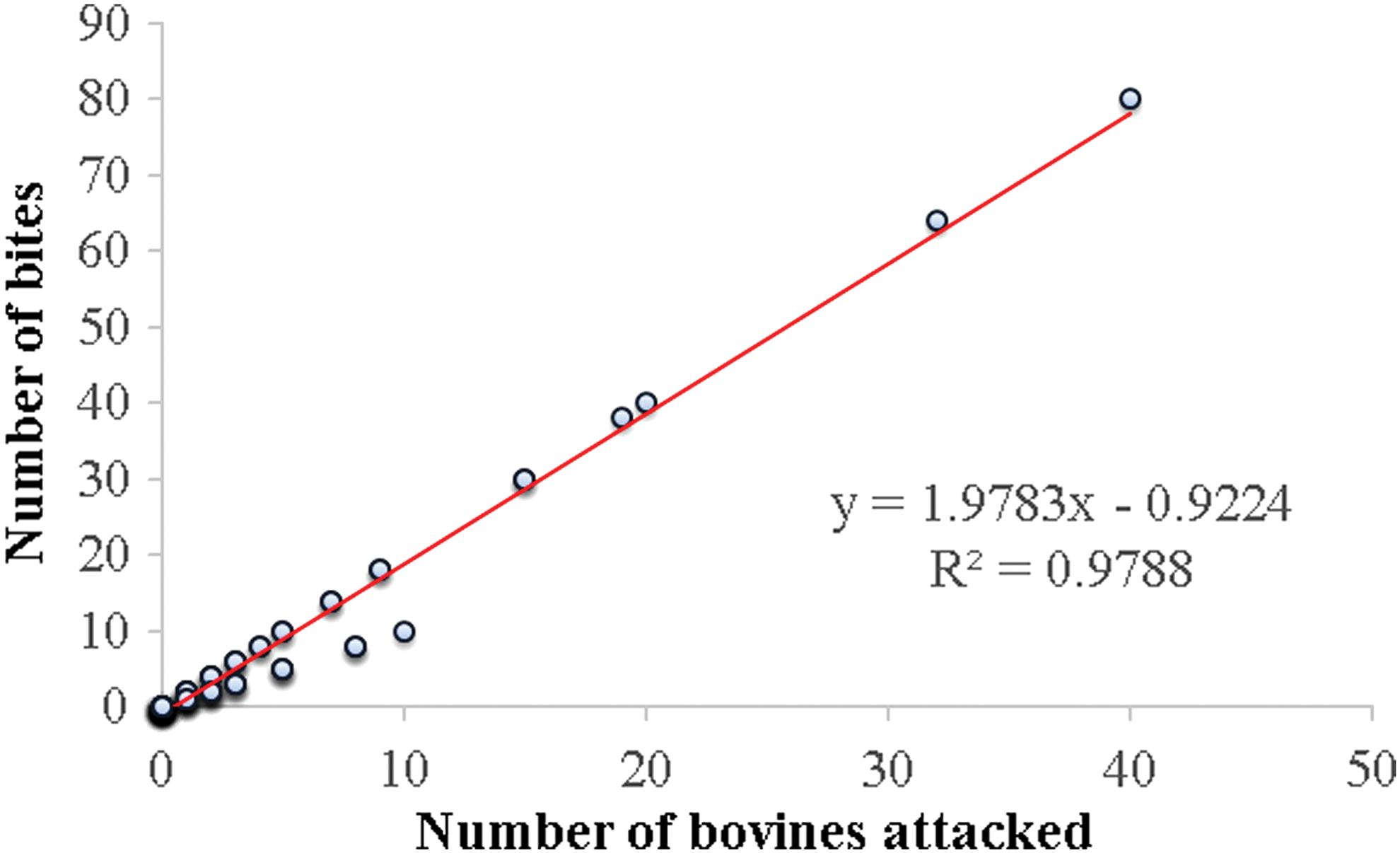
Relationship between the number of bites and bovines attacked. Color images are available online.
In relation to the risk estimation (Table 3), the univariate analysis shows highest risk ratios for “corrals away from populated centers” (OR = 19.864; p = 0.0004), “density of trees >30/ha” (OR = 16.313; p < 0.0001), “presence of bat predatory birds” (OR = 15.375; p < 0.0001), and “hunting of wild animals” (OR = 12.315; p = 0.0003). The factor “shared cattle corrals” presented the lower risk ratio (OR = 4.278; p < 0.0096). Results from multivariate analysis with all the risk factors indicate that “corrals away from populated centers” shows the highest risk ratio (OR = 23.47; p = 0.006) (Table 4).
Univariable Analysis of Risk Factors Associated with Bites of Hematophagous Bats in Cattle
Multivariable Analysis of Risk Factors Associated with Bites of Hematophagous Bats in Cattle
The spatial analysis shows that more attacks from hematophagous bats occurred in sites with high vegetation index (Fig. 4).

Vegetation index, attacked, and not attacked farms in the study area. Color images are available online.
Discussion
The presence of hematophagous bats (D. rotundus) in the rural sector of Santa Elena province was higher (93%) than other species of bats (7%). These results are similar to those obtained by Mendes et al. (2009) in an Amazonian reserve located in the northeast of Brazil in the town of Antonio Dino, which had few human settlements and D. rotundus captures corresponded to 95%. Another study carried out in a rural area of Paraguay also reported a high proportion (71%) of captured D. rotundus (Quintana et al. 2011). However, in a study from the Valle del Cauca-Colombia, low proportion of D. rotundus (0.83%) was detected and surpassed by insectivorous bats (81.15%), fructivorous bats (11.9%), and nectivorous bats (6.1%) (Nuñez et al. 2012). These percentages could be attributed to the fact that captures were done in urban areas and D. rotundus prefers to settle in small populated areas where they can find natural refuges (caves, hollow trees, etc.). The large percentage of hematophagous bats obtained in this study suggests the consideration of measures to prevent the rabies virus from entering the area, as well as to adopt reservoir control measures to avoid the impact of D. rotundus bites on livestock productivity such as skin damage and deaths from anemia (Anderson et al. 2014, Scheffer et al 2014).
Results on the prevalence of D. rotundus attacks indicate 69% on farms and 23.3% on bovine. In a study conducted by Mialhe (2014), the prevalence of attacks on cattle was 3% and for equines 28.6%, suggesting that D. rotundus apparently prefers to attack equines, probably because the thinner skin facilitates feeding. Since in this study the presence of equines was almost null, we attribute that the prevalence of hematophagous bat attacks could be related to the presence and distribution of species susceptible to bites. For instance Cárdenas (2017) indicated that populations of hematophagous bats living in less altered conditions may feed on diverse species, including wild animals.
Generally, attacks by hematophagous bats depend on the diversity and dynamics of the environment, as well as on land use practices (De Andrade et al. 2016). In this context, some factors associated with hematophagous bat attacks on cattle such as the high density of trees, the presence of bat predatory birds, hunting of wild animals, and presence of cattle's barnyards far from populated areas were analyzed in this study. Corrals located far from populated areas were at higher risk of being attacked by bats (OR = 19.864; p = 0.0004), followed by farms with tree density >30/ha (OR = 16.313; p = 0.0001), and the presence of bat predatory birds (owls and hawks) (OR = 15.375; p < 0.0001) suggesting that man-induced environmental modifications in bat habitats, ecological dynamics, and changing former wildlife areas into peri-urban areas might be important factors influencing hematophagous bat attacks (Mayen 2003). The multivariate analysis confirms that the risk factor “corrals away from populated centers” (OR = 23.466; p = 0.006) could be associated with strategies of living habits and food-searching behavior for helping the species survival. Furthermore, the epidemiological characteristics of rabies by hematophagous bats have been associated with topographic and geographical factors (Kobayashi et al. 2008). For instance, some migration patterns of rabies outbreaks have been mentioned by Lord (1980) who reported cases in areas near rivers that have trees for the protection of bats. Consequently, this study recommends more research on the influence of these factors, which are determinant for the control and surveillance of cases of rabies in cattle and humans.
Although in the study area the presence of the rabies virus was negative in the populations of hematophagous bats (reservoirs). It should be noted that previous studies from Lee et al. (2012), De Andrade et al. (2016), and Castro et al. (2016) have reported that D. rotundus has great resistance to ecological changes and a wide geographic distribution; therefore, outbreaks of rabies could occur within large areas (>500 km). In Ecuador, the OIE WAHIS surveillance system (World Animal Health Information System 2017) has reported an average of 46 outbreaks of bovine rabies per year in the period 2014–2017, causing large losses of animals and even humans in some cases (Correa 2011, Romero et al. 2014). Therefore, this study considers a latent risk that the rabies virus enters the province of Santa Elena.
The information generated in this study could help in the prioritization of areas at risk for hematophagous bat attacks and the implementation of prevention and control strategies in the transmission of the rabies virus. The shared approach “One health” may be a fundamental pillar for institutional partnerships to control cases of rabies. Thus, management and intervention methods for preserving human, animal, and environmental health require to be supported by the participation of rural population in campaigns on rabies vaccination for exposed people and animals, better access to veterinary services, and early warning systems for rabies as well as eco-friendly strategies to control D. rotundus populations based on knowledge of living habits and feeding behaviors.
Footnotes
Acknowledgments
The authors thank Magaly Valencia Avellán for her collaboration with the translation of this article.
Authors Disclosure Statement
No competing financial interests exist.