




Abstract
By the nature of their environment and behavior, free-roaming cats are at increased risk of exposure to a wide range of pathogens compared with client-owned cats. Consequently, free-roaming cats can act as a reservoir for possible zoonotic infections. In this study, 140 cats were prospectively recruited over a 12-month period from a free-roaming cat spay and neuter clinic and a local animal shelter in the state of Iowa. The presence of antileptospiral antibodies was measured using a microscopic agglutination test against six leptospiral serovars (canicola, pomona, icterhemorrhagiae, bratislava, hardjo, and grippotyphosa). In addition, serum samples were tested for the presence of antibodies against Toxoplasma gondii and Dirofilaria immitis using an ELISA and lateral flow immunoassay, respectively. Serum samples from 12/139 cats (8.6%) were positive for the leptospiral serovars tested, with bratislava having the highest prevalence. Cats were more likely to be positive in the spring than in the fall or summer. Positive titers to T. gondii and D. immitis were present in 42/140 cats (30%) and 9/140 cats (6.4%), respectively. Cats >72 months of age were more likely to be seropositive to T. gondii than cats in younger age groups. Feline Leptospira spp. seroprevalence was higher in this Midwestern location than has previously been reported elsewhere in the United States. Contrary to previously reported seasonal trends, this population was more likely to be Leptospira spp. seropositive in the spring rather than fall or summer. Seroprevalence of D. immitis in this geographical location was substantially lower than previous reports of free-roaming cats in the United States.
Introduction
Free-roaming cats have been shown to have higher seroprevalence to numerous pathogens than their client-owned counterparts (Nutter et al. 2004, Cong et al. 2016). There is a concern that free-roaming cats can act as a vector for transmission of infectious agents to other cats as well as other species, including humans (Pinsky et al. 1991, Weigel et al. 1999, Cunningham et al. 2008). Consequently, seroprevalence studies of free-roaming cats can be useful in estimating regional prevalence of certain pathogens.
The ease and availability of point-of-care tests for feline retroviruses have allowed for the rapid identification of seropositive free-roaming cats and has contributed substantially to our understanding of some of the risk factors associated with retroviral infections (O'Connor et al. 1991, Levy et al. 2006).
Serological surveys of leptospirosis in free-roaming as well as client-owned cats have been reported in many countries (Mylonakis et al. 2005, Lapointe et al. 2013, Chan et al. 2014, Rodriguez et al. 2014, Weis et al. 2017), including the United States (Markovich et al. 2012, Shropshire et al. 2016). Overall seropositivity in these studies has ranged from 5% to 35% with no clear association with clinical disease.
Owing to their role as the definitive host in its life cycle, feline toxoplasmosis has been extensively studied in free-roaming cat populations; some risk factors for seroprevalence, including age, hunting habits, and reproductive status, have been identified (Dubey et al. 2002, Ballash et al. 2015, Cong et al. 2016). Interestingly, the presence of cats has been noted as a potential risk factor for toxoplasmosis in other species, underscoring the importance of this species in maintaining toxoplasmosis in the environment (Fredebaugh et al. 2011).
In contrast, feline heartworm infection has mostly been studied in client-owned cats and cats with signs of cardiovascular or respiratory disease (Atkins et al. 1998, Lin et al. 2017). Data from the few existing studies of free-roaming cats using heartworm antibody testing have reported rates as high as 11% in this population (Luria et al. 2004, Fernandez et al. 2010).
In this study, we report the seroprevalence, including seasonal and age-related variations, of Leptospira spp., Toxoplasma gondii, and Dirofilaria immitis in a population of free-roaming cats living in a rural environment in Iowa.
Materials and Methods
Cats
Cats were recruited from a spay and neuter program for free-roaming cats (September 2015 to November 2016) as well as a participating animal shelter (January 2016 to December 2016). The specific county of capture was recorded when available. A venous blood sample (∼2–3 mL) was collected from the jugular or medial saphenous vein of each cat using a 3 cc syringe and 22G needle. Blood samples were stored in serum separator tubes and centrifugation was performed within 4 h of collection. Separated serum was stored at −80°C until serological testing was performed.
The reproductive status of female cats was determined based on a known history of spay or the presence or absence of a spay scar on the abdominal midline. The reproductive status of males was determined based on the presence or absence of testicles. For age analysis, cats had their ages estimated based on physical examination findings (presence of deciduous or adult dentition, severity of dental disease, and hair coat). For data analysis, cats were divided into three age groups: <6 months, 7–72 months, and >72 months. The moment of collection was classified as spring (March 21 to June 20), summer (June 21 to September 20), fall (September 21 to December 20), or winter (December 21 to March 20).
Testing
Retroviral testing was performed using a SNAP® FIV/FeLV Combo Test or SNAP® Feline Triple® ELISA kit (Idexx Laboratories, Westbrook, ME) according to manufacturer instructions. Serum samples were tested for antileptospiral antibodies by in-house microscopic agglutination test (MAT) using live cultures of canicola, pomona, icterohemorrhagiae, bratislava, hardjo, and grippotyphosa serovars (Veterinary Diagnostic Laboratory, Iowa State University, Ames, IA). The lowest serum dilution tested was 1:100; samples that demonstrated >50% agglutination at a serum dilution of 1:100 or greater were considered positive. Anti-T. gondii antibody testing was accomplished by use of an in-house nontitrated competitive ELISA (Veterinary Diagnostic Laboratory). Results were reported as a ratio of optical densities of the sample sera over the control sera (S/N ratio). S/N ratios >1.0 were considered positive. Circulating antibodies to D. immitis were detected by use of the Solostep® Feline Heartworm test lateral flow immunoassay (Heska, Loveland, CO, performed by Animal Health Diagnostic Center, Cornell University, Ithaca, NY). Heartworm antigen testing was performed using SNAP Feline Triple Test ELISA kit (Idexx Laboratories) according to manufacturer instructions.
Statistical analysis
Statistical analysis was performed using a commercial software (SAS v 9.4, Cary, NC). Logistic regression of seropositivity was modeled using age group, reproductive status, season, and weight as explanatory variables. Significance of effect of these variables on seroprevalence was determined using Wald chi-squared test. Odds ratios with a confidence interval of 95% were calculated to determine significance level as a predictor of seropositivity. Pearson correlation analysis was used to evaluate associations between different seropositive statuses. Results were considered statistically significant if p < 0.05.
Results
Cats
One hundred forty cats were recruited during the spring (n = 32), summer (n = 28), fall (n = 52), and winter (n = 28). One hundred four cats (74%) were sampled while under heavy sedation during a community spay/neuter and release program. Thirty-six cats (26%) from a local shelter were sampled using manual restraint. The county in which the cats were captured was recorded in 134 cases (Fig. 1). The study group was composed of 41 intact males, 11 neutered males, 71 intact females, and 16 spayed females. The reproductive status of one female was not recorded. The median weight of the cats included in this study was 2.65 kg (range 0.9–10.9 kg). Based on estimated ages, available for 136 cats, the median age was 12 months (range 2–144 months). Cats aged between 7 and 72 months were the most common age group (n = 96), followed by cats of 6 months or less (n = 32), and cats >72 months of age (n = 8).
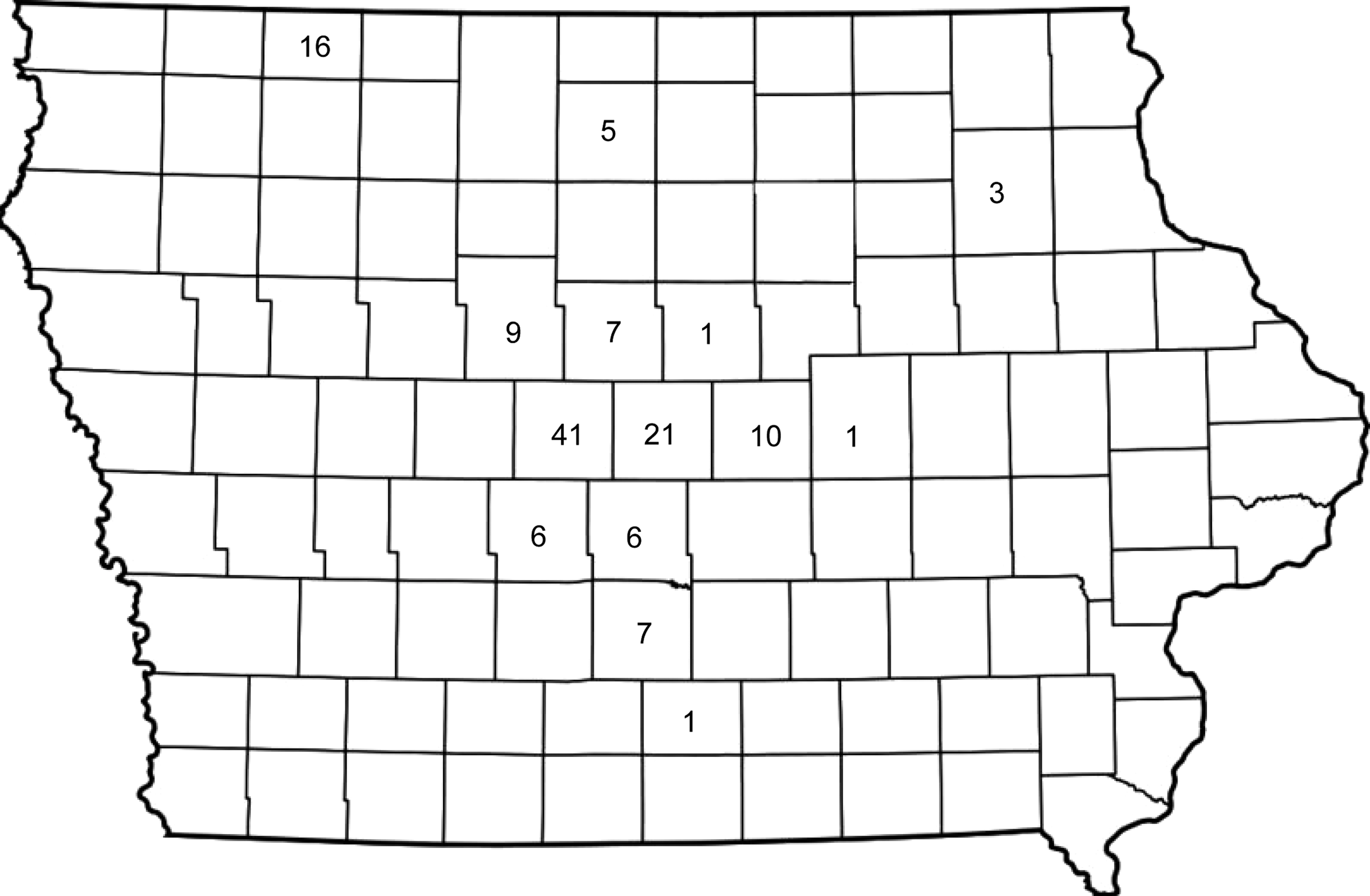
Distribution, by county, of free-roaming and shelter cats tested for seroprevalence of infectious agents in Iowa.
Pathogen testing
Two of the 137 cats (1.5%) for which FeLV antigen testing results were available were positive. Of the 111 cats for which anti-FIV antibody testing results were available, 4 were positive (3.6%). Retroviral coinfection was not found in any of the cases. However, three FIV-positive cats and one FeLV-positive cat were positive for antibodies to T. gondii. A weak but significant correlation was found between seropositivity for FIV and T. gondii (r = 0.20, p = 0.03). None of the retroviral-positive cats were positive for antibodies to Leptospira spp. or D. immitis. Leptospiral MAT results were available for 139 cats (Table 1). Twelve cats (8.6%) were seropositive with the highest titer obtained being 1:800. Ten cats (7.2%) were seropositive to only one serovar, whereas two cats (1.4%) were seropositive to two serovars. Bratislava was the most common serovar detected and was positive in 7/12 cats. Of the 140 cats that were tested for antibodies to T. gondii, 42 (30.0%) were positive. Antibodies to D. immitis were detected in 9 of 140 (6.4%) cats tested. Fifteen cats included in this study were also tested for D. immitis antigen as part of their retroviral testing kit. All were negative including one cat that tested positive for D. immitis antibodies.
Distribution of Leptospiral Microscopic Agglutination Test Results According to Serovar for 139 Cats
Influence of season, age, weight, and reproductive status
Based on statistical analysis, age, weight, and reproductive status did not appear to have a significant impact on risk of Leptospira spp. seropositivity (Table 2). However, the season did have an effect on risk of seropositivity with odds ratios being significantly higher in the spring (n = 7) than in the summer (n = 1) or fall (n = 2) (Table 3). In contrast, seropositivity for T. gondii was not influenced by season, weight, or reproductive status (Table 4). The risk of T. gondii seropositivity was significantly higher in cats >72 months of age than in younger age groups (Table 5). For D. immitis, FIV, or FeLV, age, season, weight, or reproductive status did not have a significant impact on risk of seropositivity.
Wald Chi-Square Analysis of Effect of Recorded Variables on Leptospira spp. Seropositivity
Logistical Regression of Seasons for Leptospira spp. Seropositivity
CI, confidence interval.
Wald Chi-Square Analysis of Effect of Recorded Variables on Toxoplasma gondii Seropositivity
Logistical Regression of Age Groups for Toxoplasma gondii Seropositivity
m, months.
Discussion
Previous reports of feline leptospirosis seropositivity vary widely based on the geographical area and populations studied as well as the serovars and cutoff titers used for MAT seropositivity (Shophet 1979, Mylonakis et al. 2005, Arbour et al. 2012, Markovich et al. 2012, Lapointe et al. 2013, Azócar-Aedo et al. 2014, Chan et al. 2014, Rodriguez et al. 2014, Shropshire et al. 2016, Weis et al. 2017). This is only the second North American study documenting leptospirosis in a free-roaming cat population. Despite including a serovar that was not evaluated in our study (autumnalis), Markovich et al. (2012) reported a lower seroprevalence (4.8%) than was found in our report. Regional variations in pathogen prevalence might explain part of this discrepancy (Ward et al. 2002), but data presented in this study as well as in previous publications suggest that timing of sampling might play an important role in reported seropositivity rates (Ward 2002, Lee et al. 2014, Rodriguez et al. 2014). In the Markovich study, all the samples were obtained over a single day during the fall, whereas sampling in this study occurred at multiple time points over an entire year. Underlining the importance of sampling time, over half of the seropositive cats in our study were sampled in the spring.
Similarly to Lapointe et al. (2013), bratislava was the most common serovar identified. This is an interesting finding since swine are one of the primary reservoirs of this serovar and Iowa has a substantial swine production industry (Miller et al. 1990). Moreover, in a seroprevalence study of mice captured from swine farms in Iowa, bratislava was the most prevalent serovar reported (Smith et al. 1992). Recently, a seroprevalence study in captive prairie dogs in Iowa also identified bratislava as being the predominant serovar (Olds et al. 2015). Since these were captive animals, it was postulated that infected rodents, possibly chipmunks, were the source of infection. As mentioned previously, autumnalis was not included in our serovar panel and, therefore, might falsely lower our reported seroprevalence. Although this serovar has repeatedly been found to be one of the most commonly detected in cats (Mylonakis et al. 2005, Markovich et al. 2012, Weis et al. 2017), its relevance, at least in dogs, has often been questioned due to the fact that its titers can be nonspecifically increased in response to vaccination as well as other illnesses (Barr et al. 2005, Sykes et al. 2011).
In keeping with previous reports of T. gondii seroprevalence in the American Midwest, approximately one-third of the cats had detectable antibodies to T. gondii, and older cats were significantly more likely to be positive (Fredebaugh et al. 2011, Ballash et al. 2015, Saevik et al. 2015). This is not surprising as anti-T. gondii antibodies are known to persist for years and, therefore, increased age equates to increased exposure. Unfortunately, the assay used could not differentiate IgM from IgG antibodies to T. gondii, making it impossible to determine whether positive antibody titers were due to an active infection or simply previous exposure.
Although previous studies have evaluated heartworm antibody seropositivity in client-owned cats in the Midwest, this is the first report of seroprevalence in free-roaming cats in Iowa (Watkins et al. 1998, Miller et al. 2000). The seroprevalence in Iowa reported in our study (6.4%) differs greatly with that previously reported in client-owned cats by Watkins et al. (43%). However, the population from that report was heavily biased since testing was based on suspicion of heartworm disease by a veterinary cardiologist. Our results are more in keeping with those reported by Miller et al. (2000). Indeed, although their study of client-owned cats does not include cats from Iowa, the seroprevalences from surrounding states varied from 7.7% to 14%. Comparing with other studies of free-roaming cats, our seroprevalence was lower than what has been reported in free-roaming cat populations inhabiting warmer more tropical areas of the Americas such as Grenada and Florida where seroprevalences of 8% and 11.6%, respectively, have been reported (Luria et al. 2004, Fernandez et al. 2010). These prevalences parallel the differences in heartworm antigen seropositivity between cats from the southern United States, where antigen positivity ranges from 0.6% to 1.6%, and the Midwest where positive antigen tests are reported in 0%–0.6% of cases (Levy et al. 2017). Although none of the cats tested for heartworm antigen in our study were positive, it is possible that is due to the limited number that were tested as well as the limited sensitivity of this test in cats (Lee and Atkins 2010). In addition, heat treatment of samples before antigen testing, a practice that has been shown to significantly increase the sensitivity of this test (Little et al. 2014, Gruntmeir et al. 2017), was not performed in our study. No significant associations were found between the presence of antibodies to D. immitis and factors such as age, weight, reproductive status, concurrent infection, or season; however, this might have been due to the overall low seroprevalence in this study population. In a large North American study evaluating the presence of D. immitis antigen in almost 35,000 cats, intact male cats and cats with concurrent retroviral infections were found to be at increased risk of being infected with D. immitis (Levy et al. 2017).
Unfortunately, the diagnostic method used in our study (serology) precludes making any conclusions as to the presence of an active infection in these cats, as opposed to prior exposure. It also makes it difficult to elucidate the role free-roaming cats might play in the transmission of these pathogens to other mammals. The majority of our positive MATs were only 1:100. Contrary to the more stringent requirements in canine leptospirosis, the use of convalescent titers to Leptospira spp. in cats has only rarely been reported in feline studies that were not performed in this study (Fessler and Morter 1964, Larsson et al. 1985, Arbour et al. 2012). Moreover, the sensitivity of serology for detection of infection or previous exposure in cats has been questioned due to the reported low titers seen in cats with known leptospiral infections. Experimental feline infections have shown that feline serum titers might not be as long lived as canine titers (Fessler and Morter 1964). Alternatively, it has been proposed that the serovars used in most studies are not representative of the predominant feline serovars and might not only underestimate the total seroprevalence but also the strength of the antibody response (Markovich et al. 2012). The presence of leptospiral organisms in the blood or urine of the cats of our study was never tested for, be it by nucleic acid or antigen detection. Shedding of Leptospira spp. is of concern since studies of client-owned cats with outdoor access have confirmed urinary shedding of organisms, even in the absence of positive MAT titers (Arbour et al. 2012, Chan et al. 2014). In addition, previous experimental studies in cats have shown that shedding can last for many weeks postinfection (Fessler and Morter 1964, Larsson et al. 1985). Likewise, no convalescent data were available for T. gondii serology and fecal floatation examinations were not performed on any of the cats. This is especially important since our serological test did not differentiate between IgM and IgG antibodies, thus making any conclusions as to the acute versus chronic nature of the exposure challenging. The pathophysiological consequences of possible infection were not evaluated in our population of cats. Since the cats were either housed in a shelter or participating in a spay and neuter program, only a cursory physical examination was performed and, although no cats appeared visibly ill, indicators of renal or liver function were not assessed and thoracic imaging was not performed to assess for lung pathology. Although sporadic cases of illness in cats have been related to leptospirosis, the true role of this organism in feline diseases remains unclear (Arbour et al. 2012). Regardless, a growing body of literature suggests that cats are exposed to and can become infected with this organism. Further elucidation of this pathogen's role in feline disease will require a more rigorous use of diagnostic methods capable of documenting active infections (convalescent titers and blood and urine PCRs).
Conclusions
This study reports a higher seroprevalence of leptospirosis in free-roaming cats than has previously been suggested in the United States and indicates that feline seroprevalence to this pathogen might vary seasonally. Feline heartworm antibody seroprevalence in this population was lower than in warmer areas of the continent, paralleling the trend in canine heartworm infection. In keeping with previous reports, feline seroprevalence of T. gondii increased with age in this population of cats.
Footnotes
Acknowledgment
The authors thank the volunteers of the Feral Cat Alliance for their assistance in collecting samples for this project.
Author Disclosure Statement
No competing financial interests exist.