




Abstract
An outbreak of dengue and high densities of Aedes aegypti were reported in 2014 in northern Mozambique, suggesting an increased risk for other arboviruses such as chikungunya virus (CHIKV) in this region. The aim of this study was to investigate the occurrence of CHIKV during an outbreak of dengue virus (DENV) in Pemba city in northern Mozambique in 2014. Febrile patients (n = 146) seeking medical attention at the Pemba Provincial Hospital between March and April 2014 were enrolled in this study. Blood samples from each participant were tested for chikungunya and DENV RNA, IgM and IgG antibodies using PCR and ELISA, respectively. The median age of the patients was 26 years (interquartile range: 20–34 years), and 52.7% (77/146) were female. We found that 7.0% (8/114) of the patients were positive for CHIKV IgM and 31.5% (46/146) presented with CHIKV IgG antibodies. DENV IgM and IgG antibodies were detected in 38.3% (46/120) and 28.2% (33/117) of the patients, respectively. This study is the first investigation regarding the occurrence of CHIKV in the north of Mozambique over the last 60 years and our data suggest that Mozambicans had been silently exposed to the virus in this part of the country, indicating that not only DENV but also CHIKV is an arbovirus to consider in febrile patients seeking medical attention in northern Mozambique.
Introduction
A
Our hypothesis is that not only DENV but also other arboviruses such as CHIKV occur silently in northern Mozambique.
In this context, we conducted a seroepidemiological study to investigate the presence of CHIKV in Pemba city during the ongoing DENV outbreak in 2014.
Methods
Study design and setting
We conducted a cross-sectional study in Pemba city, the capital city of the Cabo Delgado Province in northern Mozambique. Febrile patients (n = 146) were recruited between March and April 2014. The inclusion criteria were presence of an axillary temperature ≥37.6°C or self-reported fever within the previous 5 days. Patients with a readily identifiable focus of infection such as otitis, sinusitis, purulent pharyngitis, cellulitis, urinary tract infection, dental abscess, septic arthritis, pneumonia, or pelvic inflammatory disease were excluded.
Pemba is a coastal city of the Indian Ocean (Fig. 1) with an area of 102 km2 and a population of 174,572. The average temperature is 25.1°C, the relative humidity 74.1%, and the average monthly precipitation is 84.2 mm. The climate is tropical with two seasons, a rainy season spanning from November to April and a dry season from May to October.
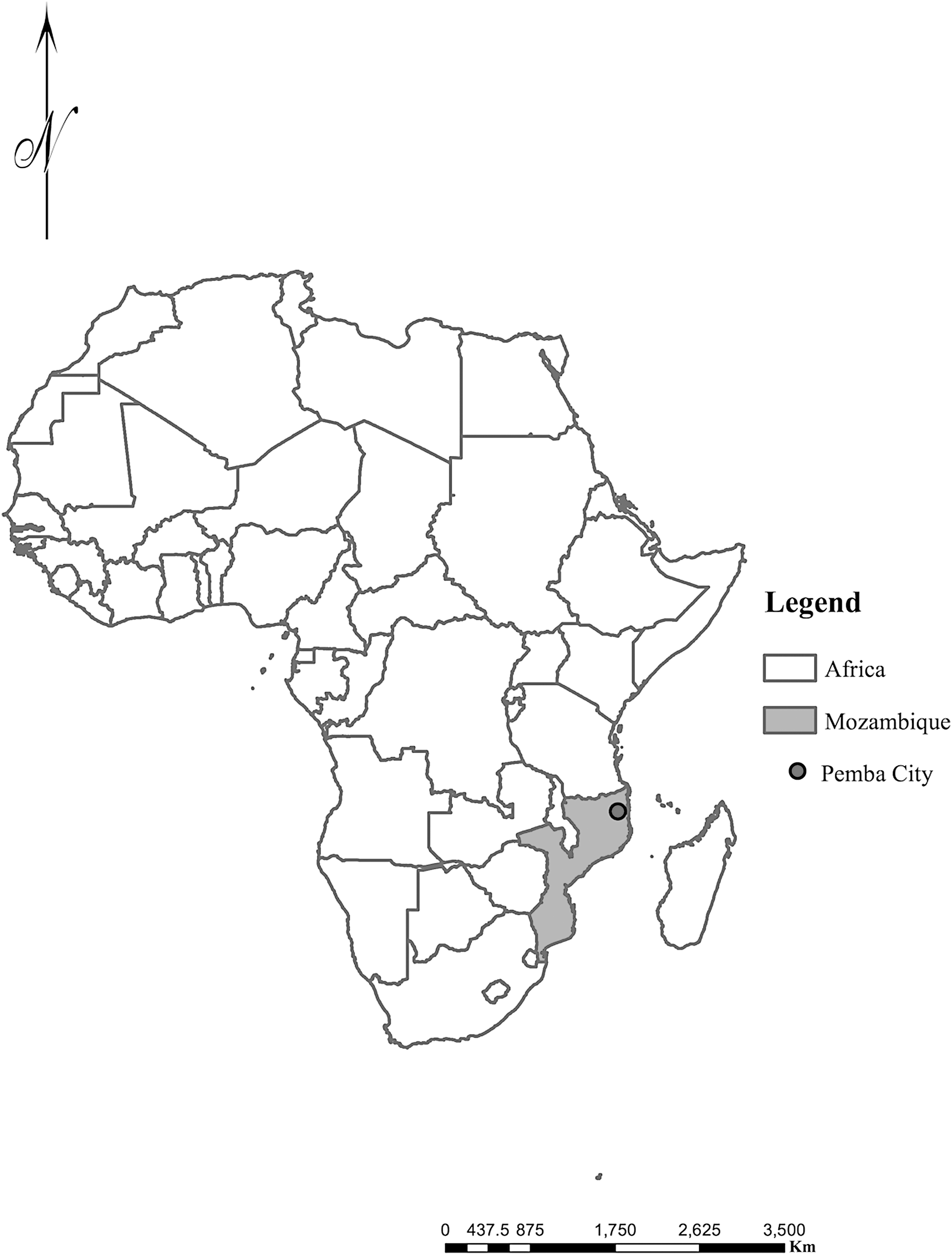
Geographical location of Pemba city and Mozambique.
Ethics statement
The study was approved by the National Bioethics Committee for Health from Mozambique (Ref. no. IRB00002657). All participants signed an informed consent form before data and sample collection.
Questionnaire
Clinical, epidemiological, and demographic data were collected from all patients using a questionnaire.
Blood sample
Patients provided venous blood collected into serum separation tubes (6 mL, both from BD Vacutainer).
Laboratory testing
Serology
Serum samples were tested for CHIKV-specific antibodies using a commercial ELISA for detecting IgM or IgG antibodies (EUROIMMUN AG, Lübeck, Germany) following the manufacturer's instructions. The presence of DENV IgM and IgG antibodies in serum samples was evaluated using a commercial ELISA (PanBio, Brisbane, Australia) following the instructions provided by the manufacturer.
PCR
Viral RNA was extracted from serum samples using the QIAamp RNA Viral Mini Kit (Qiagen, Inc., CA) according to the protocol provided by the manufacturer. Eluted RNA was stored at −80°C pending analysis. The DENV real-time rtPCR was performed as previously described in detail (Alm et al. 2014).
CHIKV PCR was performed using a real-time rtPCR assay. The primers and probe were purchased from Thermo Fisher (Applied Biosynthesis) and had the following sequences: F: 5′-TCGCATCTAGCTATAAAACTAATAGAGCAG-3′ and R: 5′-CTGTCCGACATCATCCTCCTTG-3′ and probe 5′-CGACTCAACCATCCTG-3′ (6-fluoresceinamidite-minor groove binder). The assay was carried out in 25 μL reaction mixtures containing 5 μL RNA template, nuclease-free water, SuperScript III One-Step RT-PCR System with Platinum Taq DNA Polymerase, 0.9 μM of each primer, and 0.2 μM probe. Amplification was performed in Applied Biosystems 7500 real-time PCR system (Thermo Fisher) using thermocycling parameters as follows: reverse transcription at 50°C for 30 min, inactivation at 95°C for 2 min followed by 45 cycles of fluorescence detection at 95°C for 15 s, and annealing at 60°C for 1 min.
Statistical analysis
Results were analyzed using the statistical software package SPSS 17.0 for Windows (SPSS, Inc., Chicago, IL). For continuous variables, we calculated median and interquartile range (IQR). For categorical variables, we calculated the absolute frequencies and its proportions.
Results
Median age of the participants was 26 years (IQR: 20–34 years) and 52.7% (77/146) were female. A majority of the patients were citizens of Mozambique (131/141; 92.9%) and more than half (73/136; 53.3%) had a secondary level of education. Of the study participants, 17.7% (22/124) were hospitalized and only 5.2% (7/136) had history of international travel. The median time between onset of symptoms and blood collection was 4 days (IQR: 1–6 days). DENV IgM and IgG antibodies were detected in 38.3% (46/120) and 28.2% (33/117) of the patients, respectively (Table 1). A total of 99 patient samples were tested using DENV PCR and 37 (37.4%) were found positive.
CHIKV, chikungunya virus; DENV, dengue virus; IQR, interquartile range.
CHIKV IgM and IgG antibodies were detected in 7.0% (8/114) and 31.5% (46/146) of the tested patients, respectively (Table 1). A total of 88 patient samples were screened by CHIKV PCR but all were found negative.
Eight patients had detectable levels of both DENV and CHIKV IgG antibodies and four were positive for DENV and CHIKV IgM.
No difference in the proportion of seropositive individuals was observed between females and males and the median age of the patients was comparable in all groups (patients tested for DENV IgM, DENV IgG, CHIKV IgM, or CHIKV IgG, respectively).
In terms of age distribution, DENV antibodies were less frequently detected in older participants (>49 years old), while the presence of CHIKV IgG antibodies increased with age.
The proportion of DENV IgM-positive individuals and individuals positive for CHIKV IgM was higher among hospitalized patients (10/19; 52.6% and 2/18; 11.1%, respectively) compared with outpatients (28/81; 34.6% and 4/77; 5.2%, respectively).
Discussion
Arboviruses have been neglected for several decades in Mozambique and are rarely considered when patients with acute febrile illness seek medical attention in Mozambique. In the country, most of febrile patients are assumed to suffer from malaria (Salomao et al. 2015). However, the recent dengue outbreak reported in Pemba in 2014 (Massangaie et al. 2016) and the number of dengue confirmed cases reported among febrile patients during the 2015–2016 postoutbreak period in the same region (Oludele et al. 2017) indicate that arbovirus infections represent an important differential diagnosis to malaria in northern Mozambique. Knowledge regarding the current situation of chikungunya fever in north of Mozambique is missing and the most recent study reporting on CHIKV in this region was performed in 1957 (Kokernot et al. 1960). For this reason, we investigated the presence of antibodies against CHIKV and DENV in patients seeking medical attention at the Pemba Provincial Hospital. In this study, the proportion of DENV IgM-positive patients (38.3%) was lower than reported in Pemba and Nampula during the corresponding dengue outbreak investigation (Massangaie et al. 2016), but higher than observed during the postoutbreak period in 2015–2016 (Oludele et al. 2017) and in 2013–2014 in Tanzania (Kajeguka et al. 2016), a country that shares its border with Mozambique in the north. Interestingly, the proportion of DENV PCR-positive patients in this study was much higher than reported during the outbreak investigation (Oludele et al. 2017). The proportion of DENV IgM-positive patients was higher among hospitalized compared with outpatients. This result supports previous findings showing DENV infections to represent an important determinant for hospitalization (Pierro et al. 2015).
We detected CHIKV IgM and IgG antibodies in 7.0% and 31.5% of the febrile patients, supporting our initial hypothesis of a previously unrecognized circulation of CHIKV in Pemba city. We were unable to detect CHIKV viral RNA, which might be due to sporadic occurrence of CHIKV cases. We acknowledge that only 88 (60.3%) of 146 samples were tested for CHIKV PCR due to the limited availability of resources and serum. Because CHIKV IgM antibodies can persist in the blood for several months (Pierro et al. 2015), detection of CHIKV IgM alone cannot confirm acute disease. We observed an increase of CHIKV IgG antibodies with age, suggestive of previous exposure to CHIKV. A similar age-related pattern was described in a recent study conducted in the south of Mozambique (Gudo et al. 2015). As observed for patients presenting with DENV IgM, the proportion with detectable CHIKV IgM antibodies was higher in hospitalized compared with outpatients. This is in accordance with the findings from a study performed in Tanzania, in which CHIKV infection was found to be an important cause for hospitalization (Crump et al. 2013). We acknowledge that a limitation of this study is the lack of convalescent samples. Because of limited access to high-containment laboratories, virus neutralization assays were not performed to confirm the ELISA results. However, a recent publication by our group in collaboration with the Institute of Virology, University of Bonn Medical Centre, Bonn, Germany, found a high level of agreement between this IgG anti-CHIKV ELISA and plaque-reduction neutralization tests (Mugabe et al. 2018), demonstrating the robustness of this ELISA.
Conclusion
Our data show that individuals living in northern Mozambique are exposed to CHIKV, suggesting that the risk of arbovirus infection in northern Mozambique extends beyond DENV. For this reason, clinicians should consider arbovirus in the differential diagnosis of patients present with fever. This study is the first epidemiological investigation of CHIKV since the late 50s in this region. Our results highlight the need for further investigations to determine the magnitude and extent of the spread of CHIKV and DENV in northern Mozambique.
Ethics Approval and Consent to Participate
The study was approved by the Mozambican National Bioethics Committee (ref. no. IRB00002657). Written consent was requested and obtained from each patient or legal guardian before enrollment.
Footnotes
Acknowledgments
We thank all participants for accepting to participate in this study. Second, we thank all health professional from Pemba Provincial Hospital who participated in patient recruitment. This study was funded by the European Foundation Initiative into Neglected Tropical Diseases (EFINTD).
Disclaimer
Our article does not present any individual's data, however, consent to participate was obtained from each participant as stated in the Ethics Statement section.
Authors' Contributions
A.M., M.M., G.P., and E.S.G. designed the study. A.M., M.M., G.P., S.A., J.O., A.T., K.I.F., and N.L. participated in patient recruitment, sample collection, and testing. A.M., M.M., and E.S.G. wrote the first draft of the article. All authors reviewed the article.
Author Disclosure Statement
No competing financial interests exist.