




Abstract
Ticks are obligate blood-sucking ectoparasites that infect a wide range of animals and humans, causing a variety of both human and animal diseases around the world. Ixodes nipponensis is the most commonly reported tick in Korea and Japan, but it is very rare in China. In this study, six I. nipponensis samples were collected from three black goats in Hunan province, China. Ticks identified morphologically as I. nipponensis were then examined by PCR with two different molecular markers: mitochondrial cox1 and the second internal transcribed spacer of ribosomal DNA genes. Sequence comparison and phylogenetic analysis of the cox1 sequences confirmed that all of the examined hard Ixodes ticks represented I. nipponensis. This finding indicates a potential risk of zoonotic I. nipponensis infection in humans and animals in China. To our knowledge, this is the first report documenting the occurrence of I. nipponensis infection in goats in China.
Introduction
T
Identification and differentiation of hard ticks have traditionally been based on morphological features, such as overall size, the shape of the spiracular plate, the grooves of the scutum, the adanal plates, and so on (Nava et al. 2015). However, these criteria are often insufficient for specific identification and differentiation, particularly at the Ixodes and other closely related hard ticks (Barker et al. 2014). Molecular techniques have provided alternative approaches for the accurate identification and differentiation of many ectoparasite species (Sunantaraporn et al. 2015, Kelomey et al. 2017, Pereira et al. 2017, Xue et al. 2017). Some genetic markers, such as the mitochondrial (mt) cox1 and the second internal transcribed spacers (ITS-2) of nuclear ribosomal DNA (rDNA) gene sequences, have been shown as useful genetic markers for the accurate identification and differentiation of the hard Ixodes ticks (Song et al. 2011, Kovalev et al. 2016). Ixodes nipponensis (Acari: Ixodidae), a species of the Ixodidae family, can infect broadly animals and humans. I. nipponensis is the most commonly reported tick in Korea and Japan (Ryu et al. 1998, Ko et al. 2002, Iwakami et al. 2014, Yun et al. 2014, 2016), but is rarely reported in China (Takada et al. 1998).
The objective of this study was to identify the I. nipponensis infection in goats in China based on mt cox1 and the ITS-2 rDNA genes. The results should provide a foundation for the control of I. nipponensis infection in goats and humans in this province and elsewhere.
Materials and Methods
Sample collection and DNA extraction
A total of six hard ticks (sample codes Incs01-06) were collected between April and May 2017 from three black goats (year >1) (Fig. 1A) in Hunan province, China. Approximately 1200 black goats were reared on this farm. All the black goats were farmed under semiextensive conditions, which means that during daytime goats grazed in communal natural grasslands and returned to fenced areas at night. None of the black goats were vaccinated against ticks. These hard ticks were washed in physiological saline for three times, identified preliminarily to species based on morphological characters (Fig. 1B), fixed in 70% (v/v) ethanol, and stored at −20°C until use. Total genomic DNA was isolated from midbody section of each single tick using sodium dodecyl sulfate/proteinase K treatment, followed by spin-column purification (Wizard® SV Genomic DNA Purification System; Promega) and eluted into 30 mL H2O according to the manufacturer's recommendations.
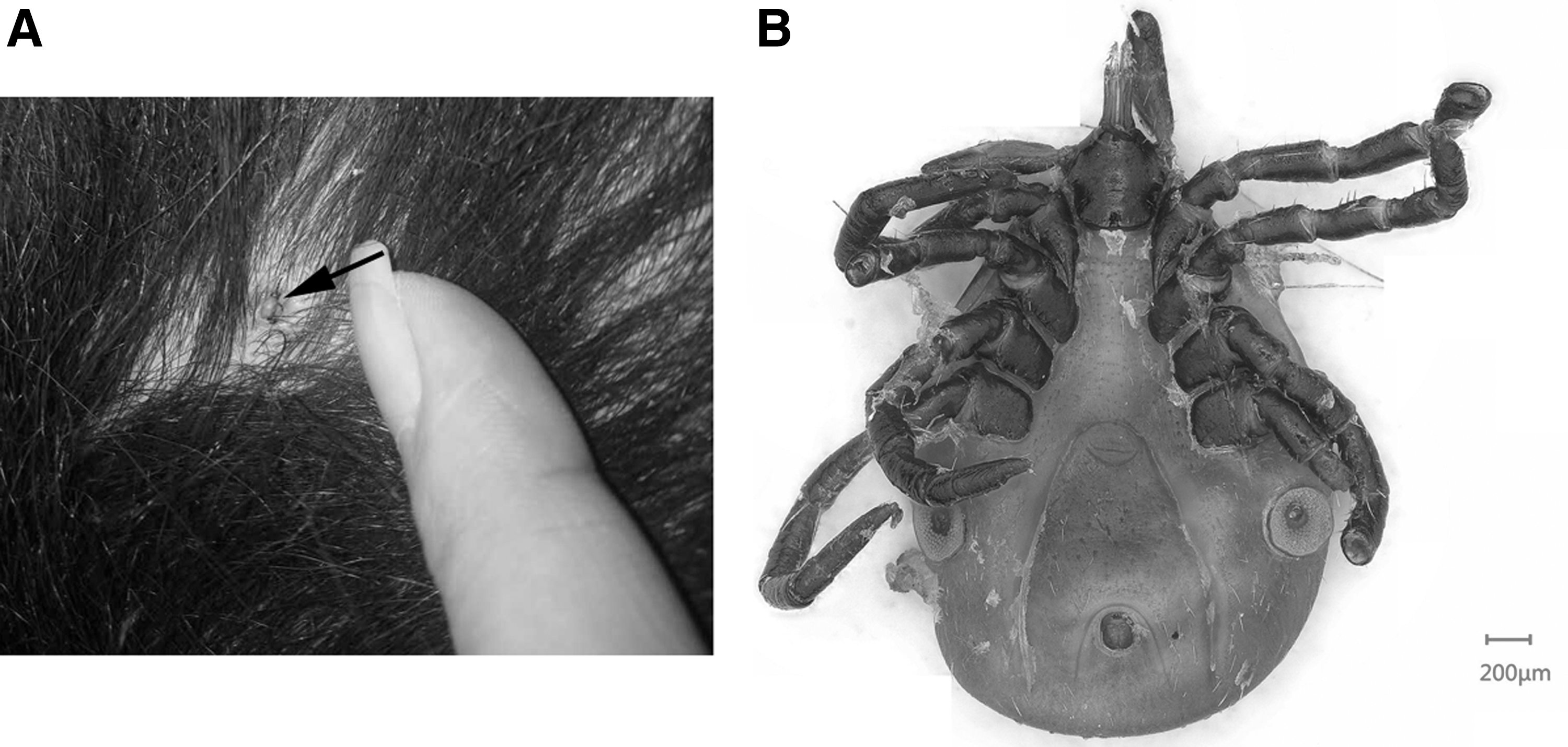
Ixodes nipponensis infection in black goat
Enzymatic amplification and sequencing
The cox1 and ITS-2 rDNA genes were amplified with primers, respectively. (Chitimia et al. 2009, 2010). PCRs (25 μL) were performed in 3.0 μL of MgCl2 (25 mM), 0.25 μL of each primer (50 pmol/μL), 2.5 μL 10 × rTaq buffer (100 mM Tris-HCl and 500 mM KCl), 2 μL of dNTP mixture (2.5 mM each), 0.25 μL of rTaq (5 U/μL) DNA polymerase (TaKaRa Biotechnology, Dalian, China), and 2 μL of DNA sample in a thermocycler (Biometra, Göttingen, German). The cycling conditions were 94°C for 5 min (initial denaturation), followed by 35 cycles of 94°C for 30 s (denaturation), 55°C for 30 s (annealing), 72°C for 1 min (extension), and then 72°C for 5 min (final extension). Negative control (without DNA template) was included in each amplification run. Each amplicon (5 μL) was examined by 1% (w/v) agarose gel electrophoresis to validate amplification efficiency. PCR products were sent to Life Technology (Beijing, China) for sequencing from both directions.
Sequences analysis and reconstruction of phylogenetic relationships
Sequences of the mt cox1 and ITS-2 rDNA genes were separately aligned using the software MAFFT 7.263 (Katoh and Standley 2016). To study the phylogenetic relationships, 11 representative Ixodes tick species (Fig. 2) were considered in this study, with Haemaphysalis flava (NC_005292) as the out-group. Sequences of pcox1 with consensus lengths (772 bp) were aligned using the MAFFT 7.263 program. Maximum likelihood (ML) analyses were performed using PhyML 3.0 (Guindon et al. 2010). A BioNJ starting tree was used as a starting tree to search for the ML tree with the GTR+I+G model of evolution using JModeltest (Posada 2008) based on the Akaike information criterion. The subtree pruning and regrafting method was chosen, and the middle of which was estimated using the median. ML analyses were checked on the basis of 100 bootstrap replicates (Bf). Phylograms were drawn using FigTree v.1.31 (
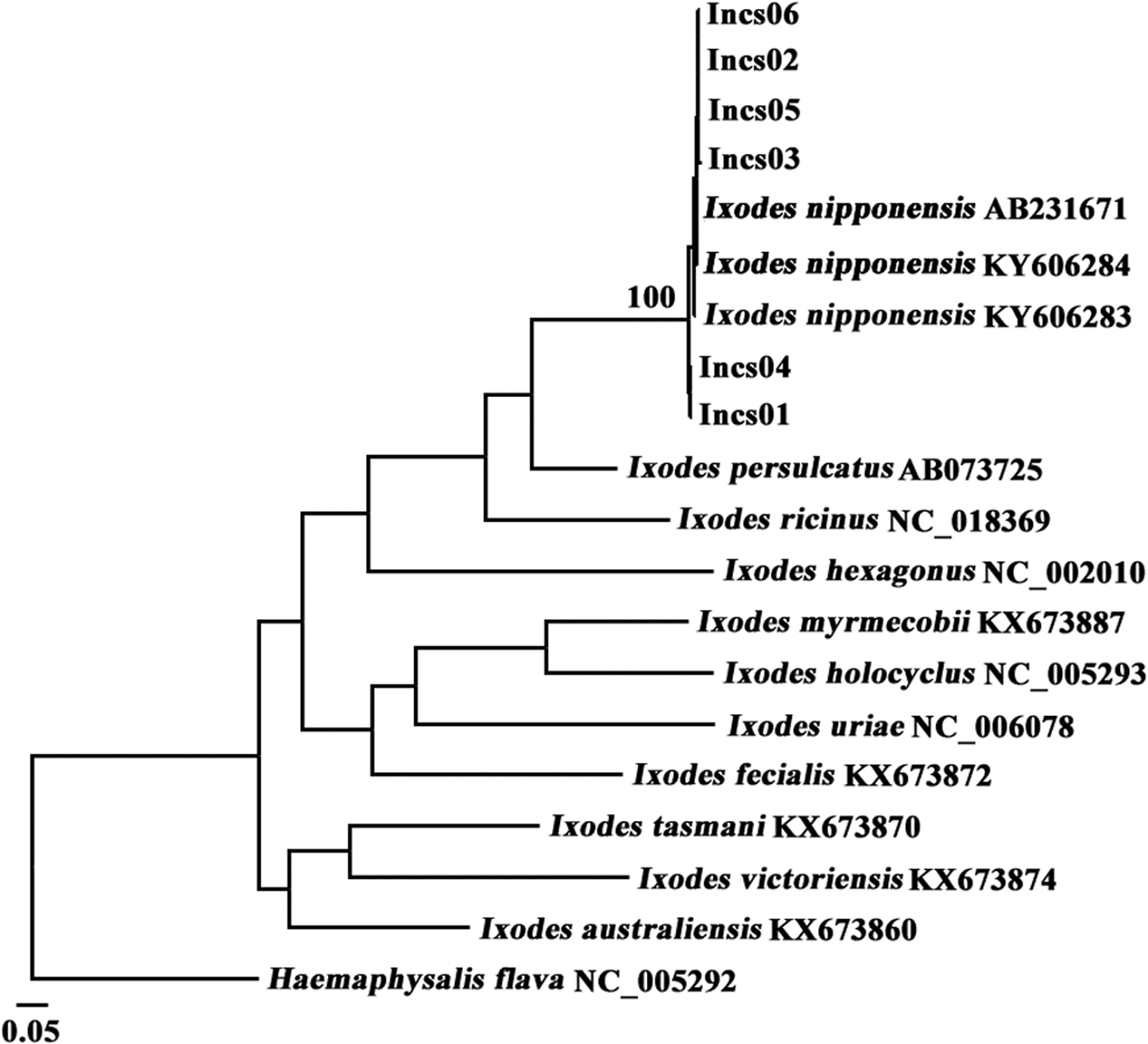
Phylogenetic analysis based on the mitochondrial cox1 gene sequences of Ixodes species.
Results and Discussion
Morphological examination indicated that the hard ticks from this study were Ixodes according to their anal groove shape and lack of festoons (Fig. 1 B). The mt cox1 and ITS-2 rDNA genes were amplified individually from six Ixodes ticks and then subjected to agarose gel electrophoresis. Amplicons of all tick samples appeared as a single band with ∼830 and 950 bp (not shown) in size, respectively. The mt cox1 and ITS-2 rDNA sequences have been deposited in the GenBank under the accession numbers KX266861–KX266866.
The sequences of the mt cox1 and ITS-2 rDNA of the examined six ticks were 772 and 904 bp in length, respectively. The sequences of all six hard ticks were identical or nearly identical (>99.2% identity) with respect to all the two molecular markers examined, indicating that these hard ticks were of the same species. The intraspecific sequence variations among samples of I. nipponensis isolates were 0–1%, whereas the interspecific sequence differences among members of the Ixodes were significantly higher, being 9.9–22.4% for cox1 gene. These results were consistent with those of previous studies (Song et al. 2011, Kovalev et al. 2016). Very interestingly, the length and nucleotide sequences of the ITS-2 rDNA of six I. nipponensis ticks sequenced in this study are exactly identical. Comparison of the mt cox1 and ITS-2 sequences of the examined ticks by BLAST search or pairwise alignment revealed 99% and 96% identity to previously published corresponding sequences for I. nipponensis from Japan (GenBank accession nos. AB231671 and D88847, respectively), thus providing unequivocal support that these hard ticks from this study represented I. nipponensis.
To further ascertain the identity of each of the hard ticks, phylogenetic relationships of hard ticks within genus of Ixodes were reconstructed. Phylogenetic analyses of the sequences of cox1 from 9 individual I. nipponensis isolates, 10 other Ixodes ticks, using ML, are shown in Figure 2. In this tree, the I. nipponensis samples form monophyletic group with high statistical support (Bootstrapping frequency = 100), and all the I. nipponensis isolates were more closely related to I. persulcatus than to other Ixodes ticks. Taken together, these findings further confirmed that all Ixodes isolates examined in this study were I. nipponensis.
These genes (cox1 and ITS-2 rDNA) are encoded by the mt and nuclear genomes. Usually, mt DNA has a faster rate of gene evolution than ITS rDNA, and is more useful for distinguishing hard tick species within the same genus (Latrofa et al. 2003). However, the ITS rDNA is also an excellent tool for quickly distinguishing between known tick species (Song et al. 2011). The multiple sequence alignments of the two genes used in this study showed significant differences in mt cox1 and ITS rDNA sequences between tick species within the same genus Ixodes. Our results have demonstrated that mt cox1 and ITS rDNA were useful genetic markers for determining Ixodes tick species and for differentiating between different Ixodes tick species with high morphological similarities.
In conclusion, several studies have suggested that I. nipponensis is prevalent in China, suggesting that I. nipponensis is an emerging tick in goats and pose a potential threat to humans. Therefore, it is imperative that increasing prevalent surveillance of goats and effective measures for prevention and better control of I. nipponensis and tick-borne pathogens are urgently needed in China. To our knowledge, this is the first report documenting the occurrence of I. nipponensis infection in goats in China.
Footnotes
Acknowledgments
Project support was provided, in part, by the National Natural Science Foundation of China (no. 31372431) and Scientific Research Fund of Hunan Provincial Education Department (no. 16A102).
The findings and conclusions in this report are those of the authors and do not necessarily represent the views of the funding agencies.
Author Disclosure Statement
No competing financial interests exist.